
What Causes a Solar Eclipse? The Science Behind the Shadow
On a clear April afternoon in 2024, millions of people across North America stopped what they were doing and looked up. Streetlights flickered on at 2 p.m. Birds went quiet. The temperature dropped. For a few minutes, day turned into an eerie twilight — and the Sun’s ghostly outer atmosphere shimmered around a black disk in the sky. It was a total solar eclipse, and it left first-time watchers speechless.
But what actually causes a solar eclipse? The short version is simple: the Moon gets in the way. The longer version involves orbital geometry, a cosmic coincidence of size and distance, and a shadow racing across the Earth at thousands of miles per hour. This guide walks through all of it — no physics degree required.
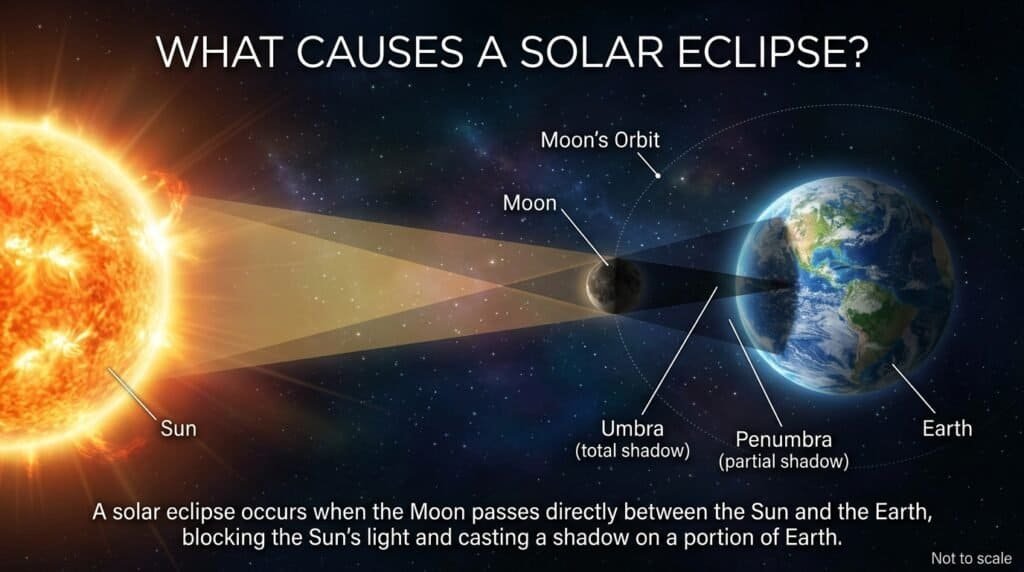
The short answer: A solar eclipse happens when the Moon passes directly between the Sun and the Earth, blocking some or all of the Sun’s light and casting the Moon’s shadow onto Earth’s surface. It can only happen during a new moon, when the Sun, Moon, and Earth line up in a straight line.
 A total solar eclipse: the Moon completely covers the Sun’s disk, revealing the corona — the Sun’s outer atmosphere, normally hidden by the Sun’s glare.
The Three-Body Lineup: How a Solar Eclipse Actually Happens
Picture three billiard balls. The Sun is a glowing ball 93 million miles away. Earth is a much smaller ball orbiting it. And the Moon is a still smaller ball orbiting Earth, roughly a quarter of a million miles from us. Most of the time, these three bodies are scattered around their orbits with nothing special going on.
A solar eclipse begins when the Moon swings into a very specific position: directly between the Sun and the Earth, so that all three form a straight line. Astronomers have a word for this perfect lineup — syzygy, pronounced “SIZ-uh-jee.” During syzygy, the Moon blocks the Sun’s light from reaching part of Earth, exactly the way your hand blocks a flashlight beam when you hold it up in front of your face.
Here is the thing most people get wrong: the Moon is not “covering the Sun” in any physical sense. The Moon is tiny compared to the Sun — the Sun’s diameter is about 400 times larger than the Moon’s. The Moon just happens to sit in the one spot where it can intercept the sunlight headed our way and throw a shadow onto the ground. From our viewpoint on the surface, it looks like the Moon is swallowing the Sun. What is really happening is far less dramatic and far more geometric: we are standing inside the Moon’s shadow.
 The geometry of a solar eclipse: during a new moon, the Moon slides between the Sun and Earth. Observers in the dark inner shadow (umbra) see a total eclipse; those in the lighter outer shadow (penumbra) see a partial one.
That shadow is the key to understanding everything about solar eclipses — what type you see, where you have to stand, and why total eclipses are so hard to catch. So let us talk about the shadows.
Umbra, Penumbra, and Antumbra: The Moon Casts Three Shadows
Hold your hand under a desk lamp and look at the shadow it makes on the table. You will notice the shadow has a dark center and a softer, fuzzier edge. That is because the lamp, like the Sun, is not a single point of light — it has width. Light from different parts of the lamp reaches around your hand at slightly different angles, creating a gradient from dark to light.
The Moon does the same thing in space, on a planetary scale. When sunlight hits the Moon, it casts two distinct shadows:
- The umbra — the small, dark, cone-shaped inner shadow where the Sun is completely blocked. If you are standing inside the umbra on Earth, you see a total solar eclipse. The umbra is narrow, often less than 150 miles wide where it touches Earth, which is why totality is visible only along a thin track called the path of totality.
- The penumbra — the much larger, lighter outer shadow where the Sun is only partly blocked. If you are standing in the penumbra, you see a partial solar eclipse. The penumbra can span thousands of miles, so partial eclipses are visible to far more people.
There is also a third, less-discussed shadow: the antumbra. When the Moon is farther from Earth in its orbit, the umbra’s cone ends before it reaches our planet. Beyond that point, the shadow spreads back out — that is the antumbra. Observers inside the antumbra see the Moon silhouetted against the Sun with a ring of sunlight still visible around it. That is an annular eclipse, and it explains why not every central eclipse goes fully dark.
So the “cause” of a solar eclipse has two layers: the alignment of the three bodies, and the geometry of the shadows that alignment produces. Where you stand in those shadows decides everything you experience.
Why Eclipses Don’t Happen Every Month
This is the question that trips up almost everyone who first learns the basics. If a solar eclipse just needs the Moon between the Sun and Earth, and the Moon passes between the Sun and Earth every single month at new moon, why isn’t there an eclipse every month?
The answer is a tilt. The Moon does not orbit Earth in the same flat plane as Earth’s orbit around the Sun. Its orbit is tilted by about five degrees relative to that plane, which astronomers call the ecliptic plane. Five degrees sounds like nothing, but across a quarter-million miles of distance, it is enormous. At most new moons, the Moon passes slightly above or slightly below the Sun in our sky, and its shadow sails harmlessly past Earth into empty space.
Eclipses can only happen when two conditions coincide:
- It must be a new moon — the Moon has to be on the Sun’s side of Earth. (A full moon, with Earth between the Sun and Moon, can only produce a lunar eclipse, which is a different event entirely.)
- The new moon must occur near a lunar node — one of the two points where the Moon’s tilted orbit crosses the ecliptic plane. Only near a node does the Moon’s shadow have any chance of hitting Earth.
The alignment of the Moon’s orbit means these conditions line up during roughly two windows each year, each lasting a few weeks. Astronomers call these windows eclipse seasons. A solar eclipse can only happen inside an eclipse season. That is why we get between two and five solar eclipses per year — and never more than two of them total — instead of twelve.
Think of it like trying to thread a needle while riding a bicycle. The needle (the node) is only in front of you during eclipse season, and the thread (the new moon) only comes around once a month. You need both at once, and even then, the closer the new moon lands to the exact node, the more central — and more spectacular — the eclipse.
The 400-to-1 Coincidence: Why the Moon Fits the Sun So Perfectly
Here is the strangest part of the whole story. The Sun is about 400 times wider than the Moon. It is also about 400 times farther away. Because apparent size depends on the ratio of size to distance, the two ratios cancel out almost exactly — and the Sun and Moon appear nearly the same size in our sky, each spanning roughly half a degree.
That near-perfect match is why a total solar eclipse looks the way it does. If the Moon appeared much smaller, it could never cover the Sun fully, and total eclipses would be impossible. If it appeared much larger, it would blot out not just the Sun but also the delicate corona around it, and we would lose the most beautiful part of the show. Instead, the Moon is just barely big enough to cover the Sun’s bright face while leaving the corona visible — a white-hot crown of plasma streaming millions of miles into space.
Planetary scientists call this a coincidence, and they mean it literally: no physical law requires the numbers to work out this way. Earth is the only planet in our solar system with a moon at the right size and distance to produce striking total solar eclipses. And the match is not permanent. The Moon is drifting away from Earth at roughly the speed your fingernails grow — about an inch and a half per year. Hundreds of millions of years from now, it will appear too small to cover the Sun, and total solar eclipses will be a memory. We happen to live in the narrow window of geological time when the fit is just right.
The Four Types of Solar Eclipses
Not every solar eclipse looks the same. Depending on how precisely the three bodies align and how far the Moon is from Earth at the time, you get one of four types:
| Type | What causes it | What you see |
|---|---|---|
| Total | The Moon completely covers the Sun’s disk; you are in the umbra. | Daytime darkness, the corona blazing around a black disk, stars appearing at midday. |
| Partial | The alignment is off-center; you are in the penumbra. | The Sun looks like a crescent — a bite taken out of it. The sky stays bright. |
| Annular | The Moon is near its farthest point from Earth, so it looks slightly too small to cover the Sun; you are in the antumbra. | A brilliant “ring of fire” — the Sun’s edge glowing around the dark Moon. |
| Hybrid | The Moon’s distance is right at the limit, and Earth’s curvature tips the balance along the path. | The eclipse starts annular, becomes total in the middle of its path, then turns annular again. Extremely rare. |
 An annular solar eclipse, the “ring of fire.” It happens when the Moon is slightly farther from Earth and appears too small to cover the Sun completely.
A partial eclipse, by the way, is not a lesser version of the event — it is simply what most of the world sees during any eclipse. Even during a spectacular total eclipse, only the narrow path of totality goes dark. Everyone else within the penumbra, often spanning a continent, sees a partial eclipse. If you have ever noticed the Sun looking like a crescent cookie through eclipse glasses, you were standing in the penumbra.
What Actually Happens During Totality
People who have seen a total solar eclipse describe it as a full-body experience, not just something you watch. Here is the sequence, which unfolds over roughly two to three hours from start to finish, with totality itself lasting only a few minutes:
- First contact. The Moon’s edge begins to creep across the Sun. Nothing looks different to the naked eye yet — you need proper solar filters to see anything at this stage.
- The partial phases. Over the next hour or so, the Sun becomes a shrinking crescent. The light takes on a strange quality, shadows sharpen, and the temperature starts to drop. Animals often behave as if evening is arriving.
- Baily’s beads and the diamond ring. Just before totality, the last bits of sunlight stream through valleys on the Moon’s rugged edge, breaking into a string of brilliant beads. The final bead flares into the “diamond ring” — a dazzling point of light beside the dark Moon.
- Totality. The diamond ring vanishes, and day becomes night. The corona — the Sun’s outer atmosphere, a million degrees hot yet too dim to see against the normal glare — bursts into view as pearly-white streamers. The sky darkens enough for bright stars and planets to appear. The horizon glows orange in every direction, like a 360-degree sunset. This is the only time it is safe to look at the eclipse with the naked eye.
- The show reverses. A second diamond ring flashes on the opposite side, the corona disappears, and the partial phases run in reverse as the Moon slides away.
Totality at any one spot can last from a few seconds to a maximum of about seven and a half minutes. The reason it is so brief: the Moon’s shadow races across Earth’s surface at up to several thousand miles per hour, driven by the Moon’s orbital motion and Earth’s rotation. You are standing still; the shadow is sprinting.
Why Total Eclipses Are Rare Where You Live
A total solar eclipse happens somewhere on Earth roughly every 18 months. That sounds frequent until you look at a map of where those paths fall. The umbra’s track is a ribbon, typically under 150 miles wide, sweeping across a small slice of the planet. Oceans cover 70 percent of Earth, so most total eclipses play out over open water with no audience at all.
The result: while total eclipses are regular on a planetary scale, any single spot on the map waits an average of 360 to 410 years between total eclipses. The 2024 total eclipse crossed North America from Mexico to Canada; the next total eclipse visible from the contiguous United States arrives in 2044 — and it will only touch Montana and the Dakotas. Eclipse chasers plan entire trips — sometimes across oceans — around these narrow paths, because for most people, a total eclipse is a once-in-a-lifetime event that requires travel.
Safety note: It is never safe to look directly at the Sun without proper protection — except during the brief minutes of totality, when the Sun is fully covered. For every partial phase, and for the entire duration of partial and annular eclipses, use certified eclipse glasses (look for the ISO 12312-2 standard) or a pinhole projector. Ordinary sunglasses, no matter how dark, are not safe. Eye damage from staring at the Sun is painless and can be permanent.
Solar Eclipses in History and Science
Long before anyone understood orbital mechanics, eclipses terrified and fascinated people. Many ancient cultures read them as omens — dragons devouring the Sun, gods expressing anger, the world briefly coming undone. But eclipses were also among the first astronomical events humans learned to predict. Chinese astronomers were forecasting eclipses as early as the 4th century BC, working from centuries of careful records.
In modern science, total eclipses have done serious work. During the total solar eclipse of 1919, astronomer Arthur Eddington photographed stars near the darkened Sun and showed that their light was bent by the Sun’s gravity — exactly as Einstein’s general theory of relativity predicted. That single observation made Einstein a household name. Today, scientists still use total eclipses to study the corona, the solar wind, and the Sun’s magnetic field, because the Moon provides a better Sun-blocker than any instrument we can build.
FAQs: Questions People Ask About Solar Eclipses
What causes a solar eclipse in simple terms?
The Moon moves between the Sun and the Earth and blocks the Sun’s light, casting its shadow on Earth. It only happens during a new moon, when all three bodies line up.
Why don’t solar eclipses happen every month?
Because the Moon’s orbit is tilted about five degrees relative to Earth’s orbit around the Sun. At most new moons, the Moon passes above or below the Sun and its shadow misses Earth. Eclipses only occur during “eclipse seasons,” when the new moon lines up near the points where the Moon’s orbit crosses Earth’s orbital plane.
What is the difference between a total and a partial solar eclipse?
It depends on where you stand in the Moon’s shadow. In the dark inner shadow (the umbra), the Sun is completely covered — a total eclipse. In the lighter outer shadow (the penumbra), only part of the Sun is covered — a partial eclipse.
What causes an annular solar eclipse, the “ring of fire”?
An annular eclipse happens when the Moon is near the farthest point in its orbit from Earth, so it appears slightly smaller than the Sun. It blocks the Sun’s center but leaves a bright ring of the Sun’s edge visible around it.
How long does a solar eclipse last?
The partial phases stretch over two to three hours. Totality — the period when the Sun is fully covered — is much shorter, from a few seconds up to about seven and a half minutes at most, because the Moon’s shadow moves rapidly across Earth’s surface.
Is it safe to look at a solar eclipse?
Only during the brief minutes of totality is it safe to look with the naked eye. At all other times — including all partial and annular eclipses — you need certified eclipse glasses meeting the ISO 12312-2 standard, or an indirect method like a pinhole projector. Regular sunglasses are never sufficient.
When is the next total solar eclipse?
Total solar eclipses occur somewhere on Earth about every 18 months, each visible only along a narrow path. Check NASA’s eclipse predictions for the upcoming dates and paths, since the exact locations change with every eclipse.
Conclusion
A solar eclipse is caused by one of the simplest mechanisms in astronomy: the Moon passing between the Sun and Earth and throwing its shadow onto our planet. The reason it feels so extraordinary is everything around that simple mechanism — the tilted orbit that makes eclipses rare, the 400-to-1 coincidence that makes the Moon fit the Sun so precisely, and the razor-thin path of totality that turns a planetary event into a personal one.
If you ever get the chance to stand in the Moon’s shadow, take it. A partial eclipse is interesting. Totality is something else entirely — two minutes of midday darkness that people remember for the rest of their lives. Just bring the right glasses, and make sure you are standing in the right shadow.
Read Also: Astronomy 101 Free Course: Learn the Night Sky Without Spending a Dime
