
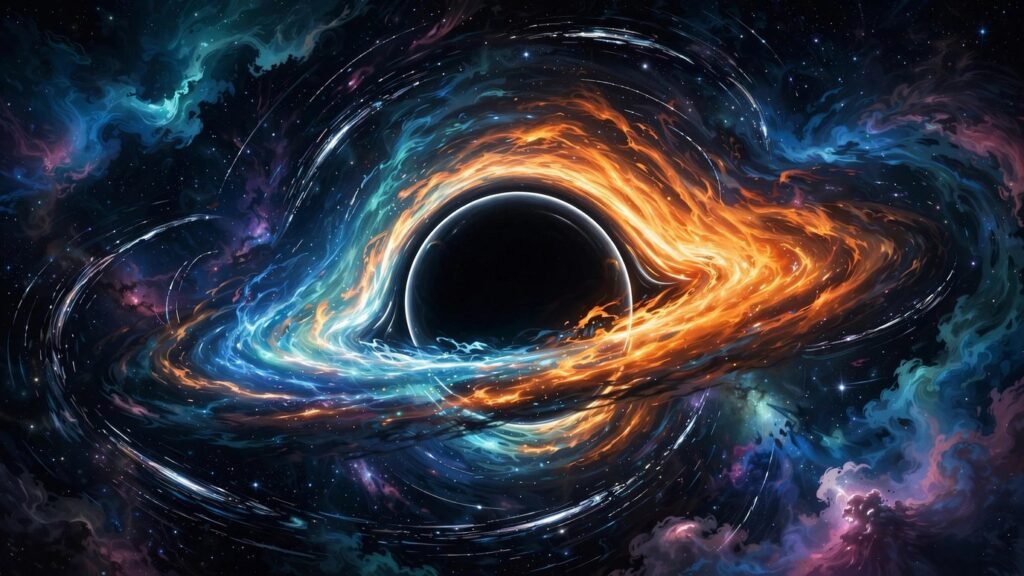
Picture this: you’re in a spaceship, drifting toward a black hole. Not the swirling, glowing monster from the movies — a real one. Your engines are off. You’re falling. Ahead of you is a sphere of perfect darkness, and you know that once you cross its edge, nothing in the universe can ever pull you back out. Not a rescue ship. Not a signal. Not even light itself.
So what actually happens next? Does the black hole crush you instantly? Do you see the entire future of the universe flash before your eyes? Does time stop? Scientists have spent over a century wrestling with these questions, and the answers are stranger than almost any science fiction — partly because some of them are still open questions.
In this guide, we’re going on the full journey: right up to the event horizon, across it, and down into the heart of the black hole itself. No math degree required. (If you’re curious about how these monsters form in the first place, that’s a different story — this one is entirely about what happens inside.)
The short answer: Inside a black hole, you fall toward the center with no way to stop or turn around — every possible direction leads inward. Tidal forces stretch your body into a long strand (spaghettification), time behaves so strangely that the center becomes your unavoidable future, and at the very middle sits the singularity, a place where the laws of physics as we know them break down completely.
What Is the Event Horizon, Really?
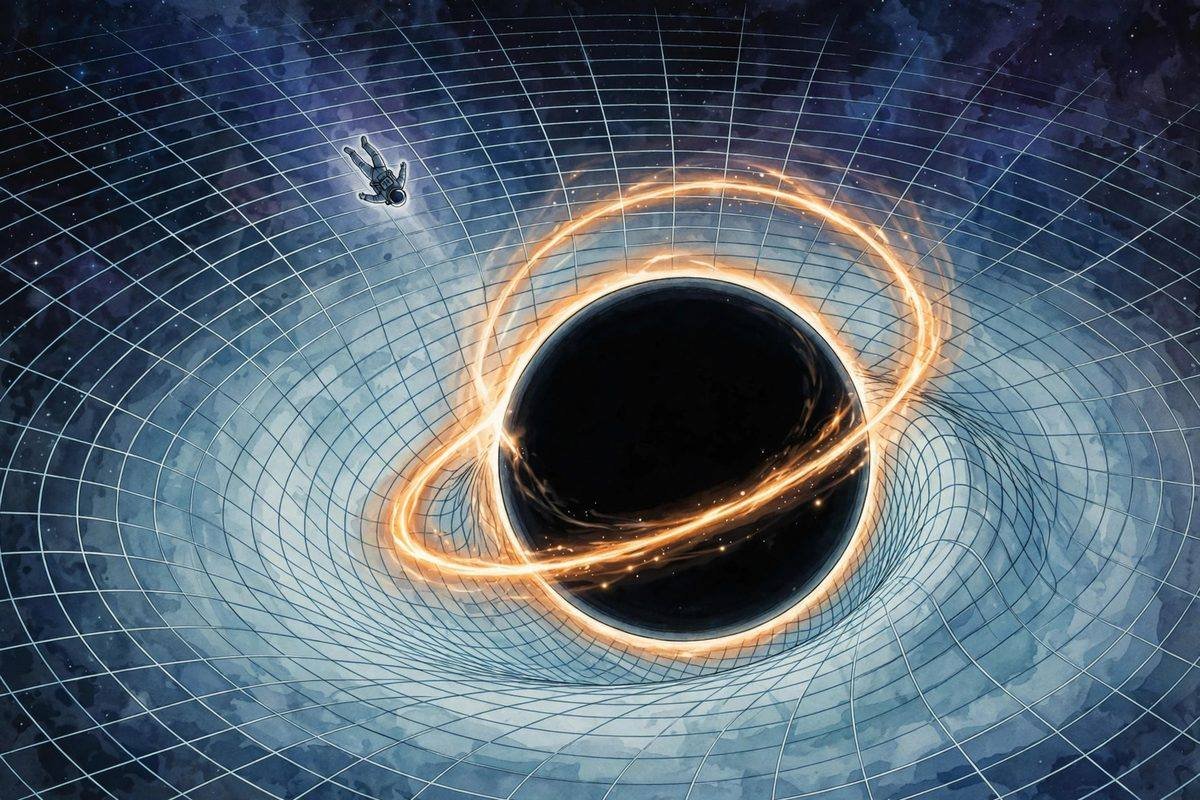
Before we go inside, we need to understand the door. The event horizon is the boundary around a black hole beyond which escape is impossible. It’s not a surface you could touch or a wall you could see. It’s a mathematical line in space: cross it, and every path that leads back out to the universe would require moving faster than light — which nothing can do.
Here’s the part that surprises most people: the event horizon itself is invisible and, for you as the falling astronaut, completely uneventful. There’s no flash, no jolt, no alarm. If you fell into a large enough black hole, you would drift right across the boundary without any local sensation that you’d passed the point of no return. The crossing is only dramatic from the outside — more on that in a moment.
The Point of No Return
Think of the event horizon like the edge of a waterfall in a river with an incredibly strong current. Upstream, you can still paddle back. But there’s a line — and once your boat crosses it, no amount of paddling will save you. The current is simply faster than anything you can do.
Around a black hole, that “current” is the inward flow of spacetime itself, and the speed limit you’re fighting is the speed of light. Past the horizon, spacetime is falling inward faster than light can travel outward. So light — and everything else — is carried inward no matter what it does.
How Big Is It?
The size of the event horizon depends entirely on the black hole’s mass. A black hole with the mass of our Sun would have a horizon only about 6 kilometers across. The supermassive black hole at the center of our galaxy, Sagittarius A*, packs in about 4.3 million Suns, so its horizon is roughly 25 million kilometers across — about 18 times wider than the Sun itself. The bigger the black hole, the gentler the conditions at its edge — a fact that will matter a lot when we get to spaghettification.
What Would You See as You Approach the Horizon?
The journey inward is a light show. As you fall closer, the black hole’s gravity bends the light from the stars behind it around the darkness, so the black sphere in front of you appears to grow far larger than it really is. Starlight wraps around it in thin, curved streaks. Distant stars get smeared and distorted into strange arcs, like looking through a warped lens the size of a world.
Meanwhile, something deeply unsettling is happening to the universe you’re leaving behind.
To the Outside Universe, You Freeze and Fade
Here’s the famous part. To anyone watching from a safe distance, you never actually appear to cross the horizon. Your clock seems to slow down. The light leaving you gets stretched to longer and longer wavelengths — redder, dimmer — until you appear to freeze at the edge, fading into darkness. From their perspective, your fall takes forever.
But that’s their perspective, distorted by gravity’s effect on light and time as seen from far away. In your own experience, nothing slows down. You fall right through in a perfectly ordinary amount of time. Both views are correct — general relativity says each observer gets its own valid version of events, depending on their path through spacetime. It’s one of the most mind-bending confirmed predictions in all of physics.
What Happens the Moment You Cross the Event Horizon?
You cross. Nothing happens. That’s the honest answer for a sufficiently massive black hole.
Your watch keeps ticking. Your heart keeps beating. You can look back over your shoulder and still see the outside universe — though it will look increasingly squeezed into a shrinking, reddening patch of light above you, while darkness closes in from every other direction. One physicist described the sensation as falling downhill — except downhill is everywhere.
The “No Drama” Crossing
For a supermassive black hole, the tidal forces at the horizon are astonishingly weak, because the horizon sits so far from the center that the gravity gradient across your body is tiny. You wouldn’t feel a tug, a stretch, or any warning at all. The boundary is real — you’re now trapped — but your body can’t detect it.
This changes completely for a small, stellar-mass black hole, whose horizon hugs close to the center. There, the tidal forces at the edge are already lethal. But for the giants, the crossing is silent.
Why You Can’t Turn Around
Once inside, the geometry of spacetime itself turns against you. Outside the horizon, you can choose to move in any spatial direction — including away. Inside, the math of general relativity says that every future-pointing path, every direction you could possibly travel through space and time, curves toward the center.
Physicists put it this way: inside the horizon, the singularity isn’t just “in front of you” — it’s in your future. Trying to avoid it by flying away would be like trying to avoid next Tuesday by walking north. No engine, no rocket, no trick of navigation can change where your future points. That’s what “point of no return” truly means — it’s not a force holding you in, it’s the shape of time itself.
What Is Spaghettification?
Now for the part everyone asks about. Spaghettification is the stretching of an object by tidal forces — the difference in gravitational pull between one end of your body and the other. As you fall feet-first, your feet are closer to the black hole’s center than your head, so gravity yanks on them harder. You get pulled longer and longer while being squeezed thinner from the sides, like dough being rolled into a noodle.
The name sounds funny. The physics is not. Near a stellar-mass black hole, these tidal forces become strong enough to tear apart molecules, then atoms — reducing you, eventually, to a stream of fundamental particles spiraling inward. Astronomers have actually watched this happen to entire stars: in 2019, a tidal disruption event called AT2019qiz showed a star being stretched into a thin stream of gas as it ventured too close to a supermassive black hole.

Small Black Holes vs. Supermassive: Where the Tearing Starts
This is the great twist of black hole interiors. Bigger black holes are gentler at the horizon. The tidal force at the edge actually gets weaker as the black hole’s mass grows — it drops with the square of the mass. So your experience depends entirely on which black hole you picked:
| Black hole type | Mass (approx.) | Horizon size | What happens to you |
|---|---|---|---|
| Stellar-mass | ~10 Suns | ~60 km across | Torn apart by tidal forces before you reach the horizon |
| Intermediate | ~1,000 Suns | ~6,000 km across | Stretched near the horizon; destruction follows quickly inside |
| Supermassive (like Sagittarius A*) | ~4.3 million Suns | ~25 million km across | Cross the horizon unharmed; torn apart deeper inside |
| Ultramassive | ~billions of Suns | Wider than our solar system | Could fall for hours or days before tidal forces become lethal |
Here’s the catch, though: wherever the tearing starts, the ending is the same. Physicist Andrew Hamilton, who has simulated black hole interiors in detail, calculated a wonderfully grim rule of thumb — regardless of the black hole’s mass, you’ll be shredded roughly a tenth of a second before you reach the center. The big ones just let you enjoy the ride longer first.
How Long Does the Fall to the Center Take?
In your own time — the time your watch measures — the fall from the horizon to the center is shockingly brief for a small black hole and surprisingly leisurely for a giant one.
- Stellar-mass black hole (~10 Suns): mere milliseconds. You’d barely have time to register the crossing before the end.
- Sagittarius A* (~4.3 million Suns): on the order of a minute or so of your own time — time to look around, watch the universe shrink to a dot, and contemplate your choices.
- A billion-solar-mass giant: hours. You could, in principle, eat lunch on the way down.
But remember the outside observer? For them, your entire fall is frozen at the horizon, stretched across eternity. You get a minute; they get forever. Both are true. If you like having your mind bent by this kind of stuff, Daily Scope 67 publishes regular science explainers that scratch the same itch.
What Is the Singularity at the Center?
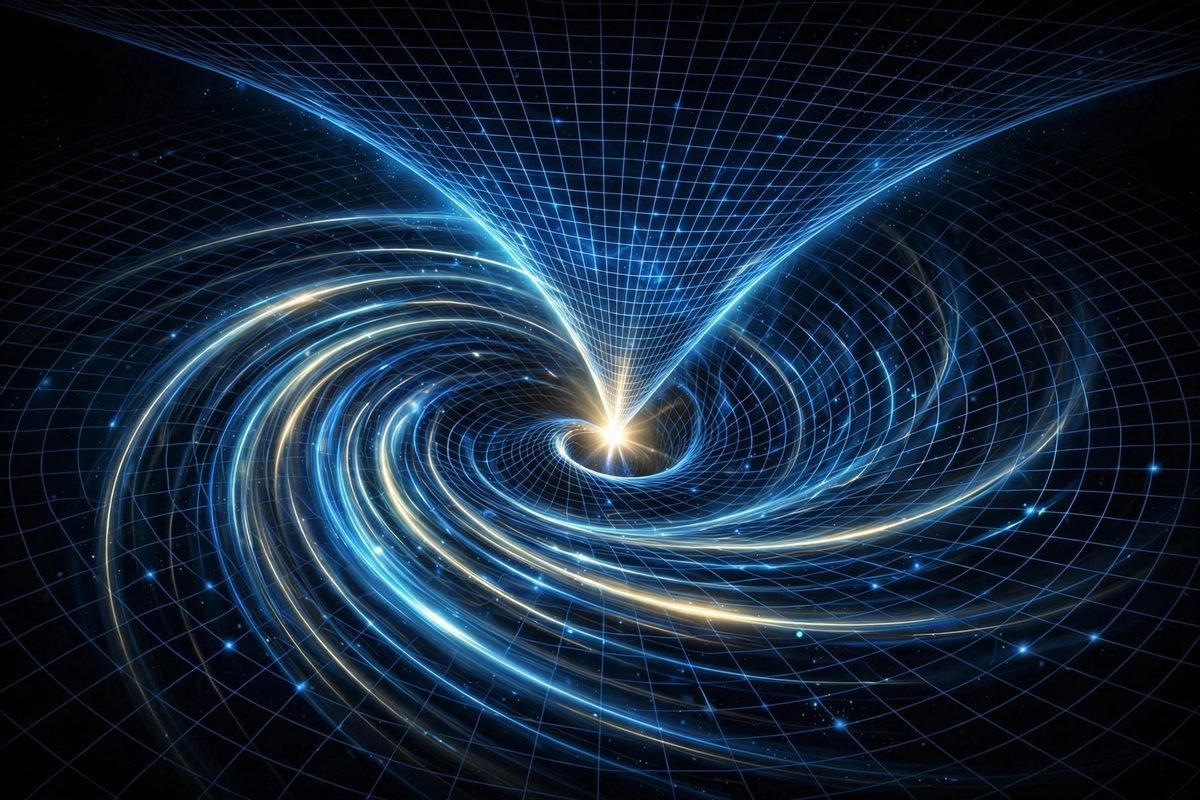
At the heart of every black hole, according to Einstein’s general relativity, lies the singularity: a region where matter is crushed to infinite density and the curvature of spacetime becomes infinite. Our equations don’t just struggle there — they produce nonsense. Divide-by-zero, infinities, breakdown.
Most physicists read that breakdown as a message, not a fact. When your theory spits out infinities, it usually means the theory has reached the edge of its territory. The singularity is where general relativity waves a white flag and says: a deeper theory is needed here — a theory of quantum gravity that we don’t yet have.
Is It Really a Single Point?
For a simple, non-rotating black hole, the math describes the singularity as a point — zero size, infinite density. But real black holes spin, and for a rotating black hole the equations suggest something even weirder: a ring singularity, a one-dimensional loop of infinite density. Some solutions to Einstein’s equations even suggest that passing through the middle of that ring could, mathematically, lead somewhere else entirely — which is where ideas about wormholes come from.
Emphasis on mathematically. Whether any of that corresponds to reality is unknown, and most physicists are deeply skeptical that a stable wormhole shortcut actually exists inside a real black hole.
What Might Replace the Singularity?
Several candidate theories of quantum gravity offer guesses about what really sits at the center:
- A quantum bounce: some models suggest collapsing matter rebounds at unimaginably small scales, possibly forming a new expanding region — a bounce rather than a dead end.
- A fuzzball: string theory proposes that black holes are actually tangled balls of strings with no singularity and no true interior at all.
- Something else entirely: the honest answer is that nobody knows. The singularity is a placeholder labeled “here be dragons,” and whatever replaces it will likely rewrite our understanding of space and time.
Does Time Really Stop Inside a Black Hole?
Not exactly — but what happens to time inside is arguably the strangest part of the whole story. Outside a black hole, you move freely through space while time marches forward, one second per second, no choice in the matter. Inside the horizon, those roles get scrambled.
Space and Time Swap Jobs
The equations say that inside the horizon, the direction toward the center behaves like time: it’s a direction you must move along, just as you must move toward tomorrow. Meanwhile, the time coordinate starts behaving more like a spatial direction. This is why physicists say the singularity lies in your future. You don’t travel to it through space — you travel to it the way you travel to next week: inevitably.
So Do You Experience Time Normally?
Yes — and that’s the eerie part. Your watch ticks normally. Your thoughts proceed in order. You age at the usual rate. Nothing about your local experience of time feels broken. What’s broken is the geometry around you: the future has been reshaped into a funnel, and every tick of your watch carries you closer to the center whether you move or not. You could fire your engines at full blast in any direction and it wouldn’t buy you a single extra second.
What Happens to Your Information? (The Black Hole Information Paradox)
Here’s a question that has haunted physics for fifty years: when you fall in and get shredded down to particles at the singularity, what happens to the information that made you, you? The arrangement of your atoms, your memories, the exact quantum state of everything you were?
Quantum mechanics insists information can’t be truly destroyed. But a black hole seems to destroy it effortlessly. This clash — between quantum theory and general relativity — is the black hole information paradox, and one of the deepest unsolved problems in science.
Hawking Radiation: Black Holes Slowly Evaporate
In 1974, Stephen Hawking showed that black holes aren’t entirely black: quantum effects near the horizon cause them to leak a faint trickle of particles, now called Hawking radiation. Over truly immense timescales, this radiation carries the black hole’s mass away until it evaporates completely.
But here’s the problem: Hawking’s original calculation suggested this radiation is random — it carries no information about what fell in. So if the black hole evaporates and the information is gone, quantum mechanics breaks. If the information somehow escapes in the radiation, then our understanding of the smooth event horizon breaks. Something has to give.
Firewalls and Other Wild Ideas
Theorists have proposed increasingly dramatic resolutions:
| Idea | What it claims | Status |
|---|---|---|
| Information escapes in radiation | Subtle patterns in Hawking radiation encode everything that fell in | Leading view; mechanism still debated |
| Firewall | A wall of high-energy particles at the horizon incinerates anything crossing | Controversial proposal from 2012; would break the “no drama” crossing |
| Fuzzballs | There is no interior or singularity — just a tangled surface of strings | String-theory proposal; untested |
| Remnants / baby universes | Information escapes into a new region of spacetime or a tiny remnant | Highly speculative |
The honest summary: the paradox is unsolved. Whoever cracks it will likely unlock quantum gravity itself.
Could Anything Survive Inside a Black Hole?
Let’s be direct: no. Not you, not a spaceship, not anything made of matter as we understand it.
The supermassive case is the most generous scenario physics allows — you cross the horizon alive, you get some time to look around, and then tidal forces do their work anyway. There is no orbit inside the horizon, no hovering, no hiding. Every trajectory ends at the center, and the center ends everything.
Could some exotic future technology change this? It would need to do more than resist crushing forces — it would need to rewrite the causal structure of spacetime, to make “outward” a direction that exists again. That’s not an engineering problem. That’s a “new laws of physics” problem. And if you’re hungry for more curious guides on science and technology, 9bio is worth a bookmark.
What Do Scientists Actually Know — and What Are They Guessing?
After all this strangeness, it’s worth drawing a clean line between established physics and educated speculation. Good science is honest about the boundary.
What we’re confident about:
- The event horizon is real, and nothing can escape from inside it.
- Crossing the horizon of a large black hole involves no local drama — confirmed by the mathematics of general relativity.
- A distant observer sees infalling objects freeze and redshift at the horizon, while the infaller crosses in finite time.
- Inside, all paths lead to the center; tidal forces (spaghettification) destroy infalling matter.
- Black holes emit Hawking radiation and evaporate over enormous timescales.
What we don’t know:
- What actually happens at the singularity — our theories break down there.
- Whether information that falls in is preserved, destroyed, or escapes somehow.
- Whether firewalls, fuzzballs, wormholes, or something unimagined describes the true interior.
- What a complete theory of quantum gravity looks like — the missing piece behind all of the above.
Frequently Asked Questions
What happens inside a black hole in simple terms?
You fall toward the center and can’t stop. Tidal forces stretch you out like spaghetti, and everything ends at the singularity — a point where our current physics breaks down. There is no way out, no matter what you do.
Would it hurt to fall into a black hole?
For a stellar-mass black hole, you’d likely be torn apart before you even reached the horizon — quickly, at least. For a supermassive black hole, you’d cross the horizon feeling nothing, then be stretched apart deeper inside. Either way, the end isn’t survivable.
Can you see inside a black hole from the outside?
No. By definition, no light or signal can travel from inside the horizon to the outside. Everything we “know” about the interior comes from the mathematics of general relativity, not direct observation — and the math itself breaks down at the singularity.
Is there really a singularity inside every black hole?
General relativity predicts one, but most physicists suspect the singularity is a sign that the theory is incomplete rather than a literal description. A future theory of quantum gravity will likely replace it with something else — we just don’t know what yet.
What is spaghettification?
It’s the stretching of an object by tidal forces near a black hole: gravity pulls harder on the parts of your body closer to the center than on the parts farther away, elongating you vertically while squeezing you horizontally — like spaghetti.
Does time stop inside a black hole?
Your own time keeps flowing normally — your watch ticks as usual. What’s strange is the geometry: inside the horizon, moving toward the center becomes as unavoidable as moving toward tomorrow. The singularity isn’t just ahead of you in space; it’s ahead of you in time.
Could a black hole be a portal to another universe?
Some solutions to Einstein’s equations hint at such possibilities — wormholes, white holes, other regions of spacetime. But these are mathematical curiosities with no evidence behind them, and the crushing interior of a real black hole makes them extraordinarily unlikely as actual doorways.
Conclusion
So, what happens inside a black hole? You cross an invisible boundary feeling nothing, discover that every direction now leads inward, get stretched by tides that grow without limit, and meet a center where physics itself gives up. Along the way, time doesn’t stop for you — it just gets reorganized so thoroughly that the middle of the black hole becomes your unavoidable future.
The remarkable thing is how much of this we actually understand. A century of relativity gives us the horizon, the freezing-and-fading view from outside, the no-drama crossing, spaghettification, and the inescapable funnel of spacetime — all on solid mathematical ground. And the equally remarkable thing is where the understanding ends: at the singularity, where our two greatest theories collide and neither survives intact.
That boundary — between what we know and what we don’t — is exactly where the most exciting physics of the next century will happen. The inside of a black hole isn’t just a place where things end. It might be where our next theory of everything begins.
Read Also: Something Very Bad Is Going to Happen: What the Feeling Means & What to Do (Explained Simply)

1 Comment