
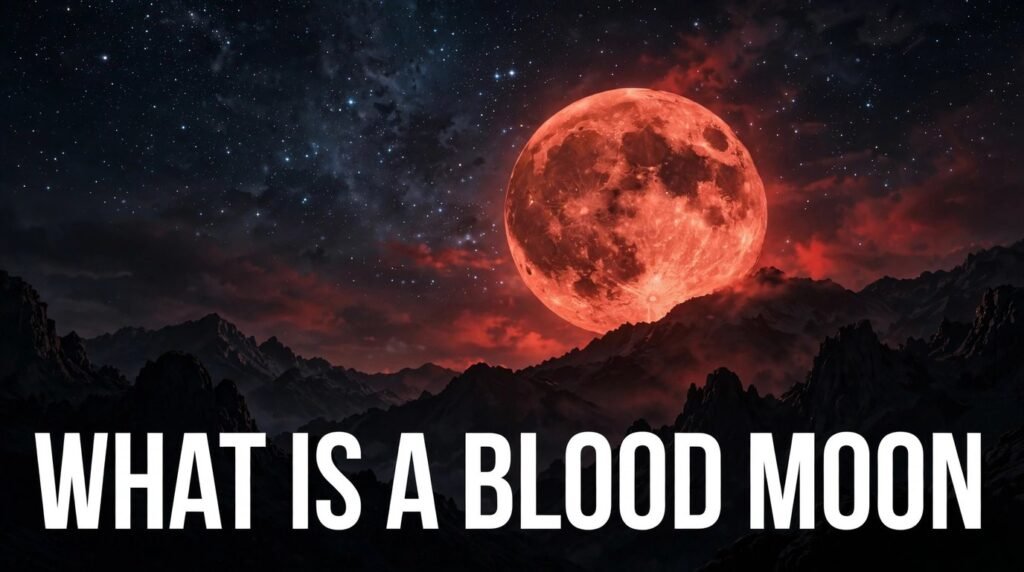
You step outside on a clear night, look up at the full Moon, and something feels wrong. It is still there, still round, still bright enough to notice at once — but it is not white anymore. It has turned a deep copper red, like a coin held up against a sunset. People stop on pavements. Phones come out. Someone nearby says the words you have probably heard before: blood moon.
It is a strange sight, and it is also a completely normal one. A blood moon is not a different kind of Moon, and it is not a sign that anything has gone wrong in the sky. It is what happens when the Earth gets directly between the Sun and the Moon, and our own shadow falls across the lunar surface. The red colour comes from sunlight passing through our atmosphere on its way to the Moon. Once you know that, the whole event starts to make sense — and it becomes much easier to enjoy when the next one comes around.
The short answer: A blood moon is the popular name for a total lunar eclipse. It happens at full moon, when the Sun, Earth and Moon line up and the Moon moves fully into the darkest part of Earth’s shadow, called the umbra. Sunlight filtering through Earth’s atmosphere bends toward the Moon, blue light is scattered away, and only red and orange light gets through — so the Moon glows red instead of going dark.
More Information: Why Does the Moon Shine at Night? 5 Brilliant Reasons
What Is a Blood Moon, Exactly?
The phrase itself is the first thing to clear up. There is no separate object in the sky called a blood moon. Astronomers do not use the term in a formal way. It is a nickname, and a good one, for a total lunar eclipse — the moment when the Moon is fully covered by Earth’s shadow and takes on that red glow.
That distinction matters because it tells you what to expect. A blood moon is not a Moon that has changed colour on its own. The Moon is not burning, bleeding, or breaking apart. It is simply lit differently for a while. The light reaching it has travelled through Earth’s atmosphere first, and that journey changes its colour before it arrives.
You can think of it like this. On an ordinary full moon night, sunlight hits the Moon directly and bounces back to your eyes, bright and white. During a total lunar eclipse, the Earth blocks that direct sunlight. The only light that still reaches the Moon has slipped around the edges of our planet, through a thick layer of air. That air acts like a filter. It lets the reds and oranges through and holds back the blues. The result is a Moon that looks as if it has been dipped in rust.
The effect is strongest when the Moon is deep inside the shadow. At the start of the eclipse it may look only slightly dimmed, with a dark bite taken out of one side. As it slides further in, the colour deepens. By the middle of totality, when the whole face of the Moon is inside the umbra, the red is at its richest. Then, slowly, the process reverses, and the familiar white Moon returns.
Why the name stuck
People have watched lunar eclipses for thousands of years, long before anyone knew what caused them. A red Moon in the night sky is hard to ignore, and hard to forget. It looks dramatic, almost unreal, and it does not happen every month, so it earned a name that matched how it looked.
Modern astronomy kept the science and kept the nickname too. “Total lunar eclipse” is the precise term. “Blood moon” is the one most people actually say. Both describe the same event, and you will see both used in eclipse guides, news stories, and observing notes. If a headline talks about a blood moon, it is talking about a total lunar eclipse.
Why Does the Moon Turn Red?
This is the part that surprises most people. The red colour has almost nothing to do with the Moon itself, and everything to do with Earth’s atmosphere.
Sunlight looks white to us, but it is really a mix of many colours. When that light passes through air, the shorter blue wavelengths get scattered in all directions much more easily than the longer red wavelengths. This is called Rayleigh scattering, and it is the same effect that makes the sky blue during the day and sunsets red in the evening.
During a total lunar eclipse, the geometry lines up in a very specific way. The Sun is behind the Earth from the Moon’s point of view. Direct sunlight cannot reach the Moon at all. But some sunlight grazes the edge of the Earth, passes through our atmosphere, and gets bent slightly inward — refracted — toward the Moon. On that long trip through the air, the blue light is scattered away. What is left is the red and orange light, and that is what lights up the lunar surface.
Why sunsets are the perfect comparison
If you have ever watched a sunset, you have already seen the same physics at work. When the Sun is low, its light has to travel through far more atmosphere to reach your eyes than it does at midday. The blue light gets scattered out along the way, and the Sun looks orange, then red, as it sinks.
A blood moon is that sunset light, projected onto the Moon. In fact, the light falling on the eclipsed Moon has passed through every sunset and every sunrise happening around the edge of the Earth at that moment. It is a ring of twilight, bent inward, landing on a surface a quarter of a million miles away. That is a lovely thought to hold onto while you watch: the red you are seeing is Earth’s dawns and dusks, all at once.
The exact shade can change from one eclipse to the next. Sometimes the Moon looks a bright copper orange. Sometimes it is a deep, almost brick red. Sometimes it is darker, closer to brown, with a grey edge. The difference comes down to what is in Earth’s atmosphere at the time — dust, cloud, and particles from volcanic eruptions or wildfires can all make the eclipse darker or redder. No two blood moons look exactly alike, which is part of why people keep going out to see them.
How Does a Total Lunar Eclipse Happen?
A lunar eclipse can only happen at full moon. That is a strict rule, not a tendency. At full moon, the Sun, Earth and Moon are roughly in a line, with the Earth in the middle. The Moon is on the opposite side of the Earth from the Sun, fully lit from our point of view — and, crucially, in a position where Earth’s shadow can fall on it.
But a blood moon does not happen at every full moon. If it did, we would see one every month, and the name would lose its magic. The reason it does not is the tilt of the Moon’s orbit. The Moon travels around the Earth on a path that is tilted by about five degrees compared to the path the Earth takes around the Sun. Most months, at full moon, the Moon passes slightly above or slightly below Earth’s shadow, and nothing happens. Only when the alignment is close enough — when the Moon crosses the plane at just the right time — does it slide into the shadow.
When it does, the eclipse unfolds in stages. First comes the penumbral phase, when the Moon enters the outer, fainter part of Earth’s shadow, called the penumbra. The dimming here is subtle. You might notice the Moon looks a little less bright on one side, or you might not notice anything at all if you are not looking carefully.
Then the partial phase begins. The Moon starts to move into the umbra, the dark central shadow, and a curved dark shape creeps across its face. This is the part that looks like something is taking a bite out of the Moon. The bite grows larger and larger until the whole disc is inside the umbra. That is the start of totality — the blood moon itself.
Totality can last around an hour. The Moon hangs there, red and dim, fully inside the shadow. Then it begins to leave the umbra on the other side, the partial phase runs in reverse, the penumbral shading fades, and the ordinary full Moon is back. The whole event, from first faint dimming to last, can take several hours, which is why a lunar eclipse is such a relaxed thing to watch. There is no rush. You can go outside, check on it every ten or fifteen minutes, and watch it change.
What Happens During a Blood Moon, Step by Step
If you are planning to watch one, it helps to know the order of events so you can tell where you are in the show. Here is how a typical total lunar eclipse plays out:
- First penumbral contact: The Moon touches the faint outer shadow. Nothing obvious changes yet. The Moon may look very slightly grey on one edge.
- Partial eclipse begins: The Moon starts entering the umbra. A dark, curved shadow appears and grows across the face of the Moon.
- Totality begins: The last sliver of bright white disappears. The whole Moon is inside the umbra and turns red, copper, or orange.
- Greatest eclipse: The Moon is deepest in the shadow. This is usually when the colour is at its richest and most even.
- Totality ends: A bright sliver reappears on the opposite edge. The red begins to fade as the Moon slides out of the umbra.
- Partial eclipse ends: The Moon is fully out of the umbra. Only the faint penumbral shading remains.
- Penumbral eclipse ends: The Moon leaves the outer shadow completely. The eclipse is over, and the full Moon looks normal again.
You do not need a telescope or any special timing to enjoy this. The phases are slow and obvious, and the best moments — the start of totality, the middle of it, and the end — are easy to spot with the naked eye. If you do have binoculars, they make the colour and the texture of the lunar surface easier to see, but they are a bonus, not a requirement.
Blood Moon vs Supermoon vs Blue Moon
These three names get mixed up a lot, and it is easy to see why. They all describe a full Moon that is somehow special, and they all turn up in headlines. But they describe three completely different things. A blood moon is about Earth’s shadow. A supermoon is about distance. A blue moon is about the calendar. A single full Moon can, on rare occasions, be more than one of these at once — but most of the time, they are separate events.
| Feature | Blood Moon | Supermoon | Blue Moon |
|---|---|---|---|
| What it is | A total lunar eclipse | A full Moon at its closest point to Earth | The second full Moon in one calendar month, or the third full Moon in a season with four |
| What causes it | Earth blocks direct sunlight; only red light filtered through our atmosphere reaches the Moon | The Moon’s orbit brings it nearer to Earth, so it looks slightly larger and brighter | The timing of full moons against our calendar months |
| What it looks like | Red, copper, or orange, and dimmer than usual | Slightly larger and brighter than an average full Moon | Looks like an ordinary full Moon — it is not actually blue |
| How often it happens | Only when Sun, Earth and Moon line up closely at full moon | Several times a year, when a full Moon coincides with the Moon being near Earth | Roughly every two to three years |
| Safe to watch with the naked eye | Yes | Yes | Yes |
The key difference is simple. A blood moon changes colour because of an eclipse. A supermoon changes apparent size because of distance. A blue moon does not change at all — it is just a quirk of how we count full moons in a month. The Moon does not turn blue, and it does not turn red either, unless an eclipse is happening.
It is also worth knowing that a blood moon is not the same as a “red moon” seen low on the horizon. When the Moon is rising or setting, it often looks orange or red for a few minutes because its light is travelling through a thick slice of atmosphere near the ground. That is the same scattering effect, but it is not an eclipse, and the colour fades as the Moon climbs higher. A true blood moon stays red even when it is high in the sky, because the cause is Earth’s shadow, not the Moon’s position near the horizon.
Is a Blood Moon Dangerous to Watch?
No. A blood moon is completely safe to watch with the naked eye, and you do not need special glasses, filters, or any protective equipment at all.
This is one of the biggest differences between a lunar eclipse and a solar eclipse. During a solar eclipse, you are looking toward the Sun, and you must never look at it directly without proper eclipse glasses. During a lunar eclipse, you are looking at the Moon, which only shines by reflected sunlight. Even at its brightest, moonlight is far too faint to harm your eyes. During totality, the Moon is actually much dimmer than usual, because it is only lit by that filtered red light.
That makes a blood moon one of the easiest astronomical events to enjoy. You can watch it from your garden, your balcony, a park, or a window. You can bring children, you can take photographs with a phone, and you can look up for as long as you like. There is nothing to prepare for in terms of safety — just dress warmly if it is a cold night, and give your eyes a few minutes to adjust to the dark so the red colour stands out properly.
If you wear glasses, keep them on. If you have binoculars or a small telescope, they will show you more detail — the darker patches of the lunar seas, the brighter highlands, and the way the red colour is not perfectly even across the face. But none of that is needed. The naked-eye view is the classic one, and it is more than enough.
How Often Do Blood Moons Happen?
Blood moons are not rare in the way a once-in-a-lifetime comet might be, but they are not monthly either. They happen only when the geometry lines up at full moon, and that alignment does not occur every month because of the tilt of the Moon’s orbit.
Some years have two total lunar eclipses. Some years have one. Some years have none at all. That uneven pattern is normal. It is also why eclipse watchers pay attention to the calendar: a year with no total lunar eclipse at all is not a mistake, it is just how the cycles fall.
The gaps between blood moons can feel long if you miss one, but the wait is part of the appeal. When the next one arrives, it feels like an occasion. People plan for it, check the weather, set alarms, and go outside together. A total lunar eclipse is visible from a whole hemisphere at once — everywhere it is night on Earth while the eclipse is happening — so millions of people can watch the same red Moon at the same time. That shared experience is a big part of why blood moons capture the imagination in a way an ordinary full Moon does not.
It also helps to know the difference between a total lunar eclipse and the other kinds. A partial lunar eclipse, when only part of the Moon enters the umbra, is more common and still worth watching, but the Moon does not turn fully red. A penumbral lunar eclipse, when the Moon only passes through the faint outer shadow, is the subtlest of all — the dimming can be so slight that many people do not notice it unless they are looking for it. Only a total eclipse gives you the full blood moon effect.
When Is the Next Blood Moon?
Here are the dates that matter, based on the eclipses around now. If you missed the most recent one, the next total lunar eclipse is the one to put in your diary.
| Eclipse | Date | Details |
|---|---|---|
| Most recent total lunar eclipse | March 3, 2026 | Total lunar eclipse — a blood moon, with totality lasting about 59 minutes |
| Partial lunar eclipse | August 28, 2026 | Partial eclipse, with about 97% of the Moon in shadow — not a total blood moon |
| Penumbral lunar eclipses | February 20, July 18, and August 17, 2027 | Faint penumbral eclipses only — no total lunar eclipse in 2027 |
| Next total lunar eclipse (next blood moon) | December 31, 2028 | Total lunar eclipse, visible across Europe, Africa, Asia, Australia and the Pacific |
The December 31, 2028 eclipse is a particularly good one to look forward to. It falls on New Year’s Eve, it is a total eclipse, and it will be visible across a huge part of the world — Europe, Africa, Asia, Australia and the Pacific. If you are in any of those regions and the sky is clear that night, you will be able to watch the Moon turn red as one year ends and the next begins.
The March 3, 2026 eclipse, the most recent total one, is a useful reference point for what to expect. Totality lasted about 59 minutes — just under an hour of full red Moon, with the partial phases stretching out on either side. That is a typical length for totality. Some total lunar eclipses last a little longer, some a little shorter, but around an hour is a good guide for planning your evening.
The August 28, 2026 eclipse is worth mentioning because it can cause confusion. About 97% of the Moon was in shadow, which sounds almost total — and it would have looked dramatic, with only a thin bright sliver left. But it was still a partial eclipse, not a total one, so it was not a blood moon in the full sense. The distinction matters if you are comparing photographs or stories: a near-total partial eclipse and a true total eclipse look different, and the fully red Moon only appears when the whole disc is inside the umbra.
And 2027 is a year to be honest about. There is no total lunar eclipse in 2027. The lunar eclipses that year — on February 20, July 18, and August 17 — are penumbral only, which means the Moon will pass through the faint outer shadow and dim very slightly. They are real eclipses, and careful observers may notice the shading, but they will not produce a blood moon. If you want the red Moon, December 31, 2028 is the date to wait for.
How to See a Blood Moon
Seeing a blood moon is easy, but a little preparation makes it much better. The most important thing is a clear sky and a view of the Moon. Everything else is about comfort and making the most of the slow, changing show.
- Check the date and time for your location. A lunar eclipse is visible everywhere it is night, but the exact timing of first contact, totality, and last contact depends on where you are. Check a reliable eclipse guide for your town on the day, and note when totality begins and ends.
- Find a spot with a clear view. You do not need to travel to a dark-sky site. A garden, a rooftop, a park, or even a window with a view of the Moon will do. What matters is that no building or tree blocks the Moon during the eclipse.
- Let your eyes adjust. Step outside a few minutes early. Avoid looking at bright phone screens if you can. Your eyes will adapt to the dark, and the red colour will look richer and deeper.
- Watch the phases, not just totality. The partial phases are beautiful in their own right. Watching the shadow creep across the Moon, then watching the red deepen, then watching the bright Moon return, is the full experience.
- Bring binoculars if you have them. They are not required, but they make the colour and the surface detail much clearer. A small pair of ordinary binoculars is perfect.
- Take photographs, but do not spend the whole night behind a screen. A phone on a steady surface can capture the red Moon, especially during totality when the Moon is dimmer and easier to photograph. Take a few shots, then put the phone down and watch with your eyes.
- Dress for the night. Totality lasts around an hour, and the whole eclipse takes much longer. Bring a warm layer, a chair if you want one, and a hot drink. You will enjoy it far more if you are comfortable.
- Check the weather. Cloud is the one thing that can spoil a blood moon. A few thin clouds can add atmosphere to a photograph, but thick cloud will hide the Moon completely. If the forecast is bad, a short drive to clearer skies can be worth it.
More Information: Lord of the Rings T Shirt
One more tip, and it is the simplest one: go outside with someone. A blood moon is a shared event by nature — the same red Moon is visible to everyone on the night side of Earth at the same time. Watching it with family or friends, even just standing in a garden together and looking up, turns a quiet astronomical event into a memory. The Moon will be red whether you watch alone or not, but it is more fun with company.
What Does a Blood Moon Look Like Through Binoculars or a Telescope?
With the naked eye, a blood moon is a smooth red disc, glowing quietly against the stars. Through binoculars, that disc starts to show texture. You can make out the darker patches — the lunar maria, the old lava plains that look like seas — and the brighter highlands around them. The red is not perfectly even. Some parts look deeper and darker, others lighter and more orange, and the edge of the shadow can still be faintly visible as it moves.
Through a small telescope, the view gets richer still. The craters along the edge of the Moon stand out in relief, lit at a low angle by that filtered red light. The colour seems to shift as you look from the centre of the disc to the edge. It is a slower, quieter view than a bright full Moon through the same telescope, because the light is dimmer — but that dimness is what makes it comfortable to look at for a long time.
If you are new to telescopes, a blood moon is a forgiving first target. The Moon is large, bright, and easy to find. You do not need to know star charts or coordinates. Point the telescope at the red disc, focus until the edge is sharp, and take your time. The Moon will stay red for around an hour during totality, so there is no pressure to rush.
For photographers, the same advice applies. Use a tripod if you have one, keep the exposure short enough that the Moon does not blur, and take several shots at different settings. The red Moon against a dark sky, with a few stars visible around it, makes a striking photograph — and because the Moon is dimmer during totality, you may even capture stars in the same frame that would normally be washed out by moonlight.
Common Myths About Blood Moons
A red Moon is dramatic enough that stories have grown up around it in almost every culture. Some of those stories are beautiful, and some are simply wrong. Here are the ones you are most likely to hear, and what is actually going on.
A blood moon means something bad is about to happen
This is the oldest myth of all. In many ancient cultures, a red Moon was read as an omen — a warning of war, famine, or disaster. It is easy to see why. A red Moon looks unsettling if you do not know what causes it, and people have always tried to find meaning in the sky.
There is no evidence for any of it. A blood moon is a predictable astronomical event, caused by the alignment of the Sun, Earth and Moon. It does not affect weather, earthquakes, health, or human behaviour. It is a shadow and some scattered light, nothing more — and nothing less. The wonder is in the physics, not in a warning.
The Moon is actually bleeding or on fire
No. The Moon is a cold, rocky world with no air and no fire. It cannot bleed, and it cannot burn. The red you see is sunlight that has passed through Earth’s atmosphere. The Moon itself has not changed at all. As soon as the eclipse ends, it goes back to looking white and bright, exactly as before.
You need special glasses to watch a blood moon
This confusion comes from solar eclipses, where looking at the Sun without protection can seriously damage your eyes. A lunar eclipse is completely different. You are looking at the Moon, not the Sun, and moonlight is safe. No glasses, no filters, no precautions are needed. If someone tells you to buy special blood moon glasses, you do not need them.
A blood moon only happens once in a lifetime
It can feel that way if you miss a few in a row, especially with a gap like the wait from 2026 to the end of 2028. But blood moons happen regularly over the years, whenever the alignment lines up. The gaps vary, and some years have none, but they are not once-in-a-lifetime events. If you miss one, there will be another — it is just a question of when, and where you need to be to see it.
The Moon turns red because it is close to Earth
Closeness can make the Moon look larger, as in a supermoon, but it does not make it red. The red colour comes from Earth’s shadow and Earth’s atmosphere, not from distance. A blood moon can happen whether the Moon is near or far in its orbit. The two effects are independent, even though they can occasionally happen at the same time.
Frequently Asked Questions About Blood Moons
What is a blood moon in simple terms?
A blood moon is a total lunar eclipse. The Moon moves fully into Earth’s darkest shadow, and sunlight filtering through Earth’s atmosphere turns it red or copper-coloured instead of letting it go dark. It only happens at full moon, when the Sun, Earth and Moon line up.
Why is it called a blood moon?
It is called a blood moon because of its colour. During totality, the Moon glows a deep red, like blood, because blue light is scattered away by Earth’s atmosphere and only red and orange light reaches the lunar surface. The name is a nickname, not a scientific term — astronomers call it a total lunar eclipse.
When is the next blood moon?
The next total lunar eclipse — the next blood moon — is on December 31, 2028. It will be visible across Europe, Africa, Asia, Australia and the Pacific. There is no total lunar eclipse in 2027, only faint penumbral eclipses on February 20, July 18, and August 17, 2027.
How long does a blood moon last?
Totality, when the Moon is fully inside Earth’s shadow and fully red, can last around an hour. The most recent total lunar eclipse, on March 3, 2026, had totality of about 59 minutes. The whole eclipse, including the partial phases before and after totality, takes much longer — several hours from start to finish.
Is it safe to look at a blood moon?
Yes, completely safe. You can watch a blood moon with the naked eye for as long as you like, with no special glasses or filters. You are looking at moonlight, which is far too faint to harm your eyes. This is very different from a solar eclipse, where you must never look directly at the Sun without proper protection.
What is the difference between a blood moon and a supermoon?
A blood moon is a total lunar eclipse, when Earth’s shadow turns the Moon red. A supermoon is a full Moon that happens when the Moon is at its closest point to Earth, so it looks slightly larger and brighter. A supermoon does not change colour. The two are caused by completely different things, although they can occasionally happen at the same time.
Can you see a blood moon everywhere?
A total lunar eclipse is visible from everywhere on Earth where it is night while the eclipse is happening — which is a whole hemisphere at once. That is much wider than a solar eclipse, which is only visible along a narrow path. Whether you can see a particular blood moon depends on whether the Moon is above the horizon where you are, and whether the sky is clear.
Final Thoughts
A blood moon is one of those rare sky events that needs no equipment, no expertise, and no special preparation — just a clear night and a willingness to look up. It is a total lunar eclipse, a moment when the Earth steps between the Sun and the Moon and paints our nearest neighbour red with filtered sunset light. It lasts around an hour at its peak, it is safe to watch with the naked eye, and it is visible to everyone on the night side of the planet at the same time.
If you missed the March 3, 2026 eclipse, do not worry. The next one is already on the calendar: December 31, 2028, visible across Europe, Africa, Asia, Australia and the Pacific. Put the date somewhere you will see it, check the timing for your location closer to the day, and plan to step outside. Watch the shadow creep across the Moon, watch the red deepen, and watch the bright Moon return. It is a slow, quiet, beautiful piece of astronomy — and it is free, open to anyone who looks up.
Read Also: When Is the Next Lunar Eclipse? (2026 Guide)
