
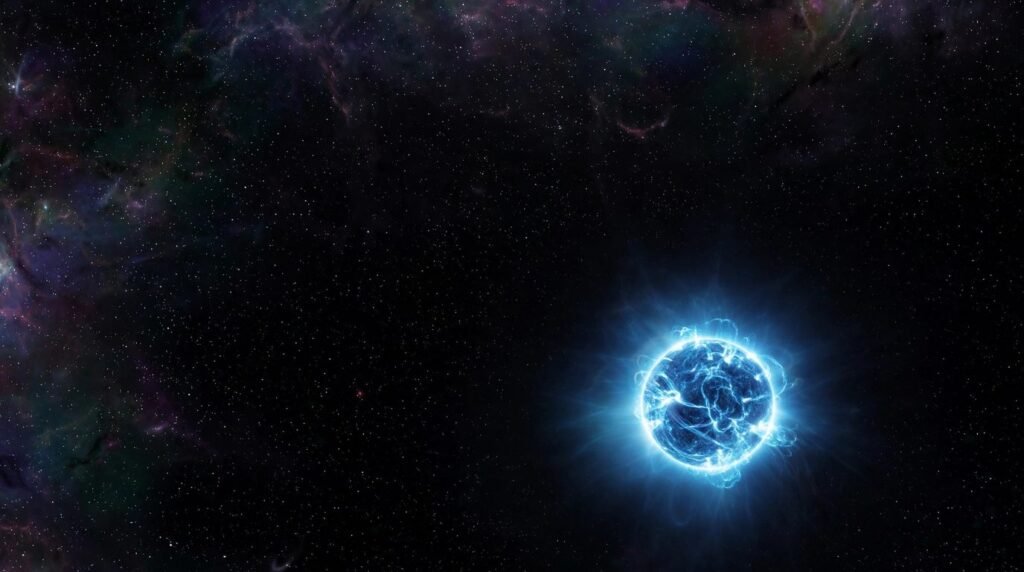
If you’ve ever wondered what is a neutron star, picture this: take the entire mass of the Sun — every planet, every comet, all that nuclear fire — and crush it down until it fits inside a city. Not a country. A city. What you get is a neutron star: the densest thing in the universe that you can actually see, an object so extreme that a single teaspoon of its matter would weigh about a billion tons.
These are the corpses of giant stars, and they refuse to go quietly. Some of them spin hundreds of times every second. Some have magnetic fields so strong they can crack their own crust and briefly outshine the whole galaxy. And in 2017, two of them crashed into each other and lit up the sky in a way that let astronomers watch gold being forged in real time.
This guide explains what a neutron star actually is, how one is born, what’s inside it, and why scientists are still arguing about what happens at its core.
The short answer: A neutron star is the collapsed core left behind when a massive star (roughly 8–20 times the Sun’s mass) explodes as a supernova. About 20 kilometers across yet packing 1.4 to more than 2 times the Sun’s mass, it’s made almost entirely of neutrons packed as tightly as matter can physically be packed. Neutron stars spin incredibly fast, have crushing gravity and magnetic fields, and come in exotic flavors — including pulsars and magnetars.
How Does a Neutron Star Form?
Every star is a balancing act. Gravity pulls everything inward; the energy released by nuclear fusion in the core pushes everything outward. For billions of years, the two forces hold each other in a stalemate. But the stalemate can’t last forever, because stars eventually run out of fuel.
In a star at least eight times as massive as the Sun, the final act plays out fast. The star burns through hydrogen, then helium, then carbon, neon, oxygen, silicon — each heavier fuel burning faster than the last — until the core is made of iron. And iron is where the music stops. Fusing iron doesn’t release energy; it absorbs it. The core has no more tricks left.
What happens next is one of the most violent events in nature. With no fusion pressure left to hold it up, the iron core — roughly the size of Earth — collapses in less than a second. The outer layers of the star, meanwhile, are still hanging out there in space, and gravity yanks them down too. They slam into the collapsing core at a significant fraction of the speed of light and rebound, blasting outward in a supernova explosion that can briefly outshine an entire galaxy.
The core, though, doesn’t rebound. It keeps collapsing until something stops it. Protons and electrons are squeezed together so violently that they merge into neutrons, in a process called electron capture. In a matter of seconds, a core the size of Earth becomes a ball of nearly pure neutrons just 20 kilometers wide. A neutron star is born.
The idea isn’t new — astronomers Walter Baade and Fritz Zwicky proposed back in 1934 that supernovae could leave behind superdense neutron bodies. It took until 1967, when graduate student Jocelyn Bell Burnell detected the first pulsar, for the universe to confirm they were right.
How Big (and Heavy) Is a Neutron Star?
Here is the part that breaks most people’s intuition. A typical neutron star is about 12 miles (20 kilometers) across — you could drive across it in fifteen minutes. That’s it. That’s the whole star.
But crammed into that tiny sphere is about 1.4 times the mass of the Sun, and some neutron stars are far heavier. The heaviest well-measured one, a fast-spinning pulsar called PSR J0952-0607, weighs about 2.35 times as much as the Sun — so heavy it sits near the edge of what a neutron star can be before it gives up and collapses into a black hole. (Its discoverers nicknamed its kind “black widow” pulsars, because they slowly devour their companion stars.) Another heavyweight, PSR J0740+6620, tips the scales at about 2.08 solar masses — and NASA’s NICER telescope measured its radius at roughly 12.4 kilometers, nearly the same as a much lighter neutron star, which tells physicists the matter inside is remarkably stiff and hard to squeeze.
The density this produces is genuinely hard to comprehend:
- A sugar cube of neutron star matter would weigh about a billion tons on Earth — NASA’s own comparison is Mount Everest squeezed into a sugar cube.
- The core reaches densities several times that of an atomic nucleus — the densest stable matter known anywhere in the universe.
- Surface gravity is around 200 billion times stronger than Earth’s. If you could stand on a neutron star (you can’t — you’d be flattened into a layer of atoms), escaping would require accelerating to roughly a third of the speed of light.
To put the scale in perspective: the Sun contains about 333,000 Earths’ worth of mass. A neutron star holds more mass than the Sun in a ball you could fit inside most cities.
What’s Inside a Neutron Star?
Nobody has ever seen inside a neutron star — obviously — but physicists have built detailed models of its layers, and the picture is wonderfully strange. Think of it like an onion, if onions were made of the most extreme matter in existence.
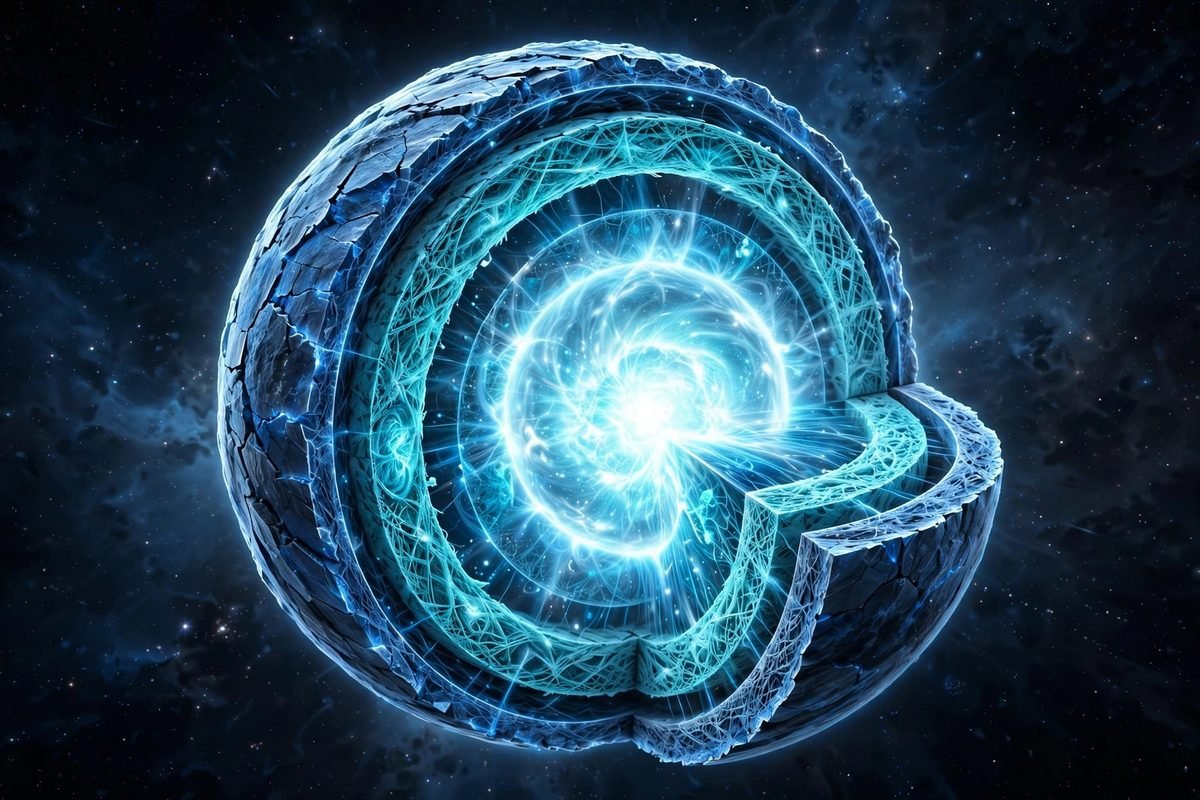
The atmosphere is a whisper-thin layer of hot plasma, just centimeters to meters thick. Below that sits the outer crust, about a kilometer deep: a solid crystal lattice of heavy atomic nuclei (mostly iron-group elements) with electrons flowing between them. This is already far denser than anything on Earth, and it’s the star’s “skin.”
Deeper still is the inner crust, where pressure gets so intense that neutrons start leaking out of the nuclei — a boundary physicists call the “neutron drip line.” Here the models predict something delightful: nuclear pasta. The competition between nuclear attraction and electric repulsion squeezes matter into shapes that researchers (with a straight face, in peer-reviewed papers) call gnocchi, spaghetti, lasagna, and even “nuclear waffles.” For a typical neutron star, this pasta layer is about 100 meters thick.
Below the crust lies the core, which makes up most of the star. In the outer core, nuclei dissolve entirely into a soup of neutrons with a dash of protons and electrons — the neutrons likely flow as a frictionless superfluid, while the protons may act as a superconductor. And the inner core? That’s where certainty ends. The pressure may crush neutrons into hyperons, or melt them entirely into a soup of free quarks. As one physicist put it, we’re in the regime where “we do not know what happens at these insane pressures and densities.” Figuring out the core’s true nature is one of the biggest open questions in physics — and it’s exactly what NASA’s NICER mission on the International Space Station was built to probe.
What Stops a Neutron Star From Collapsing Into a Black Hole?
Good question — gravity clearly wants to keep crushing. The thing that holds the line is a quantum mechanical rule called the Pauli exclusion principle, which says that identical fermions (particles like neutrons) can’t occupy the same quantum state. As gravity squeezes neutrons together, they run out of low-energy slots to sit in, so they’re forced into higher-energy states — and that resistance creates an outward pressure called neutron degeneracy pressure.
It’s the same principle that holds up white dwarfs (via electrons), but neutrons are far more massive, so neutron stars can be far denser. The catch: degeneracy pressure has a limit. If a neutron star gains too much mass — by feeding on a companion star or merging with another neutron star — gravity eventually wins, and the whole thing collapses into a black hole.
That tipping point is called the Tolman-Oppenheimer-Volkoff limit, and it’s thought to sit somewhere around 2.2 solar masses (give or take). The fact that astronomers have found neutron stars at 2.08 and 2.35 solar masses means the limit is being mapped in real time — every heavyweight neutron star discovered tightens the constraint on what matter can survive.
Why Do Neutron Stars Spin Hundreds of Times Per Second?
Picture a figure skater spinning with her arms outstretched. When she pulls her arms in, she spins dramatically faster. That’s conservation of angular momentum, and neutron stars are the most extreme demonstration of it in the universe.
The massive star that died was already rotating — slowly, majestically, taking days or weeks per turn. Then its core collapsed from Earth-size to city-size, shrinking by a factor of roughly a hundred thousand in radius. All that rotational momentum got concentrated into a tiny ball, so the newborn neutron star spins furiously. A typical young neutron star rotates several to dozens of times per second.
And some go much, much faster. Millisecond pulsars — old neutron stars that were spun up even further by stealing gas from a companion star — can rotate hundreds of times per second. The current record holder, PSR J1748-2446ad, spins at 716 times per second. Its equator is whipping around at a serious fraction of the speed of light.
What Is a Pulsar, Exactly?
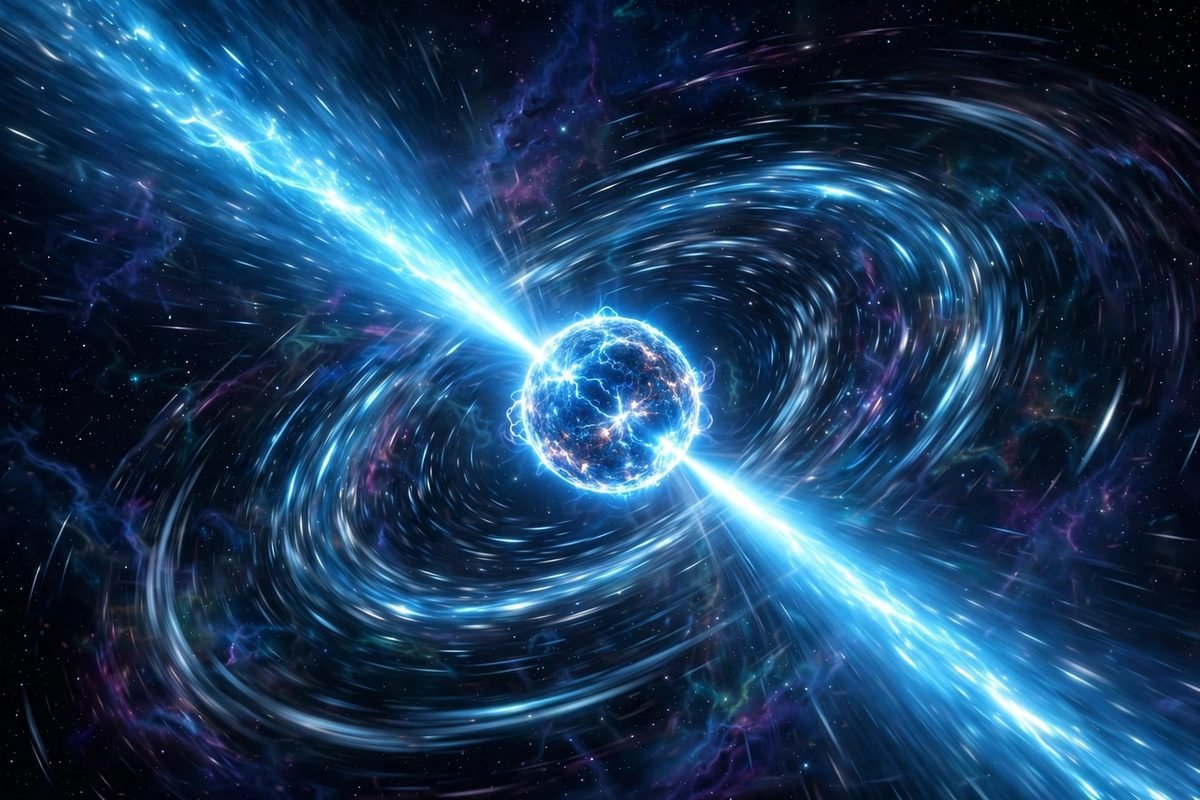
A pulsar is a neutron star — specifically, a spinning neutron star whose magnetic poles sweep beams of radiation across space like a lighthouse. We only see the pulses when a beam happens to point at Earth, which is why they appear to blink on and off with metronomic precision.
The first one was found in 1967, when Jocelyn Bell Burnell — then a 24-year-old graduate student working under Antony Hewish at Cambridge — noticed a strange, strictly periodic radio signal repeating every 1.337 seconds. She’d found CP 1919, the first pulsar. The discovery was so unexpected that the team half-jokingly labeled the signal “LGM” — Little Green Men. (Hewish received the 1974 Nobel Prize for the discovery; Bell Burnell’s omission remains one of the most discussed snubs in science history.)
The most famous pulsar sits at the heart of the Crab Nebula, the expanding wreckage of a supernova that Chinese astronomers recorded in 1054 AD. The Crab pulsar spins about 30 times per second — and it has been doing so, slowing almost imperceptibly, for nearly a thousand years.
Because pulsars are such perfect clocks, astronomers use them as cosmic timepieces. Networks of pulsars are even being used to hunt for gravitational waves rippling through the galaxy. Not bad for stellar corpses.
What Is a Magnetar — and Why Are They the Scariest Magnets in Nature?
If pulsars are the workhorses of the neutron star family, magnetars are its monsters. A magnetar is a neutron star with a magnetic field of 1014 to 1015 gauss — that’s a quadrillion times stronger than Earth’s magnetic field, and thousands of trillions of times stronger than a fridge magnet.
These fields are so intense they’re embedded in the star’s solid crust, and when the crust cracks under the strain — a starquake — the energy release is apocalyptic. On December 27, 2004, a magnetar called SGR 1806-20, sitting about 50,000 light-years away on the far side of the galaxy, suffered a giant flare that released about 2 × 1046 ergs of energy in a tenth of a second. It was the brightest explosion ever recorded from beyond our solar system. The blast saturated gamma-ray detectors on multiple satellites, measurably ionized Earth’s upper atmosphere, and briefly disrupted radio communications — from 50,000 light-years away. In that fraction of a second, the magnetar released more energy than the Sun produces in about 150,000 years.
Magnetars may also be behind one of astronomy’s hottest mysteries: fast radio bursts. In April 2020, a magnetar in our own galaxy called SGR 1935+2154, about 30,000 light-years away, fired off an intense millisecond radio burst — the first fast radio burst ever traced to a known source inside the Milky Way. It strongly suggests that at least some of the mysterious extragalactic FRBs astronomers have been puzzling over are magnetars screaming across the cosmos.
How Do Astronomers Actually Study Neutron Stars?
You can’t exactly visit one, so astronomers have gotten creative. Since neutron stars are small and faint in visible light, most of the action is in X-rays and radio waves.
The flagship tool right now is NICER — NASA’s Neutron star Interior Composition Explorer, mounted on the International Space Station since June 2017. NICER times the arrival of X-ray photons from spinning neutron stars with exquisite precision, which lets scientists measure both a star’s mass and its radius at once. That combination is gold: it directly constrains the “equation of state” of ultradense matter — basically, the rulebook for how matter behaves when you crush it beyond nuclear density. NICER’s measurements of the heavyweight PSR J0740+6620 showed that even at 2.08 solar masses, the star is about the same size as a 1.4-solar-mass neutron star — a finding that forced theorists to rethink their models of neutron star cores.
Radio telescopes do the other half of the work. Arrays around the world monitor hundreds of pulsars, timing their pulses to millionths of a second. And gravitational wave detectors like LIGO and Virgo listen for the spacetime ripples that neutron stars make when they orbit and merge — which brings us to the most spectacular neutron star event ever observed.
What Happens When Two Neutron Stars Collide?
On August 17, 2017, LIGO and Virgo detected gravitational waves from two neutron stars spiraling into each other about 130 million light-years away, in a galaxy called NGC 4993. About two seconds later, NASA’s Fermi telescope caught a short gamma-ray burst from the same patch of sky. Telescopes around the world swung into action, and for the first time in history, astronomers watched a single cosmic event in both gravitational waves and light — the dawn of multi-messenger astronomy.
The aftermath was a kilonova: a turbocharged explosion that, over the following days, glowed with the unmistakable spectral fingerprints of freshly forged heavy elements. The collision had created enormous quantities of gold, platinum, and other heavy elements through rapid neutron capture — the first direct proof of a decades-old theory that neutron star mergers are the universe’s foundries for the heaviest elements on the periodic table. There’s a decent chance the gold in your wedding ring was forged in an event exactly like GW170817, billions of years ago.
If stories like this make you want to keep up with the biggest breakthroughs in science and technology, The Modern Post (https://themodernpost.co.uk/) is one of the publications worth bookmarking — it covers the discoveries reshaping how we see the world, from deep space to everyday tech.
Neutron Star vs White Dwarf vs Black Hole: How Do They Compare?
Stars don’t all die the same way. What a star becomes depends almost entirely on how massive it was in life. Here’s how the three possible corpses stack up:
| White Dwarf | Neutron Star | Black Hole | |
|---|---|---|---|
| Progenitor star mass | Less than ~8 Suns | ~8–20 Suns | More than ~20 Suns |
| Size | About the size of Earth (~12,700 km) | About the size of a city (~20 km) | Event horizon varies; singularity has no size |
| Typical mass | Up to 1.4 Suns | 1.4 to ~2.4 Suns | 3+ Suns (up to billions for supermassive) |
| Teaspoon weighs | Several tons | ~1 billion tons | Meaningless — escape is impossible |
| Held up by | Electron degeneracy pressure | Neutron degeneracy pressure | Nothing — gravity won completely |
| Famous example | Sirius B | Crab pulsar | Cygnus X-1 |
And within the neutron star family itself, there are distinct personalities:
| Ordinary Neutron Star | Pulsar | Magnetar | |
|---|---|---|---|
| Magnetic field | Strong (~1012 gauss) | Strong, with beamed emission | Extreme (1014–1015 gauss) |
| Spin | Fast (seconds to milliseconds) | Fast, precisely clocked | Slower, but violently active |
| Signature | Faint X-ray glow | Regular radio/X-ray pulses | X-ray bursts, giant flares, starquakes |
| Famous example | Central compact objects | Crab pulsar (30 Hz) | SGR 1806-20 |
Frequently Asked Questions
How much would a teaspoon of neutron star weigh?
About a billion tons — roughly the weight of Mount Everest, according to NASA. This is the single most quoted neutron star fact for a reason: nothing else in everyday experience conveys what “nuclear density” actually means. For comparison, a teaspoon of white dwarf matter (already absurdly dense) would weigh only several tons.
What is the densest thing in the universe?
As far as directly observable matter goes, neutron stars — their cores reach densities several times that of an atomic nucleus, around 1017 to 1018 kilograms per cubic meter. Black holes are “denser” in the sense that their singularity has no defined volume, but you can’t observe or measure matter inside one, so neutron stars hold the title for the densest known state of matter.
How long do neutron stars live?
Essentially forever, on human timescales. A neutron star cools slowly over millions to billions of years, gradually fading from a blazing X-ray source to a cold, dark stellar remnant. Because nothing can un-crush that matter, a neutron star will outlast nearly everything else in the universe — unless it merges with something or accretes enough mass to collapse into a black hole.
Can you see a neutron star from Earth?
Not with your eyes — they’re far too small and dim in visible light. But radio telescopes easily pick up pulsars, and X-ray telescopes like NICER and Chandra study their high-energy glow. The Crab pulsar, 6,500 light-years away, is one of the most studied objects in the sky, even though the star itself is just 20 kilometers wide.
What is the fastest-spinning neutron star ever found?
PSR J1748-2446ad, which rotates 716 times per second. To picture that: its surface at the equator is moving at an appreciable fraction of the speed of light, and the star is right at the edge of spinning itself apart — centrifugal force nearly balancing gravity.
What is nuclear pasta?
The nickname physicists gave to the bizarre shapes matter takes in a neutron star’s inner crust, where crushing pressure forces atomic nuclei to merge into blobs (“gnocchi”), rods (“spaghetti”), and sheets (“lasagna”) — with “anti-pasta” phases like hollow tubes and bubbles deeper down. These shapes emerge from the tug-of-war between nuclear attraction and electric repulsion, and the terms appear in genuine peer-reviewed papers.
Will our Sun become a neutron star?
No — and that’s good news. The Sun is far too lightweight: at the end of its life, about 5 billion years from now, it will shed its outer layers and settle down as a white dwarf, the gentlest of the three stellar corpses. You need a star at least eight times the Sun’s mass to make a neutron star.
Final Thoughts
A neutron star is what happens when the universe takes a giant star, removes everything unnecessary, and keeps squeezing until physics itself starts to complain. Twenty kilometers of nearly pure neutrons, spinning hundreds of times a second, wrapped in magnetic fields that can crack the star’s own crust — these objects sit at the absolute limit of what matter can endure.
And they’re not just cosmic curiosities. Neutron stars are laboratories for physics we can’t reproduce on Earth, clocks precise enough to detect ripples in spacetime, and — as GW170817 proved — the forges where the universe makes its gold. The next time you look at a piece of jewelry, remember: the atoms in it were quite possibly born in the collision of two city-sized stellar corpses, 130 million light-years away. That’s not poetry. That’s just what the data says.
Read Also: BMW X3 (2026 Guide): Specs, Prices, Trims & Honest Review Explained Simply
