
Here is a number that should stop you in your tracks: about 70% of the universe is made of something nobody has ever seen, touched, or directly detected. Scientists can describe what it does. They can measure its effects with stunning precision. But ask them what it actually is — what is dark energy in space — and the honest ones will just shrug.
That something is dark energy, and it is, without exaggeration, the biggest mystery in all of science. Not the biggest mystery in astronomy — the biggest mystery, full stop. Everything we can see in the night sky — the stars, the planets, the glittering galaxies — amounts to less than 5% of what’s really out there. The rest is dark matter and dark energy, and dark energy is by far the larger share.
So let’s talk about it properly. No equations, no jargon walls, no pretending we understand more than we do. Just the real story: how we found it, what we think it might be, and why the answer matters more than you might expect.
The short answer: Dark energy is the name scientists give to whatever is causing the expansion of the universe to speed up. Discovered in 1998 when astronomers found that distant exploding stars were farther away than they should be, it makes up roughly 68–70% of everything in the universe. It may be a constant property of empty space (Einstein’s “cosmological constant”), a changing energy field called quintessence, or a sign that gravity works differently at cosmic scales. Nobody knows which one is right — yet.
How Did Scientists Discover Dark Energy?
The story of dark energy starts with something you would never expect: exploding stars.
In the 1990s, two independent teams of astronomers — the Supernova Cosmology Project, led by Saul Perlmutter, and the High-z Supernova Search Team, led by Brian Schmidt and Adam Riess — set out to answer what seemed like a straightforward question. The universe has been expanding since the Big Bang, about 13.8 billion years ago. Gravity, pulling everything toward everything else, should be slowing that expansion down, right? That’s just common sense. Throw a ball into the air and it slows down as it climbs.
The teams planned to measure exactly how much the expansion was slowing. To do it, they used a clever cosmic yardstick: Type Ia supernovae. These are exploding white dwarf stars, and they are extraordinarily useful because they all explode with roughly the same brightness. If you know how bright something really is and you measure how dim it looks from Earth, you can work out how far away it is. It’s like seeing two identical light bulbs — if one looks dimmer, it’s farther away.
The astronomers studied dozens of these supernovae in the distant universe, looking back billions of years. And what they found made no sense at all.
The supernovae were dimmer than expected — meaning they were farther away than they should have been. The universe hadn’t been slowing down. It had been speeding up. Some time around five billion years ago, the expansion of the cosmos shifted into a higher gear, and it’s been accelerating ever since.
The results were published in 1998, and in 2011, Perlmutter, Schmidt, and Riess were awarded the Nobel Prize in Physics for the discovery. It reshaped cosmology overnight.
Wait — Wasn’t the Universe Supposed to Be Slowing Down?
Yes. Absolutely. That was the whole point of the experiment.
Before 1998, cosmologists were having a lively debate, but it was a debate about which way the universe would end — not whether expansion was decelerating. Everybody agreed on deceleration. The argument was only about whether gravity would eventually stop the expansion entirely and cause everything to collapse back in on itself (a “Big Crunch”), or whether expansion would continue forever, just getting slower and slower.
Nobody — and I mean nobody — expected the expansion to be accelerating. The discovery was so strange that many scientists initially assumed the supernova data was wrong. Maybe the distant supernovae were just dimmer for some boring reason, like dust blocking their light. Maybe the telescopes were miscalibrated. The teams checked, rechecked, and checked again. Independent lines of evidence — from galaxy clusters, from the large-scale structure of the universe, from the cosmic microwave background — all started pointing the same way.
So cosmology had a problem. Gravity was supposed to be the only long-range force shaping the universe, and gravity pulls things together. Something else had to be pushing them apart. Something enormous, something invisible, something that had been quietly taking over the cosmos for the last several billion years. They called it dark energy — “dark” because it’s invisible, “energy” because it behaves like a form of energy spread through space.
What Exactly Does Dark Energy Do?
Let’s be careful here, because this is where a lot of popular explanations get sloppy.
Dark energy doesn’t blow galaxies apart the way an explosion does. Galaxies themselves, and even clusters of galaxies, are held together by gravity and aren’t being stretched. What dark energy does is act on the fabric of space itself, driving it to expand at an ever-increasing rate.
Picture the universe as a ball of dough with raisins in it — the raisins are galaxies. As the dough rises, every raisin moves away from every other raisin. That’s cosmic expansion. Now imagine the dough is rising faster and faster, not because someone turned up the heat, but because the dough itself has some strange property that makes it push outward on its own. That’s dark energy’s role.
The key phrase cosmologists use is “negative pressure.” In the equations of general relativity, dark energy behaves like something that pushes outward rather than pulling inward — almost like an anti-gravity. Everywhere in the universe, in every direction, space itself carries this repulsive effect. And because there’s so much space — and more of it being created all the time — the effect is relentless.
How Much of the Universe Is Dark Energy?
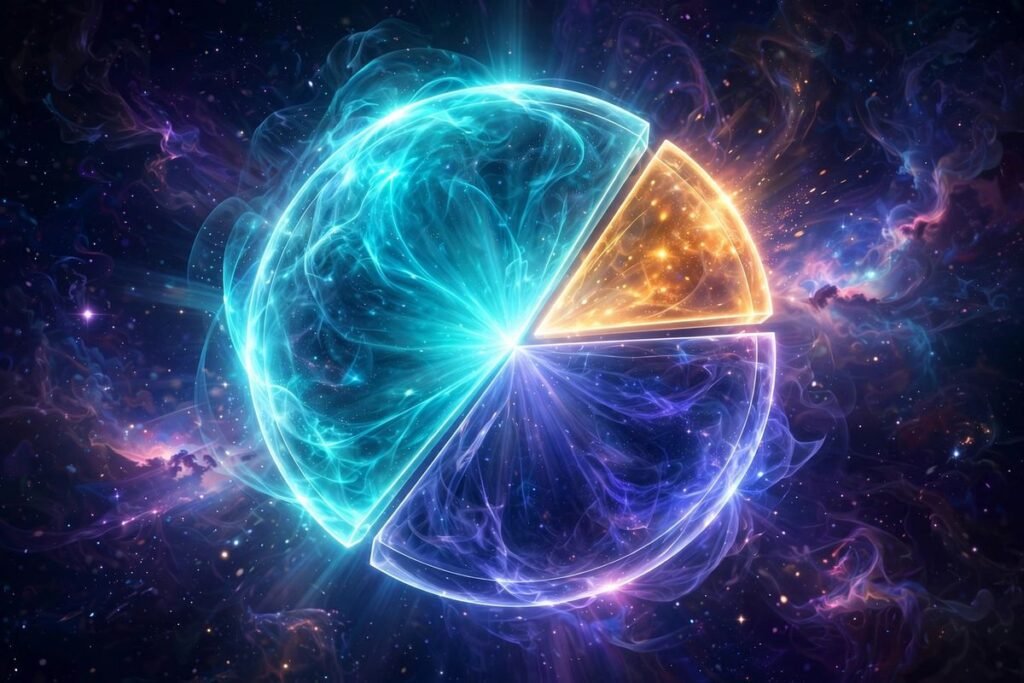
This is the part that genuinely bends the mind. According to the standard model of cosmology — called Lambda-CDM (Lambda Cold Dark Matter) — the energy budget of the universe breaks down like this:
| Component | Share of the Universe | What It Includes |
| Dark energy | ~68–70% | The unknown force accelerating cosmic expansion |
| Dark matter | ~27% | Invisible matter detected through its gravity |
| Ordinary matter | ~5% | Stars, planets, gas, dust, you, me — everything made of atoms |
Read that again. Everything you’ve ever seen — every star in every telescope image, every planet, every person who has ever lived — is less than one-twentieth of what’s actually out there. The other 95% is dark, and dark energy is the lion’s share of it.
And here’s the kicker: dark energy’s share is growing. Unlike matter, which gets diluted as space expands (the same amount of stuff spread over a bigger volume), dark energy’s density stays roughly constant as the universe grows. That means as the universe expands, there’s effectively more total dark energy than before. Matter is losing this contest, and the gap only widens with time.
Is Dark Energy the Same as Dark Matter?
This is one of the most common points of confusion, so let’s clear it up. The names sound similar, and both are invisible, but they are completely different things that do completely opposite jobs.
| Feature | Dark Energy | Dark Matter |
| Effect | Pushes the universe apart; drives expansion faster | Pulls things together; holds galaxies together with gravity |
| Share of the universe | ~68–70% | ~27% |
| Evidence | Accelerating expansion of the universe (supernovae, DESI, galaxy surveys) | Galaxy rotation speeds, gravitational lensing, galaxy cluster behavior |
| How long known | Since 1998 | Since the 1930s (Vera Rubin’s galaxy work in the 1970s made it mainstream) |
| Nature | Completely unknown — could be a property of space itself | Unknown, but thought to be some undiscovered type of particle |
Think of it this way: dark matter is the universe’s scaffolding — the invisible structure that keeps galaxies from flying apart as they spin. Dark energy is the universe’s accelerator pedal — the force pushing everything apart faster and faster. They’re teammates in one sense (both are dark), and rivals in another (one builds structure, the other stretches it).
What Is the Cosmological Constant?
Of all the explanations for dark energy, the simplest one has the best name and the strangest backstory: the cosmological constant, written as the Greek letter Lambda (Λ).
Back in 1917, Albert Einstein was building his theory of general relativity. His equations predicted a universe that was either expanding or contracting — but at the time, everyone “knew” the universe was static, unchanging, eternal. So Einstein added a fudge factor to his equations, a term that would balance gravity out and keep everything still. He called it the cosmological constant.
Then Edwin Hubble discovered that the universe was expanding after all, and Einstein reportedly called the cosmological constant his “biggest blunder.” He scrapped it.
Fast-forward to 1998. The universe isn’t just expanding — it’s accelerating. And cosmologists realized that Einstein’s discarded fudge factor was, mathematically, a perfect description of dark energy. In the simplest version of the idea, the cosmological constant is an energy inherent to empty space itself — vacuum energy. Even a perfect vacuum, with no matter at all, would carry a tiny amount of this repulsive energy. And because there’s so much empty space, those tiny amounts add up to something universe-sized.
This is the default assumption in the Lambda-CDM model, and it fits the observations extremely well. But it comes with a problem — a gigantic one. When quantum physicists try to calculate how much energy empty space should have, their answer is absurdly, ridiculously larger than what’s observed: off by a factor of about 10^120. That’s a 1 followed by 120 zeros. It is often called the worst prediction in the history of physics. If you want to understand why physicists are uncomfortable with the cosmological constant, there it is.
What Is Quintessence?
Because the cosmological constant is so awkward, some physicists have proposed a more dynamic alternative: quintessence. (The name comes from the ancient idea of a “fifth element,” alongside earth, air, fire, and water.)
Quintessence imagines dark energy not as a fixed property of space, but as a kind of invisible field that fills the universe — something like an energy that can change over time. If the cosmological constant is a concrete floor, quintessence is more like a slowly flowing river: it has a strength, and that strength might have been different in the past and might be different in the future.
Why does this matter? Because a changing dark energy would leave fingerprints in the history of cosmic expansion. If the acceleration of the universe has sped up or slowed down over billions of years in ways that don’t match a constant value, that’s a signature of quintessence — or something like it. And as we’ll see, some recent observations have made this idea suddenly very interesting.
Could Gravity Itself Be the Answer?
There’s a third possibility, and it’s the wildest one: maybe there’s no dark energy at all. Maybe Einstein’s theory of gravity — general relativity — just doesn’t work correctly at the largest scales.
General relativity has been tested beautifully within our solar system and in extreme environments like black holes. But on scales of billions of light-years, it has never been directly tested. Some theories of “modified gravity” suggest that gravity itself might behave differently over cosmic distances, producing an apparent acceleration without any dark energy component.
This is the outsider candidate. Most cosmologists lean toward dark energy being real, but the modified-gravity camp makes an important point: you shouldn’t invent a whole new mysterious substance before checking whether your existing theory might need a tweak. It’s a healthy scientific skepticism, and it’s one of the things current surveys are trying to test.
How Are Scientists Studying Dark Energy Today?
We can’t catch dark energy in a jar. So astronomers study it the way detectives study a case: by mapping its effects across cosmic history.
One of the biggest tools doing this right now is the Dark Energy Spectroscopic Instrument, or DESI, mounted on a telescope at Kitt Peak National Observatory in Arizona. Led by Lawrence Berkeley National Laboratory with hundreds of researchers worldwide, DESI is building an enormous three-dimensional map of the universe — measuring precise distances to tens of millions of galaxies and quasars. By comparing how the universe expanded at different points in its history, DESI can trace how dark energy has behaved over billions of years.
Another major project is the Dark Energy Survey, which spent six years photographing hundreds of millions of galaxies in the southern sky, measuring how their light is bent by gravity (weak gravitational lensing) and mapping the structure of the cosmos in exquisite detail.
Together, these surveys are doing something remarkable: they’re turning dark energy from a single mysterious number into a history — a story of how the universe’s acceleration has evolved. For readers who enjoy following these cosmic measurement campaigns, there are more deep-space features like this one at Daily Orvix.
Is Dark Energy Changing or Weakening?
Here is where the story gets genuinely exciting — and genuinely uncertain.
In 2025, early results from DESI suggested something provocative: dark energy might not be constant after all. The data hinted that its strength could be changing over time — possibly weakening. If true, that would be the biggest cosmological discovery since 1998 itself, and it would point toward quintessence-style theories rather than a simple cosmological constant.
But science moves carefully, and follow-up analyses have painted a more complicated picture. Later studies using the same DESI data showed that the apparent signal of changing dark energy is fragile — it depends on how the data is analyzed, and different approaches give different answers. Some analyses still favor a constant dark energy; others lean toward change. As of now, the question is open, and cosmologists are eagerly awaiting more data.
This is a good moment to appreciate how science actually works. Headlines love a revolution, but the real work is slow, careful, and honest about uncertainty. DESI is still collecting data, and the full survey should settle the question — or at least sharpen it dramatically. The coming years may rewrite this section of the story. Astronomy enthusiasts tracking these developments can find related cosmic insights at A Daily Insight 360.
What Does Dark Energy Mean for the Fate of the Universe?
This is the big one — the question dark energy was born to answer, and the one it still hasn’t fully answered.
If dark energy is a constant (the cosmological constant), the universe will keep accelerating forever. Galaxies will drift farther and farther apart. Eventually, the universe will become cold, dark, and empty — a scenario cosmologists call the Big Freeze or heat death. Stars will burn out over trillions of years, no new ones will form, and the cosmos will settle into a dark, frozen stillness. It’s a bleak picture, but it’s the current best guess.
If dark energy strengthens over time, things get weirder. In the Big Rip scenario, the acceleration becomes so violent that it eventually overwhelms gravity, then the forces holding atoms together, then atoms themselves. The universe would literally tear itself apart. This is speculative — there’s no strong evidence for it — but the equations allow it.
And if dark energy weakens over time, as some DESI hints suggest might be possible? Then the acceleration could slow, stop, or even reverse. The universe’s fate would be back on the table entirely. A weakening dark energy might even allow gravity to regain the upper hand someday, reopening the possibility of a universe that eventually contracts.
We don’t know. And that, honestly, is wonderful. The fate of everything that exists hinges on a mystery we’ve only known about for a few decades.
Frequently Asked Questions: What Is Dark Energy in Space?
Can we see dark energy directly?
No — and we may never be able to. Dark energy doesn’t emit, absorb, or reflect light. We can only observe its effects: the accelerating expansion of the universe, the way galaxies are distributed across cosmic time, and how the large-scale structure of the cosmos has evolved. It’s like feeling the wind: you can’t see it, but you can watch what it does to the trees.
Is dark energy dangerous to Earth or the solar system?
Not in any way that matters to us. Dark energy’s effects only become significant over enormous, cosmic distances — millions to billions of light-years. Within galaxies, solar systems, and certainly on Earth, gravity is overwhelmingly stronger. The space between atoms, between planets, between stars in our galaxy — none of that is being stretched in any meaningful way.
What’s the difference between dark energy and the Big Bang?
The Big Bang is the origin event — the hot, dense beginning of the universe about 13.8 billion years ago, followed by its expansion. Dark energy is something else entirely: it’s the mysterious force that, billions of years later, started making that expansion accelerate. Think of the Big Bang as the initial push, and dark energy as a second engine that switched on later and is still running.
Who discovered dark energy?
The discovery of the accelerating universe was announced in 1998 by two independent teams: the Supernova Cosmology Project, led by Saul Perlmutter, and the High-z Supernova Search Team, led by Brian Schmidt and Adam Riess. All three leaders shared the 2011 Nobel Prize in Physics. The term “dark energy” itself was coined a bit earlier, in 1998, by cosmologist Michael Turner.
Could dark energy be explained without new physics?
Possibly. The modified-gravity camp argues that Einstein’s general relativity might need updating at cosmic scales, which could produce the appearance of acceleration without any dark energy. So far, though, the simplest and most successful explanation remains that dark energy is real — it’s the alternatives that struggle to fit all the data.
Will we ever know what dark energy is?
There’s genuine reason for optimism. Surveys like DESI and the Dark Energy Survey, plus upcoming missions like the Vera Rubin Observatory’s massive sky survey and the Euclid space telescope, will map the universe’s expansion history in unprecedented detail. Within the next decade, we may learn whether dark energy is constant, changing, or something else entirely. Knowing its true nature could take longer — but we’re asking the right questions now.
Does dark energy prove the universe is infinite?
No. Dark energy tells us about the expansion rate, not the shape or size of the universe. The universe could be infinite or finite — dark energy doesn’t settle that. What it does tell us is that the expansion is accelerating, which strongly affects the universe’s future, whatever its size turns out to be.
Final Thoughts
Dark energy is a humbling reminder of how little we know. A century after Einstein, with telescopes that can see across billions of light-years, we have mapped the cosmos in extraordinary detail — and discovered that we can’t explain 70% of it. That’s not a failure of science. That’s science doing exactly what it’s supposed to do: showing us the edges of our knowledge and daring us to push past them.
The next decade will be decisive. As DESI completes its map and new observatories come online, we’ll find out whether dark energy is the constant vacuum energy Einstein scribbled into his equations, a shifting cosmic field, or a clue that our understanding of gravity itself is incomplete. Whatever the answer turns out to be, it will reshape our picture of reality as thoroughly as 1998 did.
So the next time you look up at the night sky, remember: the stars you see are the minority. Most of the universe is invisible, pushing everything apart, and waiting for us to figure it out. That’s dark energy — the greatest mystery in science, hiding in plain sight across the entire sky.
Read Also: Zola Wedding Platform (2026 Guide): What It Is, How It Works, And Whether It’s Worth Using
