
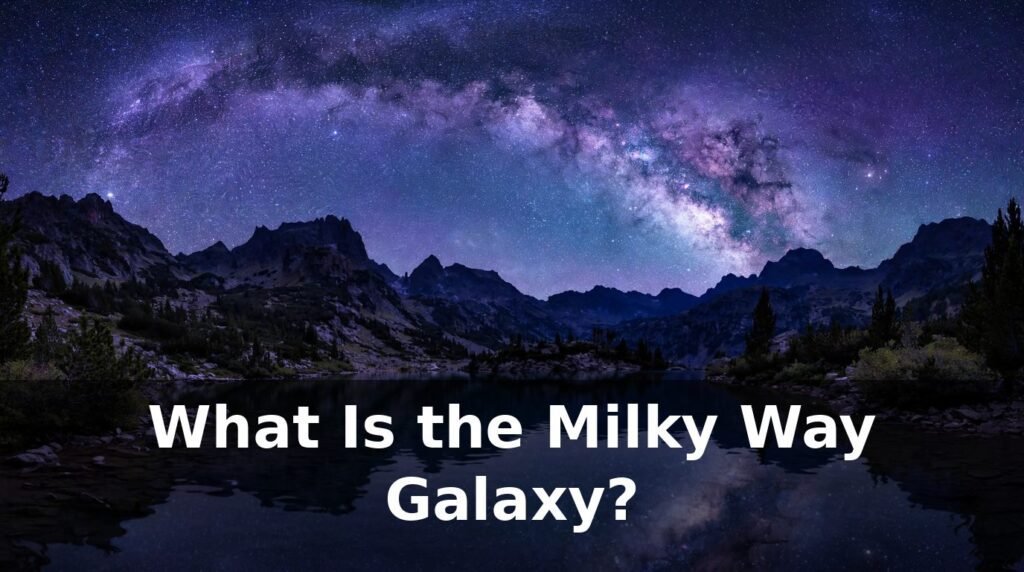
What is the Milky Way galaxy? It is the barred spiral galaxy we call home. On a truly dark night, far from city lights, you can look up and see a faint, milky band of light stretching across the sky, like someone spilled a little milk across the stars. That glowing band is our home: the Milky Way galaxy, seen from the inside.
Every star you can see with your eyes alone belongs to this one galaxy, including the Sun and every planet and comet in our solar system. When you look at that milky band, you are looking along the flat disc of the galaxy you live in, toward its crowded heart.
The short answer: The Milky Way is a barred spiral galaxy, roughly 100,000 light-years across, containing hundreds of billions of stars. Our solar system sits in one of its spiral arms, about 26,000 light-years from the centre, orbiting a supermassive black hole called Sagittarius A*.
More Information: What Is a Supermoon? Meaning, Causes and When to See One
What Does the Milky Way Look Like from Earth?
From Earth, the Milky Way looks like a pale, cloudy river of light across the night sky, brightest toward Sagittarius in the southern summer sky, because that is the direction of the galactic centre.
The band is not smooth. Dark patches of gas and dust cut across it, blocking the light behind them. The most famous is the Great Rift, a long dark lane through Cygnus and Aquila. The bright knots are dense star clouds, where thousands of stars crowd together.
Most people today have never seen this view. Light pollution washes the faint band out of the sky, and from a city it may be completely invisible, even on a clear night. You need a genuinely dark sky, which is why many people only meet it properly on holiday or on a mountain.
When you do see it, the sight is hard to forget. You are looking at the combined light of countless distant stars, too faint to pick out one by one. Binoculars break the band apart into star after star.
Once you know what is the milky way galaxy, that pale band makes sense: you are looking along its flat disc.
What Type of Galaxy Is the Milky Way?
The Milky Way is a barred spiral galaxy: a flat, spinning disc of stars, gas and dust, with arms winding out from the middle, plus a straight bar of stars running through the centre, with the arms starting from the ends of the bar. Astronomers now believe the Milky Way has this bar, which is why it carries that classification.
The arms are not solid objects. They are more like traffic jams in space, with stars, gas and dust moving in and out of them. New stars are often born inside the arms, where gas is squeezed together.
What is the milky way galaxy? A barred spiral disc of stars, gas and dust.
How Many Spiral Arms Does the Milky Way Have?
This is one of the hardest questions in astronomy, because we are mapping the galaxy from the inside, like drawing a map of a forest while standing in the middle of it.
The current picture is two main arms, the Perseus Arm and the Scutum-Centaurus Arm, plus smaller arms and spurs between them. The Sun sits in a smaller feature called the Orion Arm, or Orion Spur, between the Perseus and Sagittarius Arms. Different studies count the arms slightly differently, and the map is still being refined.
Why Is It Called the Milky Way?
The name is very old. The ancient Greeks called it the galaxias kyklos, the milky circle, and the Romans translated this into Latin as Via Lactea, the milky way. The word galaxy itself comes from the same Greek root for milk. The name has stuck because it still fits what you see.
How Big Is the Milky Way Galaxy?
The Milky Way is huge by any human measure. A light-year is the distance light travels in one year, about 9.46 trillion kilometres. Astronomers use it because kilometres become useless at this scale.
Most estimates put the visible disc at roughly 100,000 light-years across, though some studies suggest 150,000 or even 200,000 light-years when faint edge stars are counted. The exact edge is fuzzy, because galaxies have no sharp borders. The disc is roughly 1,000 light-years thick, and it sits inside a much larger halo of old stars and dark matter.
| Feature | Approximate value |
|---|---|
| Type | Barred spiral galaxy |
| Diameter of the disc | About 100,000 light-years |
| Thickness of the disc | About 1,000 light-years |
| Number of stars | 100 to 400 billion |
| Age | About 13.6 billion years |
| Distance from the Sun to the centre | About 26,000 light-years |
| Object at the centre | Sagittarius A*, a supermassive black hole |
| Time for the Sun to orbit the centre | About 225 to 250 million years |
At the speed of light, it would take about 100,000 years to cross the disc. A spacecraft is far slower. The Milky Way is our neighbourhood, but on a scale we can barely grasp.
That is the scale of what is the milky way galaxy: a disc light needs 100,000 years to cross.
How Many Stars Are in the Milky Way?
Nobody knows the exact number. The best estimates fall between 100 billion and 400 billion stars, most commonly around 200 to 300 billion, and the range reflects real uncertainty, not sloppy counting.
Counting stars in our own galaxy is difficult because we are inside it. Dust blocks our view of large parts of the disc, and many stars are small, faint red dwarfs that are hard to spot at a distance. Astronomers estimate the total by counting stars in regions we can see well and modelling how they are distributed.
Most stars in the Milky Way are smaller and dimmer than the Sun. Red dwarfs, cool, faint and very long-lived, are by far the most common type. Bright, massive stars are rare, and they live fast and die young. Our Sun is a fairly average star, a yellow dwarf, in the middle of the range.
Where Is the Sun Inside the Milky Way?
The Sun is neither at the centre nor at the edge. It sits about two-thirds of the way out, roughly 26,000 light-years from the galactic core, in a fairly quiet part of the disc, in the Orion Arm.
Being in a quiet suburb has advantages. The centre is crowded, with stars packed close together and frequent bursts of high-energy radiation. The outer edge is sparse and poor in the heavier elements rocky planets need. Our middle-ground position is calm enough for a stable solar system to last for billions of years.
Picture what is the milky way galaxy as a city of stars, with the Sun in a quiet suburb.
The Sun is not standing still. It orbits the centre with the rest of the stars in the disc, one full orbit taking about 225 to 250 million years, a galactic year. The Sun has made roughly 18 to 20 orbits since it was born, about 4.6 billion years ago.
As it circles the centre, the Sun also bobs gently up and down through the plane of the disc, crossing it roughly every 30 million years.
What Is at the Centre of the Milky Way?
At the centre sits Sagittarius A*, a supermassive black hole with a mass of about 4 million Suns, squeezed into a region smaller than the orbit of Mercury. Astronomers often shorten its name to Sgr A*.
You cannot see Sagittarius A* directly, because no light escapes from inside a black hole. But a small group of stars orbits extremely close to the centre at enormous speeds, and their orbits can only be explained by a huge, compact mass at the middle. In 2022, the Event Horizon Telescope released the first image of it, a glowing ring of hot gas around a dark shadow.
The centre is hidden from our eyes by thick clouds of dust. Radio waves, infrared light and X-rays pass through the dust more easily, so telescopes working in those wavelengths have revealed a busy region packed with old stars and gas clouds.
How Old Is the Milky Way — and How Did It Form?
The Milky Way is about 13.6 billion years old, almost as old as the universe itself, which is about 13.8 billion years old, making it one of the earliest galaxies to form.
Galaxies like ours did not appear fully formed. They grew, as small clumps of gas and dark matter came together and the young Milky Way pulled in smaller galaxies and clouds of gas, leaving streams of stars still orbiting in the halo today.
One important merger happened around 8 to 11 billion years ago, when a smaller galaxy now called Gaia-Enceladus crashed into the young Milky Way, stirring up the disc and adding stars to the halo. Astronomers can still pick out those stars today, because they move differently from the stars born here. The Sun, born about 4.6 billion years ago, is a relatively late arrival.
What Is the Milky Way Made Of?
Stars are the most visible part of the Milky Way, but they hold only a small part of its total mass. The galaxy is made of several ingredients:
- Stars: Hundreds of billions, from faint red dwarfs to rare blue giants. They hold most of the light we see, but only a small share of the total mass.
- Gas and dust: Clouds of hydrogen and helium spread through the disc. This is the raw material for new stars, and it also blocks our view in places, creating the dark lanes in the band.
- Dark matter: An invisible form of matter whose gravity holds the galaxy together. Without it, the outer stars would fly apart, because they move faster than the visible mass alone could hold. It is thought to make up most of the galaxy’s mass.
- The interstellar medium: The thin gas and dust between the stars, threaded with magnetic fields and high-energy particles called cosmic rays.
More Information: Part of Your World Lyrics: Meaning and Full Song Guide
Can You See the Milky Way from Earth?
Yes, you can, and it is one of the great sights in astronomy. You do not need a telescope, just dark skies and a little patience. It is easiest to see in summer in the Northern Hemisphere, when the bright central region rises high in the south after dark.
Here is how to give yourself the best chance:
- Get away from lights. Drive at least an hour from a town or city if you can. The darker the sky, the brighter the band.
- Check the Moon. A bright Moon washes out the Milky Way just like streetlights do. Pick a night near the new Moon, or go out after the Moon has set.
- Let your eyes adapt. It takes about 20 to 30 minutes in the dark for your eyes to reach full sensitivity. Avoid phone screens.
- Look south in summer. In the Northern Hemisphere, face south after dark in June, July or August and look for the glowing band running through Sagittarius and Scorpius.
- Give it time. Your eyes will pick out more detail the longer you look.
Will the Milky Way Collide with Andromeda?
Yes, it will, but not for a very long time. The Andromeda galaxy, our nearest large neighbour, is about 2.5 million light-years away and is moving toward us at roughly 110 kilometres per second. In about 4 to 5 billion years, the two galaxies will meet and begin to merge.
The word collide sounds violent, but galaxies are mostly empty space, so very few stars will actually hit each other. Instead the two galaxies will pass through each other, pull each other out of shape, and eventually settle into a single, larger galaxy, sometimes called Milkomeda. The Sun will probably survive, though its orbit will change.
| Feature | Milky Way | Andromeda (M31) |
|---|---|---|
| Type | Barred spiral | Spiral |
| Diameter | About 100,000 light-years | About 220,000 light-years |
| Number of stars | 100 to 400 billion | Around 1 trillion |
| Distance from Earth | We live inside it | About 2.5 million light-years |
| Visible to the naked eye? | As a band across the sky | As a faint smudge in Andromeda |
Andromeda is the larger of the two, with roughly twice as many stars and a wider disc. It is also the most distant object most people can see with their eyes alone, a faint fuzzy patch in the constellation Andromeda on a dark autumn night. That tiny smudge is an entire galaxy, similar to our own.
Frequently Asked Questions
What is the Milky Way galaxy in simple terms?
The Milky Way is the galaxy we live in: a huge, spinning collection of hundreds of billions of stars, plus gas, dust and dark matter, held together by gravity. From Earth, we see it as a milky band of light, because we are looking along its flat disc from the inside.
That is the simplest answer to what is the milky way galaxy, and this guide fills in the details.
How many stars are in the Milky Way?
Estimates range from 100 billion to 400 billion stars, most commonly around 200 to 300 billion. The true number is still uncertain, because dust hides parts of the galaxy and many stars are too faint to count directly.
How big is the Milky Way galaxy?
The visible disc is roughly 100,000 light-years across, though some studies suggest 150,000 to 200,000 light-years when faint outer stars are counted. It is only about 1,000 light-years thick, and light would take about 100,000 years to cross it.
Where is the Sun in the Milky Way?
The Sun sits about 26,000 light-years from the galactic centre, in the Orion Arm. It orbits the centre once every 225 to 250 million years, a galactic year.
What is at the centre of the Milky Way?
A supermassive black hole called Sagittarius A*, with a mass of about 4 million Suns, surrounded by a dense bulge of old stars. The centre is hidden from visible light by dust, but radio and infrared telescopes can see through it.
Can you see the Milky Way with the naked eye?
Yes, from a dark sky on a clear, moonless night, when it looks like a faint, cloudy band of light. It is invisible from most cities because of light pollution, and summer nights in the Northern Hemisphere offer the best view.
Will the Milky Way collide with Andromeda?
Yes, in about 4 to 5 billion years. The two galaxies are moving toward each other and will eventually merge into one larger galaxy. Few stars will collide directly, because the space between stars is so vast.
Final Thoughts
The Milky Way is easy to take for granted because it is always there, above us every night. Yet it is one of the most remarkable things we know: a barred spiral of hundreds of billions of stars, roughly 100,000 light-years across, with a supermassive black hole at its heart.
You do not need a telescope or a degree in astronomy to appreciate it. You need a dark sky, a clear night, and a few minutes to look up. Find the milky band and remember what you are seeing: every faint point of light in that glow is a star, and one of them, a fairly ordinary yellow star in a quiet part of the galaxy, is the one that lights your days.
That is the Milky Way. It is not a distant wonder. It is home.
So the next time you look up, remember what is the milky way galaxy: not a distant wonder, but home.
Read Also: When Is the Next Meteor Shower? Peak Dates for 2026
