
Look up at the night sky over a few weeks and the Moon seems to be playing a slow trick on you. One night it is a thin silver sliver. A week later it is a fat, glowing disc. Then it shrinks again, night after night, until it vanishes altogether. If you have ever wondered why does the moon have phases, you are asking one of the oldest questions in astronomy — and the answer is far simpler, and far more elegant, than most people expect.
The Moon is not changing shape at all. It is not growing, shrinking, or being eaten away. What changes is how much of its sunlit half we can see from Earth. That is the whole secret, and once you picture it, you will never look at the Moon the same way again.
The short answer: Why does the moon have phases? Because the Moon orbits Earth while sunlight always lights exactly one half of it. As the Moon moves around us, we see different amounts of that lit half — a sliver, a half, a full disc, then back again — completing the cycle every 29.5 days.
Why Does the Moon Have Phases? The One Simple Cause
Three things work together to create the phases, and you need all three in your head at once. First, the Sun always lights one half of the Moon, just as it always lights one half of Earth. There is a day side and a night side on the Moon at every moment. Second, the Moon orbits Earth, completing a lap roughly once a month. Third, we watch all of this from Earth, from one fixed viewpoint that moves only slowly.
As the Moon travels around its orbit, the angle between the Sun, the Moon, and Earth keeps changing. When the Moon sits between Earth and the Sun, its lit half faces away from us, so we see darkness: the new moon. When the Moon moves around to the far side of Earth, its lit half faces us fully: the full moon. In between, we see a sliding scale of partial light — crescents and quarters and gibbous shapes — because we are looking at the lit half from an angle.
A useful way to picture it is to hold a ball next to a lamp in a dark room. Stand with the lamp behind the ball and you see a dark ball. Walk around so the lamp lights the side facing you and the ball looks full and bright. The ball never changed. Your angle did. The Moon works exactly the same way, with the Sun as the lamp and Earth as your viewing spot.
The Moon Does Not Make Its Own Light
This surprises a lot of people, but the Moon is not a lamp in the sky. It is a lump of rock, about 3,474 kilometres across, and it shines only because it reflects sunlight. On average, the Moon’s surface reflects only about 7 to 12 percent of the sunlight that hits it — roughly as reflective as an old asphalt road or a lump of coal.
So why does it look so brilliant at night? Because the Sun is astonishingly bright, and the night sky is astonishingly dark. Even a dim reflector stands out against blackness. The full moon is the brightest object in the night sky by an enormous margin, even though it is really just a dark grey rock catching the Sun’s light and throwing a little of it our way.
And here is the key point for understanding phases: at any moment, exactly half the Moon is lit by the Sun and half is dark. That never changes. What changes is how much of the lit half happens to be turned toward Earth. The phases are a viewing effect, not a change in the Moon itself.
The 8 Phases in Order
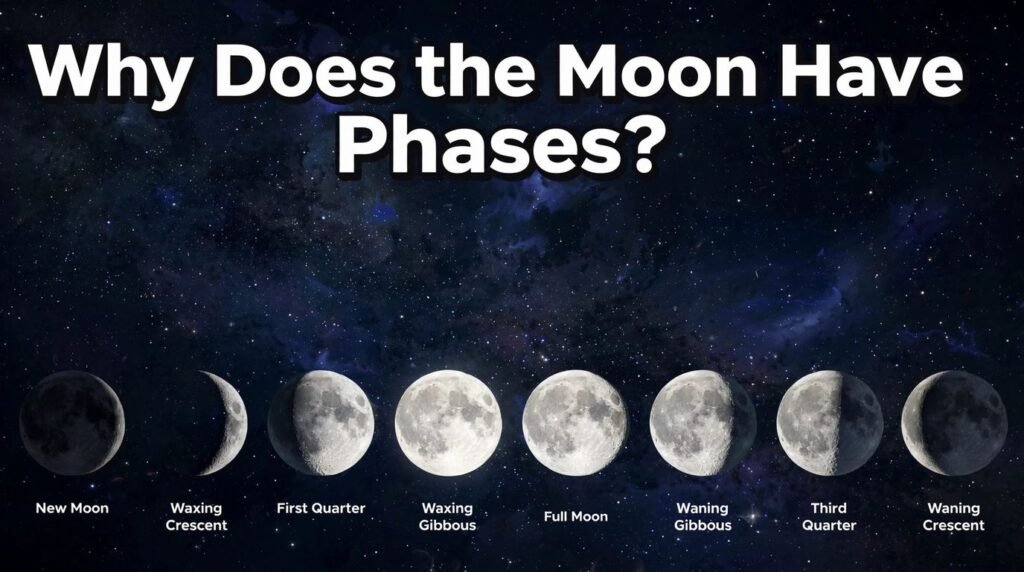
Astronomers divide the cycle into eight named phases. They run in the same order every month, like a slow, reliable clock in the sky.
| Phase | What you see | Roughly when |
|---|---|---|
| New Moon | Dark — the lit side faces away from us | Day 1 |
| Waxing Crescent | A thin sliver of light, growing nightly | Days 2–6 |
| First Quarter | Right half lit (in the Northern Hemisphere) | Day 7–8 |
| Waxing Gibbous | More than half lit, still growing | Days 9–13 |
| Full Moon | The whole face lit | Day 14–15 |
| Waning Gibbous | More than half lit, shrinking | Days 16–20 |
| Last Quarter | Left half lit (in the Northern Hemisphere) | Day 21–22 |
| Waning Crescent | A thin sliver, shrinking toward darkness | Days 23–29 |
“Waxing” means the lit part is growing, “waning” means it is shrinking. “Gibbous” is the word for a Moon that is more than half lit but not full — it comes from a Latin word for hump, because the shape looks humped. Once you know those three words, you can name any Moon you see.
The two quarter phases confuse people most. “First Quarter” and “Last Quarter” do not mean the Moon looks like a quarter of a disc. They mean the Moon is one quarter of the way through its cycle, or three quarters through it. At both quarter phases, we actually see half the Moon lit. The name describes the Moon’s position in its orbit, not the shape in the sky.
Why Does the Moon Have Phases That Change Every Night?
The Moon moves. That sounds obvious, but it is the whole reason the phases shift from night to night. In its orbit, the Moon moves about 12 degrees across the sky each day relative to the Sun’s position. That daily shift changes the Sun-Moon-Earth angle just enough that a little more, or a little less, of the lit half turns toward us.
This is why the Moon does not just jump from crescent to full. The change is gradual and continuous. Each night, the terminator — the line dividing light from dark on the Moon’s face — creeps a little further across. If you photograph the Moon at the same time for a month and flip through the pictures, you can watch the light sweep across it like a slow tide.
It also explains why the Moon rises about 50 minutes later each day. The Moon has moved along its orbit, so Earth has to rotate a little further before your part of the world turns to face it again. Moonrise, moonset, and phase are all the same motion seen from different angles.
How Long Does the Whole Cycle Take?
The full cycle of phases — from one new moon to the next — takes about 29.5 days. Astronomers call this the synodic month. It is the month our calendars are loosely based on, and it is why many traditional calendars, including the Islamic and Hebrew calendars, are lunar.
But there is a subtlety. The Moon actually completes one orbit around Earth in about 27.3 days. The difference comes from the fact that Earth is moving too. While the Moon laps Earth, Earth has travelled about a twelfth of the way around the Sun, so the Moon has to travel a little extra — about 2.2 days’ worth — to get back to the same angle with the Sun and show the same phase again.
So if someone asks how long a Moon cycle is, both answers are right in different senses: 27.3 days to go around Earth, 29.5 days to repeat its phases. The 29.5-day figure is the one that matters when you are watching the sky.
Why Do We Always See the Same Side of the Moon?
Here is another puzzle that falls out of the same story. No matter the phase, we always see the same face of the Moon — the familiar pattern people call the Man in the Moon. The far side, sometimes wrongly called the dark side, is not dark at all; it gets just as much sunlight. We simply never see it from Earth.
The reason is tidal locking. Billions of years ago, the Moon spun faster, but Earth’s gravity tugged unevenly on it and slowed its rotation until its spin period matched its orbital period exactly. Now the Moon rotates once in the same time it takes to orbit Earth once, about 27.3 days, so the same hemisphere always faces us. It is like a dancer who always faces her partner while circling the floor.
This is also why the phases look the way they do. Because the Moon’s rotation is locked, the lit half sweeps around in step with the orbit, and our view of it changes in that smooth, predictable monthly rhythm.
Why Isn’t There an Eclipse Every Month?
If the new moon passes between Earth and the Sun, and the full moon passes behind Earth, you might expect a solar eclipse every new moon and a lunar eclipse every full moon. That would be spectacular — and it does not happen, because the Moon’s orbit is tilted.
The Moon’s path around Earth is tilted about 5 degrees compared to Earth’s path around the Sun. Most months, the new moon passes slightly above or below the Sun from our viewpoint, so its shadow misses Earth. And most full moons pass slightly above or below Earth’s shadow, so they stay bright. Only when the Moon happens to cross the exact plane of Earth’s orbit at the right moment — during what astronomers call eclipse season — do the shadows line up and an eclipse occurs.
So eclipses are special cases of phases, not separate phenomena. A solar eclipse is a new moon that lines up perfectly. A lunar eclipse is a full moon that drifts into Earth’s shadow. The tilt that prevents monthly eclipses is also the reason the phases themselves are so regular and reliable.
What Is the Difference Between a Phase and an Eclipse?
People mix these up, so it is worth being precise. A phase is about how much of the Moon’s lit half we see, and it happens every night of every month. An eclipse is about shadows: the Moon’s shadow falling on Earth (solar eclipse) or Earth’s shadow falling on the Moon (lunar eclipse). Eclipses happen only a few times a year.
There is one beautiful exception that ties them together. During a total lunar eclipse, the full moon does not vanish. It turns a deep coppery red, because Earth’s atmosphere bends sunlight around the planet and onto the Moon, filtering out the blue light. That red glow — the famous blood moon — is sunlight that has passed through every sunrise and sunset on Earth at once. It is a phase, an eclipse, and an atmospheric light show all in one.
Can Moon Phases Affect Tides, Farming, or Sleep?
The Moon’s phases do not cause the tides — its gravity does, and that works in every phase. But the phases do mark the times when tides are strongest and weakest. At new and full moons, the Sun, Moon, and Earth line up, and their gravitational pulls combine to make spring tides, the highest high tides and lowest low tides. At the quarter moons, the Sun and Moon pull at right angles, partly cancelling each other, and we get neap tides, the smallest tidal range.
As for farming, planting by the Moon is an old tradition in many cultures, and some gardeners still swear by it. There is little solid scientific evidence that phases change how seeds grow, though the extra moonlight around the full moon certainly helped farmers work late before electric light. And the idea that full moons cause strange behaviour or sleeplessness? Large studies have found no reliable effect. The full moon is bright, and bright nights can disturb light sleepers — but that is the light, not the phase itself.
What the phases genuinely affect is us as skywatchers. Around the new moon, the sky is darkest, and it is the best time to see faint stars, the Milky Way, and meteor showers. Around the full moon, the sky is washed with light, and faint objects disappear. Astronomers plan their observing around the lunar cycle for exactly this reason.
Frequently Asked Questions
Why does the moon have phases instead of staying full all the time?
Because the Moon orbits Earth while sunlight lights only one half of it. We see a full moon only when the lit half faces Earth directly; at every other point in the orbit, we see the lit half at an angle, so part of it appears dark.
Why does the moon have phases that look different in the Southern Hemisphere?
The phases are the same, but the orientation is flipped. In the Southern Hemisphere, the Moon appears upside down compared to the Northern Hemisphere view, so a waxing moon lights up on the left instead of the right.
Why does the moon have phases but the Sun does not?
The Sun makes its own light, so it always looks like a full disc (apart from sunspots and eclipses). The Moon only reflects sunlight, so its appearance depends on the angle between the Sun, the Moon, and Earth.
How many moon phases are there?
There are eight named phases: new moon, waxing crescent, first quarter, waxing gibbous, full moon, waning gibbous, last quarter, and waning crescent. Between them, the Moon’s appearance changes continuously.
Why does the moon have phases every month and not every day?
The cycle follows the Moon’s orbit, which takes 29.5 days to repeat its angles with the Sun. The Moon moves about 12 degrees per day, so the visible change from one night to the next is small but noticeable.
Can you see moon phases during the day?
Yes. The Moon is often visible in daylight, especially around the first and last quarter phases, when it sits high in the sky while the Sun is up. It looks fainter than at night because the blue sky outshines it.
Does the far side of the Moon have phases too?
Yes — the far side goes through the same cycle, just in the opposite order. When we see a new moon, the far side is fully lit. When we see a full moon, the far side is dark. The phases are about sunlight angles, not about which side faces Earth.
Why does the moon have phases in simple terms?
In simple terms, why does the moon have phases? Because sunlight lights only half the Moon, and as the Moon orbits Earth we see different amounts of that lit half. That geometry is the whole answer to why does the moon have phases.
Why does the moon have phases that repeat every month?
Because the Moon’s orbit repeats every 29.5 days, the answer to why does the moon have phases follows that same monthly rhythm. Each lap changes the Sun-Moon-Earth angle in the same order, so the phases repeat.
Why does the moon have phases for beginners?
For beginners, why does the moon have phases? It helps to remember that the Moon is a ball lit from one side by the Sun. As it moves around Earth, the answer to why does the moon have phases becomes clear: we see a changing share of its lit side.
Why does the moon have phases in different shapes?
The shapes change because the viewing angle changes. When people ask why does the moon have phases in different shapes, the answer is the same geometry: a crescent, a half, and a full disc are all views of why does the moon have phases at different points in the orbit.
Why does the moon have phases and not a constant glow?
The Moon cannot glow constantly because it does not make its own light. So why does the moon have phases? Because the lit half turns toward and away from us, and that turning is why does the moon have phases change night after night.
Why does the moon have phases every 29.5 days?
The 29.5-day rhythm comes from the time it takes for the Sun-Moon-Earth angle to repeat. In other words, why does the moon have phases repeat monthly? Because that is how long the Moon needs to return to the same angle with the Sun, which is why does the moon have phases follow a monthly cycle.
Final Thoughts
Why does the moon have phases? Now you can answer it in one sentence: because the Moon circles Earth while the Sun lights only half of it, and we watch that lit half swing in and out of view over 29.5 days. It is not the Moon changing. It is geometry — sunlight, orbit, and viewpoint, playing out on the grandest scale, night after night, above all of us.
The next time you notice a crescent hanging in the evening sky, take a second to work out where the Sun must be, and which half of the Moon it is lighting. You will be reading the sky the way astronomers do — not just seeing the phase, but understanding it.
Read Also: HMO vs PPO: Which Health Plan Fits You Best in 2026?

1 Comment