
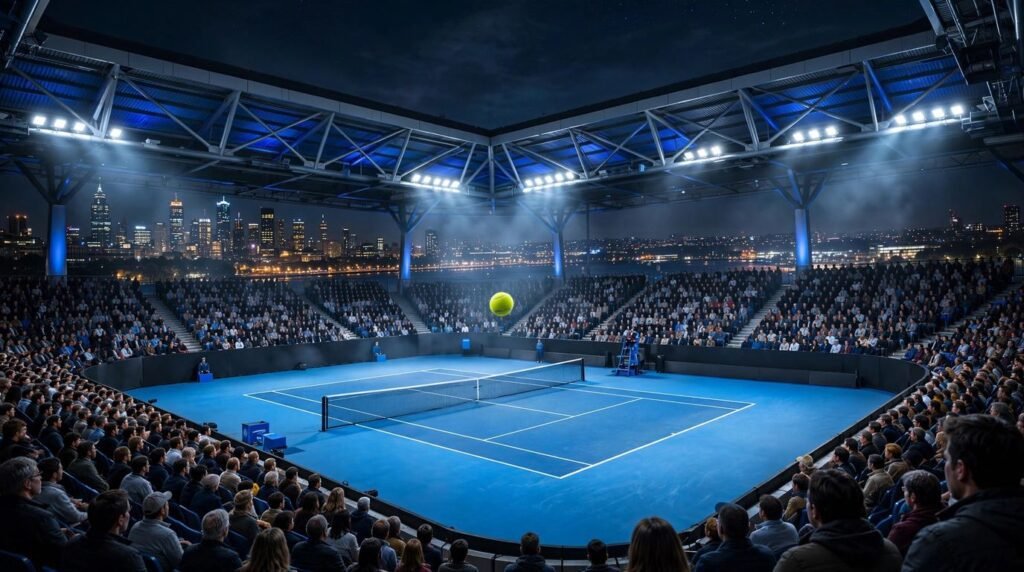
Every tennis season starts with a fortnight in Melbourne. The Australian Open is the first of the four Grand Slam tournaments, played each January at Melbourne Park — and it has a reputation the other three majors quietly envy: players call it the Happy Slam.
Whether you are planning a trip, setting your alarm for a night-session final, or just trying to understand what makes this tournament different from the other three majors, this guide covers it all: the 2027 dates, how the draw and scoring actually work, the records that define the event, a short history, and how to watch or attend.
Start with the big picture, then work down to the details. By the end, you will know the tournament like someone who has been going for years.
The short answer: The Australian Open is the first Grand Slam of the tennis year, held over roughly two weeks each January at Melbourne Park in Melbourne, Australia. The 2027 edition runs 11–31 January 2027, with the main singles draw starting 17 January. Men play best-of-five-set matches, women play best-of-three, and the champions are crowned on the final weekend.
What Is the Australian Open?
The Australian Open is one of the four Grand Slam tennis tournaments — the events that stand above everything else in the sport. The four majors are the Australian Open, the French Open, Wimbledon, and the US Open, and a Grand Slam title remains the unit by which tennis careers are measured.
That status is what gives the tournament its weight. Win all four majors across a career and you complete a Career Grand Slam, a club with very few members. Win all four in a single calendar year and you achieve the rarest feat in tennis. Every January, the road to both starts in Melbourne.
Tennis Australia runs the tournament, and the program reaches well beyond the two singles draws. Men’s and women’s doubles, mixed doubles, junior championships, and wheelchair events all share the schedule — which is part of why the fortnight feels like a festival built around tennis rather than just a tournament.
When Is the Australian Open 2027?
The next edition runs from 11 to 31 January 2027 at Melbourne Park. The tournament stretches across three weeks, and each week has its own character.
Opening Week runs from 11 to 16 January. This is the warm-up act: qualifying matches, open practice sessions where you can watch the stars train up close, kids’ events, and entertainment across the precinct. It is also the cheapest way to experience the tournament, and for many locals it is the best week of the three.
The main draw begins on 17 January and runs through 31 January. This is the championship fortnight — the 128-player singles draws, the doubles events, and the slow build toward the final weekend, when the women’s and men’s singles champions are crowned.
One practical note: the daily order of play is released progressively as results come in, so if you are planning around a specific player, check the schedule closer to the day rather than weeks out.
Where Is the Australian Open Played?

Melbourne Park has hosted the Australian Open since 1988 — its three main show courts all have retractable roofs.
The tournament lives at Melbourne Park, a dedicated tennis precinct on the edge of Melbourne’s city center. It has been the event’s home since 1988 — the year the tournament left grass behind and committed to hard courts.
Three show courts carry retractable roofs: Rod Laver Arena, the main stadium and the stage for both singles finals; Margaret Court Arena; and John Cain Arena. When rain hits or the heat spikes, the roofs close and the big matches carry on. For years, that was an advantage no other Grand Slam could match.
The courts themselves are blue GreenSet hard courts, in place since 2020. The surface plays medium-fast with a true, predictable bounce — one reason the tournament tends to reward complete, all-court players rather than one-trick specialists. Before GreenSet, the event used Rebound Ace from 1988 to 2007 and Plexicushion from 2008 to 2019.
How Does the Australian Open Draw Work?
The 128-player main draw
Both singles draws — men’s and women’s — begin with 128 players. It is single elimination: lose once and you are out. Seven consecutive wins take the title, which means the champion has beaten seven different opponents across two weeks.
That structure shapes the drama of the first week. The draw is fixed before play begins, so an early upset can blow open an entire section and hand an unexpected contender a clear path to the second week.
Seeding keeps the best apart — at first
Thirty-two players in each singles draw are seeded according to their world ranking. The seeds are spread through the draw so the top two cannot meet before the final, and the rest are protected from each other in the earliest rounds. After that, the draw is the draw.
This is where the “floaters” come in — unseeded players with dangerous games who can land anywhere. Every year, at least one big seed falls to a floater in the first few days, and the whole tournament reshuffles around the result.
Qualifying, wildcards, and lucky losers
Not everyone starts in the main draw. A qualifying event during Opening Week lets lower-ranked players fight for the last spots, with sixteen qualifiers earning their way into each singles draw. A handful of wildcards go to selected players — often Australians and promising juniors — at the organizers’ discretion.
And if a main-draw player withdraws late, a “lucky loser” takes the empty slot: the highest-ranked player to lose in the final round of qualifying. It is a strange, wonderful second chance, and lucky losers have made deep runs before.
How Does Scoring Work at the Australian Open?
Best of five for men, best of three for women
Men’s singles matches are best of five sets — first to three takes it. Women’s singles matches are best of three — first to two. A set goes to the first player to win six games with a two-game margin; at 6–6, a tiebreak decides it.
The difference matters more than it sounds. A five-set match can swing for four or five hours, and the longer format rewards physical endurance and the ability to reset mentally after dropping a set. The women’s format puts a premium on fast starts: there is simply less time to play your way into form.
The 10-point final-set tiebreak
When the deciding set reaches 6–6, there is no endless final set at the Australian Open. A 10-point tiebreak — first to ten points, winning by two — settles it. The tournament introduced this format in 2019, and the other three majors later aligned on the same rule, so every Grand Slam now finishes the same way.
Doubles, mixed doubles, and the rest of the program
Doubles events use shorter scoring than singles, with tiebreaks deciding tight sets and a match tiebreak in place of a full third set in mixed doubles. The junior and wheelchair championships follow the same basic scoring as the senior events, adapted to each competition.
If you are new to tennis scoring, the doubles matches of the first week are a friendly place to learn. They move fast, the tiebreaks arrive quickly, and the outer courts put you close enough to hear every call.
Who Holds the Australian Open Records?

The Australian Open champions lift the Norman Brookes Challenge Cup and the Daphne Akhurst Memorial Cup each January.
Some numbers at Melbourne Park are close to untouchable. These are the records that define the tournament’s history.
| Record | Holder | Mark |
|---|---|---|
| Most men’s singles titles | Novak Djokovic | 10 (2008, 2011–13, 2015–16, 2019–21, 2023) |
| Most women’s singles titles | Margaret Court | 11 |
| Most titles across all events | Margaret Court | 23 (singles, doubles, mixed) |
| Most men’s final defeats | Andy Murray | 5 runner-up finishes |
Novak Djokovic’s ten titles are the most any man has won at a single major, built across fifteen years of dominance in Melbourne. His run includes three separate streaks of three straight titles — and the city became his most reliable stage.
On the women’s side, Margaret Court’s eleven singles titles remain the benchmark, and her twenty-three titles across singles, doubles, and mixed doubles are the most anyone has ever collected at the event.
The trophies
The men’s champion lifts the Norman Brookes Challenge Cup. The women’s champion receives the Daphne Akhurst Memorial Cup, named for the five-time champion of the 1920s. Both are among the most photographed objects in Australian sport every January.
The current champions
Current tour listings name Carlos Alcaraz and Elena Rybakina as the reigning singles champions after the 2026 edition — Alcaraz’s Melbourne title completed his Career Grand Slam, per the tour’s 2027 season listings. They will arrive in January 2027 as the players everyone is chasing, though seedings, form, and the draw can redraw the picture completely before the first ball is struck.
How Did the Australian Open Begin?
The tournament started in 1905 as the Australasian Championships, played on grass. Women’s singles joined the program in 1922. For decades it was the quietest of the four majors: the long journey to Australia kept many of the world’s best players away, and the event moved between cities instead of having a permanent home.
Everything changed in 1988. The tournament settled at the newly built Melbourne Park, switched from grass to hard courts, and began its transformation into a modern sporting spectacle. Attendance grew year after year, the precinct kept expanding, and players started calling it the “Happy Slam” — a nickname that stuck because of the relaxed atmosphere, the fan-first layout, and what players describe as the best locker-room mood of the four majors.
Today it is often described as the Grand Slam of Asia/Pacific: the major that opens the season and sets its tone. The journey from a small grass-court championship to a three-week festival is one of the great venue success stories in sport.
How Does the Australian Open Compare to the Other Grand Slams?
All four majors carry equal weight in the record books, but they feel nothing alike. The surface, the season, and the setting give each one a distinct personality.
| Grand Slam | Surface | Played | City | What sets it apart |
|---|---|---|---|---|
| Australian Open | Blue hard court (GreenSet) | January | Melbourne | Season opener; retractable roofs on three show courts; famous night sessions |
| French Open | Red clay | May–June | Paris | The slowest surface; long, grinding rallies |
| Wimbledon | Grass | June–July | London | The oldest major; slick grass rewards sharp movement and bold serving |
| US Open | Hard court | August–September | New York | The final major of the year; the loudest, most electric night crowds |
The practical takeaway: the Australian Open’s hard courts sit between Wimbledon’s skiddy grass and Paris’s slow clay in speed. That middle ground is why Melbourne tends to crown the most complete all-round players — you cannot hide a weakness for two weeks here.
How Can You Watch or Attend the Australian Open?

The Grand Slam Oval is where fans gather between matches — food, music, and big screens showing the action across Melbourne Park.
Going to Melbourne Park is one of the great live-sport experiences, and the tournament is built to be accessible. Tickets are sold through the event’s official channels, with options ranging from affordable ground passes — which get you onto the outer courts and around the precinct — to reserved seats in the three roofed arenas. Opening Week is the cheapest way in, with the precinct’s own 2027 guide listing adult ground passes from $10, and the show-court finals are the first sessions to sell out, so early booking matters.
If you cannot be there in person, the tournament is carried by major sports broadcasters in every region, with streaming options alongside traditional TV coverage. Check your local listings as January approaches — night sessions in Melbourne often land at very watchable hours elsewhere in the world, so you may not even need to set an alarm.
One planning tip for international followers: Melbourne runs on AEDT (UTC+11) in January. Do the time-zone math before the big matches rather than during them.
What Makes the Australian Open Different?
Three things, really. First, the atmosphere. The “Happy Slam” nickname came from the players themselves, and it shows in the layout: big screens on the lawns, live music, food from across Melbourne, and a crowd that treats the fortnight like a summer festival that happens to feature the best tennis on earth.
Second, the heat. January in Melbourne can deliver genuine heatwaves, and the tournament’s heat policy can suspend play on the outer courts or close the roofs when conditions spike. It is part of the event’s character — fitness and preparation matter here as much as shot-making.
Third, the timing. As the first major of the year, it arrives when every contender is fresh, healthy, and full of ambition. Nobody is managing a season’s worth of fatigue yet. That is why January in Melbourne so often produces the season’s first great storyline.
Fans feel the heat too, so a day at the tournament means sunscreen, shade breaks, and steady water through the afternoon — practical hydration guidance for long, hot days outdoors is worth a read before you go.
Frequently Asked Questions
When is the Australian Open 2027?
11–31 January 2027. Opening Week — qualifying, practice sessions, and fan events — runs 11–16 January, and the main singles draw starts 17 January, with the champions crowned on the final weekend.
Where is the Australian Open played?
At Melbourne Park in Melbourne, Australia, the tournament’s home since 1988. The three main stadiums — Rod Laver Arena, Margaret Court Arena, and John Cain Arena — all have retractable roofs.
Who are the current Australian Open champions?
Current tour listings name Carlos Alcaraz (men’s singles) and Elena Rybakina (women’s singles) as the reigning champions from the 2026 edition. The 2027 champions will be decided this coming January.
How many sets are played at the Australian Open?
Men play best of five sets (first to three) and women play best of three (first to two). If the deciding set reaches 6–6, a 10-point tiebreak settles the match.
What surface is the Australian Open played on?
Blue GreenSet hard courts, used since 2020. The tournament switched from grass to hard courts when it moved to Melbourne Park in 1988.
Why is it called the “Happy Slam”?
Players coined the nickname for the tournament’s relaxed, fan-friendly atmosphere — and it stuck. Ask most professionals to name their favorite major to play, and Melbourne comes up a lot.
How can I get Australian Open tickets?
Through the tournament’s official sales channels. Ground passes are the affordable option for the outer courts and the precinct; Opening Week is the cheapest entry point; reserved arena seats — especially for the finals — sell out early.
Final Thoughts
The Australian Open earns its nickname. It is the major that starts the season, the one played in summer instead of against it, and the one that treats fans like guests rather than spectators. Whether you follow it for the tennis — the five-set epics, the tiebreak finishes, the records that keep falling — or for the festival around it, January in Melbourne is where every tennis year truly begins.
Mark the dates: 11–31 January 2027. The Happy Slam is coming, and the season starts there.
Read Also: How Do You Study Astronomy? A Complete Beginner’s Guide to Learning Online (Explained Simply)

1 Comment