

A hospital team once spent months trying to fix a terrifying problem: children were so scared of MRI machines that doctors had to sedate many of them just to get a scan. The engineers had a solution ready — better machines. But when a designer actually watched a child walk into the scanning room, crying at the sight of the giant, humming tunnel, he realized the team was solving the wrong problem entirely. The machine was fine. The experience was the problem.
That insight led to one of the most famous redesigns in modern business: MRI suites transformed into pirate ships, space adventures, and coral reefs. The technology barely changed. What changed was the thinking behind it — and that shift is what this article is about.
Design thinking is a human-centered way of solving problems. Instead of starting with your assumptions about what people need, you start with the people themselves: you watch them, listen to them, and build solutions around what you learn. It is used by startups and Fortune 500 companies, in classrooms and hospitals, and it is far simpler to learn than most people expect.
The short answer: Design thinking is a five-stage, human-centered problem-solving process — empathize, define, ideate, prototype, and test — popularized by IDEO and Stanford’s d.school. You start by understanding real people, define the actual problem, brainstorm widely, build rough versions fast, and test with users. Then you loop back and improve.
What Is Design Thinking, Really?
Strip away the buzzwords and design thinking is refreshingly plain: it is a disciplined way of making sure you solve the right problem, for the right people, before you spend real money building anything.
The classic definition comes from IDEO, the design consultancy that helped popularize it: design thinking is a human-centered approach to innovation that draws from the designer’s toolkit to integrate the needs of people, the possibilities of technology, and the requirements for business success. Tim Brown, IDEO’s chair, brought the concept to a wide audience with his 2008 Harvard Business Review article “Design Thinking.”
Three ideas sit at its core:
- Start with humans, not hypotheses. The process begins by understanding the people affected by the problem — their behaviors, frustrations, and unspoken needs — rather than jumping to solutions.
- Think with your hands. Ideas stay cheap and testable when you turn them into rough prototypes early, instead of polishing a plan in a conference room.
- Treat the process as a loop, not a line. You will revisit earlier stages constantly. Testing reveals something new about users, which sends you back to redefine the problem. That is the system working, not failing.
It is also worth saying what design thinking is not. It is not just brainstorming. It is not a synonym for creativity, and it does not require you to be a designer. Product managers, teachers, doctors, and founders use it every day without ever touching design software.
Where Did Design Thinking Come From?
Design thinking did not appear out of nowhere. Its roots stretch back to the 1960s and 70s, when researchers like Herbert Simon began studying how designers actually think and work — the messy, iterative way they frame problems instead of following a straight line from question to answer.
The modern form took shape in the 1990s and 2000s in two places that fed each other. At Stanford University, David Kelley — an engineering professor and founder of IDEO — helped establish the Hasso Plattner Institute of Design, better known as the Stanford d.school. There, the five-stage process (empathize, define, ideate, prototype, test) became the teaching backbone of design thinking education worldwide.
Meanwhile, IDEO was applying the same methods to real client work: products, services, and experiences for companies across industries. The firm’s consulting projects gave the academic framework a track record in the business world, and the d.school’s workshops and open teaching materials spread it to everyone else.
Today, the approach shows up in design schools, corporate innovation labs, and government policy teams on every continent. Its staying power comes from something simple: it works in practice, not just in theory.
Why Does Design Thinking Work So Well?
Most problem-solving fails in predictable ways. Teams fall in love with their first idea. They build what they assume users want. They discover the real problem months in, after the budget is gone. Design thinking is essentially a system for failing cheaply and learning quickly instead.
Here is why practitioners keep coming back to it:
- It fights the “solution first” trap. The empathize and define stages force you to sit with the problem longer than feels comfortable. That delay is the point — it stops you from building an elegant answer to the wrong question.
- It makes the invisible visible. Watching a real person struggle with your product teaches you things no survey can. People say one thing and do another; observation catches the gap.
- It lowers the cost of being wrong. A paper sketch tested with five users on Tuesday costs almost nothing and can save you six months of building the wrong thing. Prototyping early turns expensive mistakes into cheap lessons.
- It builds alignment. When a whole team watches users struggle, interviews them, and tests prototypes together, debates about “what users want” get shorter. Everyone saw the same thing.
- It keeps working after launch. Because the process is a loop, feedback after release feeds the next round of empathy and redefinition. Products get better in cycles instead of one big bet.
What Are the Five Stages of Design Thinking?
The Stanford d.school model breaks design thinking into five stages. Learn them in order, then forget the order — in practice you will bounce between them constantly.
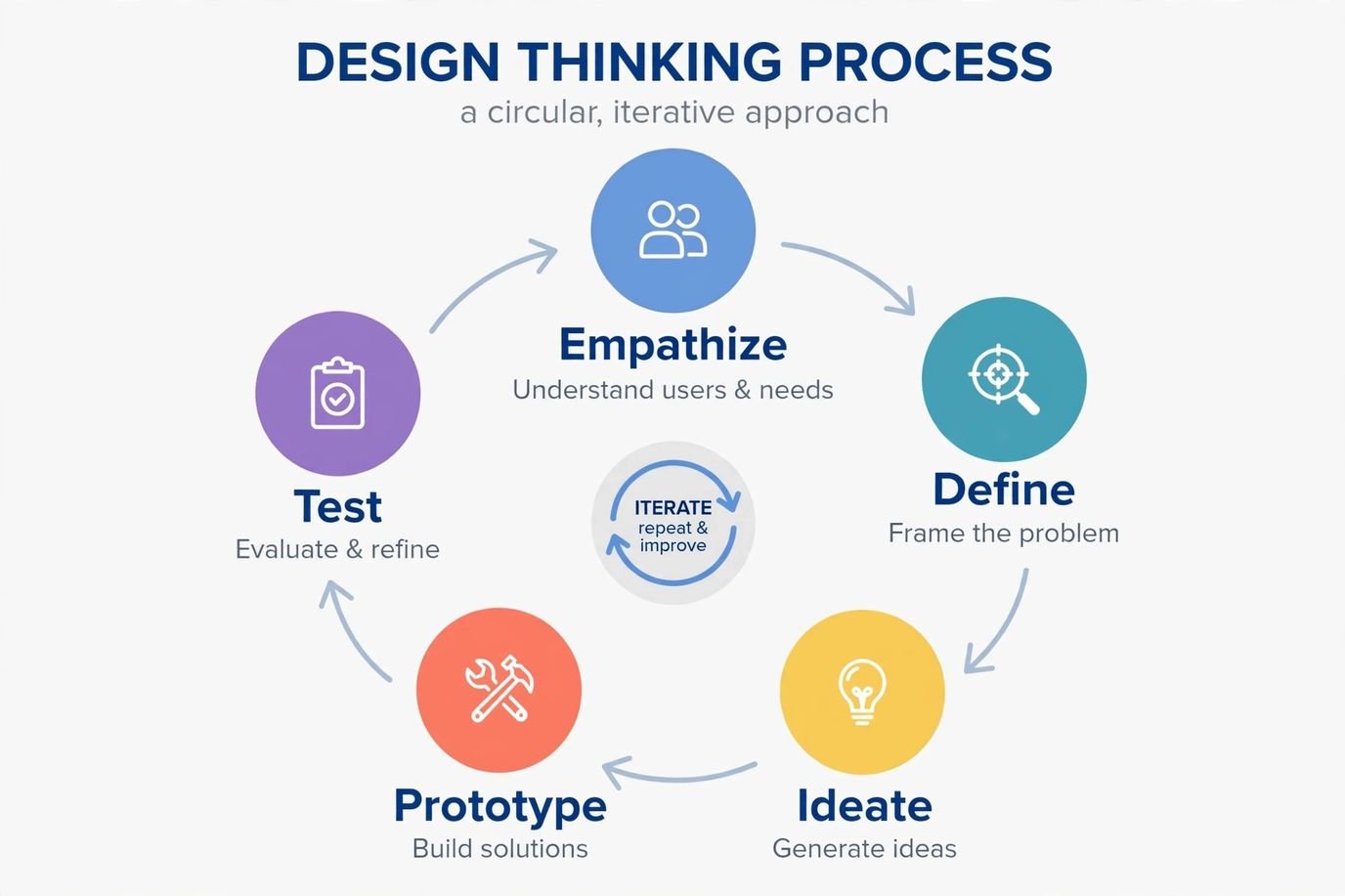
The five stages of design thinking. Teams loop back through the stages as often as needed — the circle is the point.
1. Empathize — Understand the People You Are Designing For
Empathy is the centerpiece of the whole process, and it is also the stage most teams rush through. Empathizing means doing the work to understand people in the context of the problem: how they do things, why they do them that way, what frustrates them, and what they would never tell you in a survey.
Practical ways to empathize include:
- Interviews: open-ended conversations where you ask “why” a lot and listen more than you talk.
- Observation: watching people use a product or go through a process in their real environment, noting workarounds and moments of friction.
- Immersion: experiencing the situation yourself — signing up for your own service, riding along with a customer, doing the job for a day.

Empathy interviews put you in the user’s world before you start solving anything — the foundation of the whole process.
The goal is not data collection for its own sake. It is to build genuine insight into needs people may not articulate — the kind of insight that makes the define stage possible.
2. Define — Name the Real Problem
Define is about sensemaking: taking everything you learned and distilling it into a clear, focused problem statement. A good problem statement is specific, human-centered, and framed in a way that invites solutions rather than prescribing one.
The classic format is a point-of-view statement: “[User] needs [need] because [insight].” From there, teams often convert it into “How might we…” questions — for example, “How might we make hospital check-in less stressful for elderly patients?” That single question can energize an entire ideation session because it is ambitious, specific, and open-ended all at once.
This stage is where many projects quietly get saved. Teams routinely discover here that the problem they were asked to solve is not the problem worth solving — and catching that before ideation begins is one of design thinking’s biggest wins.
3. Ideate — Generate Ideas Before Judging Them
Ideation is structured brainstorming with one iron rule: generate first, evaluate later. The d.school tradition encourages wild ideas, deferring judgment, building on the ideas of others, and going for quantity. A team that produces fifty rough ideas in an hour is doing better than a team that polishes three.
Useful ideation techniques include:
- Brainstorming: rapid, timed idea generation with the rules posted on the wall.
- Mind mapping: branching from a central problem to related concepts and solutions.
- SCAMPER: a checklist of prompts — Substitute, Combine, Adapt, Modify, Put to another use, Eliminate, Reverse — that forces fresh angles on an existing idea.
- Worst possible idea: deliberately generating terrible solutions, which loosens people up and often reveals a good idea hiding inside a bad one.
Only after the flood of ideas do you converge: group them, vote on the most promising, and pick a few to prototype. Divergence first, convergence second — never the reverse.
4. Prototype — Build the Roughest Version That Works
A prototype in design thinking is not a polished demo. It is the cheapest, fastest thing you can make that lets someone react to your idea: a paper sketch, a cardboard model, a role-played service, a clickable mockup made in an afternoon.
The mindset shift here matters more than the craft. Traditional teams build to be right; design thinkers build to learn. A rough prototype invites honest feedback in a way a slick presentation never will — people tell you what is wrong with a sketch because it clearly is not finished.
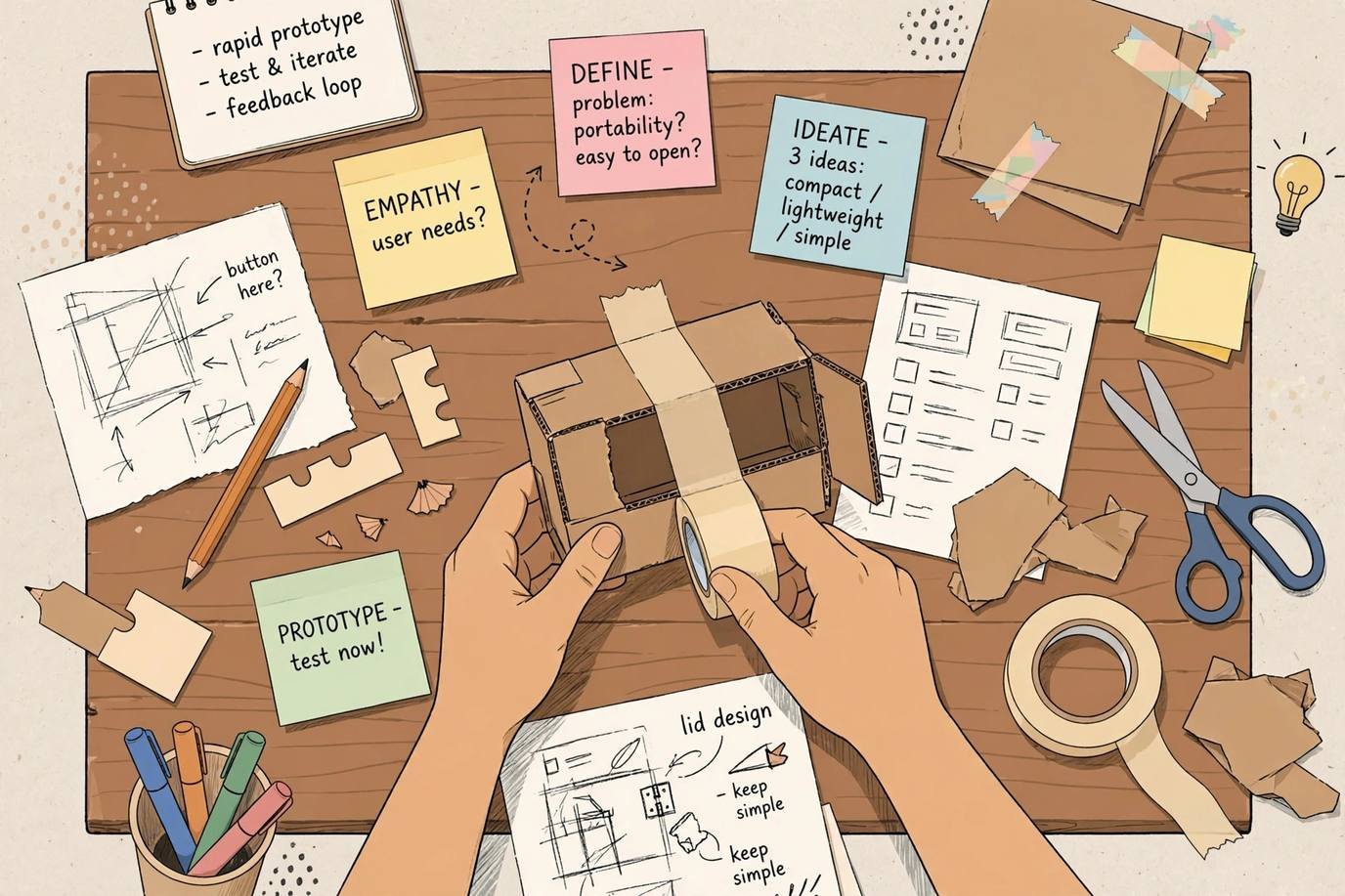
A rough prototype built in an afternoon teaches more than a polished plan built in a month.
Prototyping also forces clarity. An idea that sounds brilliant in a meeting often falls apart the moment you try to make it tangible. That is a feature, not a bug: better to watch it fall apart on a tabletop than in a production launch.
5. Test — Learn From Real Reactions
Testing means putting prototypes in front of real users, watching what they do, and listening to what they say. You are not looking for validation — you are looking for surprises. Where do people get confused? What do they ignore? What workaround do they invent on the spot?
Testing almost always sends you backward through the process, and that is exactly how it should work. A test might reveal that users do not understand your prototype (back to prototyping), that the idea misses the mark (back to ideation), or that you misunderstood the need entirely (back to empathize). Each loop makes the solution sharper.
Small tests beat big launches. Five users and a paper prototype can surface most major problems — and you can run that test this week.
How Is Design Thinking Different From Traditional Problem-Solving?
The contrast is easiest to see side by side. Traditional problem-solving usually starts with analysis and moves in a straight line toward a solution; design thinking starts with people and moves in loops.
| Aspect | Traditional Problem-Solving | Design Thinking |
|---|---|---|
| Starting point | Data, requirements, and expert analysis | Real people’s needs, observed firsthand |
| Process shape | Linear: analyze → decide → build | Iterative: loop through stages as you learn |
| Attitude to failure | Something to avoid; failure is costly | Expected early; cheap failures are the goal |
| Who decides | Experts and decision-makers | Users’ reactions guide the team |
| When ideas get tested | Late, after significant investment | Early, with rough prototypes |
| Success looks like | The plan was executed correctly | The solution actually fits people’s lives |
Neither approach is wrong in every situation. But when the problem involves human behavior — which most interesting problems do — the design thinking column tends to produce solutions that survive contact with reality.
What Tools Do Design Thinkers Actually Use?
You do not need special software to practice design thinking. Each stage has a handful of well-known methods, and most of them run on sticky notes, markers, and a willingness to talk to people.
| Stage | Common Methods | What You Get Out of It |
|---|---|---|
| Empathize | User interviews, observation, journey mapping, immersion | Real insight into needs and frustrations |
| Define | Point-of-view statements, “How might we” questions, affinity mapping | A sharp, solvable problem statement |
| Ideate | Brainstorming, SCAMPER, mind mapping, worst-possible-idea | A wide pool of candidate solutions |
| Prototype | Paper sketches, storyboards, cardboard models, clickable mockups | Something tangible people can react to |
| Test | Usability sessions, A/B comparisons, feedback interviews | Evidence about what works and what does not |
Digital tools exist for all of this — shared whiteboards, survey platforms, prototyping apps — but they are conveniences, not requirements. The methods are the method; the tools are just packaging.
How Do You Run Your First Design Thinking Workshop?
Reading about design thinking teaches you almost nothing. Doing a small version of it once teaches you a great deal. Here is a simple half-day format that works for a first attempt:
- Pick a real, narrow problem (30 minutes). Something your team actually cares about, small enough to explore in a day. “Improve our onboarding emails” beats “reinvent our company.”
- Empathize fast (45 minutes). Interview two or three real users, or role-play as them using journey mapping. Write observations on sticky notes — one observation per note.
- Define together (30 minutes). Cluster the notes into themes, then write one point-of-view statement and two or three “How might we” questions. Vote on the strongest question.
- Ideate with a timer (30 minutes). Silent brainstorming first — everyone writes ideas for ten minutes — then share, build on each other, and vote. Aim for volume.
- Prototype the winner (45 minutes). Build the top idea out of paper, slides, or a storyboard. Ugly is fine; understandable is mandatory.
- Test with one real user (30 minutes). Watch them use it. Do not explain it first — confusion is data. Note what happens.
- Debrief (15 minutes). What surprised you? What would you change? What is the next loop?
Set one ground rule at the start: no idea gets criticized during ideation, and no prototype gets defended during testing. Those two rules alone will change how your team works.
What Mistakes Do Beginners Make With Design Thinking?
Design thinking looks simple, which is why beginners stumble in such consistent ways. Watch for these:
- Skipping empathy. The most common failure. Teams interview nobody, assume they know the user, and run a process that is really just brainstorming with extra steps.
- Treating it as a checklist. The five stages are a guide, not a recipe. If you march through them once, in order, and declare victory, you missed the entire point: the loops.
- Prototyping too late — or too prettily. A polished prototype tested after months of work is not design thinking; it is traditional development with sticky notes. Build rough, build early.
- Testing for validation. If your test sessions are really pitches designed to get a thumbs-up, you will learn nothing. Go in genuinely willing to be wrong.
- Solving in the define stage. The moment someone says “we should just build an app” during problem definition, the process has derailed. Define the problem first; solutions come later.
- One and done. A single workshop is a taste, not a transformation. The real value compounds when teams loop through the process repeatedly on real work.
Where Can You Apply Design Thinking?
The honest answer is: anywhere people are involved. That covers a lot of ground, but some areas have especially strong track records.
- Product and service design. The home turf — apps, websites, physical products, and customer experiences, from onboarding flows to retail layouts.
- Healthcare. The famous example is GE Healthcare’s redesign of children’s MRI suites: after observing how frightened young patients were, designers turned the scanning experience into themed adventures — a pirate ship, a space voyage — dramatically improving the experience for kids and parents. Hospitals have since applied the same thinking to waiting rooms, discharge processes, and patient communication.
- Education. Schools and universities use design thinking to redesign curricula, improve student services, and teach students themselves how to solve open-ended problems.
- Public policy. Governments apply human-centered methods to services like benefits applications, public transit information, and emergency communication — places where confusing design has real consequences.
- Everyday life. Career changes, home organization, event planning — the stages scale down surprisingly well to personal decisions.
When Should You NOT Use Design Thinking?
Design thinking has limits, and honest practitioners admit them. It is the wrong tool when:
- The problem is purely technical. Optimizing a database query or fixing a manufacturing defect does not need empathy interviews. Use engineering methods.
- The solution is already known. If the answer is obvious and the work is execution, running a design thinking workshop is theater.
- You cannot talk to users. Empathy is load-bearing. If organizational politics or access issues mean you will never meet a real user, the process loses its foundation.
- You need an answer by Friday. The loops take time. A genuinely urgent, well-defined decision is better served by decisive leadership than by a workshop.
- The stakes demand rigor, not speed. Safety-critical systems and regulated environments need formal verification that rough prototyping cannot provide — though design thinking can still help with the human-facing parts.
Knowing when not to use it is part of understanding it. Design thinking is a powerful lens, not the only lens.
How Can You Learn Design Thinking?
The good news: the best resources are free or cheap, and the fastest way to learn is to practice on a real problem.
- Start with the d.school’s materials. Stanford’s d.school publishes process guides and method cards online that walk through each stage with exercises. They are the closest thing to an official manual.
- Try a structured course. IDEO U and various universities offer online courses that pair the framework with guided projects. Pick one with a real project component, not just lectures.
- Read the classics. Tim Brown’s writing on design thinking and IDEO’s case studies give you a feel for how the process handles real constraints — budgets, politics, deadlines.
- Practice on something small. Redesign a frustrating form, a meeting format, or a household routine using the five stages. Small loops teach the mechanics faster than one big project.
- Join or start a community of practice. Design thinking improves with feedback, and testing your facilitation on willing colleagues or friends accelerates learning enormously.
For more practical guides on creativity, business, and innovation topics, you can also browse The Modern Post — and if you run a workshop soon, keep a notebook. Your first “aha” moment with a real user is worth more than any course certificate.
Frequently Asked Questions About Design Thinking
What is design thinking in simple terms?
Design thinking is a human-centered way of solving problems. You study the people affected, define the real problem, brainstorm lots of ideas, build rough versions quickly, and test them with real users — then repeat until the solution fits.
What are the five stages of design thinking?
The Stanford d.school model lists five stages: empathize (understand users), define (state the problem clearly), ideate (generate many ideas), prototype (build quick rough versions), and test (get user feedback). The process is iterative, so you loop back through stages as you learn.
Is design thinking only for designers?
No. Despite the name, design thinking is a general problem-solving framework. Product managers, teachers, healthcare workers, founders, and policymakers all use it. No design background or software skills are required — the core skills are listening, curiosity, and a willingness to test rough ideas.
How long does the design thinking process take?
It scales to the problem. A focused sprint can run through all five stages in a single day; a complex product challenge might take weeks or months of looping. The key is that each loop is short and cheap, so you learn fast regardless of the total timeline.
What is the difference between design thinking and UX design?
Design thinking is a problem-solving philosophy focused on finding the right problem and testing early ideas. UX design is a professional discipline with specific craft skills — wireframing, interaction design, usability testing — that turns validated ideas into finished products. Design thinking often happens upstream of detailed UX work.
Can design thinking be used by small teams or solo founders?
Absolutely. The stages scale down well. A solo founder can interview five users in a week, sketch prototypes on paper, and test with friends. Small teams often move through the loops faster than large ones because there are fewer opinions to align.
What is the most important stage of design thinking?
Most practitioners would say empathize. Everything downstream depends on the quality of your understanding of users. A brilliant prototype built on a misunderstood need is still a failure — while strong empathy makes the define, ideate, and test stages dramatically easier.
Final Thoughts
Design thinking endures because it corrects a very human bias: our rush to solve before we understand. The five stages — empathize, define, ideate, prototype, test — are less a methodology than a discipline of humility. Talk to people. Admit what you do not know. Build the rough version. Let reality vote.
You do not need permission, certification, or special tools to start. Pick one small, real problem this week, run one fast loop through the stages, and pay attention to what surprises you. That surprise — the thing you would never have learned from your desk — is the whole game. Everything else is just practice.
Read Also: Australian Open 2027: What Is the Happy Slam? Dates, Draw, Records & Complete Guide

1 Comment