
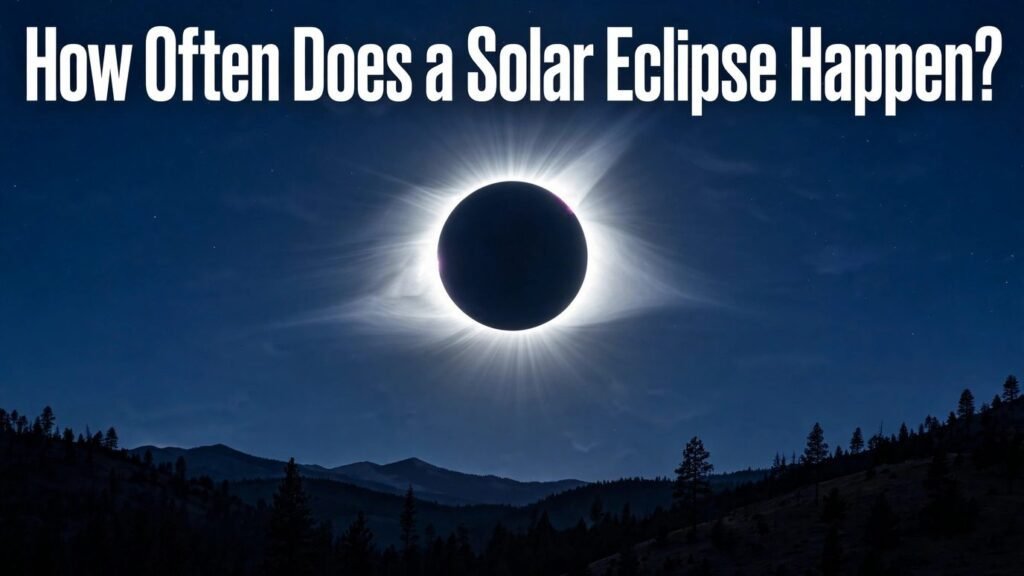
How often does a solar eclipse happen? Picture this: the middle of the day suddenly feels like dusk. The birds go quiet, the temperature drops a few degrees, and the Sun, the brightest thing in your sky, turns into a black disc ringed with wispy light. People around you gasp. Some cheer. For a few precious minutes, the world feels wonderfully strange.
If you have ever witnessed a total solar eclipse, you know it is the kind of experience that sticks with you for years. And if you have not, you have probably wondered how long you will have to wait. The answer, it turns out, depends entirely on where you are standing. Somewhere on Earth, solar eclipses are actually pretty common. Over your own backyard, though, a total eclipse is one of the rarest shows in nature.
That gap between “happens all the time somewhere” and “almost never happens here” is what makes this question so interesting. It comes down to the geometry of the Sun, the Moon, and Earth, a tilted orbit, and a shadow that is surprisingly small. Once you understand those pieces, the whole pattern falls into place.
The short answer: Somewhere on Earth, a solar eclipse happens 2 to 5 times every year. A total solar eclipse happens somewhere on the planet roughly every 18 months. But any single location has to wait an average of about 375 years between total solar eclipses, because the Moon’s dark central shadow is narrow and only sweeps across a thin path. Partial eclipses, on the other hand, are visible from much wider areas and are far more common.
How Often Do Solar Eclipses Happen Around the World?
If you count every kind of solar eclipse, partial ones included, Earth sees between 2 and 5 of them in a typical year. That number surprises a lot of people. We tend to think of eclipses as rare events, and in a sense they are, but only from the point of view of one fixed spot on the map. Zoom out to the whole planet, and they are a regular feature of the calendar.
The reason the number varies from year to year is that eclipses do not happen on a neat annual schedule. Some years bring just two solar eclipses. Other years bring four or five. The maximum is five, and years with five solar eclipses are unusual. What never happens is a year with zero. Every single year, without exception, the geometry lines up at least twice.
It is worth remembering that most of these eclipses are partial. A partial eclipse happens when the Moon covers only part of the Sun’s disc, as seen from a particular place. The Sun looks like a cookie with a bite taken out of it. It is still a beautiful sight, especially through proper eclipse glasses, but it does not bring the dramatic darkness of a total eclipse.
Why Don’t We See One Every Month?
This is the question that naturally follows. After all, the Moon orbits Earth roughly once a month, and it passes between Earth and the Sun at every new moon. So why isn’t there a solar eclipse every month?
The answer is tilt. The Moon’s orbit around Earth is tilted by about 5 degrees compared to Earth’s orbit around the Sun. That may not sound like much, but over the distance between Earth and the Moon, it makes all the difference. Most months, at new moon, the Moon passes slightly above or slightly below the Sun in the sky, and its shadow misses Earth entirely.
Think of it like trying to line up three balls on a table. If they are all rolling on the same flat surface, lining them up is easy. But if one of them is rolling on a slightly tilted ramp, it will usually pass above or below the others. Only when the Moon happens to be near one of the two points where its tilted orbit crosses Earth’s orbital plane do the three bodies line up well enough for an eclipse.
The Nodes Where Eclipses Become Possible
Astronomers call those two crossing points the nodes. The Moon passes through a node roughly every two weeks as it orbits, but the nodes themselves slowly drift over time. An eclipse can only happen when a new moon occurs close to a node. That alignment does not happen every month, but it does happen in clusters, which brings us to eclipse seasons.
What Is an Eclipse Season?
An eclipse season is a period of roughly 34 days during which the Sun is close enough to one of the Moon’s nodes for eclipses to be possible. During each season, there is typically one solar eclipse and one lunar eclipse, about two weeks apart. Sometimes a season can squeeze in three eclipses, but that is less common.
There are two eclipse seasons each year, about six months apart. That is why eclipses tend to come in pairs or small groups rather than being spread evenly through the year. If you hear about a lunar eclipse, there is a good chance a solar eclipse happened, or is about to happen, roughly a fortnight before or after it.
The seasons themselves shift gradually. Because the nodes drift backward along the Moon’s orbit, each eclipse season starts about 19 days earlier than the previous year’s corresponding season. Over a span of years, eclipse seasons cycle through all the months of the calendar, which is why an eclipse that happens in August one year might happen in July a few years later.
The Different Types of Solar Eclipses
Not all solar eclipses are the same. The kind you get depends on how precisely the Sun, Moon, and Earth line up, and on how far the Moon is from Earth at the time. There are four main types, and they differ a lot in both appearance and frequency.
- Partial solar eclipse: The Moon covers only part of the Sun. This is the most common type, and it is visible over a wide area.
- Total solar eclipse: The Moon completely covers the Sun’s disc, revealing the glowing corona. This is the rarest and most dramatic type.
- Annular solar eclipse: The Moon is too far from Earth to cover the Sun completely, so a bright ring, or annulus, of sunlight remains visible around the Moon’s dark disc.
- Hybrid solar eclipse: This is a rare eclipse that starts as annular, becomes total along part of its path, and then returns to annular. It happens when the curvature of Earth’s surface changes the apparent size of the Moon during the eclipse.
Why the Moon’s Distance Matters
The Moon’s orbit is not a perfect circle. Sometimes it is closer to Earth, and sometimes it is farther away. When it is closer, it looks slightly larger in the sky, large enough to cover the Sun completely. When it is farther away, it looks slightly smaller, and it cannot quite cover the whole Sun. That is the difference between a total eclipse and an annular one. It is a coincidence of cosmic proportions that the Sun and Moon appear almost exactly the same size in our sky, which is what makes total eclipses possible at all.
How Often Does a Total Solar Eclipse Happen?
Somewhere on Earth, a total solar eclipse occurs roughly every 18 months. That average hides a fair amount of variation. Sometimes two total eclipses happen within a single year. Other times, more than two years can pass between them. But over a long stretch of time, the average works out to about one every year and a half.
That sounds frequent until you remember how big Earth is. The Moon’s darkest shadow, the umbra, is only about 100 miles wide, and it races across Earth’s surface along a narrow track. A total eclipse is only visible from inside that track. Everyone outside it, even people just a few dozen miles away, sees only a partial eclipse or nothing at all.
So while total eclipses happen regularly on a planetary scale, they are local events. The path of totality might cross a particular country only a handful of times in a century, and it might cross your specific town just once in your lifetime, if you are lucky.
Why Your Hometown Waits Hundreds of Years
Here is the statistic that usually stops people in their tracks: any given spot on Earth waits an average of about 375 years between total solar eclipses. That number is an average, not a promise. Some places get lucky and see two total eclipses within a few years of each other. Others wait far longer than 375 years. But the average gives you a sense of just how narrow the Moon’s shadow really is.
Think of it this way. Earth has a huge surface area, and the path of totality covers only a thin ribbon of it. It is like throwing a narrow ribbon across a giant map over and over again and asking how often it lands on your house. The answer is: not often.
This is why eclipse chasers exist. People who want to see totality more than once in a lifetime do not wait for the shadow to come to them. They travel to it. Since a total eclipse happens somewhere on Earth roughly every 18 months, a dedicated chaser who is willing to fly to remote locations can see one every couple of years. For the rest of us, a total eclipse passing near home is an event worth planning around.
Partial Eclipses Are a Different Story
If you are content with a partial eclipse, the wait is much shorter. Because the Moon’s lighter outer shadow, the penumbra, is thousands of miles wide, partial eclipses are visible from enormous areas. Most locations see a partial solar eclipse every few years. You might not even notice one is happening unless you know to look, since the Sun remains bright enough to seem normal, but with eclipse glasses the missing bite of the Sun is easy to spot.
The Saros Cycle: Eclipses on a Schedule
One of the most satisfying discoveries in eclipse science is that eclipses repeat in a pattern. After about 18 years, 11 days, and 8 hours, the Sun, Moon, and Earth return to almost exactly the same relative positions, and a very similar eclipse occurs. This repeating pattern is called the Saros cycle, and it has been known since ancient times.
How the Saros Cycle Works
The Saros cycle works because 223 lunar months, the time from one new moon to the next, is almost exactly equal to 19 eclipse years, the time it takes the Sun to return to the same node. When those two cycles line up, the geometry repeats. The eclipse that follows is not identical to the previous one, though. It is shifted slightly, because the extra 8 hours in the cycle means Earth has rotated by about a third of a turn, so the eclipse path falls about 120 degrees of longitude to the west.
Why the Saros Cycle Matters for Frequency
The Saros cycle does not change how often eclipses happen, but it explains why they are predictable. Astronomers can forecast eclipses centuries in advance because the pattern is so regular. Each Saros series lasts for many centuries and produces dozens of eclipses, gradually changing character as the geometry shifts. A series might start with partial eclipses, evolve into total ones, and eventually fade back to partial eclipses before ending. Dozens of Saros series are active at any given time, overlapping with one another, which is part of why we get several eclipses each year.
Partial vs Total vs Annular vs Hybrid: A Quick Comparison
It helps to see the four types side by side, because their frequency and their experience are very different. A partial eclipse might be visible to hundreds of millions of people at once, while a total eclipse is visible to a comparatively small number of people along a narrow track.
| Type | What you see | How common is it? | Darkness during the day? |
|---|---|---|---|
| Partial | Part of the Sun covered | Most common | No, daylight barely dims |
| Total | Sun fully covered, corona visible | Rarest, roughly every 18 months somewhere | Yes, brief twilight |
| Annular | Ring of sunlight around the Moon | Less common than partial | No, a ring stays bright |
| Hybrid | Shifts between annular and total | Very rare | Only along the total section |
Which Type Should You Hope For?
If you have the chance to see a total eclipse, take it. People who have seen one often describe it as a completely different experience from a partial or annular eclipse. During totality, the sky darkens, stars can appear, the temperature drops, and the Sun’s outer atmosphere, the corona, becomes visible as delicate white streamers. It is the only time you can safely look at the Sun without protection, and only for the short duration of totality itself.
An annular eclipse is still a striking sight. The “ring of fire” is beautiful, especially photographed. But it never gets dark, and the Sun remains dangerously bright, so eye protection is needed for the entire event. A partial eclipse is a lovely curiosity, a great excuse to get outside with eclipse glasses, but it does not compare to the drama of totality.
How Often Can You See a Partial Eclipse?
Because partial eclipses are visible over such a wide area, they are the eclipses most people actually see. A typical location might experience a noticeable partial eclipse every two to three years, though many of them are small, with only a sliver of the Sun covered, and easy to miss if you are not paying attention.
There is another subtlety worth knowing. Even during a total eclipse, most of the world sees it as a partial eclipse. The path of totality might be only 100 miles wide, but the partial eclipse around it can stretch for thousands of miles in every direction. So when news reports say a total eclipse is happening, it usually means a partial eclipse is visible across a whole continent at the same time.
How to Watch a Solar Eclipse Safely
No discussion of eclipse frequency is complete without a word about safety, because the whole point of knowing when one is coming is being able to enjoy it without harming your eyes. Looking directly at the Sun, even during a partial eclipse, can cause serious and permanent eye damage. The danger is sneaky because the Sun does not feel painfully bright when part of it is covered, but the uncovered part is still intense enough to injure your retina.
Here are the basics:
- Use certified eclipse glasses or a handheld solar viewer. Ordinary sunglasses are not safe, no matter how dark they look.
- Inspect your eclipse glasses before use. If they are scratched or damaged, do not use them.
- Look through a pinhole projector if you do not have glasses. This lets you watch the eclipse indirectly, by projecting the Sun’s image onto a surface.
- Only during the brief period of totality, when the Sun is completely covered, is it safe to look without protection. The moment the Sun starts to reappear, put your glasses back on.
- If you use a camera, telescope, or binoculars, they need a proper solar filter on the front. Never look through an unfiltered optical device at the Sun.
A Common Mistake to Avoid
A lot of people assume that because the Sun looks dimmer during a partial eclipse, it must be safe to glance at. It is not. Your eyes do not have pain receptors in the retina, so damage can happen without you feeling anything at the time. The rule is simple: if any part of the Sun’s bright disc is visible, keep your protection on.
Frequently Asked Questions
How often does a solar eclipse happen in total?
Somewhere on Earth, solar eclipses of all kinds happen 2 to 5 times per year. Total solar eclipses happen roughly every 18 months somewhere on the planet. The exact number varies from year to year because the alignment of the Sun, Moon, and Earth shifts gradually over time.
Why is there not a solar eclipse every month?
The Moon’s orbit is tilted about 5 degrees relative to Earth’s orbit around the Sun. Most months, at new moon, the Moon passes above or below the Sun in the sky, and its shadow misses Earth. An eclipse only happens when a new moon occurs near one of the nodes where the two orbits cross.
How long does a total solar eclipse last?
Totality, the period when the Sun is completely covered, usually lasts only a few minutes at any given location. The maximum possible is a little over seven minutes, but most total eclipses give viewers between two and five minutes of totality. The entire eclipse, from the first partial phase to the last, takes a few hours.
What is the difference between a solar eclipse and a lunar eclipse?
A solar eclipse happens when the Moon passes between the Sun and Earth, casting its shadow on Earth. A lunar eclipse happens when Earth passes between the Sun and the Moon, casting Earth’s shadow on the Moon. Solar eclipses happen at new moon, lunar eclipses at full moon, and lunar eclipses are visible from anywhere on Earth’s night side, which is why they seem more common to any one observer.
What is an eclipse season?
An eclipse season is a roughly 34-day window during which the Sun is near one of the Moon’s orbital nodes, making eclipses possible. There are two eclipse seasons per year, about six months apart, and each season typically brings one solar eclipse and one lunar eclipse about two weeks apart.
What is the Saros cycle?
The Saros cycle is a period of about 18 years, 11 days, and 8 hours after which the Sun, Moon, and Earth return to nearly the same alignment, producing a very similar eclipse. Eclipses belong to Saros series that last for centuries, and this repeating pattern is what makes long-range eclipse prediction possible.
Will I ever see a total solar eclipse where I live?
Possibly, but it may take a long time. On average, a given location waits about 375 years between total eclipses, though some places are luckier than others. The more practical approach for most people is to travel to the path of totality when a total eclipse passes within reasonable distance. Since one happens somewhere on Earth roughly every 18 months, the opportunities do come around regularly, just not always near home.
Conclusion
So, how often does a solar eclipse happen? The honest answer has two parts, and both are true. From Earth’s point of view, solar eclipses are routine: 2 to 5 of them happen every year, with a total eclipse somewhere on the planet roughly every 18 months. From your point of view, standing in one place, they are precious and rare, especially total eclipses, which visit any given spot only about once every 375 years on average.
That tension is part of what makes eclipses special. They are not random. They follow a beautiful, predictable pattern set by the tilt of the Moon’s orbit, the rhythm of eclipse seasons, and the long, stately repeat of the Saros cycle. Knowing how that pattern works does not take away the wonder. If anything, it deepens it, because the next time the sky darkens in the middle of the day, you will understand exactly why it happens so rarely right where you are standing, and why it is happening all the time somewhere.
If a total eclipse ever comes your way, go and see it. Get your eclipse glasses ready, find a spot inside the path of totality, and look up. You will understand, in a way no article can fully explain, why people travel across the world to stand in the Moon’s shadow for a few unforgettable minutes.
Read Also: How Was the Moon Formed? The Giant Impact Explained

2 Comments