
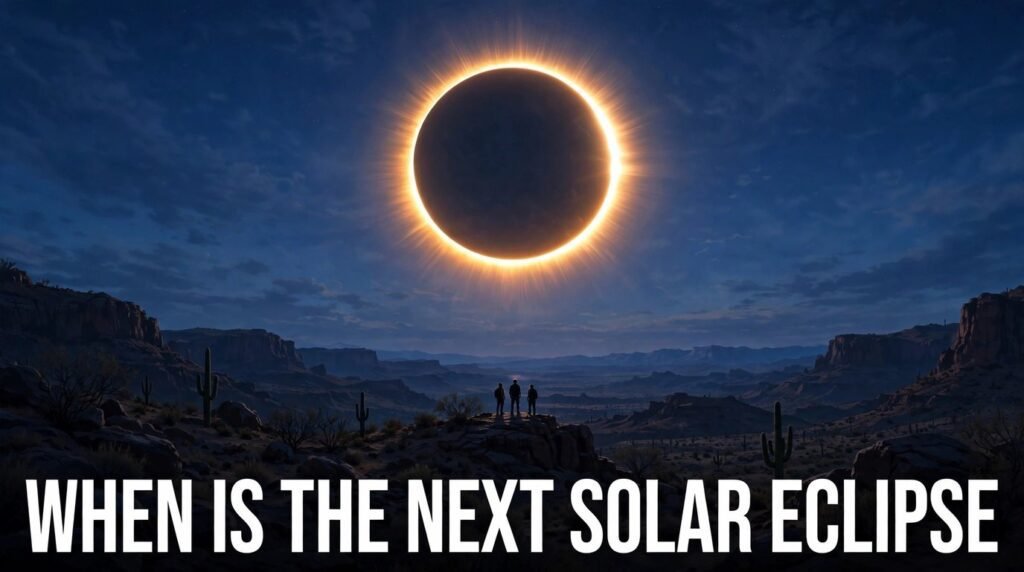
If you missed the eclipses of 2026, you are not alone. Most people only hear about a solar eclipse a few days before it happens, usually when a photo of a darkened Sun starts doing the rounds online, and by then it is often too late to travel anywhere to see it properly. The good news is that the next one is far enough away to actually plan for — and the one after it is the kind of eclipse people cross continents to witness.
The next solar eclipse falls on February 6, 2027. It will be an annular eclipse, the type that leaves a bright ring of sunlight glowing around the Moon, and it will cross southern South America. A few months later, on August 2, 2027, the next total solar eclipse arrives, and it will be one of the longest total eclipses of the century. So 2027 is shaping up to be a very good year for eclipse chasers.
This guide covers both dates in full: what kind of eclipse each one is, where you need to be to see it, what it will actually look like from the ground, and how to watch without damaging your eyes. No guesswork, no vague “sometime next year” — just the dates, the places, and the practical details.
The short answer: The next solar eclipse is on February 6, 2027. It is an annular eclipse — a “ring of fire” — visible across southern Chile and Argentina, with a partial eclipse across much of South America, Antarctica, and western and southern Africa. Greatest eclipse is at about 15:59 UTC. The next total solar eclipse follows on August 2, 2027.
More Information: How Often Does a Solar Eclipse Happen? A Simple Guide
When Is the Next Solar Eclipse?
The next solar eclipse happens on February 6, 2027. It is the first solar eclipse of 2027, and it is an annular eclipse, which means the Moon will pass directly in front of the Sun but will not quite cover it completely. Instead, a thin ring of sunlight will remain visible around the dark disc of the Moon — the famous “ring of fire” that gives annular eclipses their name.
The reason the Moon does not cover the Sun fully on this occasion is distance. The Moon’s orbit around Earth is not a perfect circle, and on February 6, 2027, the Moon will be a little farther from Earth than average. That makes its apparent size in the sky slightly smaller than the Sun’s, so even at the moment of greatest eclipse, a ring of the Sun’s disc stays uncovered. The effect lasts only a few minutes at any one location, but it is one of the most striking sights in astronomy.
The timing is worth noting if you are planning around it. Greatest eclipse — the moment when the ring is at its most complete — happens at about 15:59 UTC. That translates to late morning in southern Chile and Argentina, which is good news for anyone travelling there: the Sun will be reasonably high in the sky, the light will be strong, and you will not be craning your neck at a Sun sitting low on the horizon.
If you live outside the eclipse path, do not write the day off. A partial eclipse will be visible across a much wider area, including much of South America, Antarctica, and western and southern Africa. From those places the Moon will take a bite out of the Sun rather than forming a full ring, but it is still well worth stepping outside with proper eye protection to see.
What Will the February 6, 2027 Eclipse Look Like?
An annular eclipse unfolds in slow, distinct stages, and knowing what to expect makes the experience far better than simply staring upward and hoping for the best.
It begins with first contact, when the edge of the Moon first touches the edge of the Sun. Nothing dramatic happens at first — a small, dark notch appears on one side of the solar disc, and it grows steadily over the next hour or so. Shadows on the ground start to look slightly odd during this phase. If you are standing under a tree, the gaps between the leaves project dozens of tiny crescent Suns onto the ground, which is one of the simplest and most delightful ways to watch an eclipse without any equipment at all.
As the Moon covers more of the Sun, the light changes in a way that is hard to describe until you have felt it. It does not go dark the way it does during a total eclipse. Instead, the daylight takes on a strange, thin quality, almost as if someone turned the Sun down with a dimmer switch. Colours look slightly washed out, and the temperature often drops a few degrees. Birds sometimes go quiet, confused by the fading light in the middle of the day.
Then comes annularity itself — the ring phase. For a few minutes, the Moon sits centred on the Sun and the ring of fire burns around it. This is the moment every photographer in the path is waiting for. The ring is bright enough that you still cannot look at it with the naked eye; eclipse glasses stay on throughout an annular eclipse, unlike a total eclipse, where there is a brief window to look directly. That is an important difference, and we will come back to it in the safety section below.
After annularity, the whole process runs in reverse. The Moon slides off the Sun, the light returns to normal, and within about an hour the Sun looks ordinary again. The full event, from first contact to last contact, takes a couple of hours, but the ring itself lasts only minutes — so being in position early matters.
Where Can You See the February 6, 2027 Eclipse?
The path of annularity — the narrow band of land where the full ring of fire is visible — crosses southern Chile and Argentina. That is the destination if you want the complete experience, and both countries offer some excellent viewing locations in Patagonia, where the skies in February, the southern hemisphere summer, are often clear and the days are long.
Here is the honest travel advice: pick your spot inside the path well in advance, and have a backup location a short drive away in case of cloud. Eclipse paths are narrow, sometimes only a couple of hundred kilometres wide, and a single bank of cloud sitting over your chosen town can hide the whole event. Eclipse chasers often book accommodation in a town inside the path and keep a car ready so they can drive along the path on the morning of the eclipse if the forecast turns against them.
Outside the path, the partial eclipse covers a far larger area:
- Much of South America will see a partial eclipse, with the amount of the Sun covered depending on how close you are to the path.
- Antarctica will see a partial eclipse from research stations and the surrounding ocean.
- Western and southern Africa will see a partial eclipse, with the Sun partly covered low in the sky depending on location.
If you are in the UK, Europe, North America, or Asia, February 6, 2027 is not your day — the eclipse will not be visible from those regions. Your next chance is the total eclipse in August of the same year, which is far more accessible for European viewers.
When Is the Next Total Solar Eclipse?
If an annular eclipse is impressive, a total eclipse is something else entirely, and the wait after February is not long. The next total solar eclipse happens on August 2, 2027, and it is expected to be one of the most significant eclipses of the decade.
Totality — the period when the Moon completely covers the Sun — will last up to 6 minutes and 23 seconds at the point of maximum eclipse. That is a very long totality. Most total eclipses give viewers two or three minutes of darkness; six minutes is the kind of duration that eclipse chasers plan their holidays around, because it leaves time to actually look around, take in the corona, and watch the sky change, rather than spending the whole event fumbling with a camera.
The reason this eclipse lasts so long is a favourable combination of geometry: the Moon will be near its closest approach to Earth, making it appear larger in the sky, and the eclipse path crosses near the equator, where the Moon’s shadow moves across the ground more slowly. Put those two together and you get a long, generous window of totality.
The August 2, 2027 Total Eclipse in Detail
The path of totality on August 2, 2027 sweeps across southern Spain, then crosses the Strait of Gibraltar into Morocco, Algeria, Tunisia, Libya, and Egypt, before continuing over Saudi Arabia and Yemen. It is a path that crosses some of the driest, clearest skies on the planet, particularly over the Sahara and the Arabian Peninsula, which is one of the reasons astronomers are so excited about this eclipse. August in Egypt and Saudi Arabia is extremely hot, but the skies are reliably clear, and clear skies are what an eclipse trip lives or dies by.
For viewers in Europe, this is the accessible one. Southern Spain sits right in the path of totality, which means a total solar eclipse will be visible from mainland Europe without an intercontinental flight. Cities and towns in the south of Spain will go dark in the middle of the day, and the partial eclipse will be visible across most of Europe. That is a rare opportunity — total eclipses visible from Europe do not come around often, and the next one after this is years away.
A partial eclipse will also be visible across most of Europe, much of Africa, the Middle East, and even as a dawn partial in northern Maine in the United States, where the Sun will rise already partly eclipsed. If you are in the UK, you will see a substantial partial eclipse, with a large portion of the Sun covered — worth stepping outside for, with eclipse glasses on, even though totality itself will not reach British skies.
| Eclipse | Date | Type | Where Visible |
|---|---|---|---|
| Next solar eclipse | February 6, 2027 | Annular (“ring of fire”) | Southern Chile and Argentina |
| Next total solar eclipse | August 2, 2027 | Total (up to 6 min 23 sec) | Southern Spain, Morocco, Algeria, Tunisia, Libya, Egypt, Saudi Arabia, Yemen |
| Last annular eclipse | February 17, 2026 | Annular | Antarctica and southern South America |
| Last total eclipse | August 12, 2026 | Total | Greenland, Iceland, Spain |
The table makes the pattern clear: 2026 gave us one of each, and 2027 does the same, but the 2027 pair is the more rewarding one for most viewers, because the August total eclipse is both unusually long and unusually well placed.
What Happens During a Solar Eclipse?
A solar eclipse happens at new moon, when the Moon passes between Earth and the Sun. That sounds simple, and it raises an obvious question: if there is a new moon every month, why is there not a solar eclipse every month?
The answer is the tilt of the Moon’s orbit. The Moon’s path around Earth is tilted by about five degrees relative to Earth’s orbit around the Sun. Most months, at new moon, the Moon passes slightly above or below the Sun in the sky, and its shadow misses Earth entirely. Only when a new moon happens to fall near one of the two points where the Moon’s orbit crosses the plane of Earth’s orbit — the nodes — does the alignment line up closely enough for the Moon’s shadow to fall on Earth. That is why eclipse seasons come in clusters, and why there are usually between two and five solar eclipses in a year, rather than twelve.
When the alignment does happen, the Moon’s shadow races across Earth’s surface at thousands of kilometres per hour. The dark central part of the shadow, the umbra, is where a total eclipse is seen; the lighter outer part, the penumbra, is where a partial eclipse is seen. The umbra is narrow, which is why totality is only visible from a thin band of land, while the penumbra is wide, which is why partial eclipses are seen by millions more people.
During totality, the experience is unlike anything else in nature. The sky darkens to a deep twilight blue, the brightest stars and planets come out, and the Sun’s corona — its outer atmosphere, normally hidden by the Sun’s glare — streams out around the black disc of the Moon in pale, wispy tendrils. The temperature drops noticeably, and animals often behave as if night has fallen. Then, after a few minutes, a brilliant point of light breaks through at one edge of the Moon — the diamond ring effect — and daylight returns almost embarrassingly fast.
The Four Types of Solar Eclipse
Not every solar eclipse looks the same. There are four types, and which one you get depends on the exact distances between Earth, the Moon, and the Sun on the day.
| Type | What It Looks Like | Safe to Look Directly? |
|---|---|---|
| Total | The Moon completely covers the Sun; the corona is visible | Only during the brief minutes of totality |
| Annular | The Moon is too far away to cover the Sun fully; a ring of sunlight remains | No — glasses on the whole time |
| Partial | Only part of the Sun is covered | No — glasses on the whole time |
| Hybrid | Total in some places along the path, annular in others | Only during totality, where it is total |
A total eclipse is the only type where it is ever safe to look directly at the Sun, and only during totality itself, when the Sun’s bright disc is fully covered. The moment any part of the bright disc reappears, glasses go straight back on. Annular, partial, and hybrid eclipses outside their total segments never have a safe moment to look with the naked eye, because part of the Sun’s disc is always exposed.
Hybrid eclipses are the rarest of the four. They happen when the curvature of Earth’s surface changes the Moon’s apparent size along the path, so the eclipse starts as annular, becomes total in the middle of the path, and turns annular again before it ends. They are uncommon, and neither of the 2027 eclipses is a hybrid — February is annular throughout, and August is total throughout.
More Information: Men’s Leather Jacket
Why Solar Eclipses Don’t Happen Every Month
This is the question that follows naturally once you know that eclipses happen at new moon, and it is worth answering properly because it explains why eclipse dates are worth marking on a calendar rather than expecting one every four weeks.
Three things have to line up at once. First, the Moon must be new, sitting between Earth and the Sun. Second, the Moon must be near one of its orbital nodes, the two points where its tilted orbit crosses Earth’s orbital plane. Third, the Moon’s shadow must actually fall on Earth’s surface rather than passing above or below it. When all three line up, you get an eclipse; when any one of them is off, you get an ordinary new moon that nobody notices.
The nodes slowly drift over time, completing a full cycle roughly every 18.6 years, which is why eclipse patterns repeat in cycles called saros cycles. Astronomers can predict eclipses centuries in advance using these cycles, which is how we know the dates for 2027 — and for 2028, 2030, and beyond — with such confidence. The February and August 2027 dates are not estimates; they are calculated from orbital mechanics that have been verified against centuries of observed eclipses.
It also explains why the two 2027 eclipses are about six months apart. Eclipses tend to come in seasons roughly six months apart, when the Sun is near one of the Moon’s nodes. February 2027 is one eclipse season, August 2027 is the next, and each season produces one solar eclipse in this case.
How to Watch a Solar Eclipse Safely
This is the most important section in the whole article, so let us be direct about it: never look at the Sun without proper eye protection during a partial or annular eclipse, and never look at it without protection outside totality during a total eclipse. The Sun’s light can damage your eyes in seconds, and the damage is painless at the time, which makes it easy to underestimate. Solar retinopathy — burns to the retina from looking at the Sun — does not heal the way a sunburn on your skin does.
Here is what safe viewing actually looks like:
- Use certified eclipse glasses. Look for glasses that meet the ISO 12312-2 international safety standard. They should be noticeably darker than ordinary sunglasses — so dark that the only thing you can see through them is the Sun itself. If you can see anything else through them indoors, they are not dark enough.
- Check your glasses before use. Hold them up to a bright light and look for scratches, holes, or damage. If they are scratched or torn, throw them away and get a new pair.
- Use a solar filter on cameras, binoculars, and telescopes. Never point an unfiltered camera or telescope at the Sun, and never look through binoculars while wearing eclipse glasses — the concentrated sunlight can burn straight through them. A proper solar filter fits over the front of the optics, not over the eyepiece.
- Try a pinhole projector. If you have no glasses, a pinhole projector is a safe and simple alternative. Poke a small hole in a piece of card, hold it up to the Sun, and let the light fall through the hole onto a second piece of card or the ground. You will see a small image of the eclipsed Sun, and you will not be looking at the Sun at all.
- Do not use sunglasses, smoked glass, or exposed film. Ordinary sunglasses, even very dark ones, do not block enough of the Sun’s harmful rays. Smoked glass, CDs, and old photographic film are not safe substitutes either.
During a total eclipse, there is one exception to the glasses rule: during totality itself, when the Sun’s disc is completely covered, it is safe to look directly and take the glasses off to see the corona. But the window is short, and you need to know exactly when totality begins and ends. Use a reliable eclipse timing app or a local announcer, and put the glasses back on the moment the diamond ring appears and the first point of sunlight returns.
For the February 6, 2027 annular eclipse, there is no safe moment to look without glasses at all. The ring of fire is bright enough to damage your eyes throughout, so glasses stay on from first contact to last contact. The same applies to any partial eclipse.
How to Plan for the 2027 Eclipses
If either of the 2027 eclipses appeals to you, start planning now rather than a month before. Eclipse travel has become popular, and accommodation inside the path of totality or annularity books up fast, with prices rising sharply as the date approaches.
For February 6, 2027, the practical choice is southern Chile or Argentina. February is summer in the southern hemisphere, so expect warm days and long daylight hours, but also check the local weather patterns for your chosen town — Patagonia is famously windy, and coastal cloud can be an issue in some spots. Flying into a regional hub and driving to the path is the usual approach, and it gives you the flexibility to move along the path on the morning of the eclipse if the forecast shifts.
For August 2, 2027, southern Spain is the easiest option for European viewers, with good transport links and plenty of accommodation in and near the path. If you want the longest possible totality and the clearest skies, Egypt is the standout choice: the point of maximum eclipse, with 6 minutes 23 seconds of totality, falls over Egypt, and August skies there are almost guaranteed clear. The trade-off is the heat — August in Egypt is extremely hot, so plan for shade, water, and sun protection, and think about whether you want to watch from a city or from a desert location with a clearer horizon.
A few practical tips apply to both trips:
- Book accommodation inside the path, not just near it — being a few kilometres outside the path means seeing a partial eclipse instead of the real thing.
- Arrive at least a day early so you can scout your viewing spot and check the local forecast.
- Buy eclipse glasses well in advance from a reputable supplier, and test them before you travel.
- Decide in advance whether you are watching or photographing. Trying to do both properly during a few minutes of totality usually means doing neither well.
- Have a backup viewing location in mind, and keep an eye on the cloud forecast on the morning of the eclipse.
What About the 2026 Eclipses?
If you are wondering whether you have already missed your chance, here is the honest answer: the 2026 eclipses have both already happened. There was an annular eclipse on February 17, 2026, visible mainly from Antarctica and parts of southern South America, and a total eclipse on August 12, 2026, with totality visible from Greenland, Iceland, and Spain. If you saw either of those, you were lucky — the August 2026 total eclipse in particular drew large crowds to Iceland and northern Spain.
But missing 2026 is not a reason to feel you have missed out. The 2027 pair is, in several ways, the better set: the February annular eclipse crosses populated parts of South America rather than mostly empty Antarctic coastline, and the August total eclipse is longer and crosses more accessible territory than the 2026 total. In eclipse terms, 2027 is the year to aim for.
FAQ
When is the next solar eclipse?
The next solar eclipse is on February 6, 2027. It is an annular eclipse, visible as a “ring of fire” across southern Chile and Argentina, with a partial eclipse across much of South America, Antarctica, and western and southern Africa. Greatest eclipse is at about 15:59 UTC.
When is the next total solar eclipse?
The next total solar eclipse is on August 2, 2027. Totality will last up to 6 minutes 23 seconds, and the path crosses southern Spain, Morocco, Algeria, Tunisia, Libya, Egypt, Saudi Arabia, and Yemen. A partial eclipse will be visible across most of Europe, much of Africa, and the Middle East.
Will the February 6, 2027 eclipse be visible from the UK?
No. The February 6, 2027 eclipse is visible from South America, Antarctica, and parts of Africa. From the UK, the next eclipse to watch for is the August 2, 2027 total eclipse, which will appear as a substantial partial eclipse from Britain.
What is the difference between an annular and a total solar eclipse?
In a total eclipse, the Moon completely covers the Sun and the corona becomes visible. In an annular eclipse, the Moon is slightly farther from Earth, so it appears smaller and cannot cover the Sun fully — a bright ring of sunlight remains visible around the Moon. You need eclipse glasses for the whole of an annular eclipse, but during the minutes of totality in a total eclipse it is safe to look directly.
How often do solar eclipses happen?
Solar eclipses happen at new moon when the Moon passes between Earth and the Sun, but only when the alignment is close enough — usually two to five solar eclipses occur each year somewhere on Earth. A total eclipse is visible from any one place only very rarely, which is why people travel to see them.
Is it safe to look at a solar eclipse?
Only with proper protection. Use eclipse glasses that meet the ISO 12312-2 safety standard, or a proper solar filter on optical equipment. Never look at the Sun through ordinary sunglasses, and never look at a partial or annular eclipse with the naked eye. During totality in a total eclipse, it is safe to look directly, but put your glasses back on the moment sunlight returns.
How long will the August 2, 2027 total eclipse last?
Totality will last up to 6 minutes 23 seconds at maximum, which is unusually long. Most total eclipses last two or three minutes, so the August 2027 eclipse gives viewers one of the longest windows of totality in recent decades.
Final Thoughts
The next solar eclipse is on February 6, 2027, and it is worth more than a passing glance at the calendar. An annular eclipse over Patagonia is a genuine spectacle, and the total eclipse that follows in August is one of the longest and best placed of the decade. Between them, they give you two very different eclipse experiences in a single year — the ring of fire in February, and six minutes of midday darkness in August.
If you can only see one, choose the total eclipse in August. Totality is the experience that turns casual sky-watchers into people who plan their holidays around eclipse paths for the rest of their lives, and the 2027 total eclipse is about as good as they get: long, well placed, and under some of the clearest skies on Earth. But if South America is within reach in February, take that chance too — a ring of fire over Patagonia is not something you will forget in a hurry.
Mark both dates now, sort out your eclipse glasses early, and decide where you will be standing when the Moon crosses the Sun. The sky has already set the schedule; all that is left is for you to be there.
Read Also: How Often Does a Lunar Eclipse Happen? Explained Simply
