
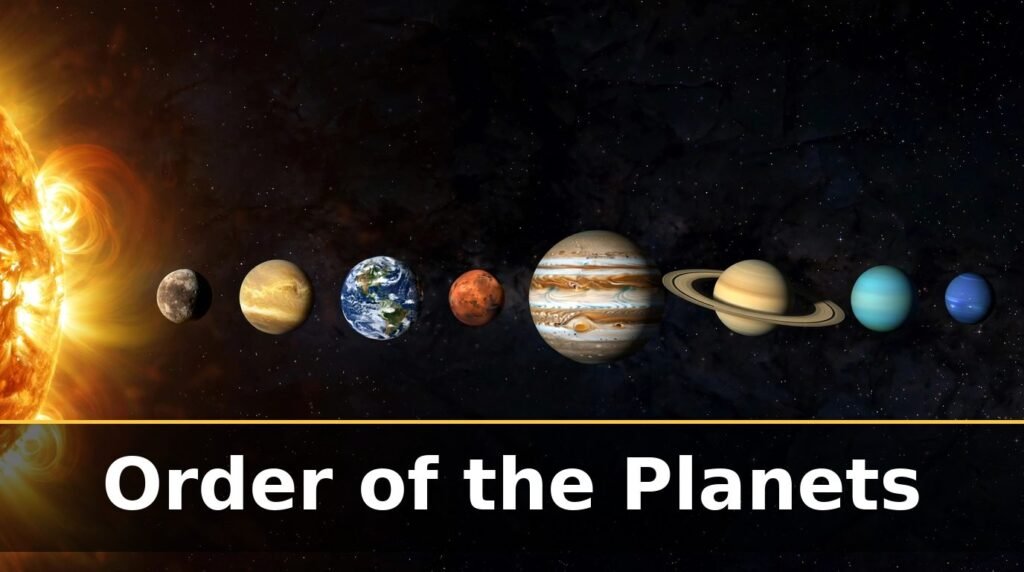
The order of the planets is the sequence of the eight planets from the Sun. If someone asked you right now to name all eight planets in order from the Sun, could you do it without hesitating? Most of us learned the list in school, then quietly forgot half of it somewhere along the way. We remember Mercury is first and Neptune is last, and Earth is in there somewhere, but the middle of the list gets fuzzy fast.
That is completely normal. The order of the planets is one of those things that feels like it should be simple, and in a way it is — there are only eight names to remember. But once you start looking at the distances, the sizes, and how long each planet takes to go around the Sun, the solar system turns out to be far stranger and more interesting than a list on a classroom poster.
This guide walks through the order of the planets one by one, from Mercury out to Neptune, with the real numbers: how far each planet sits from the Sun, how big it is, how long its year lasts, and how long a single day lasts there. You will also find a few memory tricks that actually work, a clear answer on where Pluto fits in now, and a simple way to picture the huge gaps between the planets that no textbook diagram ever shows honestly.
The short answer: The order of the planets from the Sun is Mercury, Venus, Earth, Mars, Jupiter, Saturn, Uranus, and Neptune. Mercury is the closest to the Sun at about 58 million km (36 million miles), and Neptune is the farthest at about 4.5 billion km (2.8 billion miles). The first four are small rocky planets, and the last four are giant planets made mostly of gas and ice. Pluto is no longer counted as a planet — it was reclassified as a dwarf planet in 2006.
What Is the Order of the Planets?
The order of the planets is decided by one thing only: distance from the Sun. The closest planet is first, the farthest is last, and every planet in between falls into place by how far its orbit sits from the Sun. There is no debate about the sequence, no alternative ordering, and nothing about size or discovery date changes it.
Here is the full list, in order:
- Mercury — the closest planet to the Sun
- Venus — the hottest planet in the solar system
- Earth — our home, the only known planet with life
- Mars — the red planet, and the most explored world after Earth
- Jupiter — the largest planet, bigger than all the others combined
- Saturn — the planet with the famous rings
- Uranus — the ice giant that rolls around the Sun on its side
- Neptune — the farthest planet, a deep blue world of supersonic winds
If you only remember one sentence from this article, make it that list. Mercury, Venus, Earth, Mars, Jupiter, Saturn, Uranus, Neptune. Everything else in this guide is there to help that order stick — and to make the numbers behind it feel real.
The Order of the Planets at a Glance
Before we look at each planet one by one, here is the whole solar system in a single table. The distance is given in astronomical units, or AU, where 1 AU is the distance from the Earth to the Sun — about 150 million km (93 million miles). Using AU makes the scale easier to grasp than billions of kilometres.
| # | Planet | Distance from the Sun | Diameter | Length of Year | Length of Day |
|---|---|---|---|---|---|
| 1 | Mercury | 0.39 AU (58 million km) | 4,879 km | 88 Earth days | 59 Earth days |
| 2 | Venus | 0.72 AU (108 million km) | 12,104 km | 225 Earth days | 243 Earth days |
| 3 | Earth | 1.00 AU (150 million km) | 12,742 km | 365.25 days | 24 hours |
| 4 | Mars | 1.52 AU (228 million km) | 6,779 km | 687 Earth days | 24.6 hours |
| 5 | Jupiter | 5.20 AU (778 million km) | 139,820 km | 11.9 Earth years | 9.9 hours |
| 6 | Saturn | 9.58 AU (1.43 billion km) | 116,460 km | 29.5 Earth years | 10.7 hours |
| 7 | Uranus | 19.2 AU (2.87 billion km) | 50,724 km | 84 Earth years | 17.2 hours |
| 8 | Neptune | 30.07 AU (4.5 billion km) | 49,244 km | 164.8 Earth years | 16.1 hours |
A few patterns jump out of that table right away. The first four planets are all relatively close together, within about 1.5 AU of the Sun. Then there is a huge jump to Jupiter at 5.2 AU. And the gaps keep growing — Neptune sits 30 times farther from the Sun than Earth does, and it takes nearly 165 Earth years to complete a single orbit. When Neptune was discovered in 1846, it had not even finished one full trip around the Sun by the time the year 2011 arrived.
1. Mercury — The Closest Planet to the Sun
Mercury is the smallest planet in the solar system and the one that sits closest to the Sun, at an average distance of about 58 million km (36 million miles), or 0.39 AU. It is only slightly larger than Earth’s Moon, with a diameter of 4,879 km, and it has no moons of its own and almost no atmosphere to speak of.
Being close to the Sun has two big effects on Mercury. First, it moves fast. Mercury races around the Sun at about 47 km per second, faster than any other planet, and finishes a full orbit — one Mercury year — in just 88 Earth days. Second, its temperature swings are extreme. With no real atmosphere to trap heat, the side facing the Sun can reach around 430°C (800°F), while the night side can drop to about -180°C (-290°F). That is the largest day-to-night temperature swing of any planet.
Mercury also has one of the strangest days in the solar system. It spins slowly, taking about 59 Earth days to rotate once. But because of the way its spin and orbit line up, a single day on Mercury — from one sunrise to the next — lasts 176 Earth days. So one solar day on Mercury is actually twice as long as its entire year. It is the kind of fact that sounds like a mistake until you check it twice.
Why Mercury is easy to miss
Despite being the closest planet to the Sun, Mercury is not the hottest — that title belongs to Venus, which we will get to next. Mercury is also surprisingly hard to see from Earth. Because it never strays far from the Sun in our sky, it only appears briefly just after sunset or just before sunrise, low on the horizon. Many people go their whole lives without ever spotting it with the naked eye.
2. Venus — The Hottest Planet
Venus is the second planet from the Sun, orbiting at an average distance of about 108 million km (67 million miles), or 0.72 AU. It is almost exactly the same size as Earth, with a diameter of 12,104 km, which is why it is often called Earth’s sister planet. The resemblance ends there.
Venus is wrapped in thick clouds of sulfuric acid, and its atmosphere is mostly carbon dioxide. That blanket traps heat so effectively — a runaway greenhouse effect — that the surface temperature sits around 465°C (869°F), hotter than Mercury even though Venus is nearly twice as far from the Sun. The air pressure at the surface is about 92 times what we feel on Earth, roughly the same as being nearly a kilometre underwater. No spacecraft that has landed on Venus has survived there for more than a couple of hours.
Venus has another oddity: it spins backwards compared to most planets, and it spins very slowly. One rotation takes 243 Earth days, which is longer than its year of 225 Earth days. In other words, a day on Venus lasts longer than a year on Venus. It is the only planet where that is true, and it is one of the most memorable facts in the whole order of the planets.
Why Venus shines so brightly
If you have ever seen a brilliant “star” glowing in the evening or morning sky, brighter than anything else up there, you were probably looking at Venus. Its thick clouds reflect sunlight extremely well, which makes it the brightest planet in our sky. It is often called the Morning Star or the Evening Star, depending on when it appears — but of course it is a planet, not a star at all.
3. Earth — Our Home Planet
Earth is the third planet from the Sun, at a distance of 1 AU — about 150 million km (93 million miles). That distance is the yardstick for the whole solar system: every other planet’s distance is measured against it. Earth takes 365.25 days to orbit the Sun, which is why we add a leap day every four years, and it spins once every 24 hours.
Earth is the largest of the four rocky planets, with a diameter of 12,742 km, and so far it is the only planet known to have life. Liquid water covers about 71% of its surface, and its atmosphere — mostly nitrogen and oxygen — keeps temperatures in a range where that water can stay liquid. Those two facts, water and a breathable atmosphere, are what set Earth apart from every other world on this list.
It is worth pausing on how lucky that position is. Venus is only about 40 million km closer to the Sun than Earth, and Mars is only about 78 million km farther away, yet Venus is a 465°C pressure cooker and Mars is a frozen desert with an average temperature around -63°C (-81°F). Earth sits in the narrow zone where liquid water can exist on the surface, and that “just right” distance is one of the main reasons life got started here and nowhere else we know of.
4. Mars — The Red Planet
Mars is the fourth planet from the Sun, at an average distance of about 228 million km (142 million miles), or 1.52 AU. It is about half the size of Earth, with a diameter of 6,779 km, and it gets its famous red colour from iron oxide — rust — in its soil and dust. It is the planet humans have explored the most after Earth, with orbiters, landers, and rovers studying its surface right now.
A year on Mars lasts 687 Earth days, nearly twice as long as ours. But a day on Mars is surprisingly familiar: it takes about 24.6 hours to spin once, only around 40 minutes longer than an Earth day. That is one reason Mars feels like the most Earth-like planet in some ways, and why it is the main target for future human exploration.
Mars has two small moons, Phobos and Deimos, and it is home to the largest volcano in the solar system. Olympus Mons is about 22 km high — roughly two and a half times the height of Mount Everest — and about 600 km wide. Mars also has a canyon system, Valles Marineris, that stretches for about 4,000 km, long enough to span the entire United States from coast to coast. Ancient riverbeds and dried lake basins show that liquid water once flowed across its surface billions of years ago, even though the planet is cold and dry today.
The Rocky Planets vs the Giant Planets
The first four planets in the order — Mercury, Venus, Earth, and Mars — belong to one family, and the last four belong to another. The difference is so sharp that astronomers split the solar system into two groups. The order of the planets puts the rocky planets first and the giants last.
The four terrestrial (rocky) planets
Mercury, Venus, Earth, and Mars are called terrestrial planets because they are made mostly of rock and metal. They are relatively small, they have solid surfaces you could (in theory) stand on, and they have few or no moons. They are packed close together near the Sun, all within 1.52 AU.
The four giant planets
Jupiter, Saturn, Uranus, and Neptune are the giants. They have no solid surface — they are made mostly of hydrogen, helium, and, in the case of Uranus and Neptune, icy materials like water, ammonia, and methane. They are vastly bigger than the rocky planets, they spin much faster, and they have many moons and ring systems.
| Feature | Rocky planets (Mercury–Mars) | Giant planets (Jupiter–Neptune) |
|---|---|---|
| Made of | Rock and metal | Gas and ice |
| Surface | Solid ground | No solid surface |
| Size | Small (4,879–12,742 km) | Huge (49,244–139,820 km) |
| Moons | 0–2 each | 14–95+ each |
| Distance from Sun | 0.39–1.52 AU | 5.2–30.07 AU |
| Day length | Mostly 24 hours or longer | Under 18 hours |
Jupiter and Saturn are usually called gas giants, while Uranus and Neptune are called ice giants, because they contain a much larger share of icy compounds. Together the four giants hold more than 99% of all the planetary mass in the solar system.
5. Jupiter — The Largest Planet
Jupiter is the fifth planet from the Sun, orbiting at an average distance of about 778 million km (484 million miles), or 5.2 AU. It is the giant of the solar system: with a diameter of 139,820 km, it is more than 11 times wider than Earth, and it weighs more than all the other seven planets combined. More than 1,300 Earths could fit inside it.
Jupiter takes 11.9 Earth years to complete one orbit, but it spins faster than any other planet. One day on Jupiter lasts just 9.9 hours. That rapid spin is part of what drives its dramatic weather. The most famous feature is the Great Red Spot, a storm wider than Earth that has been raging for at least 190 years — some estimates say much longer. Winds inside it can reach speeds of around 400 km per hour.
Jupiter also has the largest family of moons in the solar system, with 95 officially recognised moons. The four biggest — Io, Europa, Ganymede, and Callisto — are known as the Galilean moons, after Galileo Galilei, who discovered them in 1610. Ganymede is the largest moon in the solar system, bigger than the planet Mercury. Europa is one of the most exciting places in the search for life, because it hides a global ocean of liquid water beneath its icy crust.
6. Saturn — The Ringed Planet
Saturn is the sixth planet from the Sun, at an average distance of about 1.43 billion km (886 million miles), or 9.58 AU. It is the second-largest planet, with a diameter of 116,460 km — about nine and a half times wider than Earth — but it is also the lightest planet for its size. Saturn is made mostly of hydrogen and helium, and it is so low in density that it would float in water, if you could find a bathtub big enough.
Saturn is famous for one thing above all: its rings. They stretch about 280,000 km across, yet in most places they are only about 10 metres thick. They are made of countless pieces of ice and rock, ranging from grains of sand to chunks the size of houses, and they are the most spectacular ring system in the solar system. Other giant planets have rings too, but none of them come close to Saturn’s.
A year on Saturn lasts 29.5 Earth years, and a day lasts just 10.7 hours. Saturn has 146 officially recognised moons, the most of any planet. Its largest moon, Titan, is bigger than Mercury and has a thick atmosphere — the only moon in the solar system with one. Titan even has lakes and rivers on its surface, though they are filled with liquid methane instead of water. Another moon, Enceladus, sprays jets of salty water into space from a hidden ocean below its ice, making it one of the most promising places to look for life beyond Earth.
7. Uranus — The Planet on Its Side
Uranus is the seventh planet from the Sun, orbiting at an average distance of about 2.87 billion km (1.8 billion miles), or 19.2 AU. It is an ice giant with a diameter of 50,724 km, about four times wider than Earth, and it takes 84 Earth years to complete a single orbit. It was the first planet discovered with a telescope, spotted by William Herschel in 1781.
Uranus is the oddball of the solar system because it rotates on its side. Most planets spin more or less upright, like a top. Uranus is tilted by about 98 degrees, so it essentially rolls around the Sun on its side. Scientists think it was knocked over by a huge collision long ago. The result is extreme seasons: each pole gets about 21 years of continuous sunlight followed by 21 years of darkness.
Uranus gets its pale blue-green colour from methane in its atmosphere, which absorbs red light and reflects blue. It is also the coldest planet in the solar system by measured temperature, dropping to around -224°C (-371°F), even though Neptune is farther from the Sun. Uranus has 28 known moons, and its moons are named after characters from the works of William Shakespeare and Alexander Pope — a tradition no other planet follows.
8. Neptune — The Farthest Planet
Neptune is the eighth and farthest planet from the Sun, at an average distance of about 4.5 billion km (2.8 billion miles), or 30.07 AU. It is slightly smaller than Uranus, with a diameter of 49,244 km, but a little heavier. A year on Neptune lasts 164.8 Earth years, and a day lasts about 16.1 hours.
Neptune is a deep blue world, coloured by methane in its atmosphere, and it has the fastest winds in the solar system. Storms there can reach speeds of up to 2,100 km per hour — faster than the speed of sound on Earth, and strong enough to cross the planet’s entire face in a matter of hours. A giant dark storm spotted by the Voyager 2 spacecraft in 1989 was later found to have vanished, showing that Neptune’s weather changes fast.
Neptune holds a special place in astronomy history: it was found by mathematics before it was ever seen through a telescope. Astronomers noticed that Uranus was not moving quite as predicted, worked out that an unseen planet must be pulling on it, and calculated where to look. When Johann Galle pointed his telescope at that spot in 1846, Neptune was right there. It is still the only planet discovered by prediction rather than by observation.
Where Does Pluto Fit In?
If you learned the order of the planets before 2006, you probably learned nine of them, with Pluto last. So what happened to Pluto?
In 2006, the International Astronomical Union (IAU) set out a formal definition of what counts as a planet, and Pluto did not meet all three parts of it. A planet must orbit the Sun, be round because of its own gravity, and have cleared its neighbourhood of other objects. Pluto passes the first two tests but fails the third: it shares its region of space with many other icy objects in the Kuiper Belt, and it has not cleared them away. The order of the planets has stayed at eight ever since.
So Pluto was reclassified as a dwarf planet. It is still out there, at an average distance of about 5.9 billion km (39.5 AU) from the Sun, and it is still a fascinating world — NASA’s New Horizons spacecraft flew past it in 2015 and found mountains of ice, a heart-shaped glacier, and a thin atmosphere. But it is not one of the eight planets, and the order of the planets now ends at Neptune.
There are four other officially recognised dwarf planets besides Pluto: Ceres, Haumea, Makemake, and Eris. Eris is actually slightly more massive than Pluto, and its discovery in 2005 is one of the things that forced astronomers to finally settle the question of what a planet is.
How to Remember the Order of the Planets
The classic way to remember the order of the planets is a mnemonic — a sentence where the first letter of each word matches the first letter of each planet. The most famous one is:
My Very Excellent Mother Just Served Us Nachos.
- My — Mercury
- Very — Venus
- Excellent — Earth
- Mother — Mars
- Just — Jupiter
- Served — Saturn
- Us — Uranus
- Nachos — Neptune
If you do not like that one, make your own. The sillier the sentence, the better it sticks — that is half the point. Any sentence with eight words starting with M, V, E, M, J, S, U, N will do the job. Some people prefer to group the planets in pairs instead: Mercury and Venus are the two with no moons, Earth and Mars are the two most Earth-like, Jupiter and Saturn are the two gas giants, and Uranus and Neptune are the two ice giants. Four pairs are easier to hold in your head than eight separate names.
A trick for the distances
The distances are harder to memorise than the names, but one comparison helps: think of the solar system as a neighbourhood. The four rocky planets are all crammed into the first few houses on the street. Then there is a long empty stretch before Jupiter, and the gaps between the giants get bigger and bigger. Jupiter is about five times farther from the Sun than Earth, Saturn is about twice as far as Jupiter, Uranus is about twice as far as Saturn, and Neptune is about one and a half times as far as Uranus. The pattern is not exact, but it gives you a feel for how spread out the outer solar system really is.
Another useful fact: light from the Sun takes about 8 minutes to reach Earth, but it takes more than 4 hours to reach Neptune. When you look at Neptune, you are seeing light that left the Sun hours ago. That is how far away the last planet in the order really sits.
Why the Order of the Planets Matters
Knowing the order of the planets is more than a trivia question. It is the basic map of our neighbourhood in space, and it explains a lot about why each planet is the way it is. Distance from the Sun decides how much heat and light a planet gets, which decides whether water can be liquid, whether an atmosphere can survive, and whether life has any chance at all.
The order also tells the story of how the solar system formed. About 4.6 billion years ago, the Sun formed from a collapsing cloud of gas and dust, and the leftover material flattened into a disc around it. Close to the young Sun, it was too hot for light gases to stick around, so only rock and metal could clump together — that is why the inner planets are small and rocky. Farther out, where it was cold, hydrogen, helium, and ice were plentiful, so the outer planets grew enormous. The order of the planets is a fossil record of that process, still written in the sky.
And it is a useful map for anyone watching the night sky. If you know the order, you know which planets can appear near the Sun in the evening sky and which ones can be seen all night long. Mercury and Venus never stray far from the Sun, so you will only ever see them around sunrise or sunset. Mars, Jupiter, and Saturn can be high overhead at midnight. Once you know the order, the sky stops being a random scattering of bright dots and starts to make sense.
Frequently Asked Questions
What is the order of the planets from the Sun?
The order of the planets from the Sun is Mercury, Venus, Earth, Mars, Jupiter, Saturn, Uranus, and Neptune. Mercury is the closest to the Sun and Neptune is the farthest. This order is based on each planet’s average distance from the Sun.
How many planets are there in the solar system?
There are eight official planets in the solar system. Pluto was once counted as the ninth planet, but it was reclassified as a dwarf planet by the International Astronomical Union in 2006, so it is no longer included in the order of the planets.
What is the easiest way to remember the order of the planets?
The easiest way is the mnemonic sentence “My Very Excellent Mother Just Served Us Nachos,” where each word starts with the same letter as a planet in order: Mercury, Venus, Earth, Mars, Jupiter, Saturn, Uranus, Neptune. Grouping them in pairs also helps: the two moonless planets, the two Earth-like planets, the two gas giants, and the two ice giants.
Which planet is closest to the Sun?
Mercury is the closest planet to the Sun, at an average distance of about 58 million km (36 million miles), or 0.39 AU. It is also the smallest planet, and it completes one orbit in just 88 Earth days.
Which planet is farthest from the Sun?
Neptune is the farthest planet from the Sun, at an average distance of about 4.5 billion km (2.8 billion miles), or 30.07 AU. A single year on Neptune lasts 164.8 Earth years, so Neptune has completed only one full orbit since it was discovered in 1846.
Is Pluto still a planet?
No. Pluto is now classified as a dwarf planet. It was reclassified in 2006 because it has not cleared its orbital neighbourhood of other objects, which is one of the three requirements in the International Astronomical Union’s definition of a planet. Pluto is still a real and interesting world, but it is not one of the eight planets.
What are the rocky planets and the gas giants?
The rocky planets, also called terrestrial planets, are Mercury, Venus, Earth, and Mars — small, solid worlds made mostly of rock and metal. The giant planets are Jupiter, Saturn, Uranus, and Neptune. Jupiter and Saturn are gas giants, made mostly of hydrogen and helium, while Uranus and Neptune are ice giants, containing more water, ammonia, and methane.
Final Thoughts
The order of the planets — Mercury, Venus, Earth, Mars, Jupiter, Saturn, Uranus, Neptune — is one of the simplest lists in astronomy and one of the most rewarding to actually understand. Each name in that list is a whole world, with its own weather, its own moons, and its own story. Mercury’s 176-day sunrise, Venus’s backwards spin, Mars’s giant volcano, Jupiter’s centuries-old storm, Saturn’s impossible rings, Uranus rolling on its side, Neptune’s supersonic winds — none of that shows up in the list itself, but it is all there once you start looking.
If you take one thing away from this guide, let it be this: the solar system is not a neat row of evenly spaced dots. It is a small crowded inner neighbourhood and a vast, mostly empty outer expanse, held together by the Sun’s gravity. The order of the planets is the map of that neighbourhood. Learn the eight names, remember the mnemonic, and the next time you look up at a bright “star” in the evening sky, you will know exactly which world you are looking at — and how far away it really is.
Read Also: Proxima Centauri b: Our Nearest Exoplanet Explained

3 Comments