
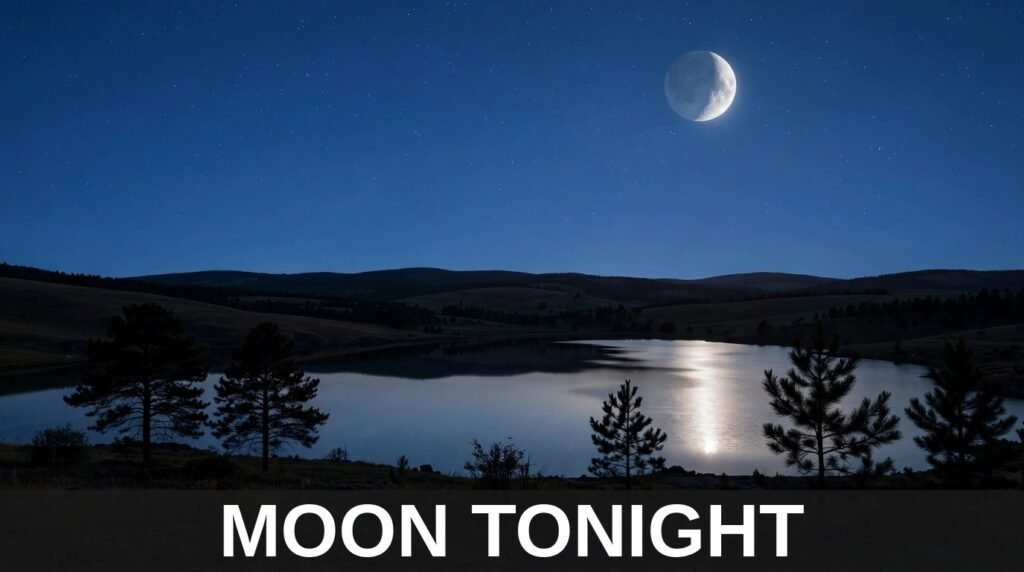
Step outside tonight — Monday, 16 November 2026 — and the Moon is a waxing crescent on the very edge of First Quarter, with roughly 40 to 45 per cent of its Earth-facing side lit by the Sun. It rose around the middle of the day, so by the time darkness falls it is already well up in the southern sky for Northern Hemisphere viewers, and it will stay with you until late in the evening before it sets. If the air is clear, look carefully at the dark part of the disc: you may catch the faint grey glow of earthshine there, sunlight bouncing off the Earth and softly lighting the night side of the Moon.
That is tonight. Tomorrow the lit part will be a little wider, the night after that wider still, and within about a week the Moon will be completely full. The good news is that you never have to guess. This guide shows you how to check the moon tonight — and on any other night of the year — including its phase, how much of it is illuminated, and the exact times it rises and sets where you live. It also walks through what each of the eight phases actually looks like, and how to get a noticeably better view with nothing more than your eyes and an ordinary pair of binoculars.
Tonight’s Moon at a Glance
Here is the quick answer for tonight, 16 November 2026. The sections after this one explain how to find the same details for any date and any town.
| Detail | Tonight |
|---|---|
| Phase | Waxing crescent, one day before First Quarter |
| Illumination | About 40–45% of the visible disc lit |
| Moon age | About 7 days into the cycle (the cycle began with the new moon on 9 November) |
| Moonrise | Around the middle of the day |
| Moonset | Late evening, in the hours before midnight |
| Best viewing window | From dusk until it sinks low in the west late in the evening |
| Next milestone | First Quarter on 17 November 2026 |
One honest caution: rise and set times are local. They shift with your longitude, your latitude and even the hills on your horizon, so treat the times above as the pattern for tonight rather than a promise for your street. Getting your own exact figures takes less than a minute, as you will see below.
How to Check the Moon’s Phase on Any Night
You only ever need three pieces of information: the phase name, the illumination percentage, and the rise and set times. Here is how to get each one, in the order that makes the most sense.
1. Work out where the Moon is in its cycle
The Moon runs through all of its phases in about 29.5 days — the lunar month, counted from one new moon to the next. If you know the date of the last new moon, simple counting tells you roughly where you are. Around day 0 the Moon is new. By day 7 or so it reaches First Quarter and looks half lit. Around day 14 or 15 it is full. Near day 22 it reaches Last Quarter, and by day 29.5 the cycle starts again. Tonight’s Moon, at about seven days old, sits exactly where you would expect: just short of the quarter mark, with a little under half of its face lit.
2. Use a moon phase calendar or an astronomy app
A moon phase calendar — in a printed almanac, in many weather apps, or in a dedicated astronomy app — gives you the phase name and illumination for any date you choose, past or future. The better ones also list the Moon’s age in days and its rise, transit and set times. Two things are worth checking when you use one. First, make sure it is set to your location, because rise and set times are meaningless without a place attached. Second, remember that the illumination figure describes the part of the Moon facing Earth. The Sun always lights exactly half of the Moon; the percentage tells you how much of that lit half we can see from here.
3. Let the moonrise time confirm the phase
Phase and moonrise are locked together, so each one can check the other. The rules of thumb are simple. A new moon rises at about sunrise and sets at about sunset, which is why you never see it. A first quarter moon rises around midday and sets around midnight. A full moon does the opposite of a new moon: it rises at sunset and sets at sunrise, shining all night. A last quarter moon rises around midnight and sets around midday. So if a friend tells you the Moon came up just as the Sun went down, you already know it is within a day of full — no calendar needed.
How to Find Moonrise and Moonset Times for Your Town
People are often surprised that moonrise is not at the same time every night. The Moon travels eastward in its orbit, covering roughly 13 degrees of sky per day. Because of that steady eastward drift, the Earth has to rotate a little further each night to bring the Moon back up over your horizon. The average delay works out at about 50 minutes later per day, though it is not fixed: depending on the season and your latitude, the gap between one moonrise and the next can be closer to half an hour or well over an hour.
For exact times, use a source that lets you enter your town or coordinates. Most good weather apps now include a moon section with rise, set and illumination. Astronomy apps go further and show the Moon’s live position, its altitude above the horizon and the direction (azimuth) where it will appear. Almanac and observatory websites publish daily tables as well. Look for the transit time while you are there: that is when the Moon crosses your meridian, its highest point of the night, and usually your steadiest, clearest view of it.
Two small things catch people out. Rise and set times are calculated for a perfectly flat horizon, so if you live behind hills, a ridge of rooftops or tall trees, the Moon will seem to rise late and set early. And moonrise does not always happen in the east in the same spot — through the month the rising point swings noticeably north and south along the horizon, so scan a wider stretch of skyline than you might expect.
The Eight Moon Phases and What Each One Looks Like
Nothing about the Moon itself changes as it goes through its phases. The Sun lights one half of it at all times. What changes is our viewpoint: as the Moon circles the Earth, we see the lit half from different angles, and the familiar shapes are simply the portions of that lit half turned towards us. Here is the full sequence, in order, with the descriptions written for Northern Hemisphere viewers (in the Southern Hemisphere the lit side appears on the opposite side).
| Phase | Illumination | When it is up | What you will see |
|---|---|---|---|
| New Moon | 0% | Daytime, close to the Sun | Effectively invisible — the dark side faces us and the Moon is lost in the Sun’s glare |
| Waxing Crescent | 1–49% | Evening, following the Sun down in the west | A slim bow of light on the right-hand side; the rest of the disc often glows faintly with earthshine |
| First Quarter | 50% | Afternoon and evening; high in the sky at sunset | Exactly half lit; craters and mountains along the dividing line cast long, sharp shadows |
| Waxing Gibbous | 51–99% | Evening and past midnight | A swelling oval, still lit from the right, growing fatter every night |
| Full Moon | 100% | Rises at sunset, up all night | The whole face lit and very bright, but flat — with the Sun directly behind us, shadows vanish and fine detail washes out |
| Waning Gibbous | 99–51% | Late evening through to morning | The light now shrinks from the right-hand edge; the left side carries the light |
| Last Quarter | 50% | Rises around midnight, high at dawn | The left half lit; a morning moon, often still visible in blue sky after sunrise |
| Waning Crescent | 49–1% | The hours before dawn, low in the east | A thin, ageing crescent; earthshine returns as the lit part dwindles |
Two words in those names do a lot of work. “Waxing” simply means the lit part is growing, night by night, on the way to full. “Waning” means it is shrinking, on the way back to new. And “gibbous” — from a Latin word for a hump — describes any phase where more than half of the face is lit but it is not yet, or no longer, completely full.
Waxing or Waning? A Ten-Second Test
Stand outside, look at the Moon, and check which side carries the light. In the Northern Hemisphere, if the right-hand side is lit, the Moon is waxing — the light is growing towards full. If the left-hand side is lit, it is waning. Generations of sky-watchers have remembered this with the letters D, O, C: as the month advances, the Moon’s lit shape traces a D (waxing, bulging to the right), then a round O at full, then a C as it wanes away. Read the shape like a word and you have the story of the month in order.
The test flips in the Southern Hemisphere, where the left-hand side lights first and a waxing moon looks like a C. Near the equator the crescent can appear to lie almost flat on its back, like a smile or a bowl — sailors once called this the “wet moon,” imagining it could hold water. None of these moons is behaving differently; only your viewing angle on the same geometry has changed.
The Best Time to Look at the Moon, Phase by Phase
Each phase has its own best hour, and its own kind of beauty. A waxing crescent belongs to the early evening: go out just after sunset, face west, and you will find it hanging above the glow where the Sun went down. These are also the finest nights for earthshine, when the dark part of the disc shows up as a soft grey ball cradled in the bright crescent.
Around First Quarter you get what many observers quietly consider the best moon of the month. It is high in a darkening sky at a civilised hour, and because the Sun’s light rakes across its surface at a low angle, the boundary between light and dark — the terminator — is crowded with long shadows that throw craters, mountain ranges and crater walls into relief. You can even spot it in the afternoon, a pale half-moon in blue sky, which surprises people who think of the Moon as strictly a nighttime object.
The full moon plays by different rules. Its great moment is moonrise itself: arrive a few minutes before sunset, face east, and watch the disc lift over the horizon, looking strangely huge — an effect called the moon illusion, produced by your brain comparing it with trees and rooftops rather than empty sky. It is glorious to watch but, photographically and through binoculars, the flat lighting of the following hours actually hides surface detail. The gibbous nights just before and just after full often give you the better bargain: nearly the same brightness, with a terminator still carving shadows somewhere on the face.
The waning phases ask more of your schedule. The last quarter moon rises around midnight and is at its best in a quiet dawn sky, and the old waning crescent is a prize for early risers only, floating low in the east in the hour before sunrise. If you have never seen one, it is worth setting the alarm once — a hair-thin crescent with earthshine, in a brightening sky, is one of the loveliest sights the Moon offers.
Tips for a Clearer View of the Moon Tonight
- Look along the terminator. Wherever you are in the month, the most interesting detail sits on the line between light and shadow. Aim your eyes — or your binoculars — there first.
- Use binoculars if you have them. Any pair helps, and a standard 7×50 or 10×50 set is ideal: wide, bright and easy to hold. Brace your elbows on a wall, a car roof or your knees and the view steadies dramatically.
- Hunt for earthshine on crescent nights. The faint glow on the dark part is sunlight reflected off the Earth. It is strongest in the first few evenings after a new moon and again just before the next one — which makes tonight, with the crescent nearing First Quarter, close to your last good chance this cycle.
- Give it some height. A low moon shimmers and wobbles as its light fights through the thickest air, and haze near the horizon dims it. For a crisp view, wait until it has climbed well clear of rooftops — unless you are deliberately chasing the oversized moonrise effect.
- Photograph it with your phone properly. Tap on the Moon to focus, then drag the exposure down until grey surface markings appear instead of a white blob. Lean the phone against something solid, or use a timer, to kill the shake.
- Check the right forecast. “Clear tonight” in a general forecast can still hide thin, high cloud that veils the Moon. An hourly cloud-cover forecast tells you far more.
- Step away from direct light for faint detail. The Moon itself is bright enough to see from a city centre, but earthshine and the fainter shading on the disc show up much better away from streetlights.
Why You Might Not Be Able to See the Moon Tonight
Every month, someone concludes the Moon has gone missing. It has not — but there are four usual culprits. The first is timing: the Moon spends roughly half its life in the daytime sky, and on some nights it simply rises after you have gone to bed or sets before you go out. The fix is to check the rise and set times before you blame the sky.
The second is direction. The Moon travels along roughly the same path as the Sun, so in the evening it belongs to the southern part of the sky for Northern Hemisphere viewers — if you spent ten minutes scanning the north, you were looking the wrong way. The third is the horizon: buildings, hills and trees can hide a low moon completely, especially a young crescent that never climbs far before setting. And the fourth is the oldest one of all — cloud, sometimes so thin you can see stars through it while the Moon dissolves into a blur. Check the times, face the right way, find a gap in the rooftops, and the “missing” Moon usually turns up.
Key Moon Dates to Put in Your Diary
- First Quarter — 17 November 2026. Tomorrow the Moon reaches the exact half-lit stage, high in the evening sky.
- Full Moon — 24 November 2026. The next full moon, known in North American tradition as the Beaver Moon, rises at sunset and shines all night.
- Last Quarter — 1 December 2026. The half-lit morning moon, rising around midnight.
- New Moon — 8 December 2026 (9 December in UTC). The Moon sits between the Earth and the Sun and disappears from view, resetting the cycle — and giving stargazers their darkest skies of the month.
Frequently Asked Questions
What phase is the Moon in tonight?
It changes slightly every night, so the honest answer always carries a date. The “at a glance” box at the top of this page gives tonight’s phase, illumination and age as this guide is published, and the steps in the checking section above show you how to get the same three facts for any other night in under a minute.
What time does the Moon rise tonight?
There is no single answer — it depends on the phase and on where you live. Around First Quarter, as the Moon is this week, moonrise falls near the middle of the day, which is why it is already high when darkness comes. Near full moon it rises at sunset. For the exact minute in your town, enter your location in a weather or astronomy app’s moon section, and remember the time creeps roughly 50 minutes later from one night to the next.
Why does the Moon look different every night?
Because it is moving. The Moon orbits the Earth once every 27.3 days, and as it travels, the angle between the Sun, the Moon and us keeps changing. The Sun always lights half of the Moon, but from Earth we see a different slice of that lit half each night — a sliver after new moon, half at the quarters, the whole face at full. The full cycle of shapes, new moon back to new moon, takes about 29.5 days.
What does “40% illuminated” actually mean?
It means that 40 per cent of the part of the Moon facing Earth appears lit. It does not mean only 40 per cent of the Moon is receiving sunlight — the Sun always lights exactly one half of the lunar surface. The percentage is purely about our viewpoint, which is why it runs from 0% at new moon to 100% at full and back again.
Can you see the Moon during the day?
Yes — for much of the month, if you know where to look. Around First Quarter the Moon is up for most of the afternoon, pale but unmistakable in a blue sky; around Last Quarter it lingers into the morning. The days near new moon are the exception, when it sits too close to the Sun to pick out, and the full moon is a night-only sight because it is on the opposite side of the sky from the Sun.
How can I tell if the Moon is waxing or waning?
Check which side is lit. In the Northern Hemisphere, light on the right means the Moon is waxing and growing towards full; light on the left means it is waning. In the Southern Hemisphere the pattern is reversed. The D–O–C sequence is the memory aid: a waxing moon resembles a D, the full moon an O, and a waning moon a C.
Conclusion
The Moon is the one astronomical object that rewards even a thirty-second look, and it changes enough from night to night that a quick check before you step outside is always worth it. Tonight you get a plump waxing crescent, a day short of First Quarter, with the terminator doing its best shadow work and a fading trace of earthshine on the dark side. Tomorrow it will be a fraction fatter. Give it a week, and the Beaver Moon will be rising at sunset — and now you know exactly how to check on it, whatever night it is.
Read Also: Strawberry Moon
1 Comment