
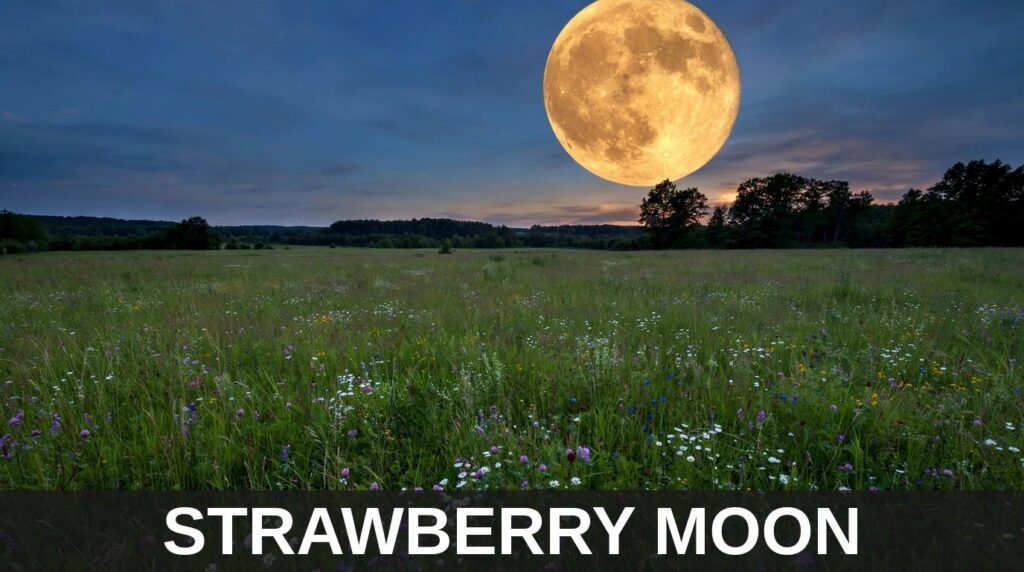
Every June, the full moon arrives with a name that sounds good enough to eat. The Strawberry Moon is the traditional name for June’s full moon, and it has nothing to do with the moon turning pink or red. It is a harvest marker, handed down from Native American tribes who used it as a signal that the wild strawberries were ripe and ready to pick. In 2026, the Strawberry Moon reaches its peak on Monday, June 29, at 7:57 p.m. Eastern Time, and it comes with a couple of quirks worth knowing about before you step outside.
This guide covers what the Strawberry Moon is, where the name came from, the exact date and time for 2026, why the 2026 edition is a little unusual, and the simple steps that will get you the best view of it.
When Is the Strawberry Moon in 2026?
The Strawberry Moon peaks on Monday, June 29, 2026, at 7:57 p.m. EDT, which is 23:57 UTC. That is the moment the moon is at its fullest, with its entire face lit by the sun. Because a full moon happens at a single instant for the whole planet, only the clock reading changes from place to place:
| Time Zone | Peak Illumination |
|---|---|
| Eastern (EDT) | June 29, 7:57 p.m. |
| Central (CDT) | June 29, 6:57 p.m. |
| Mountain (MDT) | June 29, 5:57 p.m. |
| Pacific (PDT) | June 29, 4:57 p.m. |
| United Kingdom (BST) | June 30, 12:57 a.m. |
| Central Europe (CEST) | June 30, 1:57 a.m. |
Here is the part that matters for actually watching it: you do not need to be outside at the exact minute of the peak. The moon looks completely full to the naked eye for about a day on either side, so the evenings of June 28, June 29 and June 30 all give you a full-looking moon. For most people, the finest view comes at moonrise on the night of June 29, when the moon climbs over the southeastern horizon just after sunset, big and golden.
One calendar detail trips people up. Because January 2026 opened with a full moon on January 3, the Strawberry Moon is actually the seventh full moon of the year, not the sixth. The name follows the month, though, not the count. June’s full moon is the Strawberry Moon, whatever number it happens to be.
Why Is It Called the Strawberry Moon?
The name comes from the Algonquian peoples of northeastern North America, and it was shared, in their own languages, by tribes including the Ojibwe, Dakota and Lakota. For these communities, the moons were a calendar written in the sky. Each full moon’s name described what the land was doing at that moment, and June’s moon announced one of the shortest and sweetest harvests of the year: the wild strawberry season.
The wild strawberry that ripens across the northeast and Great Lakes region in June, Fragaria virginiana, does not keep. The berries ripen in a brief rush, often just a couple of weeks, and anything not gathered quickly goes to the birds and animals. A moon that told you the picking had started was genuinely useful information, the kind of reminder a whole community could plan around. The Haida people of the Pacific Northwest had their own version of the same idea, calling this moon the Berries Ripen Moon.
These names survived because they were written down. The Maine Farmers’ Almanac began publishing Native American moon names in the 1930s, and The Old Farmer’s Almanac carried the tradition to a wide readership, pairing the Indigenous names with colonial American and European alternatives. That is why “Strawberry Moon” is now the standard name across North America, even though no single naming system was ever universal. Different nations in different climates watched for different signs, and other tribes had other names for the same moon.
One misconception is worth clearing up, because it spreads every year. The Strawberry Moon is not named for its colour. June’s full moon can look golden or amber when it hangs low in humid summer air, but that is true of any low full moon, and the name would be the same if the moon rose a plain silvery white. It is named for a fruit, not a tint.
Other Names for June’s Full Moon
Strawberry Moon is the best-known name for June’s full moon, but it is far from the only one. Other traditional names for this moon include:
- Rose Moon — the old European name, for the roses that bloom in June. Strawberries are not native to Europe, so European tradition named the moon after its own June harvest of flowers.
- Honey Moon and Mead Moon — European names tied to the belief that late June was when honey was ripe and ready to be gathered from hives, making this the “sweetest” moon of the year. The word “honeymoon” for the weeks after a wedding is often linked to this tradition of June marriages and mead.
- Hot Moon — a straightforward name for the arrival of summer heat.
- Blooming Moon — for the explosion of flowers in early summer.
- Green Corn Moon — marking the stage of the corn crop.
- Birth Moon and Egg Laying Moon — names that reflect the season when many animals give birth and birds are on their nests.
Read together, the names tell one story from several cultures at once: June is a month of abundance, of things ripening, blooming and being born, and every community named the moon after the part of that abundance it depended on most.
What Makes the 2026 Strawberry Moon Different?
Two things set the 2026 Strawberry Moon apart, and both work quietly against its size while rewarding anyone who watches it rise.
It is a micromoon
The 2026 Strawberry Moon is a micromoon, the second and last of 2026. A micromoon is the opposite of a supermoon: it occurs when the full moon falls close to apogee, the point in the moon’s elliptical orbit where it is farthest from Earth, roughly 252,000 miles away. At that distance the moon appears about 7 percent smaller and a little dimmer than an average full moon. Honestly, you are unlikely to notice the difference with your eyes alone. The moon does not keep a reference copy of itself in the sky for comparison. But it is a good reminder that the moon’s size in our sky is not fixed; it breathes in and out a little across the year as the orbit carries it nearer and farther away.
It rides the lowest path of the year
The second quirk is easier to appreciate. A full moon always sits directly opposite the sun in the sky, and in late June the sun is near its highest, following the long, high arc of the summer solstice season. So the full moon does the reverse: it follows the lowest, shallowest arc of any full moon of the year for Northern Hemisphere watchers, rising in the southeast, skimming along above the southern horizon and setting in the southwest without ever climbing high.
A low moon is a dramatic moon. Close to the horizon, the famous moon illusion kicks in and the disc looks noticeably larger than it does overhead, even though its actual size has not changed at all. Its light also has to push through a much thicker layer of air, and in the humid air of a June evening that tends to deepen its colour to gold or amber. Put the two effects together and the 2026 Strawberry Moon should look its best in the first hour after moonrise: low, large-looking and warm-toned, exactly the picture most people imagine when they hear its name.
The Strawberry Moon of 2025 Was One for the Record Books
If the 2026 edition sounds low, last year’s was lower still. The Strawberry Moon of 2025 peaked on Wednesday, June 11, 2025, at 3:44 a.m. EDT, and it was the lowest full moon seen in the Northern Hemisphere in nearly two decades. The reason was a major lunar standstill, a point in the moon’s 18.6-year cycle when its orbit tilts to its greatest extremes and the moon rises and sets at its farthest points along the horizon. Combined with the already-low path of a June full moon, the standstill dragged the 2025 Strawberry Moon down to a crawl just above the southern horizon. It will not hang that low again until 2043.
The comparison is useful for setting expectations. The 2026 Strawberry Moon takes a low path because of the season, as every June full moon does, but the standstill extreme has passed. Expect a pleasantly low, golden moon rather than a once-in-a-generation one, and you will not be disappointed.
How to Watch the Strawberry Moon
Watching a full moon needs no equipment and no expertise, but a little planning turns a glance into an event. Here is what actually helps:
- Watch it rise, not just shine. The best moment is moonrise, shortly after sunset on June 29. A full moon rises in the east to southeast at around sunset, and the first half hour, while it clears the horizon, is when the moon illusion and the golden colour are strongest.
- Find a clear southeastern horizon. Because this moon stays low, buildings, hills and tree lines can hide it for much of the night. A field, a shoreline, a rooftop or the top of a gentle hill facing southeast is ideal.
- Check your local moonrise time. It varies with your location and longitude, so look it up for your own town rather than relying on a national headline time. The peak moment is fixed, but moonrise is local.
- Give it three nights. If clouds spoil June 29, the moon will look just as full on June 28 and June 30. Full moons are forgiving like that.
- Skip the telescope, bring binoculars if you have them. A full moon is so bright that a telescope mostly shows a flat, washed-out disc. Ordinary binoculars, though, reveal the dark lunar seas and the bright ray systems around craters like Tycho beautifully, and they are comfortable to use while the moon is low.
- Photograph it with something in the frame. A low moon photographed beside a barn, a tree line, a church spire or a skyline looks far larger and more striking than the moon alone against black sky. A phone on a steady surface or a tripod will do; tap to focus on the moon and slide the exposure down so the disc does not blow out to white.
Frequently Asked Questions
What is a Strawberry Moon?
The Strawberry Moon is the traditional name for the full moon in June. The name comes from Algonquian Native American tribes, who used it to mark the short season when wild strawberries ripen and are ready to gather. It refers to the time of year, not to the moon’s colour or shape.
When is the Strawberry Moon in 2026?
It peaks on Monday, June 29, 2026, at 7:57 p.m. Eastern Time (23:57 UTC), which is 12:57 a.m. BST on June 30 in the United Kingdom. The moon looks full on the nights of June 28, 29 and 30, and the best view is at moonrise on June 29.
Does the Strawberry Moon actually turn pink or red?
No. The name has nothing to do with colour. Like any full moon near the horizon, it can look golden or amber because its light passes through more of Earth’s atmosphere, but on a clear night it rises the same silvery white as any other full moon once it climbs higher.
Is the Strawberry Moon a supermoon?
Not in 2026. The June 29, 2026 full moon is a micromoon, meaning it falls near apogee, the farthest point in the moon’s orbit. It appears about 7 percent smaller than an average full moon, the opposite of a supermoon.
Why does the Strawberry Moon stay so low in the sky?
A full moon sits opposite the sun. In late June the sun follows its highest path of the year, so the full moon follows the lowest path of any full moon of the year for Northern Hemisphere observers, crossing the southern sky without climbing high.
When was the Strawberry Moon in 2025?
It peaked on Wednesday, June 11, 2025, at 3:44 a.m. EDT. That edition was famous for being the lowest full moon in nearly two decades, an effect of the major lunar standstill, and a full moon will not hang that low again until 2043.
What is the next full moon after the Strawberry Moon?
July’s full moon is the Buck Moon, named for the new antlers growing on male deer at that time of year. In 2026 it follows at the end of July, roughly a month after the Strawberry Moon.
A Sweet Marker for the Start of Summer
The Strawberry Moon has survived for centuries because it earned its place. It told people when to gather food, it marked the turn from spring into summer, and it still gives anyone who looks up a reason to step outside on a June evening. In 2026 it arrives on June 29 as a micromoon on the lowest path of the year, which sounds like a list of drawbacks and is actually a recipe for the most photogenic moonrise of the summer. Find a clear view to the southeast, be there as the light fades, and watch June’s moon come up gold over the fields, just as it did when its name was a piece of practical news rather than a headline.
Read Also: Perseids Meteor Shower
1 Comment