
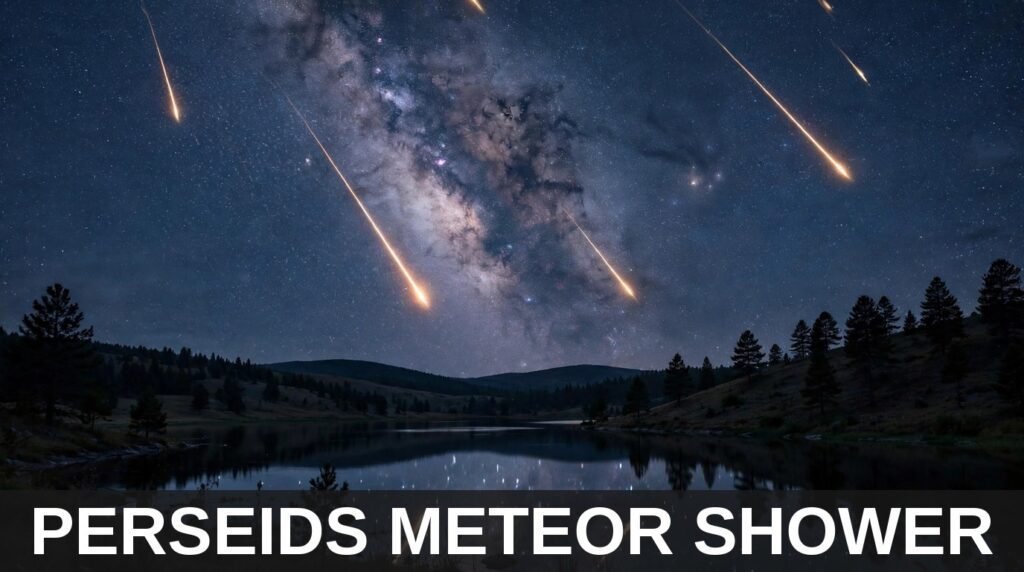
Every August, the night sky puts on the one show that even casual stargazers mark on the calendar. The Perseids meteor shower returns in 2026, and this year it brings a gift that skywatchers rarely get: a peak night with no moonlight at all. The shower reaches its best on the night of August 12–13, 2026, just as the Moon turns new, so the sky stays properly dark from dusk to dawn. If you have ever meant to watch a meteor shower and never quite got around to it, this is the year to finally stay up late.
This guide covers everything you need: when the Perseids peak in 2026, the best hours to be outside, where in the sky to look, how many meteors you can realistically expect, and the simple steps that separate a memorable night from a disappointing one.
What Is the Perseids Meteor Shower?
The Perseids meteor shower is an annual display of shooting stars that appears every summer when Earth passes through a trail of dust and grit left behind by a comet. Each speck of debris — most no bigger than a grain of sand — slams into the upper atmosphere at around 59 kilometres (37 miles) per second. The air in front of it compresses and heats until it glows, and that brief streak of light is what we call a meteor.
The shower takes its name from the constellation Perseus. All of its meteors appear to radiate from one point in that constellation, the way snowflakes seem to stream from a single spot on a car windscreen. That point is called the radiant, and it is simply a trick of perspective — the meteors themselves are spread across the whole sky.
The Perseids have been watched for roughly two thousand years, with the earliest records coming from ancient China. They are loved for good reason: they arrive during warm summer nights in the Northern Hemisphere, they produce plenty of bright meteors, and they are reliable. Unlike some showers that fizzle in poor years, the Perseids almost always deliver.
When Does the Perseids Meteor Shower Peak in 2026?
The Perseids are active for more than a month, from about July 17 to August 24, 2026. Activity builds slowly through late July, climbs steeply in the second week of August, and then fades over the following week. The peak — the night of maximum activity — falls on August 12–13, 2026.
Forecasters at the International Meteor Organization and the American Meteor Society place the predicted maximum at about 14:53 UTC on August 13. Because the Perseid peak is broad rather than a single sharp spike, the mornings of both August 12 and August 13 should be rewarding, and the nights either side of the peak (August 11–12 and 13–14) are still well worth watching if clouds threaten on the main night.
| Perseids 2026 — Key Facts | Details |
|---|---|
| Active period | July 17 – August 24, 2026 |
| Peak night | August 12–13, 2026 |
| Best viewing hours | Midnight to dawn, strongest around 2–4 a.m. local time |
| Moon phase at peak | New Moon on August 12 — no moonlight interference |
| Radiant | Constellation Perseus, rising in the northeast |
| Parent comet | 109P/Swift-Tuttle |
| Typical peak rate | Up to ~100 meteors per hour (ZHR) in a dark sky; 2026 may run somewhat lower |
Why the 2026 Perseids Are Something Special
Moonlight is the meteor watcher’s oldest enemy. A bright Moon washes out the fainter half of any shower, and in many years it sits squarely on the Perseid peak. Not in 2026. The Moon reaches its new phase on August 12, at 17:37 UTC, which means it is absent from the night sky entirely on the one night it matters most. Seasoned observers rate this the darkest Perseid peak since 2021, and the next comparably dark one is years away.
August 12, 2026 is remarkable for another reason: earlier that same day, the Moon passes directly in front of the Sun, producing a total solar eclipse visible along a path crossing parts of Russia, Greenland, Iceland and Spain. Few dates on the astronomical calendar pack an eclipse and a moonless meteor peak into the same 24 hours.
One honest note of caution. The International Meteor Organization’s models suggest that in 2026 Earth passes through a slightly sparser patch of the comet’s debris stream, so peak rates may come in lower than the classic figure of 100 meteors per hour — perhaps a zenithal hourly rate of 30 to 50. There is also a chance that a thin filament of older debris crosses Earth’s path around 01:00 UTC on August 13, give or take a few hours, briefly boosting counts early in the night for observers in Europe and North America. Even at the modest end of the forecasts, a moonless sky shows you far more faint meteors than a moonlit one, so 2026 still promises an excellent show.
What Causes the Perseids? Meet Comet Swift-Tuttle
Every Perseid meteor begins as dust shed by comet 109P/Swift-Tuttle. The comet’s nucleus is about 26 kilometres (16 miles) across — the largest object that makes repeated passes through the inner solar system — and it swings around the Sun once every 133 years. It was last at perihelion in 1992 and is not due back until 2126.
On each pass, sunlight warms the comet and it sheds a stream of dust and small fragments along its orbit. Earth ploughs through that stream every August, and the particles — mostly sand-grain to pea-sized — meet the atmosphere at enormous speed. At 59 kilometres per second, even a grain of sand carries enough energy to ionise the air around it, producing the bright streak we see from the ground, typically burning up around 100 kilometres (60 miles) overhead.
The comet is named after the two astronomers who independently spotted it in 1862, Lewis Swift and Horace Tuttle. When you watch a Perseid burn, you are watching a fragment of that comet — dust that may have been drifting in space for centuries — end its journey in a second of light.
Where to Look: The Radiant in Perseus
The Perseid radiant sits in the constellation Perseus, near the famous Double Cluster and not far from the W-shape of Cassiopeia. From mid-northern latitudes, Perseus clears the northeastern horizon by mid-evening and climbs steadily all night. The higher the radiant climbs, the more meteors you see, which is why the hours after midnight are always better than the evening hours.
Here is the part beginners often get wrong: do not stare directly at Perseus. Meteors that appear close to the radiant leave short trails, because you are looking almost straight down their path. The longest, most dramatic streaks show up 40 to 50 degrees away from the radiant. The practical approach is to lie back, take in as much sky as you can, and let your eyes rest somewhere high and dark — roughly toward the northeast through to overhead. If you trace any meteor’s trail backwards and it points toward Perseus, you have caught a genuine Perseid rather than a random sporadic meteor.
How Many Meteors Will You Actually See?
Shower forecasts quote a figure called the ZHR, or zenithal hourly rate — the number of meteors a single observer would see in one hour under a perfectly dark sky with the radiant directly overhead. The Perseids’ classic ZHR is around 100, though the International Meteor Organization expects a lower figure in 2026, as explained above.
Real life trims that number down. What you actually count depends mostly on your sky:
- City centre: light pollution hides all but the brightest fireballs. Expect a handful of meteors per hour, even at the peak.
- Suburbs: a noticeable improvement — perhaps 10 to 20 per hour at the peak with a reasonably dark patch of sky.
- Rural, genuinely dark sky: this is where the shower earns its reputation. In a typical year, observers count 40 to 60 meteors per hour near the peak; in 2026, plan on the lower half of that range and enjoy anything extra as a bonus.
Two things are worth remembering. First, meteors arrive in bursts and lulls — five in two minutes, then nothing for ten. Give the shower at least an hour before judging it. Second, patience pays better after midnight, when your side of Earth has rotated to face into the debris stream and the radiant stands high.
How to Watch the Perseids: A Simple Plan
You need no equipment at all for this shower — your eyes are the best instrument ever made for it. What makes the difference is preparation. Follow these steps and you will see far more than someone who wanders outside for five minutes.
- Choose your night. Aim for the night of August 12–13, 2026. If the forecast looks cloudy, the nights of August 11–12 and 13–14 are nearly as active.
- Find darkness. Drive away from town if you can. A beach, a hillside, a playing field or a country lane with a clear view of the sky all work. The darker your surroundings, the fainter the meteors you will catch.
- Go out late. The show improves after midnight and is usually strongest between about 2 a.m. and dawn, when Perseus stands high.
- Let your eyes adapt. Full dark adaptation takes 20 to 30 minutes. Every glance at a bright phone screen resets the clock, so put the phone away or switch it to its red night mode, and use a red torch if you need light.
- Get comfortable. A reclining garden chair or a blanket on the ground beats standing with a cricked neck. August nights turn cool after midnight, so bring a warm layer, and something hot to drink never hurts.
- Skip the telescope. Telescopes and binoculars show too small a patch of sky. Meteors can appear anywhere, so the naked eye wins.
- Stay at least an hour. Rates rise and fall. The people who report “I saw nothing” are almost always the people who went back inside after ten minutes.
Watching the Perseids from the Southern Hemisphere
The Perseids are primarily a Northern Hemisphere shower, because the radiant in Perseus never climbs high in southern skies. From southern Australia, South Africa or South America, Perseus stays low in the north and only rises shortly before dawn, so hourly rates are much lower than in the north. It is still worth a look in the pre-dawn hours if you are far from city lights — meteors seen near a low radiant can skim the atmosphere at a shallow angle and produce unusually long, slow trails, a type watchers call earthgrazers. Just set your expectations lower than the headline figures, which are always quoted for northern observers.
Tips for Photographing the Perseids
Photographing meteors is a game of patience and numbers. Set a camera on a tripod with the widest lens you own, focus manually on a bright star, and use a high ISO (1600–3200) with exposures of about 15 to 25 seconds. An intervalometer — or the camera’s built-in interval timer — lets it shoot continuously while you watch from your chair. Point the camera so it takes in a generous area of sky with some landscape for foreground interest; aiming partway between the radiant and overhead is a good compromise, since meteors there show decent-length trails and appear frequently. Take hundreds of frames. Most will hold only stars, but a few will catch a meteor, and one good fireball makes the whole night worthwhile.
Frequently Asked Questions
When is the best time to see the Perseids meteor shower in 2026?
The best night is August 12–13, 2026, and the best hours are after midnight until dawn, with the strongest activity usually between about 2 a.m. and 4 a.m. local time. The shower is active from July 17 to August 24, and the nights immediately before and after the peak are also good.
Will the Moon interfere with the Perseids in 2026?
No — 2026 is one of the best years in a long while. The Moon is new on August 12, so there is no moonlight at all during the peak. That makes this the darkest Perseid peak since 2021.
What comet causes the Perseids meteor shower?
Comet 109P/Swift-Tuttle. Earth passes through the trail of dust it leaves along its 133-year orbit every August, and those dust particles burning up in the atmosphere are the Perseid meteors.
Why are they called the Perseids?
Because their radiant — the point in the sky their trails appear to stream from — lies in the constellation Perseus. Meteor showers are traditionally named after the constellation containing their radiant.
Do I need a telescope or binoculars to watch the Perseids?
No. Meteors can appear anywhere in the sky, so the naked eye, which takes in the whole sky at once, is the best tool. Telescopes and binoculars restrict your view to a tiny patch and will cause you to miss almost everything.
How many meteors will I see per hour?
Under a dark rural sky at the peak, a typical Perseid year produces counts of roughly 40 to 60 meteors per hour for a single observer. Forecasts suggest 2026 may be somewhat quieter than the classic peak, and light pollution reduces numbers sharply — city observers may see only a few per hour.
Can I see the Perseids from the Southern Hemisphere?
Yes, but expectations should be modest. The radiant stays low in the northern sky and only rises before dawn, so rates are far lower than in the Northern Hemisphere. Dark skies and the pre-dawn hours give you the best chance.
Conclusion
The Perseids meteor shower rarely disappoints, and in 2026 the conditions are about as good as they get: a peak on the night of August 12–13 with a new Moon, warm summer weather, and no equipment needed beyond a blanket and a little patience. Pick a dark spot, stay out past midnight, give your eyes time to adjust, and let comet Swift-Tuttle’s ancient dust do the rest. Set the alarm — this is one sky show worth losing a little sleep over.
Read Also: Diomede Islands: Yesterday and Tomorrow, 2.4 Miles Apart
1 Comment