
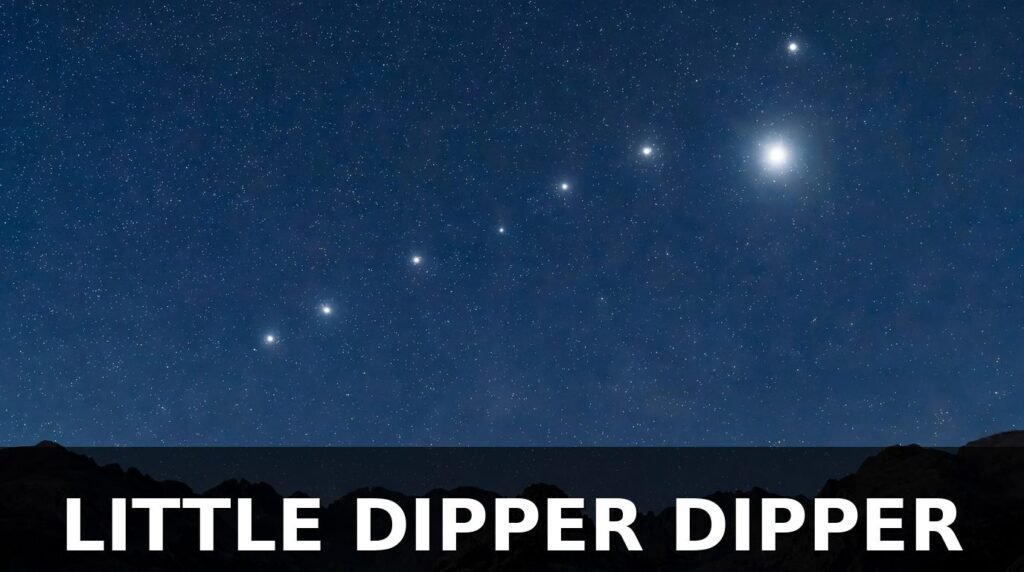
If you have ever stood under a dark sky and tried to find the Little Dipper, you probably know the feeling: the Big Dipper jumps out at you straight away, while its smaller namesake seems to hide. That is not your eyesight failing you — the Little Dipper really is much fainter, and most beginners look for it the wrong way, scanning the sky for a small ladle instead of finding the Big Dipper first and letting it point the way.
So what is the little dipper dipper pattern, exactly? It is a group of seven stars that form the brightest part of the constellation Ursa Minor, the Little Bear. Four stars make a small bowl, three more curve away to form a handle, and at the very tip of that handle sits Polaris, the North Star — the most useful star in the northern sky.
The short answer: The Little Dipper is a seven-star asterism inside the constellation Ursa Minor. Its handle ends at Polaris, the North Star, which sits less than one degree from the north celestial pole. Find the Big Dipper first, follow its two pointer stars about five times their separation, and you land on Polaris — then trace the faint handle back to the Little Dipper’s small bowl.
What Is the Little Dipper Dipper?
The Little Dipper is an asterism, not a constellation. A constellation is an official region of the sky — there are 88 of them, and Ursa Minor is one. An asterism is an informal star pattern inside a constellation. The Big Dipper is an asterism inside Ursa Major in exactly the same way. So when someone says “the Little Dipper”, they mean the seven brightest stars of Ursa Minor, arranged in a ladle shape.
The whole pattern spans roughly 25 degrees across the sky, about the width of your outstretched hand held at arm’s length. Four stars form the bowl, three form the handle, and Polaris caps the end of the handle. The two bowls face each other across the sky, like two ladles pouring into one another.
The Little Dipper is circumpolar for most observers in the Northern Hemisphere, which means it never sets below the horizon. It circles the north celestial pole all night, every night of the year, changing only its orientation. It is not visible from most of the Southern Hemisphere: south of the equator, Polaris sits below the horizon, and the whole pattern goes with it.
The Seven Stars of the Little Dipper
The seven stars are not equally bright, and that unevenness is the whole reason the pattern is hard to spot. Three are reasonably bright. The other four are faint enough for city lights to wipe them out completely.
| Star | Designation | Brightness (magnitude) | Distance from Earth | What it is |
|---|---|---|---|---|
| Polaris | Alpha Ursae Minoris | 1.98 | About 433 light-years | Yellow supergiant, the North Star |
| Yildun | Delta Ursae Minoris | 4.4 | About 183 light-years | White main-sequence star |
| Epsilon Ursae Minoris | Epsilon Ursae Minoris | 4.2 | About 347 light-years | Yellow giant, close binary |
| Zeta Ursae Minoris | Zeta Ursae Minoris | 4.3 | About 380 light-years | White star in the bowl |
| Eta Ursae Minoris | Eta Ursae Minoris | 4.9 | About 97 light-years | White star, faintest of the seven |
| Kochab | Beta Ursae Minoris | 2.08 | About 131 light-years | Orange giant, brightest bowl star |
| Pherkad | Gamma Ursae Minoris | 3.05 | About 487 light-years | White giant, outer bowl star |
In astronomy, a lower magnitude means a brighter star. Polaris, at magnitude 1.98, is the brightest of the seven; Eta Ursae Minoris, at magnitude 4.9, is the faintest, and under anything but a dark sky it simply vanishes. The distances are the commonly cited figures — Hipparcos put Polaris at about 433 light-years, while Gaia measurements suggest closer to 447. Either way, the light you see from Polaris tonight left the star more than four centuries ago.
The four bowl stars are Kochab, Pherkad, Zeta and Eta Ursae Minoris. The three handle stars are Polaris, Yildun and Epsilon Ursae Minoris. Remember that order — handle first, bowl second — and the pattern starts to make sense when you look up.
Polaris: The Star at the End of the Handle
Polaris is the reason the Little Dipper matters. It is not the brightest star in the sky — not even close. Sirius holds that title, and Polaris ranks only around 50th in brightness. What makes Polaris special is its position: it sits less than one degree from the north celestial pole, the point in the sky directly above Earth’s North Pole. It barely moves while the rest of the sky turns around it, and it always marks true north.
That is why sailors, travellers and explorers have relied on Polaris for centuries. Find Polaris, and you are facing north. Its height above the horizon also tells you your latitude: from New York, Polaris sits about 41 degrees above the horizon, because New York sits at about 41 degrees north latitude.
Polaris itself is more interesting than it looks. To the naked eye it is a single steady point of light, but it is actually a triple star system. The star you see is Polaris Aa, a yellow supergiant roughly 46 times the diameter of the Sun and around 2,500 times as luminous, with two fainter companions. It is also a Cepheid variable, pulsing gently in brightness over a cycle of about four days — a change too small to see, but important to astronomers, because Cepheids help measure distances across the universe.
Polaris has not always been the North Star, and it will not always be. Earth’s axis slowly wobbles, a motion called precession that takes about 26,000 years to complete one cycle. Around 1500 BCE, Kochab was the closest bright star to the pole. Polaris will drift closest to the pole, within about half a degree, around the year 2100, and thousands of years from now Vega will take over.
Kochab and Pherkad: The Guardians of the Pole
The two brightest stars in the Little Dipper’s bowl are the easiest part of the pattern to find after Polaris itself. Kochab, the second-brightest star in Ursa Minor at magnitude 2.08, is an orange giant about 131 light-years away. Pherkad, at magnitude 3.05, is a white giant roughly 487 light-years away. Together they form the outer edge of the bowl, the side farthest from the handle.
Ancient skywatchers called Kochab and Pherkad the Guardians of the Pole, because they march in an endless circle around Polaris, never straying far from it. Their position gives a rough sense of the time of night and the season, in the same way the Big Dipper’s handle works as a rough clock.
Kochab has its own claim to fame: about three and a half thousand years ago, it was the closest bright star to the north celestial pole — the pole star of its day. If you can only see three stars of the Little Dipper from where you live — Polaris, Kochab and Pherkad — you are not doing anything wrong. Those three are the bright ones; the other four need a darker sky.
How to Find the Little Dipper Step by Step
Do not start by hunting for the Little Dipper directly. That is the mistake almost everyone makes. The pattern is too faint to pick out of a busy sky by searching. Start with the Big Dipper instead, which is bright enough to find from almost anywhere, and use it as a signpost.
- Face north and find the Big Dipper. Look for seven bright stars in a ladle shape. In spring evenings it rides high in the north-east; in autumn evenings it sits low in the north-west.
- Find the two pointer stars. Look at the outer edge of the Big Dipper’s bowl — the side farthest from the handle. The two stars there are Dubhe (the top one) and Merak (the bottom one).
- Draw a line from Merak through Dubhe and keep going. Extend it out of the bowl, away from the handle, for about five times the distance between the two stars — roughly 25 to 30 degrees, or about three fist-widths at arm’s length.
- The moderately bright star you land on is Polaris. It is not the brightest star in that part of the sky, but it is the brightest one near where the line ends. Once you have it, you have the tip of the Little Dipper’s handle.
- Trace the handle back from Polaris. The handle curves gently away through two faint stars — Yildun, then Epsilon Ursae Minoris — toward the bowl. Use averted vision: look slightly to one side of where you expect the star to be, and your more sensitive peripheral vision will often pick it up.
- Find the bowl. At the end of the handle sits a small four-star bowl. Its two brightest corners are Kochab and Pherkad. Once you have those two, the bowl clicks into place, and you have the whole Little Dipper.
If you get stuck at step five, try binoculars. Even a small pair of 7×50 or 10×50 binoculars will show all seven stars easily, along with the colour difference between orange Kochab and white Pherkad. A telescope is not needed — the pattern is too wide for most telescope views.
A second signpost can help if the Big Dipper is hidden behind a tree or a building. Cassiopeia, the W-shaped constellation on the opposite side of Polaris from the Big Dipper, also points the way: Polaris sits roughly halfway between the Big Dipper and Cassiopeia.
When Is the Best Time to See the Little Dipper?
Because the Little Dipper is circumpolar, there is no season when it is absent. But some nights are much better than others, and the differences come down to darkness, not season.
The single biggest factor is light pollution. From a city centre, you will probably see only Polaris, Kochab and Pherkad. From a suburb, you may catch four or five stars on a good night. From a genuinely dark rural site, all seven appear. Experienced stargazers treat the Little Dipper as a built-in sky-quality meter: count how many of its stars you can see, and you have a rough measure of how dark your sky is. Three stars means heavy light pollution. All seven means a properly dark sky.
The Moon matters too. Around the full Moon, moonlight washes out faint stars just as city lights do, so the best nights are the moonless ones in the week around the new Moon. Give your eyes about 20 minutes to adapt — one glance at a phone screen resets the clock — and use a red torch if you need light.
Little Dipper vs Big Dipper: What Is the Difference?
People mix the two Dippers up constantly, and it is easy to see why — same shape, same part of the sky, similar names. But they are different patterns in different constellations.
| Feature | Little Dipper | Big Dipper |
|---|---|---|
| Parent constellation | Ursa Minor, the Little Bear | Ursa Major, the Great Bear |
| Number of stars | 7 | 7 |
| Brightest star | Polaris, magnitude 1.98 | Alioth, magnitude 1.77 |
| Overall brightness | Faint; only 3 stars easy from town | Bright; all 7 easy from town |
| Contains the North Star? | Yes — Polaris is its handle tip | No — but its pointer stars aim at Polaris |
The simplest rule: if you can see the whole ladle shape easily, you are looking at the Big Dipper. If you can see three stars and have to work to find the rest, that is the Little Dipper. And if someone tells you the North Star is the brightest star in the sky, they are wrong — Polaris is bright, but Sirius, Vega and Arcturus all outshine it. Polaris is famous for where it sits, not for how bright it is.
The Stories Behind the Little Dipper
Ursa Minor is one of the 48 constellations listed by the Greek astronomer Ptolemy in the second century, and the bear story behind it is older still. In Greek myth, Ursa Minor was often linked to Arcas, the son of the nymph Callisto, who was herself turned into the Great Bear, Ursa Major — mother and son placed in the sky together, circling the pole forever. Norse sailors called the pattern the Little Wagon, and in some Arabic traditions Kochab and Pherkad were known as the Two Calves.
The name “Polaris” comes from the Latin Stella Polaris, the pole star. Before that, sailors called it the Lodestar — the star that leads. For centuries, the Little Dipper was the night sky’s compass, clock and calendar in one: Polaris gave direction, the circling of Kochab and Pherkad gave a rough sense of the time of night, and the pattern’s slow turning through the seasons told farmers and sailors where they were in the year.
Common Mistakes When Looking for the Little Dipper
Looking for it directly. The Little Dipper is too faint to find by scanning. Always start from the Big Dipper and follow the pointer stars to Polaris. If you cannot find the Big Dipper, use Cassiopeia’s W shape on the other side of the pole.
Expecting it to look like the pictures. Star charts show a neat, clean ladle. In the real sky, the faint stars blur into the background and the bowl may be upside down depending on the season. Trust the geometry — Polaris, then the handle, then Kochab and Pherkad — rather than the picture in your head.
Trying from a brightly lit street. Street lights destroy your night vision faster than anything else. Walk a few minutes away from direct lights, or at least stand in the shadow of a building.
Giving up too fast. Your eyes need about 20 minutes to adapt to the dark, and the faint stars only appear in the last few minutes. If you step outside and look up straight away, you will see three stars and conclude the rest are not there. Wait, and try again.
Frequently Asked Questions
What is the Little Dipper?
The Little Dipper is a seven-star asterism — a recognisable star pattern — that forms the brightest part of the constellation Ursa Minor, the Little Bear. Four stars make its bowl and three make its handle, which ends at Polaris, the North Star.
How do you find the Little Dipper?
Find the Big Dipper first, then follow its two pointer stars, Dubhe and Merak, in a line about five times their separation. That line lands on Polaris, the tip of the Little Dipper’s handle. From Polaris, trace the faint handle back to the small bowl marked by Kochab and Pherkad.
Is the Little Dipper a constellation?
No. The Little Dipper is an asterism inside the constellation Ursa Minor. Ursa Minor is the official constellation; the Little Dipper is the familiar seven-star pattern within it. The same relationship holds for the Big Dipper, which is an asterism inside Ursa Major.
Why is the Little Dipper so hard to see?
Only three of its seven stars are reasonably bright — Polaris, Kochab and Pherkad. The other four shine at magnitudes between 4.2 and 4.9, which is faint enough for city lights or moonlight to hide them. From a dark rural sky, all seven are visible to the naked eye.
What is the brightest star in the Little Dipper?
Polaris, at magnitude 1.98, is the brightest star in the Little Dipper and in Ursa Minor as a whole. It is not the brightest star in the night sky — Sirius holds that title — but it is the most useful, because it sits less than one degree from the north celestial pole and always points north.
Can you see the Little Dipper all year round?
Yes, from most of the Northern Hemisphere. The Little Dipper is circumpolar, which means it never sets below the horizon. It circles the pole all night, every night of the year, changing only its orientation. It is not visible from most of the Southern Hemisphere.
Final Thoughts
The Little Dipper rewards patience in a way the Big Dipper does not. The Big Dipper gives itself away the moment you look up. The Little Dipper asks you to find the Big Dipper first, to follow a line across the sky, to wait for your eyes to adjust, and to look slightly away from where you think the faint stars should be. That effort is the point. Once you have found it on your own, you will never lose it again — and you will have learned the most practical skill in northern stargazing: how to find north on any clear night, with nothing but your eyes.
So pick a dark, moonless night, give your eyes twenty minutes, and start with the Big Dipper. Follow the pointers to Polaris, trace the handle back to the bowl, and when all seven stars fall into place you will understand why sailors trusted this little pattern with their lives.
For everyday living tips, home ideas and practical guides, DailyOrvix is a handy place to browse.
Read Also: Planets That Are Terrestrial: What Makes a Rocky World
5 Comments