
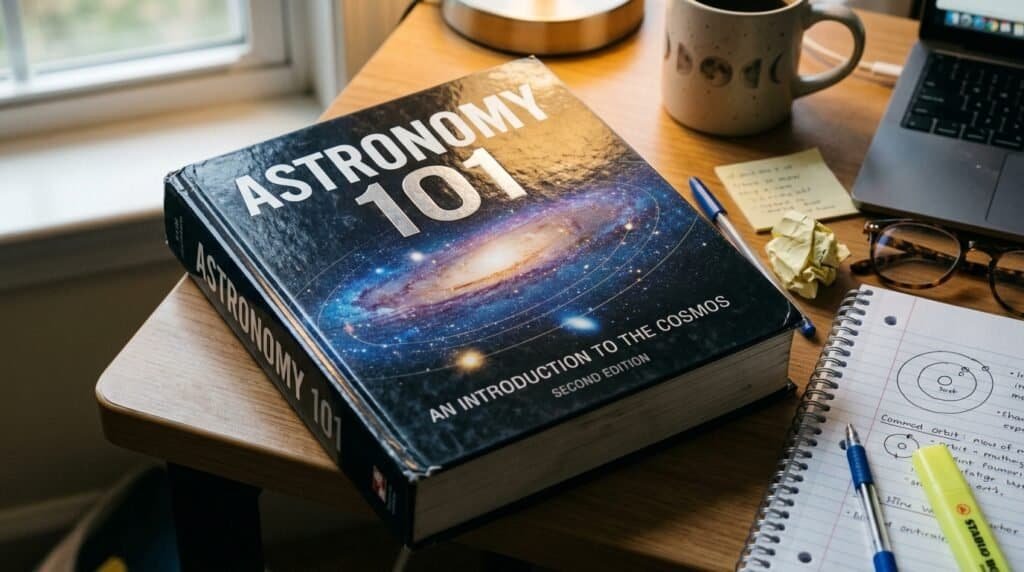
The Astronomy 101 Book: Everything You Need to Know Before You Read It
Step outside on a clear night, far from city lights, and look up. Most of us do this and feel two things at once: wonder, and a quiet frustration that we can’t name a single thing we’re looking at.
The Astronomy 101 book was written for exactly that moment. It’s a compact, beginner-friendly tour of the universe by science writer Carolyn Collins Petersen, covering everything from the Sun and Moon to black holes, dark matter, and the science behind wormholes and warp drive. But is it actually worth your time and money? This guide breaks down what’s inside, who it’s for, how it compares to rivals like Astronomy for Dummies, and what real readers think — so you can decide before you buy.
What Is the Astronomy 101 Book?
Short answer: Astronomy 101: From the Sun and Moon to Wormholes and Warp Drive, Key Theories, Discoveries, and Facts about the Universe is a 288-page beginner’s guide to astronomy, published in 2013 by Adams Media as part of their “Adams 101” series. It reads like a highlights reel of the universe: short, self-contained sections on the planets, stars, galaxies, cosmology, the history of astronomy, and even science-fiction concepts — written for curious readers with no science background.
You don’t read it like a textbook. You dip in. Each section is a few pages long, packed with facts, charts, and photographs, and you can start with whatever interests you — Jupiter’s moons, the Big Bang, the people who figured it all out — without needing what came before.
The book holds a 4.1 out of 5 rating on Goodreads from over 800 ratings, which is solid for a popular-science title. It’s also worth knowing that the publisher has released a second edition with updated coverage of gravitational waves, merging black holes, new exoplanets, and asteroid sample missions — so if you’re buying new, look for the latest edition.
Who Wrote It (And Why That Matters)
A beginner’s astronomy book is only as good as the person explaining things to you. Carolyn Collins Petersen is a professional science writer and the CEO of Loch Ness Productions, a company that creates astronomy and space-science media for planetariums, observatories, and science centers. She has written multiple books on astronomy and planetary science, produced more than seventy-five documentary scripts, and worked on projects like Losing the Dark with the International Dark-Sky Association and science narrations for MIT Haystack Observatory.
That background shows up in the writing. Petersen explains like someone who has spent her career making space science understandable to general audiences — which is precisely what a book like this needs. This isn’t a university professor adapting lecture notes; it’s a communicator who knows where beginners get lost and steers around those spots.
What’s Actually Inside: A Chapter-by-Chapter Tour
The book moves outward in layers — from our cosmic neighborhood to the edge of the observable universe — then loops back through history and finishes with how you can start observing. Here’s the journey:
The Solar System
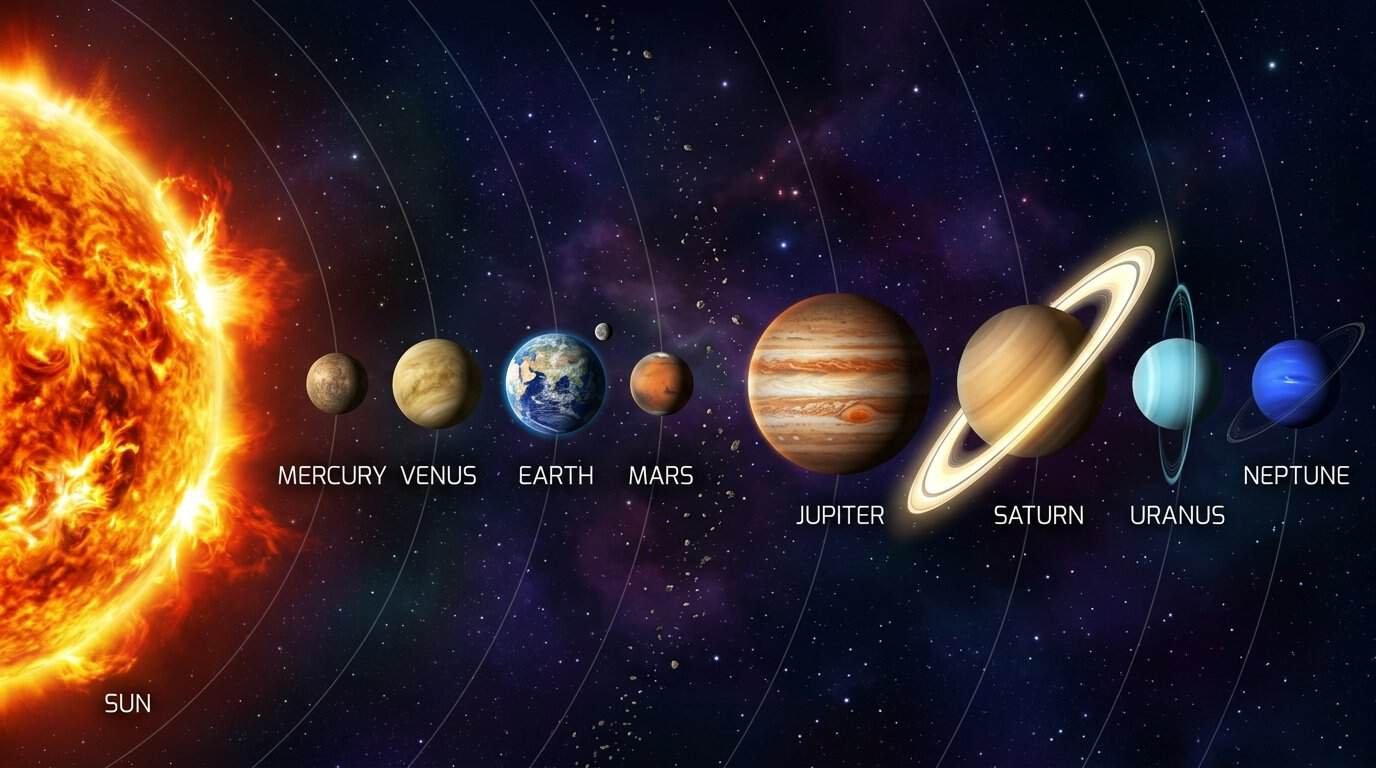
After a quick primer on astronomy terminology, the book walks through the Sun, space weather, and then each planet in order: Mercury, Venus, Earth, the Moon, Mars, Jupiter, Saturn, Uranus, and Neptune — plus Pluto, comets, meteors, meteorites, and asteroids. This is the most practical section. You’ll learn what makes Venus’s crushing atmosphere different from Mars’s dusty deserts, why Jupiter’s Great Red Spot is a storm bigger than Earth, and what Saturn’s rings are actually made of.
Stars, Black Holes, and the Deep Universe
Next comes the stellar lifecycle: how stars are born in clouds of gas and dust, how they live (including our Sun’s long, stable middle age), and how they die — as white dwarfs, neutron stars, or black holes. The coverage of star clusters, nebulae, and black holes is where the book starts to feel genuinely exciting rather than educational.
Galaxies and Cosmology’s Biggest Questions
From there it zooms out again: galaxies, how they form, our own Milky Way, active galaxies and quasars, dark matter, the structure of the universe, gravitational lensing, and the Big Bang. Two chapters deserve special mention. “A Science-Fiction Universe” tackles wormholes and warp drive with real physics — separating what’s theoretically possible from what’s pure storytelling. “Extraterrestrial Life” handles the search for life elsewhere with refreshing honesty about what we know and what we don’t.
The People Behind the Discoveries
One of the book’s strongest sections profiles the astronomers who built modern astronomy: Copernicus, Galileo, Kepler, the Herschels, Newton, Henrietta Swan Leavitt, Edwin Hubble, Einstein, Jocelyn Bell Burnell, Vera Rubin, Clyde Tombaugh, and Mike Brown (the astronomer whose work helped reclassify Pluto). For a beginner, putting faces and stories to the science makes the facts stick.
The Tools, the Missions, and the Future
The final stretch covers how astronomy is actually done: astrophysics, astrobiology, planetary science, and the great observatories — Hubble, the Kepler mission, Chandra, Spitzer, and Fermi. It closes with “The Future of Astronomy” and a final chapter, “You Can Do Astronomy,” which the author herself notes isn’t a how-to guide, but leaves you with practical thoughts on exploring the universe from your own backyard and fighting light pollution.
Who Should Read This Book (And Who Should Skip It)
This book is a great fit if you:
- Are curious about space but have no science background
- Want a broad overview before committing to a deeper book or a telescope
- Like reading in short bursts — each section stands alone
- Are a student, teacher, or parent looking for an accessible reference
- Enjoy the stories behind science, not just the facts
Consider something else if you:
- Already know the basics and want depth — the book stays deliberately shallow
- Want a practical observing guide with star charts (look at NightWatch instead)
- Need a textbook for an actual college astronomy course — try the free OpenStax Astronomy textbook
- Dislike breezy, fact-packed writing and prefer narrative science writing (try Cosmos or Astrophysics for People in a Hurry)
Astronomy 101 vs. Astronomy for Dummies: Which Should You Choose?
These two are the most common head-to-head comparison, so here’s an honest breakdown:
|
Astronomy 101 (Petersen) |
Astronomy for Dummies (Maran) |
|
|---|---|---|
|
Length |
288 pages |
~318 pages |
|
Style |
Fact-packed, section-by-section tour |
Conversational, humor-driven walkthrough |
|
Author background |
Science writer, planetarium media producer |
Professional astronomer |
|
Strongest at |
Breadth — planets to cosmology to sci-fi physics |
Practical observing advice, beginner questions answered |
|
Weakest at |
Depth; some sections feel rushed |
Can feel dated in older editions; humor isn’t for everyone |
|
Best for |
Curious readers who want the full tour fast |
Hands-on beginners who want to start stargazing |
Neither is objectively better — they solve different problems. Astronomy 101 gives you the universe in an afternoon. Astronomy for Dummies is more of a companion for your first year of looking up. If you’re still deciding, think about it this way: pick Astronomy 101 to learn about astronomy; pick Astronomy for Dummies to do astronomy.

What Real Readers Think: The Honest Version
Reader reviews paint a consistent picture. People who came in as casual space fans generally enjoyed it — the short sections, the photographs, and the sheer range of topics kept them engaged, and several reviewers mention it rekindled an interest in space they’d had since school.
The most common criticism is also the most useful to know about: the middle of the book — deep-space objects and the more complex phenomena — can feel dense and confusing compared to the smooth ride of the opening chapters. One reviewer put it well: the book covers a little of everything, which is great for amateurs and casual readers, but anyone looking for depth or specificity will be left wanting more.
That’s a fair assessment. This book’s job is to give you the map, not to walk every trail.
The Second Edition: What’s New
If you’re buying the book today, check which edition you’re getting. The publisher lists a second edition subtitled “From Gravitational Waves and Merging Black Holes to New Exoplanets and Asteroid Samples” — reflecting a decade of discoveries the 2013 original couldn’t include: the first direct detections of gravitational waves, the imaging of black holes, the explosion in known exoplanets, and sample-return missions to asteroids. For a science book, that update matters. Always prefer the newest edition.
How to Get the Most Out of It
- Don’t read it cover to cover in one go. Treat it like a reference you browse. Start with the topics that already fascinate you — that’s how curiosity compounds.
- Keep your phone handy. When a section mentions the Orion Nebula or Saturn’s rings, look up a photo. The book has images, but seeing the real thing cements it.
- Pair it with the actual sky. After reading about constellations or planets, step outside. Free apps like Stellarium or SkySafari will show you what’s above you tonight.
- Use the history chapters as story breaks. If the cosmology sections get heavy, jump to the astronomer profiles. Stories are easier to absorb when facts get thick.
- Follow the bibliography. The reference section at the back points to further reading — it’s your on-ramp to deeper books once a topic hooks you.
Where to Buy and What to Expect to Pay
The book is widely available in hardcover, paperback, ebook, and audiobook formats through major booksellers. Used copies are plentiful and inexpensive — often just a few dollars plus shipping — which makes it a low-risk purchase. New copies typically fall in the standard range for a popular-science hardcover. If budget matters, check your local library first; it’s a common holding.
One tip: because the content is organized in standalone sections, a used copy in good condition is just as useful as a new one for the reading experience — but remember the second edition’s updated science if you’re deciding between editions.
If It’s Not for You: 5 Worthy Alternatives
- **NightWatch by Terence Dickinson** — the gold standard practical guide for actually observing the night sky, with superb star charts.
- **Turn Left at Orion by Guy Consolmagno and Dan M. Davis** — shows you hundreds of night-sky objects visible in a small telescope, and how to find them.
- **Astrophysics for People in a Hurry by Neil deGrasse Tyson** — shorter, punchier, and more focused on the big cosmic ideas.
- **Cosmos by Carl Sagan** — the classic. More poetic and philosophical; less of a reference, more of an experience.
- **The Stars: A New Way to See Them by H. A. Rey* — the beloved, simple guide to learning constellations, recommended by *Astronomy magazine’s editors for decades.
Frequently Asked Questions
Is the Astronomy 101 book good for beginners?
Yes — it’s written specifically for readers with no science background. Short sections, plain language, and lots of illustrations make it one of the most approachable astronomy books available. Just don’t expect depth; it’s a survey, not a deep dive.
How long does it take to read Astronomy 101?
Most readers finish it in a few sittings over a week or two. Because the sections are self-contained, many people don’t read it straight through — they browse the topics that interest them, which can stretch the experience over months.
Is Astronomy 101 a textbook?
No. It’s a popular-science book, not a college textbook. Students taking an actual “Astronomy 101” course should look at their syllabus or a free open textbook like OpenStax Astronomy, which is designed for coursework.
What’s the difference between the first and second edition?
The second edition updates the science with discoveries made since 2013, including gravitational waves, merging black holes, newly discovered exoplanets, and asteroid sample-return missions. The core structure remains the same.
Do I need a telescope to enjoy this book?
Not at all. The book is about understanding the universe, not operating equipment. That said, the final chapter encourages backyard observing — even with just your eyes or a pair of binoculars.
Is Astronomy 101 better than Astronomy for Dummies?
They serve different needs. Astronomy 101 is better for a fast, broad tour of astronomy topics. Astronomy for Dummies is better if you want practical stargazing advice and answers to beginner questions in a conversational style. Many readers eventually own both.
Read Also: Complete Guide to Astronomy Textbook PDF Format: Learn the Universe Your Way
