
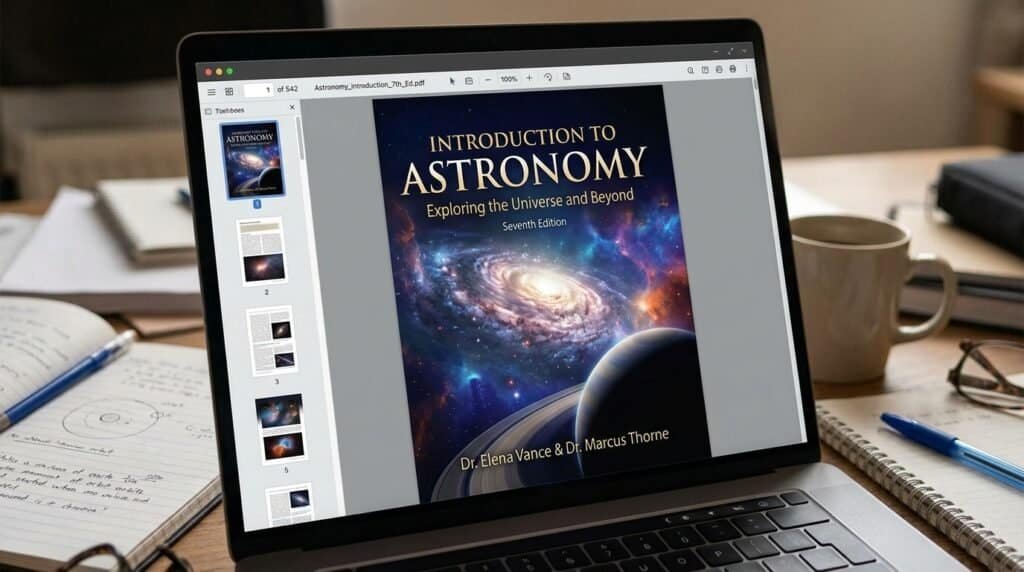
When I first decided to seriously learn astronomy beyond what I could see through a basic telescope, I felt completely lost. I had questions about nebulae, wondered why stars twinkle, and wanted to understand the lifecycle of planets. That’s when I realized I needed a proper textbook, but I also didn’t want to spend hundreds of dollars on thick hardcover books. This led me down the path of exploring astronomy textbook PDFs, and I discovered that this format has genuinely revolutionized how people learn about space.
The beauty of astronomy textbook PDFs is that they’ve made scientific education accessible to people who might not have access to expensive physical textbooks or university libraries. Whether you’re a high school student curious about the cosmos, a college student preparing for exams, or simply an adult who loves stargazing and wants to deepen your knowledge, digital astronomy textbooks offer flexibility, affordability, and convenience that traditional books simply cannot match.
Why Digital Astronomy Textbooks Have Become Essential
The shift toward digital learning materials isn’t just a trend. It’s a fundamental change in how education works in our modern world. When I started my astronomy journey, I could search for specific terms in a PDF instantly instead of flipping through pages in a physical book. I could read while lying in bed, during my lunch break, or even while waiting at the doctor’s office. The versatility is genuinely life changing for people with busy schedules.
Astronomy textbooks in PDF format also tend to be frequently updated. Unlike printed textbooks that become outdated within a few years, digital versions can incorporate new discoveries about black holes, exoplanets, and cosmic expansion. I remember reading about new exoplanet discoveries in a PDF textbook and being able to immediately access additional resources about them online, creating a richer learning experience.
Understanding Different Types of Astronomy Textbooks
Not all astronomy textbooks serve the same purpose, and that’s something I learned through experience. When I picked up my first astronomy textbook, I didn’t realize there were specific types designed for different audiences and learning goals.
Introductory Astronomy Textbooks are designed for people with no previous astronomy knowledge. These books start from basic concepts like constellations and planetary motion, then gradually build toward more complex ideas. I found these incredibly helpful because they don’t assume you know anything, and the authors spend time explaining why things happen the way they do. Examples include discussing why Venus is brighter than Jupiter despite being closer to the sun, or explaining the difference between asteroids and comets in a way that makes sense.
College Level Astronomy Textbooks go much deeper into the physics behind celestial phenomena. These materials discuss spectroscopy, the Hertzsprung-Russell diagram, and stellar evolution in mathematical detail. If you’re taking an astronomy course in college or you have some physics background, these textbooks become invaluable resources. The mathematics involved might seem intimidating at first, but these textbooks typically build up gradually.
Astrophysics Textbooks focus specifically on the physics of stars, galaxies, and the universe itself. These are more specialized and assume readers have a solid understanding of physics principles. I only ventured into these after feeling comfortable with introductory material because astrophysics textbooks don’t have time to explain basic physics.
Observational Astronomy Textbooks emphasize how to actually use telescopes and observe the night sky. These are practical guides that teach you constellation identification, telescope selection, and observation techniques. I found these particularly useful because they connected my theoretical knowledge to actual stargazing experiences.
Specialized Topic Textbooks focus on specific areas like planetary science, cosmology, or black holes. These are great once you’ve developed some foundational knowledge and want to explore specific areas that fascinate you.
Finding Quality Free and Paid Astronomy PDFs
When I first searched for free astronomy textbooks online, I was overwhelmed. There are legitimate open source resources available, but there’s also a lot of pirated content, which I learned to avoid both for ethical and practical reasons. Pirated PDFs often come with malware, and supporting piracy doesn’t help educators who create these valuable resources.
Open Textbook Library and similar platforms provide genuinely free textbooks created by educators and published under creative commons licenses. These aren’t lower quality alternatives either. Many open source astronomy textbooks rival commercially published materials in comprehensiveness and clarity.
Project Gutenberg offers a collection of astronomy books that have entered the public domain. Classic texts like older editions of popular astronomy guides are available completely free and legally. While some information might be dated, the fundamental principles of astronomy remain constant.
NASA and ESA educational resources provide free official materials about space and astronomy. These are incredibly valuable because they come from the actual organizations doing the research. I’ve used NASA’s educational PDFs alongside textbooks to get current information about missions and discoveries.
University OpenCourseWare initiatives allow many institutions to share their course materials freely, including astronomy textbooks and notes. MIT, Yale, and other universities have published textbook-like materials online completely free.
Paid astronomy textbooks available on platforms like Amazon Kindle or specialized academic publishers range from fifty to two hundred dollars typically. Investment in a quality paid textbook makes sense if you’re seriously studying astronomy or if you need a comprehensive reference material that covers everything.
Choosing the Right Astronomy Textbook for Your Level
I made several mistakes when selecting my first astronomy textbook. I picked one that was too advanced, assuming that harder material would help me learn faster. That backfired badly because I felt frustrated and confused rather than excited about learning.
For absolute beginners, choose textbooks that emphasize observation and visual learning. Look for books with lots of diagrams, star charts, and photographs. These make the content more accessible and engaging. The text should explain concepts in everyday language without assuming prior knowledge of physics or mathematics.
For intermediate learners, you can handle some mathematics and more technical explanations. Textbooks at this level typically include discussions of physical principles like gravity, radiation, and the inverse square law, but still explain them relatively simply.
For advanced students, comprehensive textbooks with detailed mathematical treatments become appropriate. These books might discuss spectral analysis, gravitational physics, and statistical methods used in astronomy research.
One approach I’d recommend is reading reviews on educational websites and, if possible, examining a sample chapter or table of contents before purchasing. Many publishers allow you to preview at least part of their textbooks online.
Essential Features of an Excellent Astronomy Textbook
Through my experience, I’ve noticed that quality astronomy textbooks share certain characteristics that make learning more effective and enjoyable.
Clear explanations are non negotiable. Complex concepts like how stars generate energy through nuclear fusion or how galaxies collide need to be explained in ways that build understanding step by step. An excellent textbook anticipates where readers might get confused and addresses those points.
Quality illustrations dramatically improve comprehension. Diagrams showing the solar system, cross sections of stars, or the stages of stellar evolution help cement concepts that would be confusing in text alone. Photographs from observatories and space missions make the material feel real and inspiring.
Chapter summaries and review questions help reinforce learning. After each chapter, I always appreciate textbooks that provide key points to remember and practice questions. These help me assess whether I’ve truly understood the material or if I need to reread certain sections.
Comprehensive indexing matters more than many people realize. When you want to revisit a concept you read about six chapters ago, a good index gets you there instantly. PDFs with searchable text are especially valuable for this reason.
Current information is important in astronomy because new discoveries happen regularly. Textbooks published in the last ten years will include information about exoplanets, gravitational waves, and other modern discoveries. Older textbooks might not mention these topics at all.
Effective Study Strategies with Digital Astronomy Materials
Learning from a PDF textbook requires a different approach than reading a physical book, and I’ve developed strategies that work really well.
Active highlighting and annotation is easier with digital PDFs. I use tools that let me highlight important concepts and add my own notes in the margins. This creates a personalized version of the textbook that reflects my learning journey.
Creating a separate study notebook helps tremendously. I don’t just passively read. I pause regularly to write summaries of what I’ve learned, draw diagrams, and work through problems independently. This active engagement with material leads to much better retention than passive reading.
Cross referencing with visual materials enhances understanding dramatically. After reading about Jupiter’s Great Red Spot in a textbook, I search for photographs from space probes. This combination of theoretical knowledge and visual confirmation creates stronger mental models.
Setting structured learning goals keeps me focused. Rather than trying to read an entire chapter at once, I set goals like learning about one type of star today, or understanding the process of stellar fusion by the end of the week. This paced approach feels less overwhelming.
Regular review sessions prevent forgetting important concepts. I periodically go back to earlier chapters to refresh concepts that form the foundation for advanced topics.
Free vs Paid Astronomy Textbooks: Making Your Decision
This question troubled me for months when I was starting out. Should I save money with free options, or invest in a premium textbook?
The honest answer is that both options have legitimate advantages. Free textbooks work wonderfully if you’re exploring astronomy casually or if you’re just starting to see if you really enjoy the subject. They let you test your interest without financial commitment. Additionally, free options developed by educators often emphasize understanding over profit, creating texts that are genuinely student focused.
Paid textbooks from established publishers typically offer polish and comprehensiveness that results from decades of refinement. They’ve been tested with thousands of students, feedback has been incorporated, and the writing has been extensively edited. If you’re taking a formal astronomy course, the textbook assigned by your professor probably was chosen because it aligns with course objectives.
My recommendation is pragmatic. Start with free resources to explore and build foundational knowledge. Once you know you’re serious about astronomy and have determined your specific interests, invest in a quality paid textbook if needed. Many people never need to purchase anything because free materials prove sufficient for their goals.
Supplementing Your Textbook Learning
Textbooks alone, no matter how excellent, can’t provide everything you need for complete astronomy understanding. I learned this when I realized that reading about constellations in a textbook felt different from actually finding them in the night sky.
Interactive planetarium software like Stellarium shows how the sky looks from any location on Earth at any time. This bridges the gap between theoretical knowledge and real observation.
Educational YouTube channels created by astronomers and science communicators provide video explanations of complex concepts. Sometimes hearing a concept explained verbally while watching animations helps it click in ways that text alone cannot.
Online courses and webinars often accompany textbooks. Many free textbooks have corresponding online courses where instructors discuss the material and answer questions.
Podcast episodes about astronomy let you absorb information during commutes or exercise. I listen to astronomy podcasts where researchers discuss their work, bringing current science to life.
Amateur astronomy communities connect you with people who observe the sky regularly. Discussing what you’ve learned with experienced observers teaches practical skills that textbooks can’t cover.
Conclusion
My journey through various astronomy textbooks in PDF format has genuinely transformed my understanding of the cosmos. What started as curiosity about a few stars has evolved into a deep appreciation for the universe’s complexity and beauty. Astronomy textbooks, whether free or paid, serve as guides through this vast subject, making the incomprehensibly large and distant feel understandable and relevant.
The availability of astronomy textbooks in PDF format represents a democratization of scientific education that would have been unimaginable just two decades ago. Students worldwide can now access the same quality educational materials regardless of their economic circumstances or geographic location. This matters profoundly because it means anyone genuinely interested in understanding the universe can pursue that knowledge.
Whether you’re standing on the next clear night looking up at stars, wondering what lies beyond our solar system, or you’re sitting at a desk working through a challenging astronomy concept, a quality textbook in your digital library becomes an invaluable companion. I encourage you to explore the resources available, find materials that match your learning style and level, and begin your own journey through the cosmos.
5. FREQUENTLY ASKED QUESTIONS
Q1: Are free astronomy textbook PDFs as good as paid ones?
Many free astronomy textbooks, especially those from universities and open textbook initiatives, rival paid textbooks in quality. However, paid textbooks from established publishers often benefit from more extensive editing and updates. Your choice should depend on your specific needs and how serious you are about the subject.
Q2: Where can I legally download astronomy textbooks for free?
Visit Open Textbook Library, Project Gutenberg, NASA educational resources, university OpenCourseWare sites, and your local library’s digital collection. These are all legal sources where astronomy textbooks are freely available.
Q3: What’s the best astronomy textbook for a complete beginner?
Look for introductory textbooks with lots of diagrams and photographs that explain concepts simply without assuming prior physics knowledge. Books that emphasize observation and visual learning work best for beginners getting their first introduction to the night sky.
Q4: Can I use astronomy textbooks for self-study without taking a formal course?
Absolutely. Many people successfully learn astronomy entirely through self-study using textbooks supplemented with online resources, planetarium software, and practical observation. The key is maintaining consistent study habits and actively engaging with the material.
Q5: How should I organize multiple astronomy textbooks for efficient learning?
Use one comprehensive textbook as your primary resource for systematic learning. Supplement it with specialized textbooks for deeper dives into specific topics that interest you. Keep notes about which textbooks cover which topics so you can reference them quickly when you need to explore a particular subject.
Q6: Are older astronomy textbooks still useful?
Older textbooks still teach fundamental astronomy principles that haven’t changed. However, modern astronomy has discovered exoplanets, gravitational waves, and refined our understanding of dark matter and dark energy. For current knowledge, use recently published textbooks, but older editions can still teach basics effectively.
Q7: Can PDF textbooks work effectively on tablets and phones?
Yes, PDF textbooks work well on all devices. Tablets particularly offer excellent reading experiences with good screen size. Many people prefer tablets for studying because they can resize text, take notes, and highlight without needing to print anything.
Q8: How do I know if an astronomy textbook is reliable and accurate?
Check if it’s published by an established academic publisher, if it’s from an open textbook initiative, or if it’s created by a university. Look for author credentials and verify that it covers current astronomical knowledge. Reader reviews on educational platforms also provide insights into reliability and quality.

1 Comment