
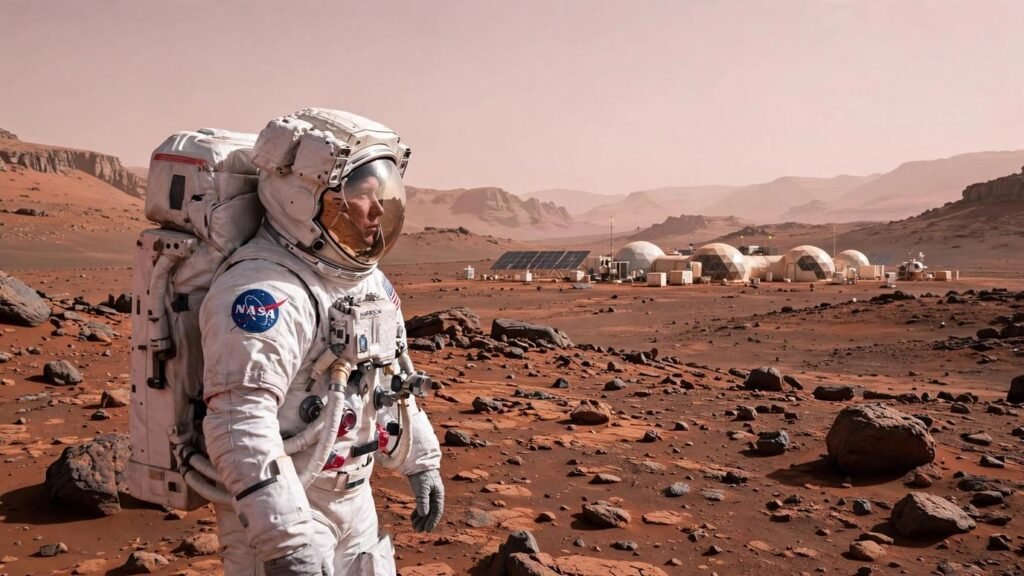
Look at a photo of Mars and it is easy to feel hopeful. The rust-red plains, the dusty sunsets, the polar ice caps — it looks like a place, not just a planet. A place where someone could land, build a home, and stay. That feeling is part of why the question keeps coming back: can humans live on Mars?
It deserves a better answer than a simple yes or no. We have sent rovers, landers, and orbiters to Mars, but knowing a planet and living on it are two very different things. A rover does not need to breathe. People do.
So let us walk through it honestly — what Mars is actually like, what would hurt us there, what we already know how to handle, and what still stands between us and a permanent home on another world.
The short answer: yes, humans could probably live on Mars one day, but not the way we live on Earth. It would mean living indoors, in sealed habitats, under artificial light and recycled air, on a planet that is cold, dry, and bathed in radiation. Mars will not welcome us. We would have to bring our welcome with us.
What Is Mars Actually Like?
Before we talk about habitats and rockets, it helps to picture the place itself. Mars is smaller than Earth, with about half the diameter, and its surface is covered in iron-rich dust that gives it that famous red color. It has mountains, canyons, volcanoes, and dried-up riverbeds that tell us liquid water once flowed there long ago.
But the similarities mostly end at the scenery. Mars has no thick, breathable atmosphere, no magnetic field like Earth’s to shield it from space radiation, and no oceans to soften its climate. A day on Mars, called a sol, is about 24 hours and 37 minutes — surprisingly close to an Earth day — but a year there lasts nearly twice as long as ours, about 687 Earth days, with longer, colder, dustier seasons.
Why Can’t We Just Breathe the Air on Mars?
This is the first and most obvious problem. The Martian atmosphere is about 95% carbon dioxide, and it is extremely thin — roughly 1% of the pressure of Earth’s atmosphere at sea level. Standing on Mars without a spacesuit would be like standing at an altitude far above any mountain on Earth, in air that contains almost no oxygen.
You could not simply take a deep breath and get used to it. Your lungs need oxygen at a certain pressure to work, and Mars cannot provide it. Even the carbon dioxide itself is a problem: in a sealed space, too much CO2 becomes toxic, so a habitat would need constant scrubbing and recycling of its air — something space stations already do, but on Mars it would have to work for months and years with no quick delivery of spare parts.
How Would We Make Oxygen on Mars?
One promising answer is to make it there instead of hauling it all from Earth. NASA’s Perseverance rover carried a small experiment called MOXIE, which successfully produced oxygen from the carbon dioxide in Mars’s atmosphere. It was a small-scale test, not a life-support system, but it proved the basic idea works. A future base would need a much larger version, running reliably day after day, for breathing and possibly for rocket fuel as well.
How Cold Is Mars, Really?
Cold is the next shock. The average temperature on Mars is around -63°C. Nights can plunge far lower, and even a warm summer afternoon near the equator would feel like a bitter winter day on Earth.
This is not just a comfort issue. Cold affects everything: batteries drain faster, materials become brittle, water freezes solid, and machinery needs heating just to keep working. A habitat would need constant power for heating, and anyone stepping outside would need a suit that is essentially a personal spacecraft — insulated, pressurized, and heated. Cold is still one of the more solvable problems: Antarctic research stations cope with brutal lows through insulation and heating. The trick on Mars is doing it with limited power, far from any repair shop.
What About Mars Radiation?
Radiation is quieter than cold, but in some ways more serious. Earth is protected by a thick atmosphere and a magnetic field that deflect much of the harmful radiation from space. Mars has neither. Its thin atmosphere offers little shielding, and it lost most of its magnetic field billions of years ago.
That means astronauts on the surface would be exposed to cosmic rays and solar radiation at levels far higher than on Earth — raising long-term health risks, with a sudden solar storm capable of delivering a dangerous dose in a short time.
How Would Astronauts Stay Safe From Radiation?
The most practical protection is also the simplest: put something between people and the sky. A Mars habitat could be buried under regolith — the loose Martian soil — or built inside a lava tube, a natural underground tunnel. A few meters of soil blocks a great deal of radiation.
Spacewalks would need to be planned around solar weather, with a shelter to retreat to when a storm is forecast. Much of life would happen underground or under cover, and going outside would be a planned expedition, not a stroll.
What Does Low Gravity Do to the Human Body?
Gravity on Mars is about 38% of Earth’s. That sounds like fun — you could jump higher, lift heavier things, and move with a strange, bouncing gait. For a short visit, it probably would be fun. For a long stay, it becomes a health problem.
We know from astronauts on the International Space Station that living without full gravity weakens bones and muscles, shifts fluids in the body, and affects vision. Mars gravity is stronger than the near-weightlessness of orbit, so it might slow those effects, but we honestly do not know by how much — no one has lived in Mars-level gravity for months or years. Exercise would help, as it does in orbit, but a permanent settlement faces a deeper question too: what happens to children born and raised in low gravity? We will not know until someone actually stays long enough to find out.
How Far Away Is Mars, and Why Does That Matter?
Distance is not just a number on a map. Mars and Earth move around the Sun at different speeds, so the distance between them changes constantly; even at its closest, Mars is tens of millions of kilometers away, and a trip there takes months, not days.
That creates two problems. First, communication is delayed — a radio signal takes several minutes each way, stretching to more than twenty minutes when the planets are far apart, so there can be no live conversation with mission control. Second, there is no quick rescue. If something goes badly wrong on Mars, help could be months away, or impossible until the next launch window. A Mars crew would need to be self-reliant in a way no human expedition has ever been before.
Is There Water on Mars?
Water is one of the brighter parts of the story. Mars is not as dry as it first appears. There is water ice at the poles, and ice mixed into the soil in many places. There is also evidence of salty liquid water in some dark streaks on slopes, though that water would be far too salty to drink as it is.
For a settlement, water is everything — for drinking, growing food, making oxygen, and possibly making fuel. Finding it locally matters enormously, because shipping water from Earth is heavy and expensive. Still, “there is ice” is not the same as “there is a tap.” Extracting, melting, filtering, and storing water on Mars, in freezing temperatures with dusty equipment, is a daily industrial job that would never really stop.
What Would a Mars Habitat Actually Look Like?
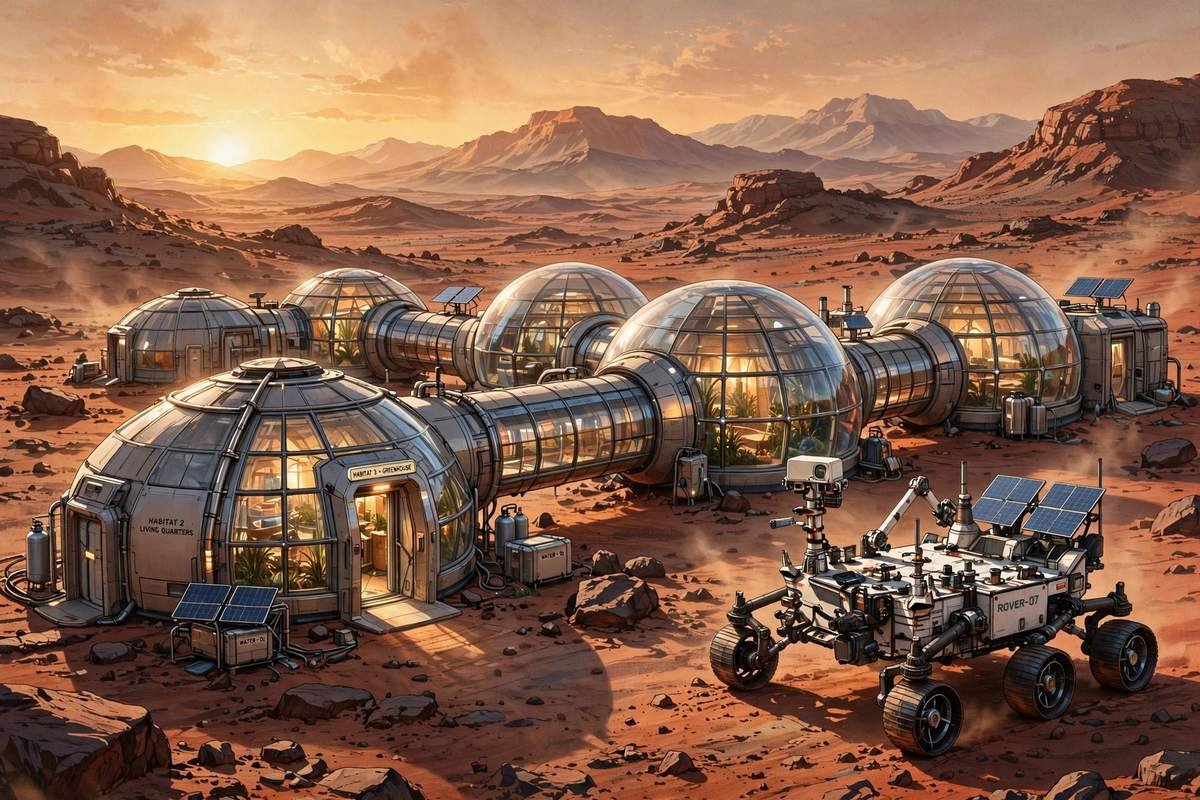
Forget the shiny glass domes of old movie posters, at least for the first bases. A real early Mars habitat would probably look more practical: squat, sturdy modules, partly buried, connected by tunnels, with airlocks between each section so that a leak in one part does not doom the whole base.
Inside, space would be tight, with small private rooms and much of the base given over to machinery — air recyclers, water purifiers, power systems, greenhouses, workshops, and storage. Windows, if they exist at all, would be small and thick, because every opening is a weak point against pressure, cold, and radiation. Over time a growing settlement could become more comfortable, but the first people on Mars would live more like submariners or Antarctic researchers than pioneers in a western. Comfort would come second. Survival would come first.
Can We Grow Food on Mars?
Food sounds simple until you try it. Mars soil, called regolith, is not soil in the farming sense. It lacks the organic matter plants need, and in many places it contains perchlorates — chemicals toxic to humans and harmful to plants. You cannot just plant seeds in Martian dirt and expect a garden.
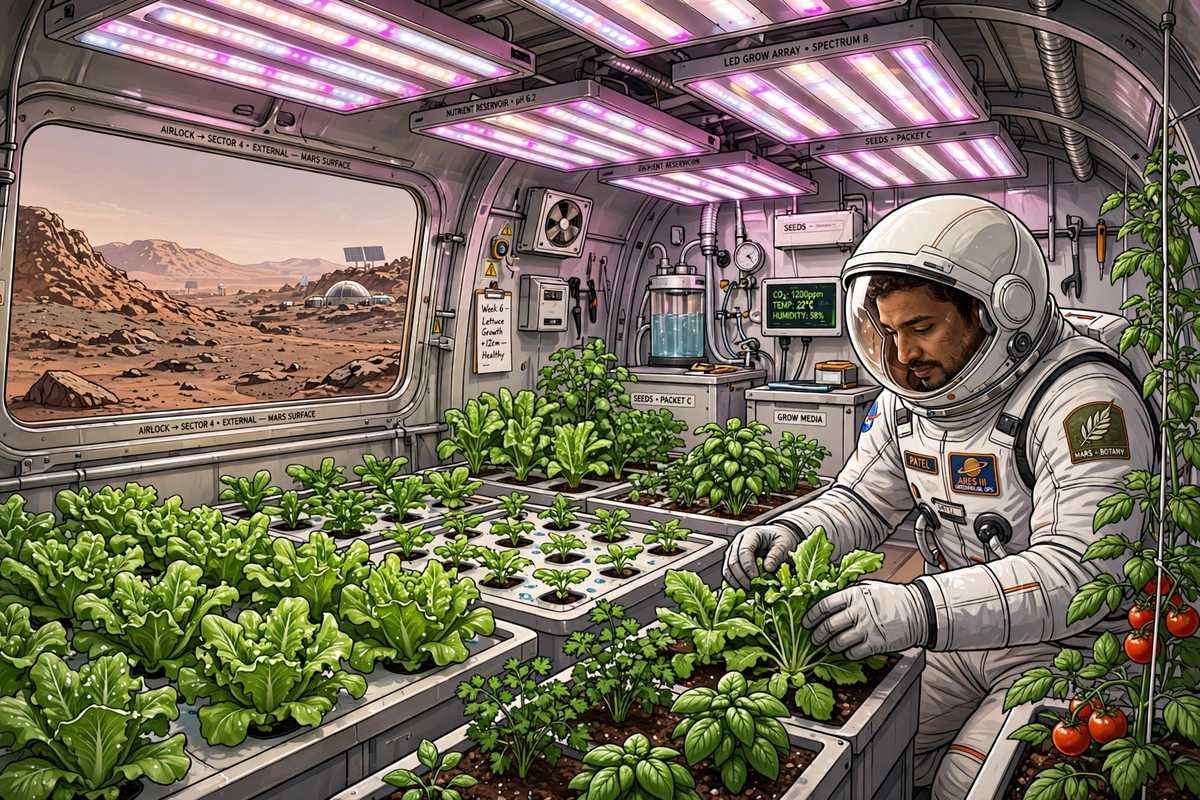
The realistic approach is hydroponics or carefully controlled greenhouses: plants grown indoors, in nutrient solutions or cleaned and treated regolith, under artificial light, in a sealed environment. That works in small-scale tests, but a base could not live on salads alone. It would need calorie-dense, reliable crops, plus protein, plus months of storage. Early missions would bring much of their food from Earth; growing enough to be truly self-sufficient is a goal for later, not for the first landing.
What Are Mars Dust Storms Like?
Mars dust is fine, clingy, and everywhere. It gets into seals, coats solar panels, and sticks to suits and equipment — and sometimes the wind picks it up into storms that can cover the entire planet for weeks.
A global dust storm does not mean hurricane-force winds, since the air is so thin that even fast winds push with less force than a breeze on Earth. The real danger is darkness: thick dust can block sunlight for weeks, cutting solar power just when a base needs heating and life support most. That is why a base that depends only on sunlight is vulnerable, and why nuclear power, batteries, or a mix of sources would need to be planned in from the start.
What Are the Biggest Mars Colonization Challenges, Taken Together?
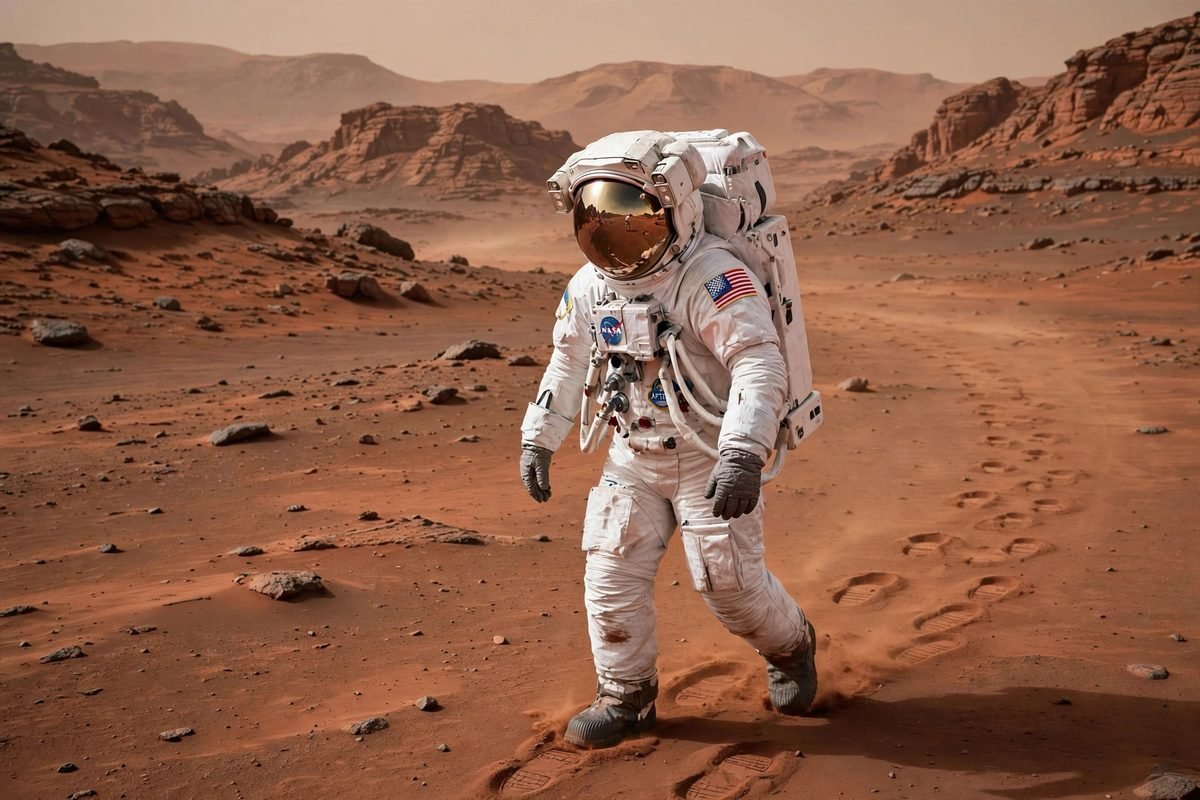
No single challenge on Mars is impossible on its own. We can make oxygen, insulate against cold, shield against radiation, and recycle water and air. The hard part is doing all of it at once, continuously, with a small crew, far from Earth, for years.
Here is how the main challenges compare:
| Challenge | On Earth | On Mars |
|---|---|---|
| Air | Breathable, free | 95% CO2, very thin, must be made and recycled |
| Temperature | Mostly manageable | Average around -63°C, extreme nights |
| Radiation | Shielded by atmosphere and magnetic field | High exposure, needs soil or underground shielding |
| Gravity | 100% | About 38% of Earth’s |
| Water | Abundant in most places | Ice in soil and poles, must be extracted and purified |
And here is how Earth and Mars stack up more broadly:
| Feature | Earth | Mars |
|---|---|---|
| Day length | 24 hours | About 24 hours 37 minutes |
| Year length | 365 days | About 687 Earth days |
| Atmosphere | Thick, oxygen-rich | Thin, mostly carbon dioxide |
| Moons | One | Two small moons, Phobos and Deimos |
| Liquid water on surface | Oceans, lakes, rivers | Mostly ice; ancient riverbeds remain |
None of this means Mars is impossible. It means Mars is a project, not a holiday — one that needs planning, redundancy, and patience.
Could People Live on Mars Permanently?
There is a difference between visiting Mars and living there. A visit might last a year or two, with a return trip planned from the start. Living there permanently means building something that can keep going without Earth — growing food, making fuel, repairing equipment, and eventually making almost everything it needs locally. Most experts who take Mars seriously think of it in stages:
- Short stays by small crews, learning to land, live, and return safely.
- Longer stays in a permanent base, with regular supply missions from Earth.
- A growing settlement that makes more of its own supplies and depends less on Earth.
- A truly self-sustaining colony, if that ever proves possible.
We are still working toward stage one. Stages three and four may be decades away, or further. Mars will not become a second Earth in our lifetimes, but it might, slowly, become a second home for a small number of very determined people.
Frequently Asked Questions
Can humans breathe on Mars without a spacesuit?
No. The atmosphere is mostly carbon dioxide, far too thin, and contains almost no oxygen. An unprotected person would lose consciousness very quickly. A pressurized suit with its own oxygen supply is essential outside a habitat.
How long would it take to get to Mars?
A crewed trip would take several months each way, depending on the launch window and the spacecraft. The exact time varies because Earth and Mars are constantly moving, so mission planners wait for the alignment that gives the shortest, most fuel-efficient route.
Is there oxygen on Mars?
There is a tiny amount of oxygen in the atmosphere, but nowhere near enough to breathe. The useful news is that oxygen can be made from the abundant carbon dioxide, as the MOXIE experiment on Perseverance demonstrated on a small scale.
Would Mars gravity harm astronauts?
It would likely weaken bones and muscles over time, though probably less severely than the near-weightlessness of orbit. Regular exercise would help, but the long-term effects of living in 38% gravity for years are still unknown.
Can plants grow on Mars?
Not outdoors, and not in raw Martian regolith. But plants can grow indoors in greenhouses with treated soil or hydroponics, controlled temperature, artificial light, and recycled water. Food production is one of the key skills a Mars base would need to develop.
What is the biggest danger on Mars?
There is no single answer, because the dangers work together. Radiation is a long-term health risk, the thin cold atmosphere is an immediate survival risk outside, and the distance from Earth means no quick rescue. Together, they demand a base that is sealed, shielded, powered, and self-reliant.
Will humans ever live on Mars permanently?
Probably, one day — but “permanently” is a long way off. The realistic path starts with short missions, then a long-term base, and only much later, if ever, a settlement that does not need Earth to survive. Mars colonization is a generational project, not a single mission.
Conclusion
So, can humans live on Mars? The honest answer is that we can probably learn to — not by changing Mars to suit us, at least not at first, but by changing how we live to suit Mars. Sealed habitats, recycled air and water, manufactured oxygen, shielded shelters, greenhouses, and careful planning could keep people alive on a planet that, left to itself, would kill them in minutes.
That sounds bleak, and in a way it is. But it is also remarkable: every challenge above has at least a partial answer already, tested in space stations, in Antarctica, in laboratories, and by rovers on Mars itself. What we do not yet have is all of those answers working together, for years, millions of kilometers from home. That is the real test ahead — and for the first time in history, living there is a serious engineering question rather than a pure fantasy.
Read Also: How Long Is a Year on Mars? Days & Seasons (2026 Guide)

1 Comment