
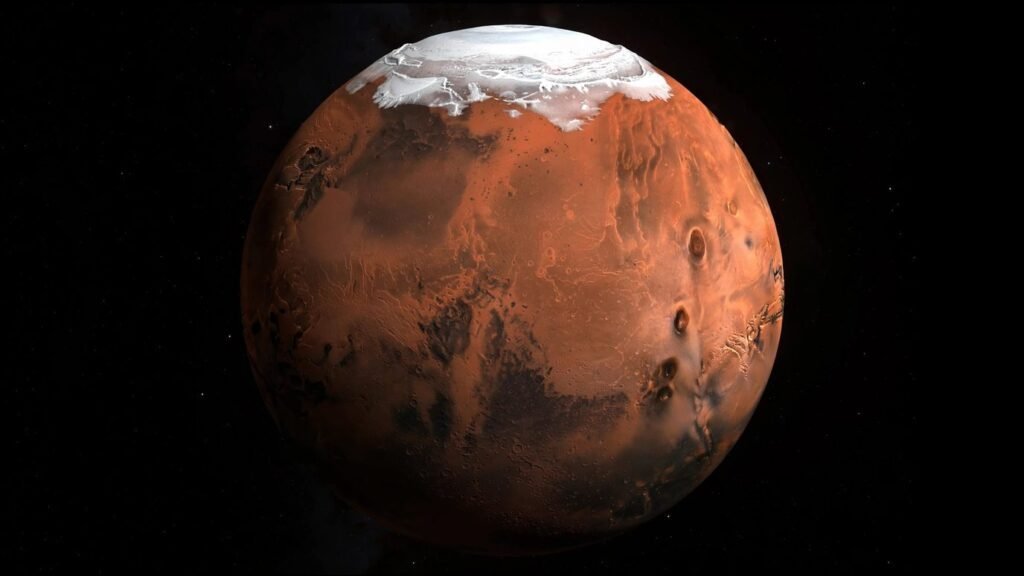
If you moved to Mars tomorrow, your birthday would suddenly become a much rarer event. Not because time itself slows down, but because the planet you are standing on takes far longer to complete one lap around the Sun. On Earth, we measure a year by that single orbit, and we are used to it taking 365 days. Mars plays by the same rule, but on a much bigger track, so its year stretches out to nearly twice the length of ours.
That difference changes more than just birthdays. It shapes how long each season lasts, how mission planners schedule rovers and landers, and even how future settlers might think about calendars. A Martian summer is not a few warm months that fly by; it is a long, slow season that can last the better part of an Earth year. So, how long is a year on Mars, exactly — and what does it actually feel like?
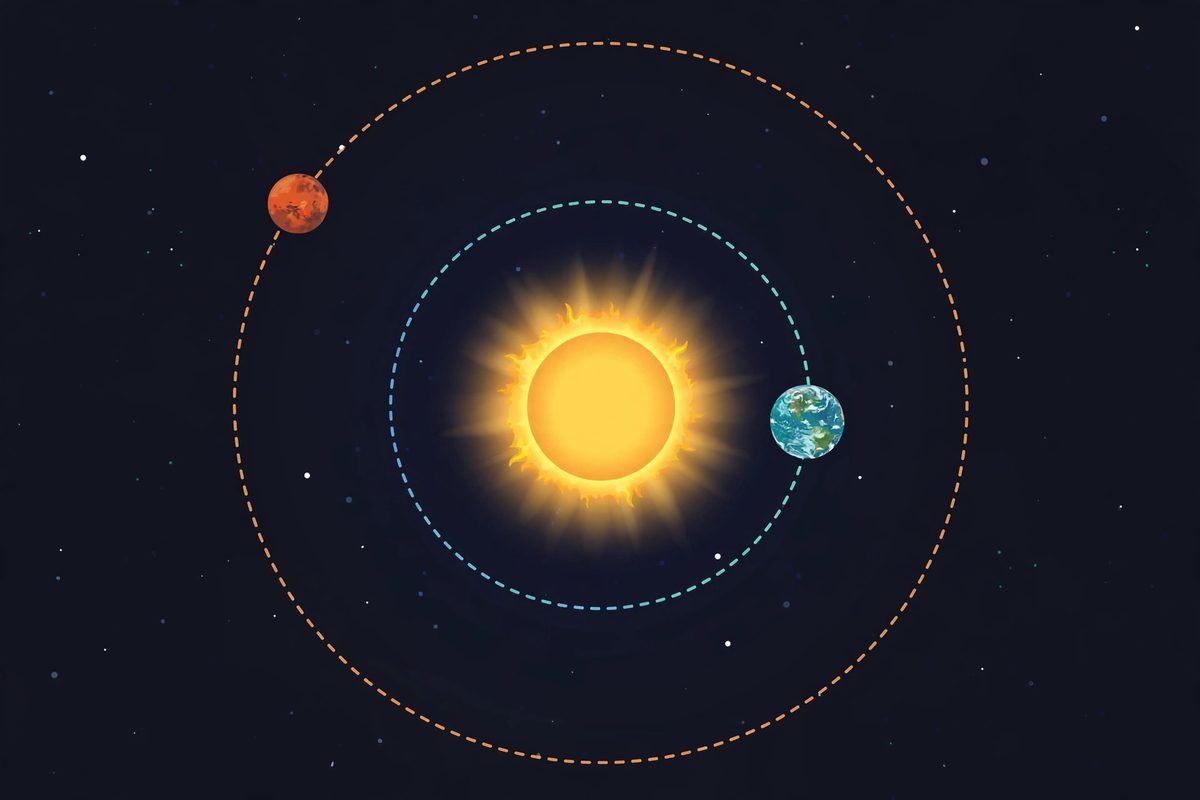
The short answer: a year on Mars lasts 687 Earth days, which is about 1.88 Earth years. Measured in Martian days, called sols, that same year is 668.6 sols long. Mars needs that extra time because it orbits farther from the Sun than Earth does, so it has a longer path to travel and moves more slowly along it.
What Counts as a Year on Mars?
On any planet, a year is simply one full orbit around its star. Earth completes its orbit in about 365.25 days, and Mars completes its orbit in 687 Earth days. There is nothing mysterious about the definition — the interesting part is why the numbers differ so much.
Mars sits roughly one and a half times farther from the Sun than Earth. Its orbit is also a wider loop, so the distance it has to cover on each trip is considerably greater. Add in the fact that planets farther from the Sun move more slowly in their orbits, and you get a year that runs almost twice as long as ours. A child born on Mars would wait nearly two Earth years between birthdays, and a mission planned to last “one Martian year” would need supplies, power, and patience for almost 23 Earth months.
That is also why scientists who work with Mars missions often talk about time in two different ways. Sometimes they use Earth days, because that is the clock mission control lives by. Other times they use sols, the Martian day, because that is the rhythm the rovers and landers actually experience. Both describe the same year — they just count it in different units.
How Many Days Are in a Mars Year?
The headline number is 687 Earth days. If you want to be more precise, a Mars year is 686.98 Earth days, which most sources round to 687. In Martian terms, that works out to 668.6 sols.
Why the two numbers? Because a Martian day is slightly longer than an Earth day. A sol lasts 24 hours, 37 minutes, and 22 seconds. That extra 37 minutes or so adds up over the course of a year, so you need fewer sols than Earth days to fill the same orbit. Think of it like measuring a long road trip in miles versus kilometres: the trip is the same length, but the number changes because the unit is different.
Here is the simple breakdown:
- 1 Mars year = 687 Earth days
- 1 Mars year = 668.6 sols
- 1 Mars year = about 1.88 Earth years
- 1 sol = 24 hours, 37 minutes, 22 seconds
For rover teams, the sol count matters enormously. A rover’s daily routine — driving, taking photos, charging its batteries, communicating with Earth — is planned sol by sol. When a mission is described as lasting a certain number of sols, engineers know exactly how many Martian sunrises and sunsets that means, even though the Earth-day equivalent is a little higher.
Earth vs Mars: A Side-by-Side Comparison
Putting the two planets next to each other makes the difference easy to see. Earth is smaller, closer to the Sun, and faster around its orbit. Mars is farther out, slower, and working with a longer track.
| Feature | Earth | Mars |
|---|---|---|
| Length of a year | 365.25 days | 687 Earth days (668.6 sols) |
| Length of a day | 24 hours | 24 hours, 37 minutes, 22 seconds |
| Average distance from the Sun | About 93 million miles (1 AU) | About 142 million miles (1.52 AU) |
| Orbital speed | About 18.5 miles per second | About 15 miles per second |
| Number of seasons in a year | 4 | 4 |
| Average season length | About 3 months | About 5 to 7 Earth months |
The table tells a story that is easy to miss if you only look at the year length. Mars does not just have a longer year — it has a slower, more stretched-out version of everything. Its days are a little longer, its seasons are much longer, and its whole annual cycle runs at a more leisurely pace.
Why Is a Mars Year So Much Longer?
Two factors work together here: distance and speed. Mars orbits at an average distance of about 142 million miles from the Sun, compared with Earth’s roughly 93 million miles. That means the loop Mars travels is far bigger. On top of that, Mars moves around its orbit more slowly than Earth does, averaging around 15 miles per second versus Earth’s 18.5 miles per second.
The Role of Mars’s Orbit
Mars’s orbit is not a perfect circle, either. It is noticeably elliptical, meaning Mars is sometimes closer to the Sun and sometimes farther away. This is measured by something called eccentricity. Earth’s orbit is close to circular, with an eccentricity of about 0.017. Mars’s eccentricity is about 0.093, which is much more stretched out.
That elliptical shape has real consequences. When Mars is nearer the Sun, it speeds up; when it is farther away, it slows down. It also means the seasons are not all the same length. In the southern hemisphere of Mars, for example, summer comes when the planet is closest to the Sun, so that summer is shorter but more intense. In the northern hemisphere, summer arrives when Mars is farther from the Sun, so it is longer and milder. The same four seasons exist on both hemispheres, but they do not feel identical.
How Distance From the Sun Affects the Year
There is a simple rule at work across the whole solar system: the farther a planet is from the Sun, the longer its year. Mercury, hugging the Sun, finishes a year in just 88 Earth days. Neptune, far out in the cold, takes nearly 165 Earth years. Mars sits between those extremes, and its 687-day year fits the pattern perfectly. It is not an oddity — it is exactly what you would expect for a planet sitting about one and a half times Earth’s distance from the Sun.
How Long Are the Seasons on Mars?
Mars has four seasons, just like Earth: spring, summer, autumn, and winter. But because the Martian year is nearly twice as long, each season lasts roughly twice as long as well. A Martian season typically runs for five to seven Earth months, depending on the hemisphere and the season in question.
That unevenness comes back to the elliptical orbit. Seasons on Mars are not neatly equal quarters of the year. In the northern hemisphere, spring is the longest season, lasting around 194 sols, while winter is the shortest at roughly 154 sols. In the southern hemisphere, the pattern flips: summer is the shortest season, and winter is the longest. So if you were planning a trip to Mars — or a mission — the hemisphere you landed in would change which season felt endless and which one passed quickly.
What Martian Seasons Actually Look Like
Seasons on Mars are driven by the tilt of the planet’s axis, just as they are on Earth. Mars tilts at about 25.2 degrees, very close to Earth’s 23.5 degrees. That similar tilt is one reason Mars feels like the most Earth-like planet in terms of seasonal behaviour. As Mars moves around the Sun, different hemispheres tilt toward or away from sunlight, creating the same cycle of warming and cooling we experience here.
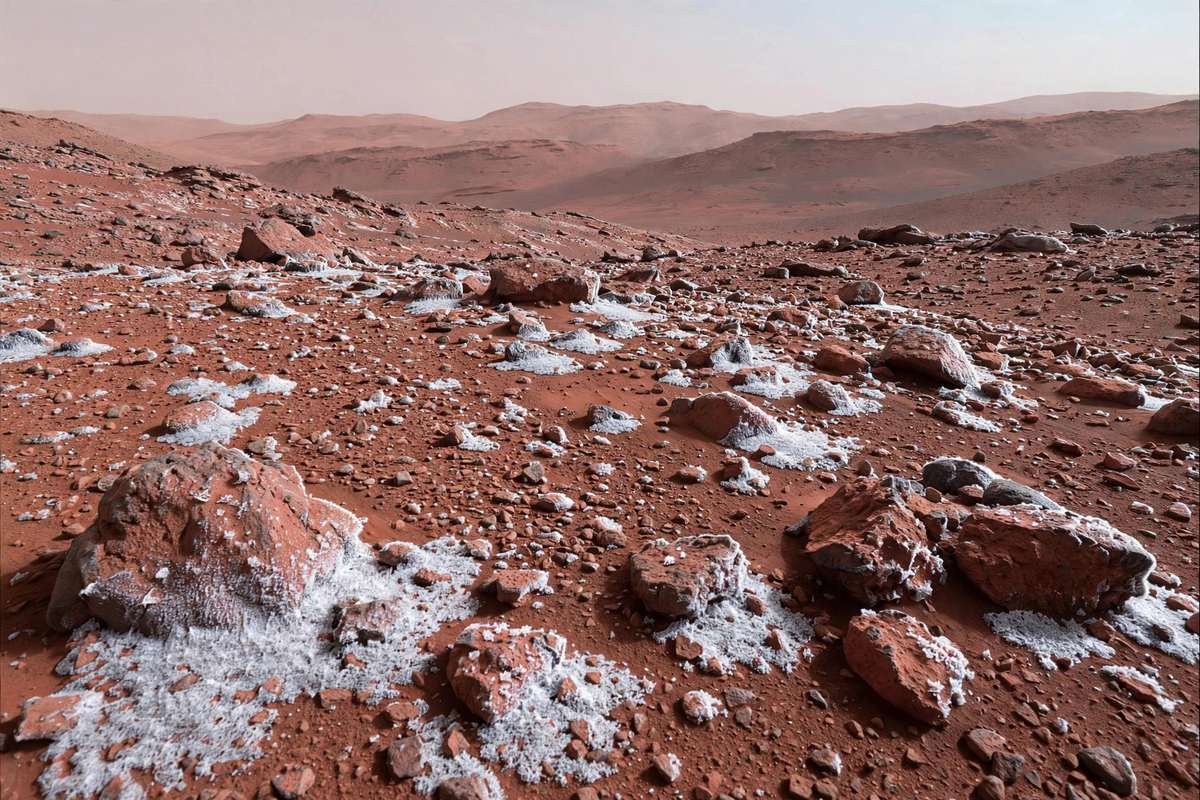
What is different is what those seasons do to the surface. Mars has polar ice caps made of water ice and frozen carbon dioxide. As the seasons change, those caps grow and shrink dramatically. In winter, carbon dioxide from the atmosphere freezes onto the polar cap, and in summer it sublimates — turns directly from ice back into gas — and returns to the atmosphere. From orbit, you can watch the caps visibly expand and retreat with the seasons, like a slow-motion breathing of the planet.
Mars Seasons and Dust Storms
Seasons on Mars also bring dust storms. The most dramatic ones tend to occur during southern spring and summer, when Mars is closest to the Sun and the extra warmth stirs up the atmosphere. Most dust storms are local and short-lived, but occasionally a regional storm grows into a planet-encircling event that can dim the skies for weeks. For solar-powered rovers, that matters: less sunlight means less power, and mission teams have to plan around the Martian seasonal calendar to keep their machines safe.
What Is a Sol, and Why Do Mars Missions Use It?
A sol is a Martian solar day — the time it takes Mars to rotate once relative to the Sun. At 24 hours, 37 minutes, and 22 seconds, it is only about 2.7 percent longer than an Earth day. That small difference sounds trivial until you try to run a mission on it.
Rover teams famously live on Mars time during the early part of a mission. Their workday shifts about 40 minutes later every Earth day, so within a couple of weeks they are working through the night by Earth clocks. It is disorienting, but it is the only way to stay in sync with a rover that wakes with the Martian sunrise and sleeps at Martian sunset. Counting in sols keeps everyone honest about what the rover is actually experiencing.
Sols are also the natural unit for describing a Martian year. Saying a year is 668.6 sols long immediately tells a mission planner how many day-night cycles a lander will endure, how many times its batteries will charge and drain, and how much wear its instruments will accumulate. Earth days are useful for talking to the public; sols are useful for running the mission.
The Martian Year Length in Everyday Terms
Numbers like 687 days can feel abstract, so it helps to translate them into everyday life. If you lived on Mars, here is what a year would mean in practice:
- Your birthday would come around once every 687 Earth days — so you would celebrate roughly half as often as you do now.
- A school year, if it followed the seasons, would stretch across almost two Earth years.
- A summer holiday planned around the warmest months would last five to seven Earth months, not three.
- A one-year work contract on Mars would keep you there for nearly 23 Earth months before it ended.
- A rover mission designed to last one Martian year would need to survive almost two Earth years of dust, cold, and radiation.
That is why the Martian year length is not just a trivia fact. It is a practical constraint that shapes how missions are designed, how long astronauts might one day stay, and how any future settlement would organise its calendar, its agriculture, and its seasons.
How Does Mars’s Year Compare to Other Planets?
Mars sits in a sweet spot in the solar system. Its year is long compared with Earth’s, but short compared with the gas giants and ice giants. Here is how a few familiar planets stack up:
| Planet | Length of a year (Earth days) |
|---|---|
| Mercury | 88 days |
| Venus | 225 days |
| Earth | 365.25 days |
| Mars | 687 days |
| Jupiter | 4,333 days (about 11.9 Earth years) |
| Saturn | 10,759 days (about 29.4 Earth years) |
| Neptune | 60,190 days (about 164.8 Earth years) |
Seen this way, Mars is not extreme at all. It is the next step outward from Earth, and its year length follows naturally from its position. What makes Mars special is not that its year is unusually long, but that it is long enough to matter for human planning while still being short enough to imagine living through — unlike a year on Neptune, which no human lifetime could ever span.
Do Martians Have a Calendar?
Mars does not have an official calendar, because nobody lives there yet. But people have already designed several, just in case. The best known is the Darian calendar, created by aerospace engineer Thomas Gangale. It divides the Martian year into 24 months — 20 months of 28 sols and 4 months of 27 sols in a typical year — with names drawn from the constellations of the zodiac and other sources. The Darian calendar also includes a system for leap years, because 668.6 sols is not a whole number, and any calendar needs a way to handle that leftover fraction.
Other proposals exist too, ranging from simple adaptations of the Earth calendar to entirely new systems built around Martian seasons. None of them is official, and none will be until there are people on Mars who actually need one. But the fact that engineers have thought this carefully about it tells you something: a calendar is not just a way of counting days. It is a way of organising a society, and a Martian society would need one that fits its own sky.
For now, scientists use a simpler system. They often count sols since a mission landed, or they refer to the solar longitude — a measure of where Mars is in its orbit — to describe the season. That is precise enough for science, even if it would be a strange way to plan a birthday party.

Why the Length of a Mars Year Matters for Future Astronauts
If humans ever live on Mars for extended periods, the length of the Martian year will shape daily life in ways that go beyond birthdays. Food production, for instance, would have to adapt to seasons that last half an Earth year or more. A crop that grows in a Martian spring would have months, not weeks, to mature — which could be an advantage, but only if greenhouses and habitats are designed for it.
Energy planning matters too. Mars is farther from the Sun, so sunlight is weaker there — roughly 43 percent as intense as on Earth. Combined with long winters and dust storms, that means power systems need to be built for long, dark stretches. A habitat that can survive a Martian winter has to be far more self-sufficient than anything we build for an Earth winter.
Psychologically, a 687-day year would also change how people experience time. On Earth, the annual cycle of seasons gives us a rhythm: spring renewal, summer warmth, autumn harvest, winter rest. On Mars, that rhythm would be stretched out, with each phase lasting twice as long. Settlers might find the long seasons calming, or they might find them monotonous. Either way, they would need a calendar — and a culture — that fits the planet they actually live on, not the one they left behind.
FAQ
How long is a year on Mars in Earth days?
A year on Mars is 687 Earth days long, which is about 1.88 Earth years. That is the time Mars takes to complete one full orbit around the Sun.
How many sols are in a Mars year?
There are 668.6 sols in a Mars year. A sol is a Martian day, lasting 24 hours, 37 minutes, and 22 seconds — slightly longer than an Earth day, which is why the sol count is lower than the Earth-day count.
Why is a year on Mars longer than a year on Earth?
Mars orbits farther from the Sun than Earth, so it travels a longer path, and it also moves more slowly around its orbit. Both factors add up to a year that is nearly twice as long as Earth’s.
How long is a season on Mars?
A season on Mars typically lasts five to seven Earth months, roughly twice as long as a season on Earth. The exact length varies by hemisphere and season because Mars’s orbit is elliptical rather than circular.
Does Mars have the same four seasons as Earth?
Yes. Mars has spring, summer, autumn, and winter, driven by the tilt of its axis, which is about 25.2 degrees — close to Earth’s 23.5 degrees. The seasons behave similarly, but they last much longer and are not all equal in length.
What is the Darian calendar?
The Darian calendar is a proposed calendar for Mars that divides the Martian year into 24 months and includes a leap-year system to handle the fractional 668.6 sols. It is not official, but it is the best-known design for how a Martian calendar could work.
How old would I be in Mars years?
To work out your age in Mars years, divide your Earth age by 1.88. A 30-year-old on Earth would be just under 16 Mars years old, because each Martian year takes almost twice as long to complete.
Conclusion
So, how long is a year on Mars? The answer — 687 Earth days, or 668.6 sols — is simple to state but rich in consequences. It means longer seasons, longer missions, longer waits between birthdays, and a whole different rhythm of life for anyone who might one day call Mars home. The planet follows the same rules as Earth, just on a grander, slower scale: a wider orbit, a slower pace, and a year that stretches nearly twice as long as the one we know.
Next time you look up at the red planet in the night sky, remember that it is not just farther away — it is living on a different clock. And that clock, ticking through 668.6 sols per year, is one of the first things any future Martian will have to learn to live by.
Read Also: Rules for Kings Cup Game (2026 Guide)

1 Comment