
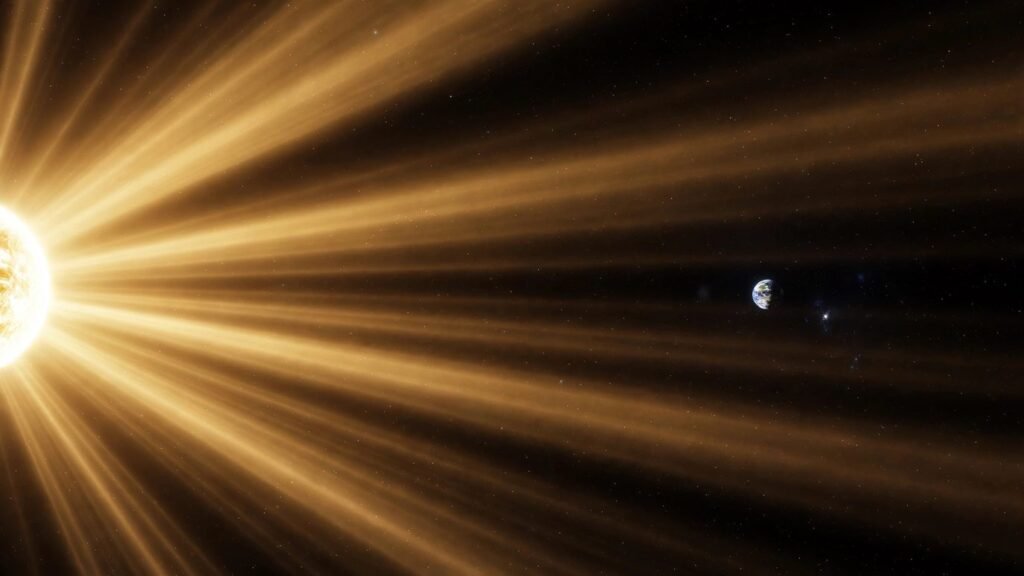
Look up at the Sun on a bright morning and it feels instant. The warmth hits your face, the sky turns blue, and it is easy to assume that light simply appears the moment it leaves the Sun. It does not. Light is fast, but it still needs time to travel. And because space is so vast, that travel time matters more than most people realize.
Every photon that reaches your eyes is a little bit old. Sunlight left the Sun minutes ago. Moonlight left the Moon just over a second ago. And the light from the nearest stars left years ago, long before you were born. When you look at the night sky, you are not seeing the universe as it is right now. You are seeing it as it was, at many different moments in the past, all at once.
That sounds strange at first, but it is one of the most useful ideas in astronomy. Once you understand how long light takes to reach Earth, distances in space start to make sense. A light-minute, a light-hour, and a light-year are not just fancy units. They are travel times. And they explain why astronomers talk about looking back in time whenever they point a telescope at a distant galaxy.
The short answer: Light from the Sun takes about 8 minutes and 20 seconds to reach Earth. Light from the Moon takes about 1.3 seconds. Light from the nearest star beyond the Sun, Proxima Centauri, takes about 4.24 years. In other words, the sunlight warming your skin right now left the Sun before you started reading this article, and the starlight you see tonight left its star years ago.
How Fast Is Light, Exactly?
Light travels through the vacuum of space at 299,792 kilometers per second. That is roughly 186,282 miles per second. To put it in everyday terms, light could circle Earth about seven and a half times in a single second. It could travel from New York to Los Angeles in about thirteen thousandths of a second, far faster than your brain can register.
That speed is constant in a vacuum. It does not matter whether the light comes from a candle, a streetlamp, or a star. In empty space, all light moves at the same speed. Physicists call this value c, and it acts as a kind of cosmic speed limit: nothing carrying information can travel faster.
On Earth, distances are so short that light travel time feels like zero. When you flip a light switch, the room seems to brighten instantly, because light crosses a room in a few billionths of a second. It is only when distances stretch to millions or billions of kilometers that the delay becomes something you can notice, measure, and talk about in minutes, hours, or years.
Why does light slow down in air, water, and glass?
Strictly speaking, light moves a little more slowly when it passes through a material such as air, water, or glass. The photons interact with atoms along the way, which delays them slightly. In air, the difference is tiny, light still moves at nearly its vacuum speed, so for astronomy, the vacuum value is the one that counts. The journey from the Sun to Earth happens almost entirely through the vacuum of space, so the 8-minute-and-20-second figure holds.
How Long Does Light Take to Reach Earth From the Sun?
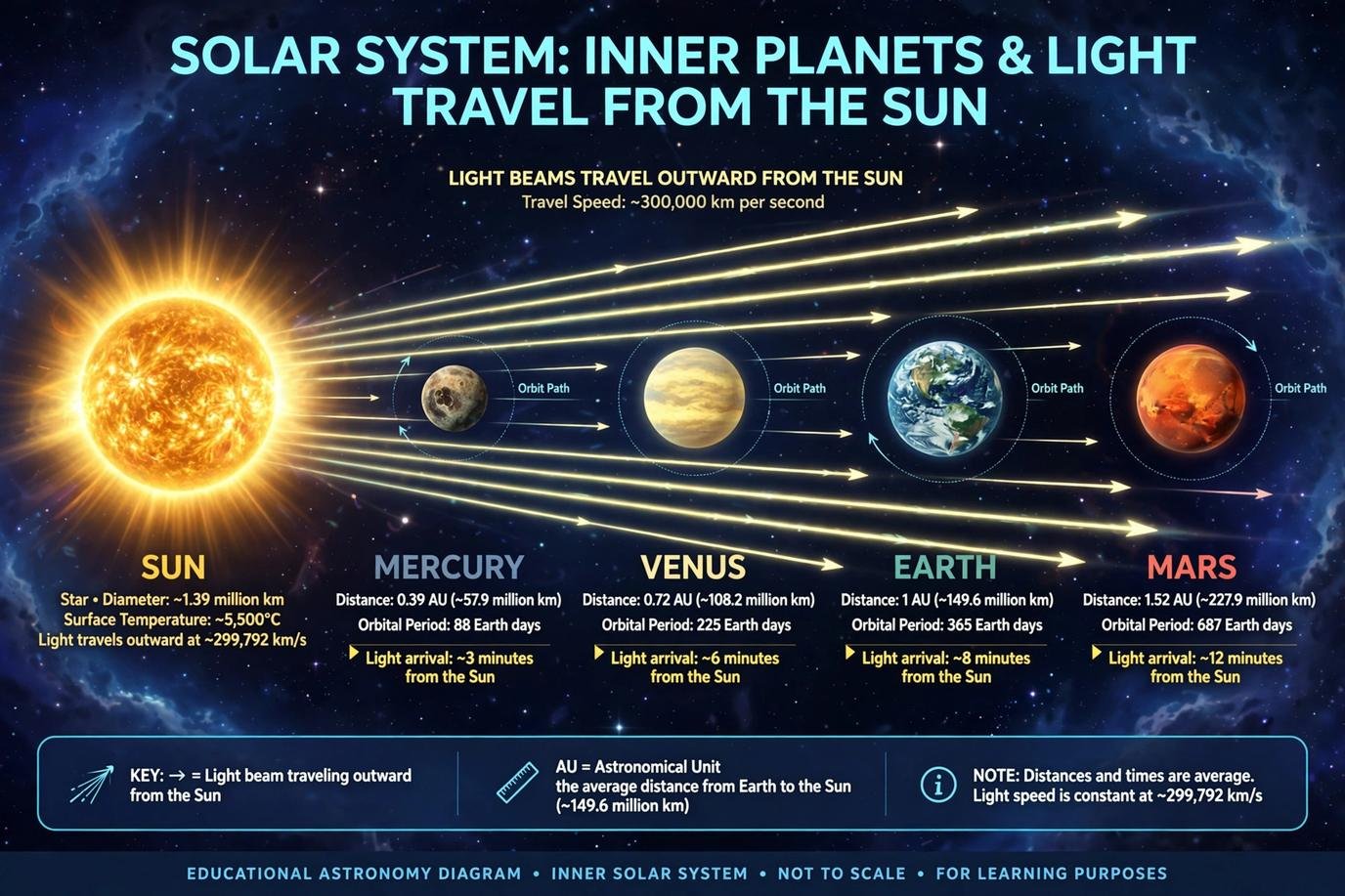
The Sun sits about 150 million kilometers from Earth on average, a distance astronomers call one astronomical unit, or 1 AU. Divide that distance by the speed of light, and you get about 499 seconds. That is 8 minutes and 20 seconds.
But that average hides a small wrinkle. Earth’s orbit is not a perfect circle; it is slightly elliptical. In early January, Earth is a little closer to the Sun, and sunlight takes about 8 minutes and 10 seconds. In early July, Earth is a little farther away, and the trip takes about 8 minutes and 30 seconds. The difference is only about 20 seconds either way, so about 8 minutes and 20 seconds is the honest answer for everyday use.
Think about what that means. If the Sun somehow switched off this instant, it will not, so do not worry, we would not know about it for more than eight minutes. The sky would stay bright, the warmth would linger, and then, eight minutes later, darkness would arrive. The delay is invisible in daily life, but it is always there.
What about the light itself, is it really 8 minutes old?
Yes, in the sense that matters here. The photons hitting Earth left the Sun’s surface about eight minutes ago. Deep inside the Sun, energy is produced by nuclear fusion in the core, and that energy can take an enormously long time to work its way outward through dense solar material. But once light escapes from the Sun’s visible surface, the photosphere, the clock that matters to us starts: about eight minutes to Earth.
How Long Does Moonlight Take to Reach Earth?
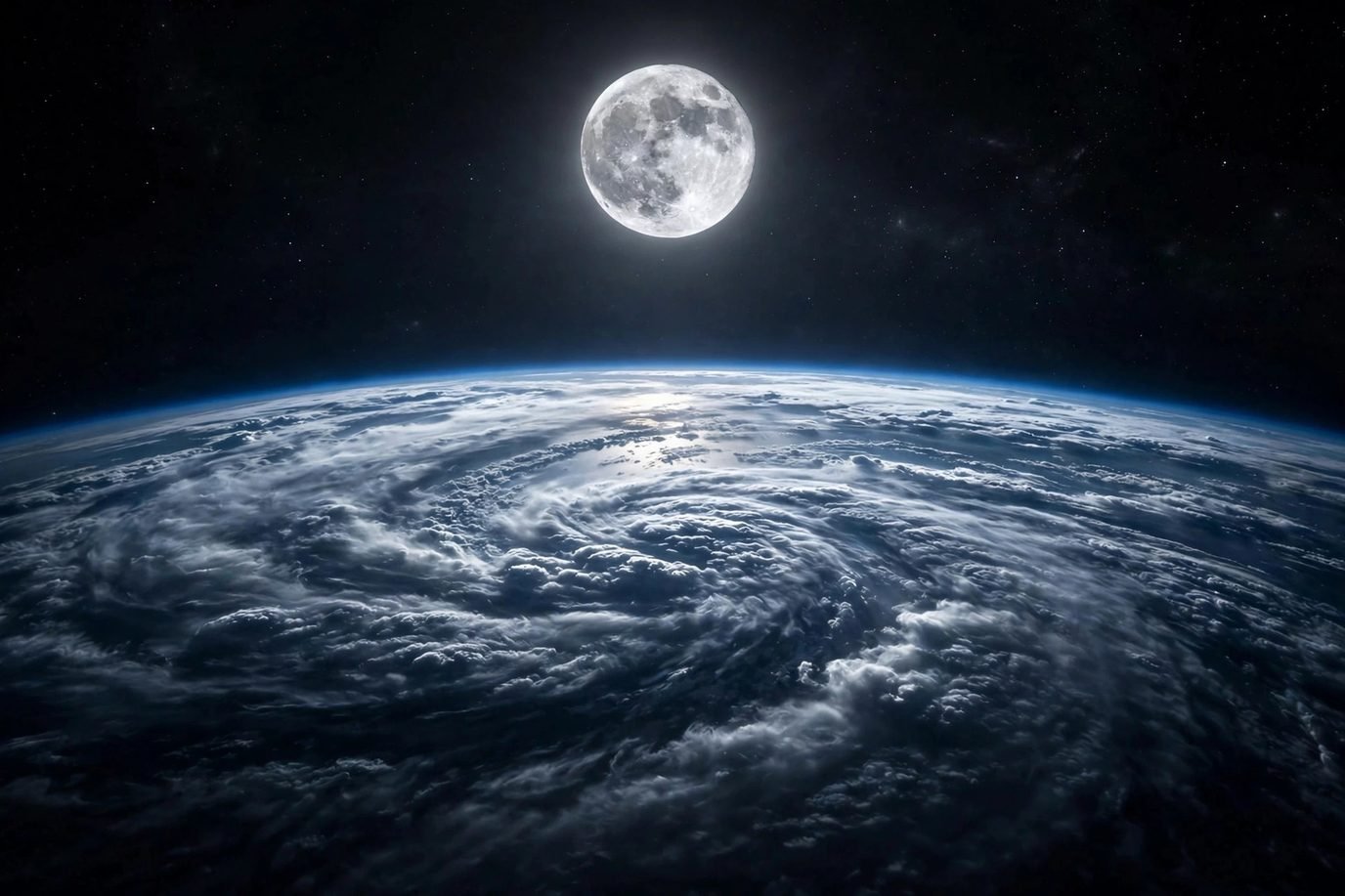
Moonlight is much quicker. The Moon orbits Earth at an average distance of about 384,400 kilometers. At the speed of light, that trip takes about 1.28 seconds, usually rounded to 1.3 seconds.
That figure is familiar to anyone who has watched footage of the Apollo missions. When mission control in Houston spoke to astronauts on the Moon, there was a noticeable pause before the reply came back. The round trip, a message to the Moon and an answer back to Earth, took about 2.6 seconds. Half of that delay was the light, in that case, radio waves, which also travel at the speed of light, going one way, and half was it coming back.
The Moon’s distance also varies a little, because its orbit is elliptical too. At its closest point, light takes about 1.26 seconds; at its farthest, about 1.35 seconds. Either way, moonlight is effectively live. When you look at the Moon, you are seeing it almost exactly as it is right now, delayed by barely more than a blink.
How Long Does Light Take From the Planets?
Once you move past the Moon, travel times grow quickly. Light from Mars, our nearest planetary neighbor at its closest, takes roughly 3 minutes to reach Earth. When Mars is on the far side of the Sun, the trip can take more than 22 minutes. That is why controlling a Mars rover in real time is impossible: every command takes minutes to arrive, and every reply takes minutes to come back.
Jupiter is farther still. Light from Jupiter takes roughly 35 to 52 minutes to reach Earth, depending on where the two planets sit in their orbits. Saturn’s light takes roughly 70 to 80 minutes, well over an hour. And light from Neptune, the most distant major planet, takes about 4 hours.
These delays are not just trivia. They shape how space missions are planned. Engineers send commands to distant spacecraft hours in advance and design probes to handle problems on their own, because a human on Earth cannot react in time. A spacecraft near Neptune is, in effect, always operating on instructions that are hours old.
| Object | Average distance from Earth | Approximate light travel time |
|---|---|---|
| Moon | ~384,400 km | ~1.3 seconds |
| Sun | ~150 million km | ~8 minutes 20 seconds |
| Mars (closest) | ~55 million km | ~3 minutes |
| Mars (farthest) | ~400 million km | ~22 minutes |
| Jupiter | ~600-900 million km | ~35-52 minutes |
| Saturn | ~1.2-1.7 billion km | ~70-80 minutes |
| Neptune | ~4.3-4.7 billion km | ~4 hours |
All values are approximate and vary with orbital positions.
What Is a Light-Minute, a Light-Hour, and a Light-Year?
Astronomers often describe distances as travel times, because kilometers quickly become unmanageably large. A light-minute is the distance light travels in one minute: about 18 million kilometers. A light-hour is about 1.08 billion kilometers. A light-year, the distance light travels in one year, is about 9.46 trillion kilometers.
Notice what a light-year is not: it is a distance, not a time. Saying a star is four light-years away means its light takes four years to reach us. It is a handy unit because it tells you two things at once: how far away something is, and how far back in time you are looking when you see it.
Here is a simple way to keep the units straight:
- Light-second: ~300,000 km, roughly the distance to the Moon, times 1.3.
- Light-minute: ~18 million km, the Sun is about 8.3 light-minutes away.
- Light-hour: ~1.08 billion km, Saturn is a little over a light-hour away.
- Light-day: ~26 billion km, well beyond the edge of the planetary solar system.
- Light-year: ~9.46 trillion km, the nearest star is about 4.24 light-years away.
When astronomers say a galaxy is 100 million light-years away, they mean its light has been travelling for 100 million years. We see that galaxy as it was 100 million years ago, not as it is today. That is why telescopes are sometimes called time machines.
How Long Does Starlight Take to Reach Earth?
The Sun is our closest star, and its light takes just over eight minutes. Every other star is vastly farther away, so their light takes years, centuries, or millennia.
Proxima Centauri, the nearest star beyond the Sun, is about 4.24 light-years away. Its light takes 4.24 years to reach Earth. Sirius, the brightest star in the night sky, is about 8.6 light-years away, so its light takes about 8.6 years. Vega, another bright summer star, is about 25 light-years away. Betelgeuse, the red supergiant in Orion, is roughly 600 to 700 light-years away, its light left around the time of the late Middle Ages, though the exact distance is still refined by astronomers.
Some of the stars you can see with the naked eye are thousands of light-years away. Their light began its journey before recorded history, before agriculture, or before modern humans existed, depending on the star. You are not just looking across space when you stargaze. You are looking across time.
| Star | Approximate distance | Approximate light travel time |
|---|---|---|
| Sun | 1 AU | ~8 minutes 20 seconds |
| Proxima Centauri | ~4.24 light-years | ~4.24 years |
| Sirius | ~8.6 light-years | ~8.6 years |
| Vega | ~25 light-years | ~25 years |
| Betelgeuse | ~600-700 light-years | ~600-700 years |
| Deneb | ~2,600 light-years | ~2,600 years |
Note: Stellar distances beyond the nearest stars carry some measurement uncertainty; treat the larger figures as good approximations.
Does This Mean We See the Past?
Yes, and this is the part that tends to change how people think about the night sky. Because light takes time to travel, every object you see is shown to you with a delay equal to its distance in light-travel time.
For everyday objects, the delay is far too small to notice. Light from a tree across the street reaches your eyes in a few hundred-billionths of a second. For the Moon, the delay is 1.3 seconds. For the Sun, eight minutes. For the stars, years.
This also means the universe has a built-in limit on what we can know right now. We cannot see a distant galaxy as it is today, because today for that galaxy will not be visible to us until its light completes the journey. Astronomers accept this and use it: by looking at galaxies at different distances, they can study the universe at different ages, almost like flipping through a photo album where the oldest pictures are the farthest away.
Could a star have already exploded without us knowing?
In principle, yes. If a distant star exploded, we would not know until its light, including the light of the explosion, reached us. For a star hundreds of light-years away, that could mean centuries of delay. Betelgeuse is often used as an example: it is expected to explode as a supernova at some point, and when it does, people on Earth will see a spectacularly bright new star, but the explosion itself will already be centuries old by the time the news arrives. There is no need to worry about this; it is simply how light works over cosmic distances.
Why Do Astronomers Care About Light Travel Time?
Light travel time is not just a curiosity. It affects real astronomical work in several practical ways:
- Measuring distances. For nearby stars, astronomers measure tiny shifts in apparent position (parallax) to get distances, then convert those into light-years. The travel time follows directly from the distance.
- Studying the early universe. The farther away a galaxy is, the older the light we receive from it. Distant galaxies show us the universe as it was billions of years ago.
- Running space missions. Engineers must account for signal delays when commanding spacecraft. A rover on Mars cannot be steered like a remote-controlled car; every instruction is planned minutes or hours ahead.
- Understanding variable stars and supernovae. When a star brightens or explodes, the timing we observe is delayed by the travel time. Correcting for that delay lets astronomers reconstruct what actually happened, and when.
- Testing physics. The constancy of the speed of light is a foundation of modern physics. Precise measurements of light travel time, including experiments on Earth and signals from spacecraft, keep confirming it.
For readers who enjoy exploring science topics in plain language, the daily science and curiosity pieces over at dailyorvix.com cover a similar mix of space, nature, and everyday questions. If you want a broader general-knowledge companion to your astronomy reading, adailyinsight360.com is another good place to browse after you finish here.
Can Anything Travel Faster Than Light?
According to our best-tested physics, no. The speed of light in a vacuum is the ultimate speed limit for anything carrying matter or information. Particles with mass would need infinite energy to reach it, and signals cannot outrun it.
Science fiction often imagines warp drives and wormholes, and physicists do discuss those ideas mathematically. But no experiment has ever shown information travelling faster than light, and no technology today comes close. This limit is also what makes light travel time unavoidable: we cannot simply get a faster update from a distant star. We have to wait for its light to arrive.
That limit also protects cause and effect. If signals could travel faster than light, an effect could, in some frames of reference, arrive before its cause. The universe, as far as we can measure, does not work that way. Light’s finite speed keeps the story of the cosmos in order, even if it means we always see the past.
How Do Scientists Measure Light Travel Time?
The first successful measurement of the speed of light came from astronomy itself. In the 1670s, Danish astronomer Ole Romer noticed that the eclipses of Jupiter’s moon Io seemed to run early or late depending on Earth’s position in its orbit. He correctly realized the difference was caused by light taking longer to cross the extra distance when Earth was farther from Jupiter. It was the first evidence that light does not travel instantaneously.
Later, laboratory experiments measured the speed of light directly, with spinning mirrors, rotating toothed wheels, and eventually lasers and atomic clocks. Today the speed of light is defined exactly, 299,792,458 meters per second, and the meter itself is defined in terms of it. Spacecraft ranging, laser reflectors left on the Moon by Apollo astronauts, and radar signals bounced off planets all confirm the same picture: light travels at a finite, measurable speed, and the travel times in this guide follow from it.
A quick experiment you can appreciate at home
You cannot easily measure the speed of light in your kitchen, but you can feel the idea behind it. Stand at one end of a long hallway and have a friend flash a torch at the other end. The flash seems instant, because the distance is tiny. Now imagine that hallway stretched to the Moon, the same flash would take 1.3 seconds. Stretch it to the Sun, and you would wait more than eight minutes. The physics does not change. Only the distance does.
What Does This Mean for How You See the Sky Tonight?
Tonight, when you step outside and look up, try this. Find the Moon if it is visible: you are seeing it as it was 1.3 seconds ago, essentially now. Find a bright star: you are seeing it as it was years or decades ago. Find the faint band of the Milky Way: much of that light left its stars thousands of years ago.
None of this makes the sky less real. It makes it richer. The sky is not a flat picture pasted onto a dome. It is a deep, layered view of time, with each point of light arriving from a different moment. The sunlight that warmed you this morning is eight minutes old. The starlight that catches your eye tonight may be older than you are. Both are reaching you right now, and both are telling you something true about the universe, just not at the same moment.
Frequently Asked Questions
How long does light take to reach Earth from the Sun?
About 8 minutes and 20 seconds on average. The exact figure varies slightly through the year, from about 8 minutes and 10 seconds in early January to about 8 minutes and 30 seconds in early July, because Earth’s orbit is slightly elliptical.
How long does moonlight take to reach Earth?
About 1.3 seconds. The Moon is roughly 384,400 kilometers away on average, and light covers that distance in about 1.28 seconds.
How long does light take to reach Earth from the nearest star?
Proxima Centauri, the nearest star beyond the Sun, is about 4.24 light-years away, so its light takes about 4.24 years to reach Earth.
Is sunlight 8 minutes old?
Yes. The photons that reach Earth left the Sun’s surface about 8 minutes and 20 seconds earlier. When you feel sunlight on your skin, you are feeling energy that began its journey to Earth minutes before you noticed it.
What is a light-year in simple terms?
A light-year is the distance light travels in one year, about 9.46 trillion kilometers. It is a unit of distance, not time, even though it has the word year in it.
Why do astronomers say telescopes look back in time?
Because light takes time to travel. The farther away an object is, the longer its light has been travelling, so we see it as it was in the past. A galaxy 100 million light-years away appears as it was 100 million years ago.
Could the Sun disappear without us knowing for 8 minutes?
In theory, yes, if the Sun vanished instantly, Earth would keep receiving its light and gravity for about eight minutes before anything changed. In reality, the Sun is stable and will not vanish, so this is a thought experiment, not a worry.
Final Thoughts
So, how long does light take to reach Earth? It depends on where the light starts. From the Moon, barely more than a second. From the Sun, about eight minutes and twenty seconds. From the nearest stars, years. From distant galaxies, millions or billions of years.
That simple fact reshapes how you see the sky. You are never looking at the universe as it is in this exact instant. You are looking at a collection of moments, layered by distance, arriving together at your eyes. The next time sunlight warms your face or starlight catches your attention on a clear night, remember the journey behind it. That light has travelled a long way, and a long time, just to reach you.
Read Also: How Do Astronauts Sleep in Space? Full 2026 Guide

1 Comment