
Contents
- Where Do Astronauts Actually Sleep?
- Frequently Asked Questions
- FinalThoughts
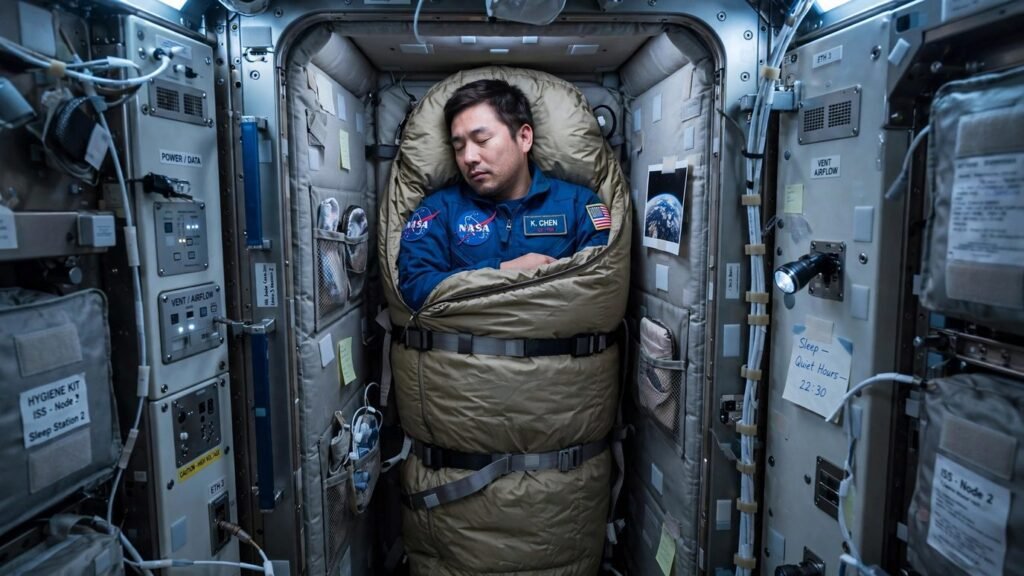
How do astronauts sleep in space? Picture this: you climb into bed, pull up the covers, and settle in for the night. Now imagine doing that with no up or down, no mattress pressing against your back, and a sunrise flashing past your window every hour and a half. That is bedtime on the International Space Station (ISS).
It sounds strange, and in some ways it is. But astronauts do sleep in space every single day, and they have a system for it that works surprisingly well. They have private sleep stations, special sleeping bags, a strict daily schedule, and a few clever tricks for light, noise, and comfort. Once you understand that system, sleeping in space starts to feel less like science fiction and more like a very well-organised camping trip — just one that happens to be orbiting Earth at high speed.
The short answer: Astronauts sleep in space in small private crew quarters on the ISS, inside sleeping bags that are strapped to the wall so they do not float away. They follow a fixed daily schedule, use dim lighting and eye masks to block out constant sunrises, and rely on earplugs, white noise, exercise, and good sleep habits to rest well in microgravity.
Where Do Astronauts Actually Sleep?
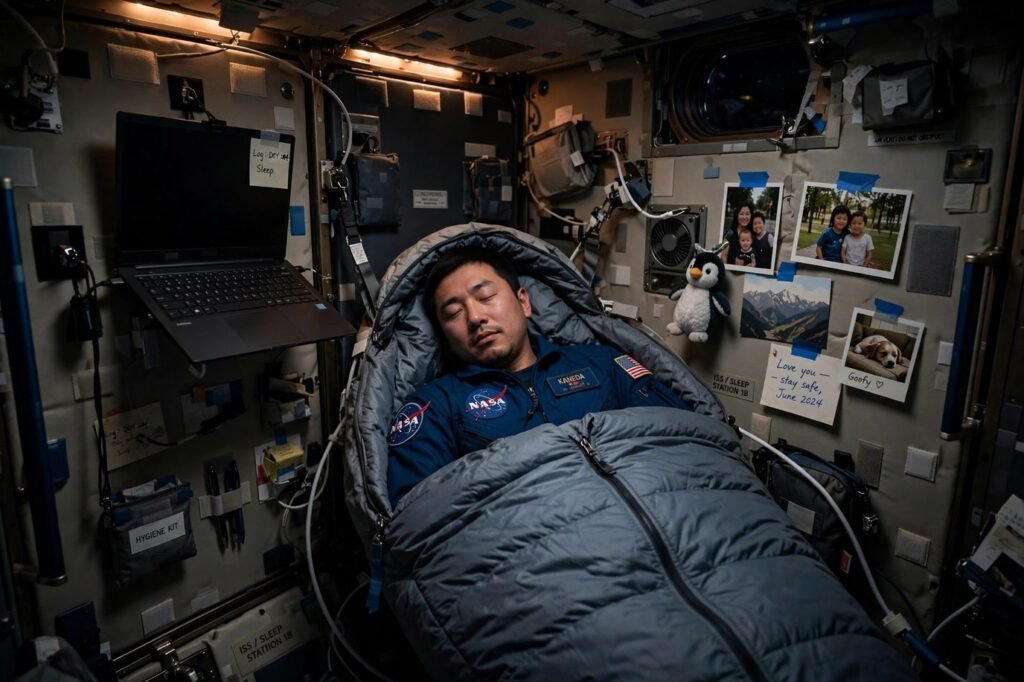
On the ISS, astronauts do not just drift off wherever they happen to be. Each crew member has a personal sleep station, a small private compartment about the size of a phone booth. It is their bedroom, office, and quiet corner all in one.
Inside, there is a sleeping bag attached to the wall, a laptop for work and video calls home, some personal items, and a little storage space. The door or curtain closes, giving the astronaut privacy in a station shared with several other people. That privacy matters. Life on the ISS is close, busy, and almost never truly quiet, so having a space that is yours — even a tiny one — helps you switch off.
The sleep stations are found in different modules of the station. Some crew members sleep in the Harmony module area, others in Russian segment quarters, depending on the crew and the mission. The details vary, but the idea is the same: a small, dark, personal space where one person can rest without floating into equipment or bumping into a crewmate.
Why a Private Room Matters in Such a Small Station
Think about sharing a house with five or six people, where you work, eat, exercise, and relax in the same few rooms. Now remove the doors between most of those rooms and add the fact that sound travels easily and everyone works on slightly different tasks. A private sleep station is the one place where an astronaut can close the door, dim the lights, and be alone.
It also helps with sleep quality. When your brain learns that one small space means “bedtime,” it becomes easier to fall asleep there, even when the rest of the station is still busy. Astronauts often personalise their quarters with photos of family, small mementos, and a favourite pillow or blanket from home, which makes the space feel less like a machine and more like a bedroom.
What Happens If an Astronaut Falls Asleep Outside Their Quarters?
It can happen, especially on a short mission or during a busy day, but it is not the usual plan. An astronaut who drifts off in a work area would slowly float around the cabin, which is not safe and not restful. That is why the sleeping bag and the private station are so important. They keep the sleeper in one place, protect them from floating equipment, and let the rest of the crew keep working.
How Do Astronauts Sleep Without Gravity?
This is the question most people ask first, and the answer is simpler than you might expect: they strap themselves in.
An ISS sleeping bag looks a bit like a regular sleeping bag, but it is designed for microgravity. It attaches to the wall of the sleep station with straps, so the astronaut stays put all night. The astronaut climbs in, zips up, and attaches the bag — or attaches themselves with straps — so they do not drift. Their arms are usually inside the bag or held loosely, and their head rests on a small pillow that is also secured.
There is no mattress to lie on, because there is no weight pressing you down. In microgravity, “lying down” does not really mean anything. Your body just floats in a relaxed position. Many astronauts say the most comfortable position is a slightly bent, neutral posture, with knees a little raised and arms floating in front of the body. It looks odd in photos, but it is the position the human body naturally takes when nothing is pulling it down.
Do Astronauts Float Around While They Sleep?
No — not if they are properly strapped in. The whole point of the sleeping bag setup is to stop that from happening. An unsecured sleeper could drift into a wall, a piece of equipment, or a ventilation fan, and could also block a passageway. So before lights-out, astronauts make sure they are secure, their bag is attached, and loose items are stowed away.
Is Sleeping in Space Comfortable?
Most astronauts say yes, once they get used to it. There is no pressure point from a mattress, no sore hip from lying on one side too long, and no pillow sliding off the bed. On the other hand, some people miss the feeling of weight and blankets pressing down on them. The sleeping bag provides some of that snug feeling, but it is not quite the same as being tucked in at home.
Over the first few days in orbit, many crew members also adjust to the feeling of floating. At first, it can feel strange to fall asleep while your body is weightless. After a while, it becomes normal. Astronauts often say they sleep well on the station, especially once their schedule settles and they find a routine that works for them.
What Does an Astronaut’s Sleep Schedule Look Like?
Astronauts on the ISS live by a schedule. It is planned in advance, down to work blocks, meals, exercise, and sleep. That might sound rigid, but it is essential. Without a schedule, it would be very easy to lose track of day and night — because in orbit, day and night do not behave the way they do on Earth.
A typical ISS day includes around eight hours set aside for sleep. The exact timing depends on the mission, the crew’s tasks, and coordination with mission control centres on the ground. The whole crew usually sleeps at roughly the same time, so the station can be quieter and dimmer during the sleep period, and busier during the work period.
Waking up is also scheduled. Alarms, a gradual brightening of lights, and a morning routine help crew members start the day, even if their body is still telling them it is the middle of the night back home.
How Do They Handle Time Zones in Orbit?
They do not use local time in the usual sense, because the station passes over many time zones in a single orbit. Instead, the ISS runs on a single station time, coordinated with mission control. Everyone follows the same clock, which keeps work, meals, communication windows, and sleep periods in sync.
That shared clock is one of the most important sleep tools on the station. If everyone slept at different times, the station would never be quiet, lights would always be on somewhere, and nobody would rest well. A shared schedule protects sleep for the whole crew.
How Do Astronauts Deal With 16 Sunrises a Day?
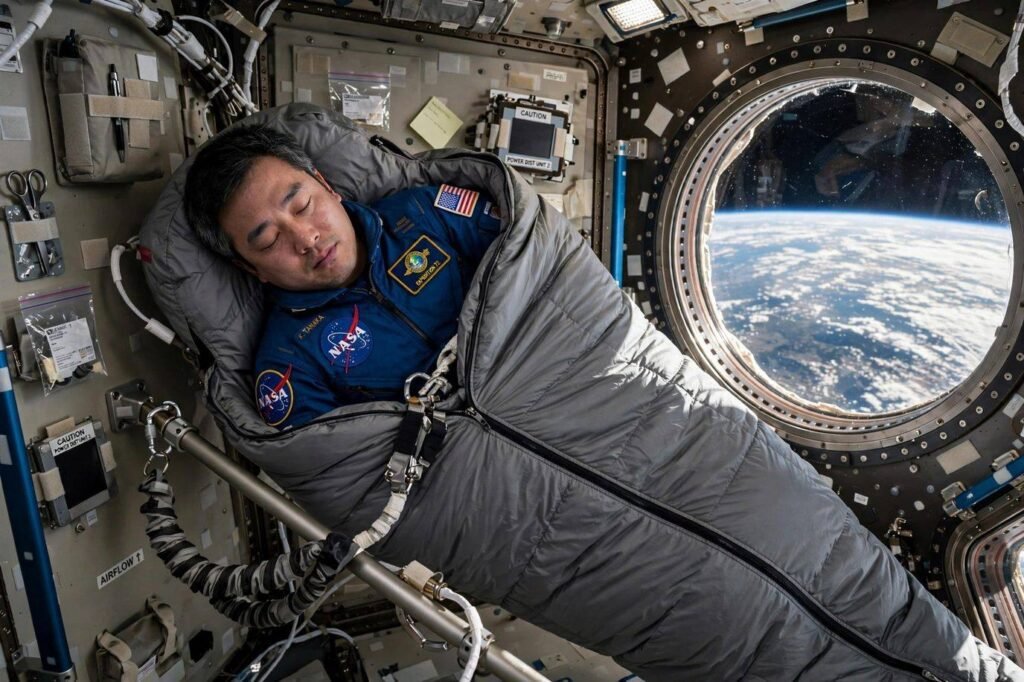
Here is the part that surprises most people. The ISS orbits Earth roughly every 90 minutes. That means crew members see a sunrise and a sunset about 16 times in a 24-hour period. If you tried to sleep by sunlight alone, you would never get a proper night.
So astronauts do not sleep by sunlight. They sleep by the clock, and they control the light around them.
During the sleep period, the station lights are dimmed. Sleep stations can be closed off and darkened. Many astronauts also use eye masks to block out any remaining light. During the work period, lights are brighter, which helps the brain stay alert. Some areas of the station also use lighting that can shift in colour and brightness to support alertness during the day and relaxation before bed.
This light management is not just about comfort. Light is one of the strongest signals your body uses to decide when to be awake and when to be sleepy. By keeping light bright during work hours and dim before bed, astronauts help their internal body clock stay on track, even while the Sun is rising and setting outside every hour and a half.
Do Astronauts Use Eye Masks and Earplugs?
Yes, many do. An eye mask is a simple, effective way to block light that leaks into the sleep station from corridors or equipment displays. Earplugs, or a small fan-like white noise source, help with sound. The ISS is never silent. Fans, pumps, and other systems run constantly to circulate air and keep the station working. That background hum is normal, but it can disturb light sleepers.
Earplugs do not block everything, and they are not meant to. Astronauts still need to hear alarms. The goal is to soften the constant hum and the occasional clank or conversation from another part of the station, so sleep is less broken.
What Is It Like to Fall Asleep in Microgravity?
Falling asleep in space feels different at first, and astronauts often describe an adjustment period. On Earth, you feel your body sink into the bed. In space, there is no sinking. You just relax, and your body stays where it is, held gently by the sleeping bag.
Some new arrivals find it hard to switch off because everything is new: the sounds, the floating feeling, the lack of a normal bedtime routine. Others fall asleep quickly because they are tired after a long, busy day. Over time, most crew members settle into a pattern. They develop their own small bedtime habits — reading, listening to music, writing in a journal, or calling family — that signal to the brain that it is time to rest.
Dreams in space are a common question, and astronauts do dream in orbit, just as they do on Earth. The content of dreams varies from person to person, and there is nothing unusual about dreaming while weightless. What can feel unusual is waking up and, for a second, not knowing which way is up. Then the sleeping bag, the straps, and the familiar walls of the sleep station remind you where you are.
Do Astronauts Get Enough Sleep in Space?
That is a question space agencies take seriously. Sleep matters for safety, focus, mood, and health, especially when you are operating complex equipment and doing demanding physical work. That is why sleep is scheduled, protected, and monitored as part of the mission, not left to chance.
Still, spaceflight can disrupt sleep. The unusual light cycle, noise, workload, excitement, and the physical effects of microgravity can all make sleep lighter or shorter, especially early in a mission. Crew members and flight surgeons work together to spot problems early — for example, by adjusting schedules, light exposure, or bedtime habits — so that poor sleep does not become a bigger issue.
If you enjoy clear, curious science explainers like this one, you will also like the science stories at 9bio, which cover everyday questions in plain language.
How Do Astronauts Stay Comfortable All Night?
Comfort in space is about small details. The sleeping bag needs to be warm enough but not too hot. Ventilation needs to keep air moving, because in microgravity warm air does not rise the way it does on Earth. Without fans, a bubble of warm, stale air could build up around a sleeper’s face. The ISS ventilation system prevents that, keeping fresh air flowing through the sleep stations.
Temperature is controlled carefully, and astronauts can adjust clothing and bedding to suit themselves. Some prefer a lighter sleep setup, others like to be more snugly wrapped. Personal preference matters, because a comfortable astronaut is a better-rested astronaut.
Hygiene before bed is also part of the routine. There is no shower on the ISS in the usual sense. Astronauts clean up with wipes, rinseless shampoo, and careful water use. Brushing teeth, changing into sleep clothes, and tidying the sleep station are all part of winding down, just as they are at home — only with a lot less water and a lot more Velcro.
What Do Astronauts Wear to Bed?
They wear comfortable sleep clothes, similar to what you might wear at home, plus socks and sometimes a light layer for warmth. The key difference is that everything needs to stay in place and not float away. Clothes are stored in bags and compartments, and small items are often attached with Velcro or kept in pockets.
There is no rule that says astronauts must wear one specific outfit to bed. The goal is comfort, warmth, and safety, and crew members choose what works for them within the station’s guidelines.
How Does Exercise Help Astronauts Sleep?
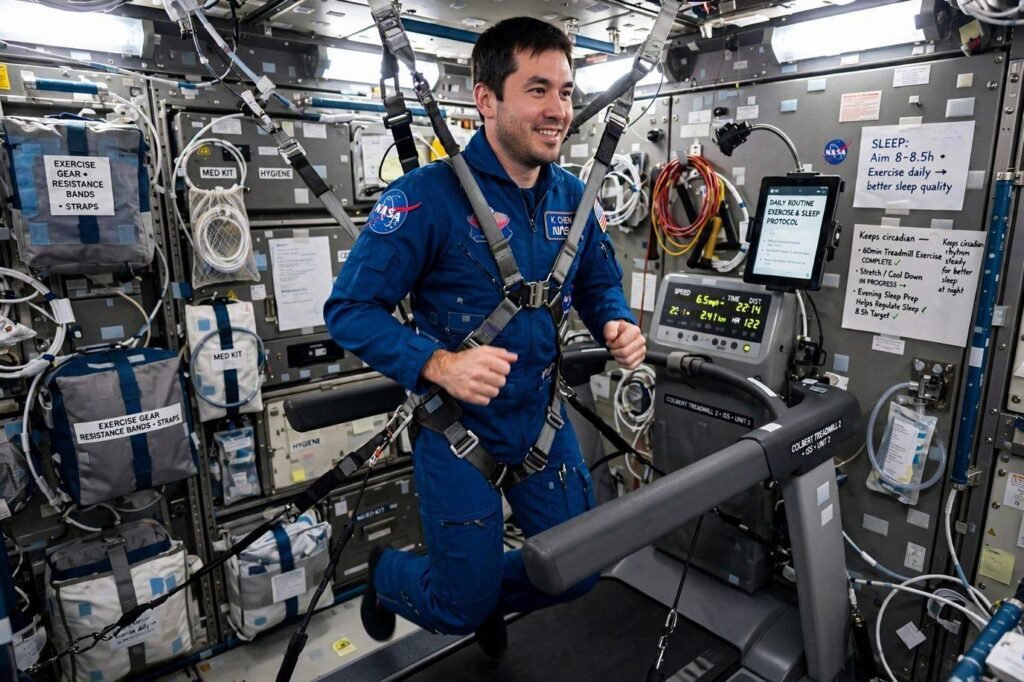
Exercise is a huge part of life on the ISS, and it helps sleep in two ways. First, it keeps the body healthy in microgravity. Without gravity, muscles and bones weaken over time, so astronauts exercise every day using special equipment — a treadmill with a harness, a stationary bike, and a resistance device that mimics weightlifting.
Second, physical tiredness helps you sleep. A day that includes hard exercise, focused work, and a full schedule usually ends with a body that is ready to rest. Exercise is scheduled during the work period, not right before bed, so astronauts have time to cool down, eat, and wind down before lights-out.
When Do Astronauts Exercise?
Exercise is built into the daily plan, usually in blocks during the workday. The exact timing varies, but the pattern is consistent: exercise most days, for a substantial part of the day, using a mix of cardio and resistance training. It is not optional extra activity. It is part of the job, and it is tracked like any other task.
That routine also gives the day structure. When your day has clear blocks — work, exercise, meals, rest — your body learns when to be active and when to slow down. That structure supports better sleep, even in an environment where the Sun does not cooperate.
What About Food, Caffeine, and Bedtime?
What astronauts eat and drink also affects sleep. Meals on the ISS are planned, varied, and eaten together when possible. Eating a proper evening meal, rather than snacking late or skipping meals, helps the body settle into a nighttime pattern.
Caffeine is allowed, but it is used carefully. Like on Earth, too much caffeine late in the day can make it harder to fall asleep. Crew members tend to avoid caffeinated drinks in the hours before bed, and they pay attention to how caffeine affects them personally. Some people are more sensitive than others, and in space, where sleep is already challenged by light and noise, that sensitivity matters even more.
Alcohol is not part of the ISS routine. The focus is on clear thinking, safety, and health, so bedtime drinks are things like water, juice, or a warm drink that does not interfere with sleep.
Do Astronauts Eat Before Bed?
They may have a snack if they are hungry, but large, heavy meals right before bed are not ideal — in space or on Earth. A comfortable, not-too-full stomach, a calm wind-down period, and a dark, quiet sleep station are a better recipe for rest than a late feast followed by immediate lights-out.
How Is Sleeping in Space Different From Sleeping on Earth?
It helps to put the two side by side. Some things are better in space, some are worse, and some are just different.
| Aspect | Earth | ISS |
|---|---|---|
| Gravity | Your body rests on a mattress, with pressure on your back or side | Your body floats in a sleeping bag, with no pressure points |
| Light at night | One sunset, then darkness until morning | About 16 sunrises and sunsets per day, controlled by station lighting |
| Noise | Usually quiet, with occasional household sounds | Constant fans and equipment hum, softened by earplugs |
| Privacy | Your own bedroom, usually | A small private sleep station in a shared station |
| Getting comfortable | Lie down, adjust pillows and blankets | Strap into a sleeping bag attached to the wall |
| Phase | Routine | Why it helps |
|---|---|---|
| Work period | Bright lights, tasks, exercise, meals | Keeps the body alert and builds healthy tiredness |
| Wind-down | Dimmer lights, personal time, hygiene routine | Signals to the brain that bedtime is coming |
| Sleep period | Dark, quiet sleep stations, shared crew sleep time | Protects rest and lets the body recover |
Those routines are not glamorous, but they work. They turn a strange environment into a predictable one, and predictability is one of the best friends good sleep has.
What Can You Learn From How Astronauts Sleep?
You do not need to go to space to use the same ideas. Astronauts sleep well because they control light, keep a regular schedule, exercise during the day, limit caffeine before bed, and create a dark, quiet, personal sleep space. Those are the same habits sleep experts recommend on Earth.
If you struggle to fall asleep, try borrowing the astronaut approach:
- Keep a regular bedtime and wake time, even on weekends.
- Dim lights and screens in the hour before bed.
- Make your bedroom dark, cool, and quiet.
- Exercise during the day, not right before bed.
- Avoid caffeine in the late afternoon and evening.
- Create a short wind-down routine you repeat every night.
You will not have 16 sunrises to deal with, but you will have streetlights, phones, and late-night noise. The astronaut lesson is simple: you cannot always control your environment, but you can control your routine — and your routine controls your sleep more than you think.
For more space and science reading in the same friendly style, check out the coverage at The Modern Post, which follows space missions and everyday science.
Frequently Asked Questions
How do astronauts sleep in space without floating away?
They sleep in sleeping bags that are strapped to the wall of their private sleep station. The straps keep them in place all night, so they do not drift around the cabin.
Do astronauts sleep lying down in space?
Not in the Earth sense. There is no up or down in microgravity, so astronauts float in a relaxed, slightly bent position inside their sleeping bag. It feels natural once they get used to it.
How many hours do astronauts sleep on the ISS?
Around eight hours are typically set aside for sleep each day, as part of a fixed schedule shared by the crew. The exact timing varies by mission and workload.
Is it dark when astronauts sleep on the ISS?
Yes, during the sleep period. Lights are dimmed, sleep stations are closed off, and many astronauts use eye masks. This blocks out the frequent sunrises outside and helps the body stay on schedule.
Do astronauts dream in space?
Yes. Astronauts dream in orbit just as they do on Earth. Dreams are a normal part of sleep, and weightlessness does not stop them.
Can astronauts sleep anywhere on the space station?
In theory, an astronaut could fall asleep in another part of the station, but that is not the plan. Sleeping in the private sleep station is safer, quieter, and more restful, and it keeps passageways clear for other crew members.
Do astronauts snore in space?
Snoring is linked to gravity pulling soft tissues in the airway, so the pattern can be different in microgravity. Some astronauts who snore on Earth snore less in space, but individual experiences vary, and it is not something crew members usually worry about.
Final Thoughts
Sleeping in space sounds impossible until you see how it works. A small private room, a strapped-in sleeping bag, a strict schedule, dim lights, earplugs, daily exercise, and a sensible approach to caffeine — put together, those simple pieces create a good night’s sleep 400 kilometres above Earth, in a place where the Sun rises 16 times a day.
The next time you climb into bed, think about the crew on the ISS doing the same thing, only vertically, weightlessly, and with Earth glowing through the window. They are not just sleeping. They are proving that with the right routine, humans can rest, recover, and do extraordinary work — even far from home.
How do astronauts sleep in space? The answer is a private sleep station, a sleeping bag strapped to the wall, and a strict schedule for light, noise, and rest.
Read Also: Lamar Odom: Life, NBA Career, Championships, and Comeback Story (2026 Guide)

1 Comment