
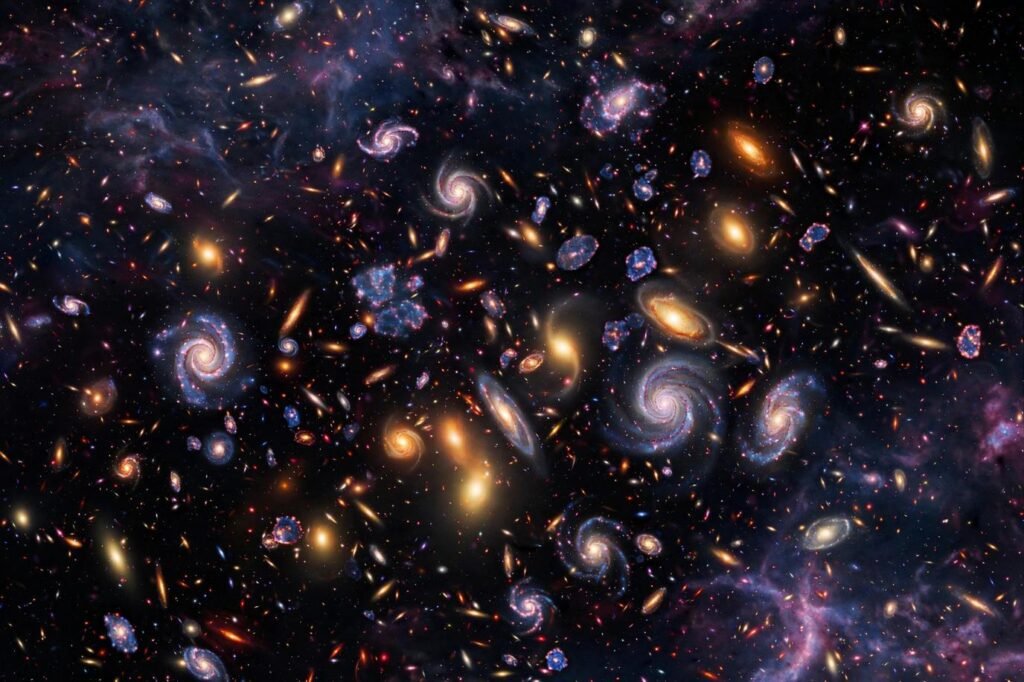
Look up at the night sky on a clear, dark evening and you will see a few thousand stars with your naked eyes. That feels like a lot. Now imagine that every one of those tiny points of light is hiding something absurd behind it — not more stars, but entire galaxies, each holding billions of stars of its own. The question of how many galaxies are in the universe sounds like trivia. It is actually one of the most important measurements in modern cosmology, because the answer tells us how the universe grew from a hot, dense beginning into the structured cosmos we see today.
Scientists have counted the galaxies more than once, and the number has changed dramatically as telescopes got better. The old textbook answer was around 200 billion. The current answer is at least ten times that. And the way they got there is a story worth understanding, because it shows how astronomers can count things they cannot even see.
The short answer: There are at least 2 trillion galaxies in the observable universe, according to a 2016 study led by Christopher Conselice at the University of Nottingham, published in The Astrophysical Journal. Older estimates put the number around 100–200 billion. The reason for the jump is that over 90% of galaxies are too faint and too distant for even the Hubble Space Telescope to detect individually — they were inferred through modeling, not counted one by one. Future telescopes like Euclid and the Vera C. Rubin Observatory may finally start confirming that hidden population.
What Do We Mean by “the Universe” Here?
Before we talk numbers, a small but important clarification: when astronomers say “how many galaxies are in the universe,” they almost always mean the observable universe — the portion of the cosmos from which light has had time to reach us since the Big Bang, about 13.8 billion years ago.
The observable universe is a sphere roughly 93 billion light-years across. It is centered on us only because we are the ones looking; every observer in the universe would draw their own observable sphere. The actual universe beyond that boundary may be far larger — some cosmologists believe it is infinite — but no light from beyond our cosmic horizon has reached us yet, so its galaxies are, for now, unknowable. Every estimate in this article refers to the observable universe.
The Old Answer: Around 200 Billion
For years, the standard answer you would find in textbooks and on museum plaques was roughly 100 to 200 billion galaxies. That number came from the Hubble Deep Fields — some of the most famous images ever taken.
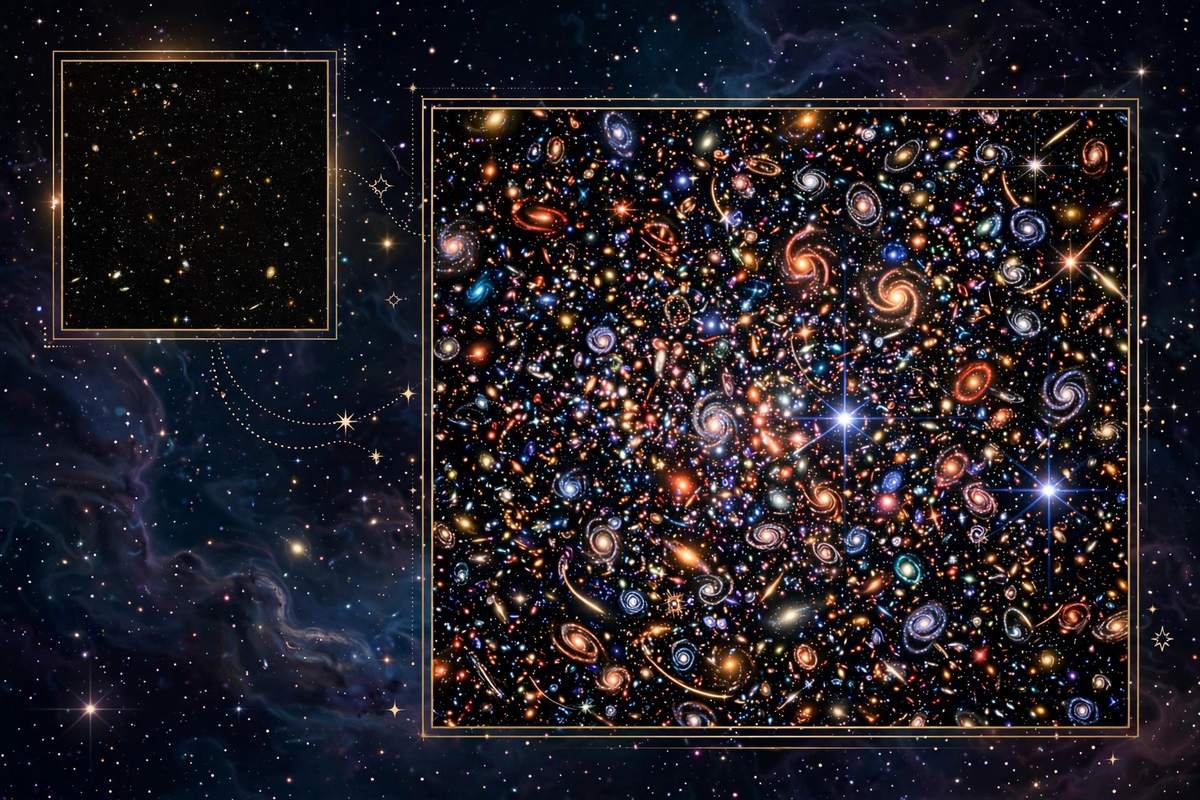
In the 1990s and early 2000s, astronomers pointed the Hubble Space Telescope at tiny, apparently empty patches of sky and left the shutter open for days. The Hubble Deep Field (1995) covered a patch of sky about the width of a tennis ball held at arm’s length, and it revealed around 3,000 galaxies in that speck. Later came the Hubble Ultra Deep Field and the eXtreme Deep Field (XDF), which went even deeper and showed roughly 5,500 galaxies in a single image.
The reasoning was straightforward: count the galaxies in that small patch, multiply by the number of such patches that fit across the whole sky, and you get the total. That extrapolation produced the familiar 100–200 billion figure. It was a reasonable first estimate — but it turned out to be wildly low, because it assumed that what Hubble could see was all there was.
The 2016 Study That Changed Everything
In October 2016, an international team led by Christopher Conselice, Professor of Astrophysics at the University of Nottingham, published a paper in The Astrophysical Journal that shook up the count. Their conclusion: there are at least 2 trillion (2 × 10¹²) galaxies in the observable universe — ten times more than previously thought.
This was not a casual revision. It was the culmination of roughly 15 years of work, part-funded by a research grant from the Royal Astronomical Society, and it drew on more than two decades of deep-sky observations from Hubble and other observatories.
Crucially, the team did not count galaxies one by one. That is impossible when most of the galaxies in question are too faint to appear in any image. Instead, they used something called the galaxy stellar mass function — a statistical description of how many galaxies of each size exist in a given slice of space at a given point in cosmic history. They measured these mass functions at many different cosmic epochs, reaching back to within about 650 million years of the Big Bang, then converted narrow deep-sky images into three-dimensional maps to measure the volume and galaxy density of slice after slice of space.
Conselice described the approach as an “intergalactic archaeological dig.” By fitting the measurements with a mathematical model, the team could infer the galaxies that were too faint for current telescopes to detect. The arithmetic ran all the way down to galaxies with a stellar mass of just a million times the Sun’s — tiny dwarf systems, similar to the satellite galaxies orbiting the Milky Way.
What the 2 Trillion Figure Actually Includes
The headline number needs a footnote. The 2 trillion estimate counts every galaxy with a stellar mass above one million solar masses. For perspective, the Milky Way has a stellar mass of roughly 60 billion solar masses — so most of the 2 trillion are small, faint systems that no survey has seen individually.
The team also published their uncertainty range: 1.4 to 2.7 trillion galaxies, with two trillion as the headline figure. And their key finding was not just the total — it was that about 90% of the galaxies in the observable universe are too faint and too far away to be studied with present-day technology. As Conselice put it when the study appeared: “It boggles the mind that over 90 percent of the galaxies in the universe have yet to be studied.”
Why the Early Universe Was So Crowded
One of the most striking findings of the 2016 study had nothing to do with the present day. The team found that in the early universe, about ten times as many galaxies were packed into a given volume of space as exist there today. Most of these were small and faint, with masses similar to the dwarf galaxies that orbit the Milky Way.
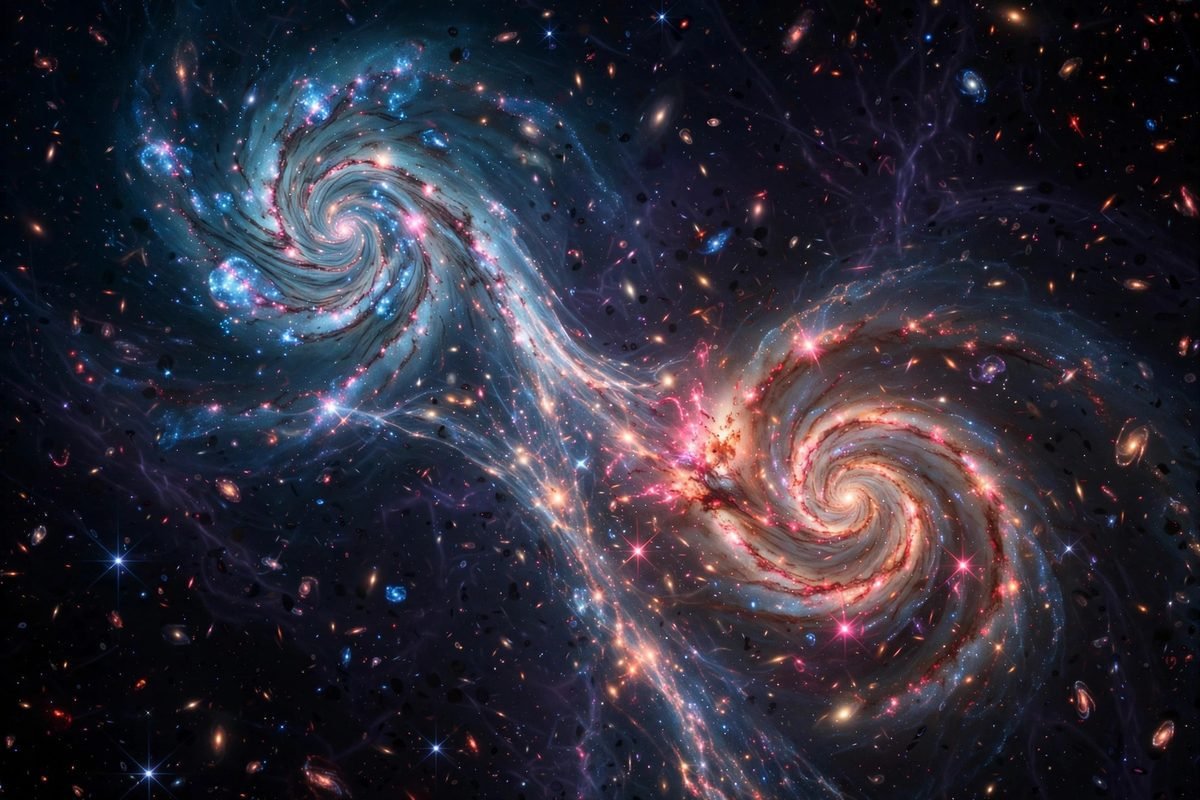
What happened to them? They merged. Over billions of years, gravitational attraction pulled these small galaxies together into the larger, brighter galaxies we see around us now. This dramatically reduced the total number of galaxies through mergers — a process the researchers described as verification of the so-called “top-down” formation of cosmic structure.
In other words, the universe did not start with a few big galaxies and grow more of them. It started with an enormous number of small ones that combined, over cosmic time, into fewer, larger galaxies. That is a profound statement about how structure formed in the universe, and it is one reason the 2 trillion figure matters beyond mere trivia.
How Deep Do Telescopes Actually See?
To understand why the count was so far off, it helps to understand the limits of our instruments. Here is how the major galaxy-counting efforts compare:
| Survey / Instrument | What It Did | Galaxies Counted |
|---|---|---|
| Hubble Deep Field (1995) | ~10 days of exposure on a tiny sky patch | ~3,000 |
| Hubble Ultra Deep Field (2004) | Deepest visible-light image of its time | ~10,000 |
| Hubble eXtreme Deep Field (2012) | Combined 10 years of exposures | ~5,500 (in one field) |
| Conselice model (2016) | 3D modeling of 20+ years of deep images | 2 trillion (estimated, not counted) |
| ESA Euclid first quick release (2025) | One week of survey data | 26 million detected |
| Rubin Observatory LSST (2026–2036) | 10-year survey of the southern sky | ~20 billion (expected) |
The numbers tell the story: we have directly seen only a small fraction of the galaxies that models say exist. Even the upcoming Rubin Observatory survey — the most ambitious galaxy census ever attempted — is expected to detect around 20 billion galaxies over a decade. That sounds enormous until you realize it is still only about 1% of the 2 trillion estimate.
The “Missing Galaxies” Problem
The 2 trillion figure created a puzzle known informally as the missing galaxies problem. If there really are 2 trillion galaxies, their combined starlight should add up to a certain brightness in the cosmic background light — the faint glow that fills the space between the stars. But measurements of that background light, taken by NASA’s New Horizons spacecraft in the dark outer solar system (far from the Sun’s glare), initially suggested less leftover light than expected.
In 2021, a team led by Tod Lauer analyzed New Horizons data and found that the total optical background light was only about twice what known galaxies could produce — which seemed to leave room for fewer unseen galaxies than the 2 trillion model implied. Then in 2024, Postman and colleagues revisited the same method with more fields and found the background light could be fully explained by known galaxies after all, with no significant leftover glow.
Where does that leave the 2 trillion estimate? It is still the most widely cited figure, and no study has directly disproven it. But it is a model-based extrapolation, not a direct count, and astronomers are careful to describe it as a lower bound — “at least 2 trillion.” The true number could be higher still, since the model cuts off at a million solar masses and says nothing about even smaller systems.
Does James Webb Change the Number?
The James Webb Space Telescope, launched in 2021, sees deeper into the infrared than Hubble could — which means it can detect some of the faintest, most distant galaxies that Hubble missed. Early Webb images confirmed that the early universe was far more crowded with small galaxies than expected, which is broadly consistent with the Conselice picture.
But Webb looks at tiny patches of sky, so it cannot directly settle the total count. That job falls to the wide-field survey telescopes: ESA’s Euclid mission, already mapping galaxies by the tens of millions, and the Vera C. Rubin Observatory in Chile, which began its decade-long Legacy Survey of Space and Time in 2026 and expects to catalog some 20 billion galaxies. Those surveys will detect the brighter portion of the hidden population and tighten the models — though the faintest dwarfs at the edge of the observable universe may remain model-inferred for decades to come.
How Many Galaxies Can We Actually See Right Now?
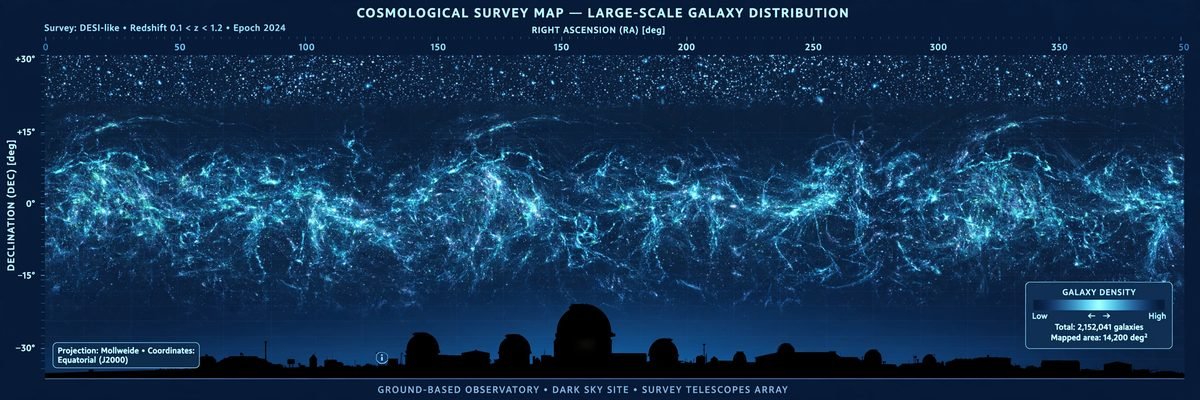
It is worth distinguishing between what exists and what we have observed. Of the estimated 2 trillion galaxies, astronomers have directly detected only a few tens of millions — roughly 0.01% of the estimated total. The rest are too faint, too small, or too far away.
Think of it like standing on a beach at night with a flashlight. You can see the grains of sand in your flashlight beam clearly, but you know the beach stretches far beyond into the darkness. The flashlight is our best telescopes. The beach is the observable universe. The 2 trillion figure is our best estimate of how far that beach extends — and how many grains it holds.
What This Number Really Tells Us
The number of galaxies in the universe is not just a big number to impress people at dinner parties. It is a measurement of the universe’s history. The fact that there were ten times more galaxies per unit of volume in the early universe than today confirms that galaxies grow by merging — the small ones combine into the large ones, and the population thins out over time.
It also tells us something humbling about our own place in the cosmos. We live in one galaxy among trillions, in a universe where 90% of the galaxies have never been studied. Every deep-sky image that reveals more of them — from Hubble’s deep fields to Webb’s infrared views to Euclid’s ongoing survey — is a reminder that the universe is far richer and more crowded than we once imagined.
And the count is not finished. As telescopes grow more powerful, the number will keep being refined. But the story of the 2 trillion galaxies will likely stand as one of the great census efforts in the history of science — proof that we can count what we cannot see, if we are clever enough about how we count.
Frequently Asked Questions
How many galaxies are in the observable universe?
At least 2 trillion, according to the 2016 study by Conselice and colleagues published in The Astrophysical Journal. Earlier estimates based on Hubble deep-field images put the number at around 100–200 billion.
Why did the estimate jump from 200 billion to 2 trillion?
The old number was a simple extrapolation from the galaxies visible in Hubble deep-field images. The 2016 study used 3D modeling of galaxy mass functions across cosmic time to infer the vast number of faint, distant galaxies that no telescope can detect — and found that over 90% of galaxies fall into that hidden category.
What is the missing galaxies problem?
The 2 trillion estimate implies a certain amount of total starlight in the universe. Measurements of the cosmic optical background light by New Horizons initially seemed to allow less room for unseen galaxies, creating a tension. A 2024 reanalysis found the background light fully explained by known galaxies, and the debate continues.
How many galaxies has the Hubble Space Telescope found?
Hubble’s deepest images each show a few thousand galaxies (around 3,000 in the 1995 Deep Field and roughly 10,000 in the Ultra Deep Field). Across all its observations, astronomers have cataloged on the order of a few hundred million galaxies — still a tiny fraction of the estimated total.
Will we ever count all 2 trillion galaxies?
Probably not one by one. Upcoming surveys like Euclid and the Rubin Observatory will detect tens of billions of the brightest ones, but the faintest dwarf galaxies at the edge of the observable universe will likely remain model-inferred for the foreseeable future.
How many stars are in the observable universe?
Roughly 200 sextillion (2 × 10²³), assuming an average of tens of billions of stars per galaxy across 2 trillion galaxies. That average is very approximate, since most galaxies in the count are small dwarfs.
Is the number of galaxies growing or shrinking?
The number per unit of volume is shrinking over cosmic time: mergers combine small galaxies into larger ones, so the early universe was far more crowded with small galaxies than today’s universe is.
Read Also: PriceCharting: What It Is and How to Use It (Explained Simply)
For more on how space science reaches beyond astronomy, 9bio.co.uk covers the people and stories behind science and culture — a good companion read when you want context beyond the cosmos.

1 Comment