
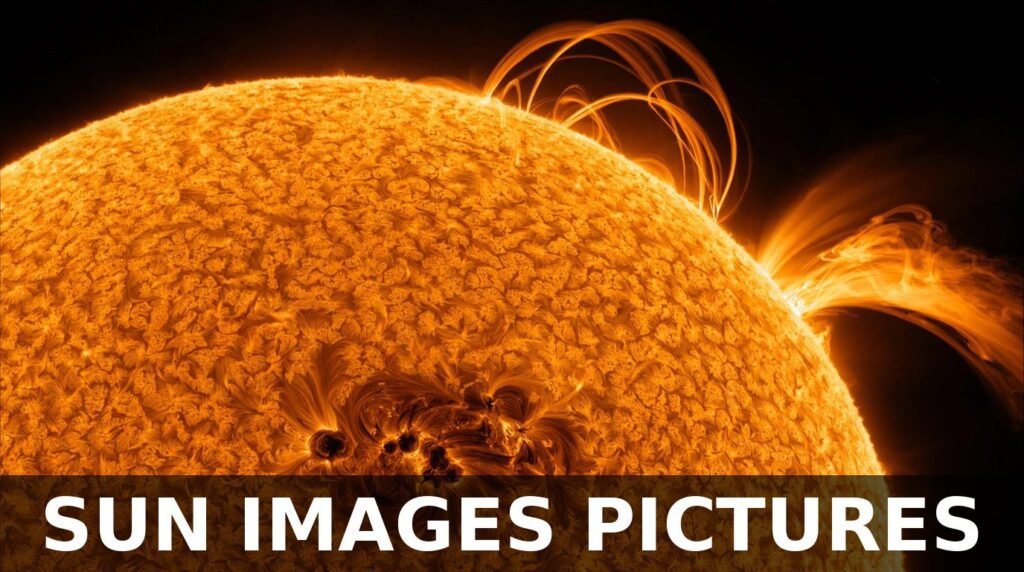
Every twelve seconds, a NASA spacecraft takes another picture of the Sun. Not one picture, but a whole set of them, each in a different kind of light, each showing a different layer of the star that runs our solar system. Since 2010 that steady rhythm has produced tens of millions of sun images pictures, from golden loops of hot gas to dark holes in the corona, and almost all of them are free for anyone to look at.
Search for sun images pictures and you will find an ocean of them: glowing orange discs, blood-red prominences, ghostly green coronas during eclipses, and close-ups where the Sun’s surface boils like a pot of water. Some are real photographs. Some are scientific data dressed in colour so human eyes can read it. All of them are beautiful, and most of them are telling you something real about how the Sun works.
This guide brings the best of it together. You will find where the finest sun images pictures live, what the different colours and wavelengths actually mean, which famous images are worth seeing, and how to take your own pictures of the Sun without hurting your eyes or your camera.
The short answer: The best sun images pictures come from NASA’s Solar Dynamics Observatory (SDO), which photographs the Sun every 12 seconds in many wavelengths, and from SOHO and ground-based telescopes. Different colours reveal different temperatures and layers, from the 5,500-degree surface to million-degree loops in the corona. You can browse them free, and with a proper solar filter you can safely photograph the Sun yourself.
What Do Sun Images Actually Show?
A picture of the Sun is never quite a photograph in the ordinary sense. The Sun is too bright, too hot and too violent to be captured the way you would photograph a landscape. Every sun image is a compromise between what the camera can record and what the star is actually doing, and the best ones are honest about that.
The simplest sun images pictures are white-light images. They show the Sun as a pale disc with dark sunspots scattered across it, and on a good day you can see granulation, the bubbling pattern of hot gas rising and cool gas sinking across the surface. These are the closest thing to what the Sun would look like to your eye if you could look at it safely, which you cannot, without a filter.
Then there are the narrow-band images, and these are where things get strange and wonderful. A hydrogen-alpha telescope shows the Sun in deep red, and suddenly the disc is alive with filaments, dark ribbons of cooler gas hanging above the surface, and prominences, great arches of glowing hydrogen leaping off the edge. An ultraviolet image shows the corona, the Sun’s outer atmosphere, as a halo of loops and streamers in gold and green, at temperatures over a million degrees.
Each type of image is a different instrument asking the Sun a different question. White light asks what the surface looks like. Hydrogen-alpha asks what the chromosphere is doing. Ultraviolet asks where the hottest gas is. Put them together and you get a layered portrait of a star, one that no single photograph could ever give you.
The Best Sources for Sun Images Pictures
If you want the best sun pictures, go to the people who take them every day. NASA’s Solar Dynamics Observatory is the first stop. SDO watches the whole Sun in ten wavelengths at once, taking images at 4096 by 4096 pixels every twelve seconds, and it posts new pictures for browsing roughly every fifteen minutes. Its data site lets you browse by wavelength and date, and its gallery of favourite images is one of the finest collections of solar photography anywhere.
The Solar Data Analysis Center, run by NASA’s Goddard Space Flight Center, keeps a page of the latest solar images from SDO and other missions, updated through the day. It is the quickest way to see what the Sun looks like right now, in every wavelength at once. The LMSAL Sun Today site offers the same daily images with a simple interface and lets you look back through the last sixty days, which is useful if you want to follow a sunspot group as it crosses the disc.
Helioviewer is the tool for explorers. It is a web application that lets you overlay images from SOHO and SDO, zoom into regions of interest, and build your own time-lapse movies of flares and eruptions. If you have ever wanted to watch a solar flare unfold frame by frame, this is where to do it.
SOHO, the Solar and Heliospheric Observatory, has been watching the Sun since the mid-1990s, and its “Sun Now” images remain a daily favourite. Its coronagraphs block out the bright disc and reveal the faint corona stretching into space, which is how the great coronal mass ejections are first spotted. For older or more specialised images, NASA’s Scientific Visualization Studio keeps a gallery of SDO’s best work, including slow-rotation movies of the Sun turning over days and weeks.
All of these sources are free to browse, and NASA’s images are generally in the public domain, which means you can download them, share them and even print them. Giving credit to NASA and the mission is good practice and is usually all that is asked.
The Colours of the Sun: Why Solar Pictures Look So Strange
Newcomers to sun images pictures often ask why the Sun is gold in one image, green in another and blood-red in a third. The answer is that most solar colours are assigned, not real. The human eye cannot see ultraviolet or extreme ultraviolet light at all, so scientists give each wavelength a colour that makes the structures easy to read.
Each wavelength corresponds to a temperature, and temperature tells you which layer of the Sun you are looking at. The cooler colours show cooler gas, and the hotter colours show gas heated to millions of degrees. Once you know the code, a solar image becomes a temperature map.
| Wavelength | Colour shown | Temperature | What it reveals |
|---|---|---|---|
| 4500 A (white light) | Natural pale yellow | ~5,500 C | Sunspots, granulation, the visible surface |
| 304 A (helium) | Red | ~50,000 C | Prominences and filaments in the chromosphere |
| 171 A (iron) | Gold | ~1 million C | Coronal loops, quiet corona |
| 193 A (iron) | Bronze/gold | ~1.5 million C | Coronal holes, hot active regions |
| 211 A (iron) | Green-gold | ~2 million C | Active regions, flaring loops |
| 131 A (iron) | Teal | ~10 million C | Flaring plasma, the hottest events |
| H-alpha (6563 A) | Deep red | ~10,000 C | Filaments, prominences, chromosphere |
The famous gold Sun that appears in so many NASA pictures is the 171-angstrom view, showing iron gas at about a million degrees. The eerie red Sun with flames around its edge is usually a 304-angstrom view, showing cooler helium gas in the chromosphere. Neither is what your eye would see, but both are truthful: they show real structures, at real temperatures, in light your eye simply cannot detect.
The Sun itself, seen in true visible light, is essentially white. It looks yellow or orange to us because Earth’s atmosphere scatters the blue light away. From space, the Sun is a brilliant white disc. The colours in solar images are a translation, and learning to read them is part of the fun.
Famous Sun Pictures Worth Seeing
Some solar images have become icons, and they are worth seeking out because each one captures the Sun doing something remarkable.
The “Canyon of Fire” is one of the best known. In September 2013, a long filament of dark plasma erupted from the Sun, and SDO watched a glowing canyon of hot material tear across the surface over two days. The resulting images show a bright, winding scar of light stretching across the solar disc, one of the most dramatic eruptions the spacecraft has ever recorded.
The big sunspot of 2014 is another. It was the largest sunspot group of its solar cycle, a dark island big enough to swallow several Earths, and it produced a series of powerful flares as it crossed the disc. The images from those two weeks show the spot growing, twisting and sparking, a reminder that sunspots are not blemishes but the visible footprints of intense magnetic fields.
SDO’s ten-year time-lapse is the grandest of all. Built from a decade of images in the 171-angstrom wavelength, sampled about once an hour, it shows the Sun breathing through an entire solar cycle, from quiet minimum to stormy maximum and back. Sunspots come and go, the corona brightens and fades, and the whole star seems to pulse with its own slow heartbeat.
Then there are the close-ups from the newest missions. The Parker Solar Probe has flown closer to the Sun than any spacecraft before it, looking back at the solar wind from inside the corona itself. The Solar Orbiter mission has returned the closest pictures of the Sun ever taken, resolving tiny bright flickers nicknamed “campfires” that may help explain why the corona is so much hotter than the surface below it.
Sun Images vs Sun Pictures: What Is the Difference?
People use the two phrases to mean slightly different things, and the distinction is useful. A sun picture is usually a photograph, something taken with a camera and a telescope, often by an amateur astronomer. A sun image is often a scientific product, a frame of data from a spacecraft instrument, coloured and processed for analysis.
The two kinds of picture have different strengths. A spacecraft image is precise, calibrated and taken in wavelengths the eye cannot see, which makes it better for science. An amateur photograph is often more beautiful in the ordinary sense, because it is taken in visible light, through Earth’s atmosphere, with an artist’s eye for composition.
The best sun images pictures online mix both kinds. NASA’s galleries supply the science images, and astrophotographers supply the visible-light portraits, the eclipse shots and the hydrogen-alpha close-ups that look like living fire. When you search for sun images pictures, you are really looking for both, and the richest results give you each in its own place.
How to Take Your Own Pictures of the Sun Safely
This section comes with a warning that cannot be overstated. Never look directly at the Sun without proper protection, and never point a camera or telescope at it without a solar filter fitted over the front of the lens. The Sun can damage your eyesight in seconds, and it can damage a camera sensor just as fast. A filter that goes over the front of the telescope, not at the eyepiece, is the only safe approach.
The simplest safe method is a solar filter made from Baader solar film or a similar material, held securely over the front of your telescope or camera lens. These filters block all but a tiny fraction of the Sun’s light and heat, and they let you see the disc, its sunspots and its limb darkening in comfort. Eclipse glasses that meet the ISO 12312-2 standard work for looking, but they are not a camera filter.
Projection is the oldest safe method of all. Aim a small telescope or binoculars at the Sun and project its image onto a white card held behind the eyepiece. You never look at the Sun at all, and a group of people can watch the projected disc together. It is how astronomers observed the Sun for centuries, and it still works beautifully for watching sunspots and eclipses.
If you want to photograph the Sun with a smartphone, do not hold it up to the Sun unprotected. Hold an eclipse-glasses lens or a piece of solar film in front of the phone’s camera instead, and keep your own eyes out of the line of sight. The results can be surprisingly good, especially during a partial eclipse, when the Sun’s crescent is one of the most photographed sights in the sky.
Photographing the Sun With a Telescope
For those who want to go further, a telescope with a proper solar filter opens up a whole world. In white light, with a full-aperture filter, you can photograph sunspots, the dark patches where magnetic fields cool the surface, and watch them change from day to day. A single sunspot group can be tracked as it rotates across the disc over two weeks, and a time-lapse of those images shows the Sun turning like a slow wheel.
A hydrogen-alpha telescope is the next step, and it is where solar photography becomes truly spectacular. These specialised instruments, such as the small dedicated solar scopes made for the purpose, isolate the red light of hydrogen and reveal the chromosphere: filaments snaking across the disc, prominences arching off the limb, and flares flashing into life. The images look like fire because, in a sense, they are.
Whatever equipment you use, a few practical rules help. Use a sturdy mount, because the Sun is a small target and any wobble blurs the image. Focus carefully on the edge of the disc or on a sunspot, and take many short exposures rather than one long one, stacking the sharpest frames together later. Shoot in the morning when the air is steadier, and keep your sessions short, because the Sun heats telescope tubes and the air inside them quickly.
Using Sun Images for Space Weather
Sun images pictures are not just pretty. They are the raw material of space weather forecasting, the science of predicting how solar activity will affect Earth.
Sunspots are the first thing forecasters look at. A large, complex sunspot group is a warning that flares may be coming, because flares erupt from the twisted magnetic fields around spots. When a flare goes off, SDO’s ultraviolet images catch the flash in real time, and the brightness and duration of the flash help forecasters judge how strong the event is.
Coronagraph images from SOHO take over from there. By blocking the Sun’s disc, they reveal coronal mass ejections, huge bubbles of charged gas, racing away from the Sun. If one is heading toward Earth, it will usually arrive in one to three days, and it can trigger geomagnetic storms, auroras and, in rare severe cases, problems for power grids and satellites.
Amateur sun-watchers contribute to this effort too. Daily white-light and hydrogen-alpha images from observers around the world fill the gaps between spacecraft observations and give forecasters a continuous record of what the Sun is doing. Your own sun pictures, shared with the community, become part of that watch.
Can You Download and Use NASA Sun Images?
Yes, and this is one of the great pleasures of solar astronomy. Images from NASA missions are generally in the public domain, because they are the work of a United States government agency, and they can be downloaded, shared and reused freely. The SDO data site, the Scientific Visualization Studio and the Helioviewer archive all offer downloads at a range of sizes.
Credit is appreciated and is usually the only condition. A line such as “Image: NASA/SDO” is enough for most uses. If an image was processed by a particular scientist or team, credit them too. A few images from other agencies or from individual photographers carry their own terms, so check the caption before reusing anything that is not clearly marked as NASA material.
The same openness applies to the data itself. SDO’s full archive is public, and anyone can download the raw frames and process them. Some of the most striking solar images online were made by enthusiasts working with the same data the scientists use, which is a reminder that the line between amateur and professional in solar astronomy has never been thinner.
What the Newest Sun Pictures Reveal
The last few years have changed what sun images pictures can show. The Parker Solar Probe, launched in 2018, has flown through the Sun’s outer atmosphere, closer to the star than any spacecraft in history, and its images look back at the solar wind from the inside. The Solar Orbiter mission, a joint European and NASA effort, has returned the closest pictures of the Sun ever taken and found a surface speckled with tiny bright eruptions.
These missions are answering an old puzzle: why is the corona, the Sun’s outer atmosphere, millions of degrees hotter than the surface beneath it? The new images suggest the answer may lie in countless small events, tiny flares and flickers that add up to an enormous amount of heat. The “campfires” seen by Solar Orbiter are one piece of that puzzle, and every new image brings another.
For anyone who loves sun images pictures, this is a golden age. The archive grows by the minute, the newest images are sharper than anything that came before, and the Sun itself is climbing toward the peak of its eleven-year cycle, which means more spots, more flares and more drama in the pictures to come.
Frequently Asked Questions About Sun Images Pictures
Where can I find the best sun images pictures?
NASA’s Solar Dynamics Observatory is the best single source, with new images every few minutes across ten wavelengths. The Solar Data Analysis Center shows the latest images from SDO and other missions, Helioviewer lets you explore and build movies, and NASA’s Scientific Visualization Studio keeps a gallery of the finest SDO images.
What is the most famous picture of the Sun?
Many people point to SDO’s golden 171-angstrom images, or the “Canyon of Fire” eruption of 2013, or the ten-year time-lapse of the Sun through a full solar cycle. The Parker Solar Probe and Solar Orbiter missions have added the closest pictures of the Sun ever taken.
Why are sun images pictures different colours?
Most solar colours are assigned by scientists, because the ultraviolet light SDO records is invisible to the human eye. Each wavelength is given a colour and corresponds to gas at a particular temperature, so the colour of an image tells you which layer of the Sun you are looking at.
Can I take a picture of the Sun with my phone?
Yes, but only with a proper solar filter held over the camera lens, such as eclipse glasses or solar film, and never by looking at the Sun directly. The results are best during a partial eclipse, when the Sun’s crescent is easy to capture.
Is it safe to photograph the Sun?
It is safe only with a solar filter fitted over the front of the lens or telescope. Never look at the Sun through an unfiltered camera, telescope or binoculars, and never use a filter that sits at the eyepiece. Projection onto a card is the safest method of all.
Are NASA sun images free to use?
Images from NASA missions are generally in the public domain and free to download, share and reuse. Credit NASA and the mission when you use them, and check the caption for images from other sources.
What is the best telescope for sun images pictures?
For white-light views of sunspots, any small telescope with a full-aperture solar filter works well. For the dramatic red prominences and filaments of the chromosphere, a dedicated hydrogen-alpha solar telescope is the tool of choice.
Conclusion
Sun images pictures are more than decoration. They are the daily record of a star, taken every twelve seconds by spacecraft, every clear morning by observers on the ground, and every few years in spectacular close-up by missions flying closer to the Sun than anyone thought possible. The gold discs, the red prominences and the ghostly coronas are all the same star, seen in different light, and each one tells you something the others cannot.
Start with NASA’s galleries, learn the colour code, and then, with a proper filter, try taking your own. The Sun is the one star you can photograph from your own backyard, and on a good day, with the right equipment, your picture can stand beside the best of them.
Read Also: J1407b: The Super-Saturn With Rings 200 Times Saturn’s