
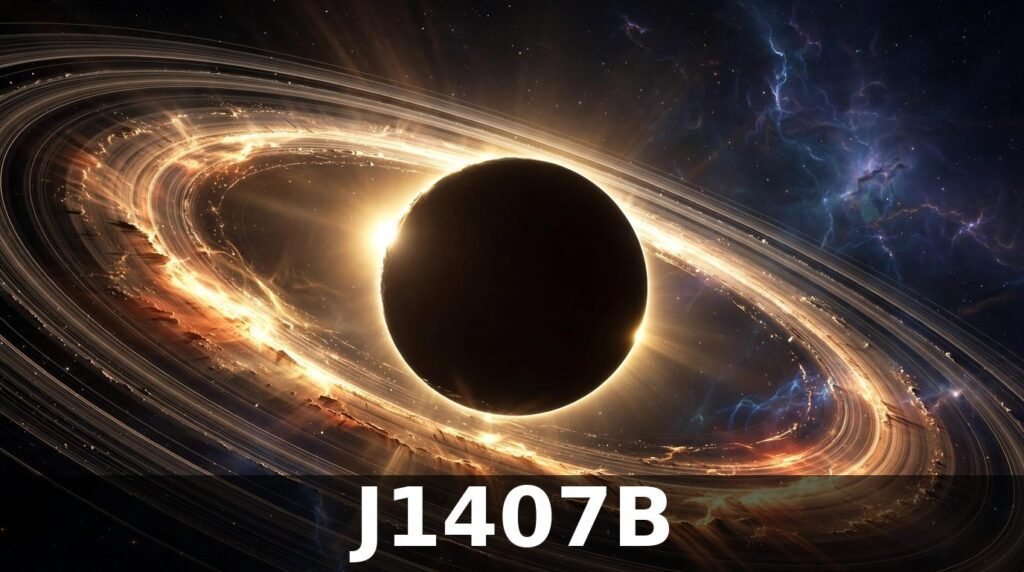
Saturn has the most famous rings in the solar system, and for a long time astronomers assumed nothing could beat them. Then a faint young star 434 light-years away dimmed for almost two months, and the explanation turned out to be far stranger than anyone expected. Hidden in that long eclipse was a ring system so enormous that Saturn’s rings look like a thin bracelet next to it.
The object behind it is called J1407b. It is a young giant planet, or possibly a brown dwarf, circling a star much like our own Sun when it was only 16 million years old. Its rings stretch about 120 million kilometres across, roughly 200 times the diameter of Saturn’s rings, and they hold about an Earth mass of dust and ice. Inside those rings, gaps hint that moons are already forming.
Nobody has ever seen J1407b directly. Everything we know about it comes from a single event: a 56-day eclipse in the spring of 2007, watched by a planet-hunting survey that was looking for something entirely different. This is the story of that discovery, what the rings are made of, and why astronomers are still waiting for the planet to come back into view.
The short answer: J1407b is a young giant planet or brown dwarf about 434 light-years away, famous for a ring system roughly 200 times wider than Saturn’s. The rings were discovered when they passed in front of the star J1407 in 2007 and blocked up to 95 percent of its light for 56 days. The system holds around an Earth mass of material, and gaps in the rings suggest exomoons are forming inside it.
What Is J1407b?
J1407b is a companion object orbiting the young Sun-like star J1407, formally catalogued as 1SWASP J140747.93-394542.6. The star sits about 434 light-years from Earth in the southern constellation Centaurus, and it is only around 16 million years old. That makes it a baby by stellar standards. Our Sun is about 4.6 billion years old, so J1407 is roughly the age the Sun was when the planets were still sweeping up the last of their building material.
The companion itself has never been imaged directly. Astronomers know it exists because of what it did to its star’s light in 2007. When a huge ring system crossed in front of J1407, the star faded dramatically, and the pattern of that fading carried a detailed fingerprint of the rings. By modelling the light curve, researchers could work out the size of the rings, the number of separate ringlets, and even where the gaps between them sit.
Estimates put J1407b’s mass at somewhere between 10 and 40 times the mass of Jupiter. That range matters, because it sits right on the borderline between a giant planet and a brown dwarf. A brown dwarf is an object too massive to be a planet but not massive enough to sustain hydrogen fusion like a star. Until the mass is pinned down more tightly, J1407b will keep both labels. Most researchers describe it as a young giant planet, while keeping the brown dwarf possibility open.
Its orbit is thought to take roughly ten years to complete, which is one reason the object is so hard to study. The 2007 eclipse was the only time its rings have been seen crossing the star. A second crossing was expected around 2017, but catching it required knowing the orbit precisely, and the timing was never certain enough to guarantee a detection.
How Was J1407b Discovered?
The discovery began with the SuperWASP project, a survey of ground-based telescopes designed to find gas giants passing in front of their stars. SuperWASP watches the brightness of thousands of stars night after night, looking for the small, regular dips that betray a transiting planet. J1407 was just one of many young stars on its list.
In the spring of 2007, something odd happened. The star began to fade, then brightened, then faded again for a week before the pattern reversed itself. Over 56 days the light dropped and recovered in a complicated sequence, and on one night it fell by half in a matter of hours. A planet crossing a star produces a simple, smooth dip. This was nothing like that.
Eric Mamajek, an astronomer at the University of Rochester, analysed the data and realised that only one explanation fitted. A vast ring system was passing between the star and Earth, and each separate ringlet blocked a different slice of starlight as it crossed. The first study was published in 2012, and a deeper analysis led by Matthew Kenworthy of Leiden Observatory followed in 2015. That second paper, published in the Astrophysical Journal, modelled the light curve in detail and mapped the ring system itself.
The discovery made J1407b the first exoplanet ever found with a ring system. Saturn, Jupiter, Uranus and Neptune all have rings, but until 2012 nobody had seen rings around a world beyond our solar system. The scale of what they found was the real shock. As Mamajek put it at the time, the planet is much larger than Jupiter or Saturn, and its ring system is roughly 200 times larger than Saturn’s rings are today.
Just How Big Are the Rings of J1407b?
The numbers are hard to picture, so it helps to compare them with things we know. Saturn’s rings span about 280,000 kilometres from edge to edge. J1407b’s ring system is about 120 million kilometres across. That is more than 200 times wider, and by area the rings cover roughly 40,000 times as much sky as Saturn’s rings do.
Put another way, the ring system is about as wide as the orbit of Venus around the Sun. If you placed it in our solar system with its centre on the Sun, its outer edge would reach almost to Earth’s orbit. Yet the object at its centre, J1407b itself, is only a few times the size of Jupiter. The rings dwarf the planet that holds them together.
The light curve tells the story of that size. The eclipse lasted 56 days because the ring system is so wide that it took nearly two months to drift across the face of the star. Within that long dimming, the brightness changed on timescales of tens of minutes, and those rapid flickers revealed the fine structure inside the rings. Kenworthy’s team counted more than 30 separate rings, with one later count reaching 37 distinct ringlets, each of them tens of millions of kilometres in diameter.
At the deepest point of the eclipse, the rings blocked as much as 95 percent of the star’s light. For days at a time, J1407 nearly vanished from view. That is an extraordinary amount of material to be hanging in space around a single young planet, and it is the reason astronomers think the system is a snapshot of moon formation in progress.
| Feature | Saturn’s rings | J1407b’s rings |
|---|---|---|
| Diameter | ~280,000 km | ~120 million km |
| Size vs Saturn | 1x | ~200x wider |
| Number of rings | Thousands of ringlets | 30-37 major rings |
| Ring mass | Tiny fraction of Earth’s mass | ~1 Earth mass of dust |
| Age | Possibly 100 million years or less | ~16 million years |
| Gaps | Carved by small moons | At least one large gap, likely an exomoon |
What Are the Rings Made Of?
The rings of J1407b are not solid bands. Like Saturn’s rings, they are made of countless particles, in this case mostly dust and ice, orbiting the planet in a flat disc. The total mass of that material is estimated at roughly one Earth mass, which is an enormous amount of solid matter to be spread around a single planet.
That mass is the key to understanding what the system is. J1407 is only 16 million years old, and its planet is still young. The rings are probably the leftover building material from the planet’s formation, a disc of dust and rock that never quite finished collapsing into moons. In our own solar system, the same kind of disc once surrounded the young giant planets, and the moons of Jupiter and Saturn grew out of it. Around J1407b, that process appears to be happening right now, on a scale far larger than anything we can see at home.
The particles themselves are mostly fine dust, which is why the rings block so much light. A ring made of large boulders would let more starlight slip through the gaps between them. A ring full of fine dust is nearly opaque, and that is exactly what the 2007 eclipse showed, with the star’s light cut by up to 95 percent at the deepest moments.
Over time, the rings are expected to thin out. As dust clumps together into larger bodies, the fine material disappears into moons, and the disc fades. Kenworthy and Mamajek estimated that within a few million years, a blink in astronomical terms, J1407b’s rings will have thinned dramatically. We are lucky to be watching the system at a moment when its rings are still at their most spectacular.
The Gaps in the Rings: Baby Moons in the Making
The most exciting detail in the ring system is not its size but its gaps. The 2015 analysis found clear spaces between some of the rings, including one large gap about 0.4 astronomical units wide, roughly 61 million kilometres. A gap that wide does not happen by accident. Something must be sweeping the dust out of that lane, and the most likely culprit is a moon.
Modelling suggests the gap could be held open by a single large satellite with a mass somewhere between that of Earth and Mars, circling J1407b once every two years. If that estimate is right, the moon would be larger than any moon in our solar system. Ganymede, the largest moon we know, is about 5,268 kilometres across. The suspected exomoon around J1407b could be far more massive, a genuine world in its own right, still gathering material from the rings around it.
Other, smaller gaps in the rings hint at more moons in the making. The picture that emerges is a whole satellite system under construction, with moons of different sizes clearing lanes in the dust as they grow. Astronomers sometimes call J1407b a “super-Saturn” because of its rings, but in a sense it is more like a miniature solar system, with a central giant and a family of moons forming around it.
That is why the discovery mattered beyond the spectacle of the rings themselves. It was the first glimpse of moon formation on a scale of millions of kilometres around an object outside our solar system. The processes that built our own Moon and the moons of Jupiter may be playing out right now around J1407b, and the ring gaps are the evidence.
Is J1407b a Planet or a Brown Dwarf?
The honest answer is that nobody is sure yet, and the uncertainty comes down to mass. Planets and brown dwarfs are separated by what happens in their cores. Above about 13 Jupiter masses, an object can briefly fuse deuterium, a heavy form of hydrogen, and that is often used as the dividing line. J1407b’s estimated mass range of 10 to 40 Jupiter masses straddles that line.
Later work tried to narrow the range. Adaptive optics and Doppler spectroscopy, which look for the tiny wobble the companion causes in its star, suggested the companion is most likely a giant planet rather than a brown dwarf. But the measurements are difficult, and the mass is still not pinned down tightly enough to settle the question for good.
For most purposes the distinction does not change what makes J1407b interesting. Whether it is a planet or a brown dwarf, it is a young giant world with the largest ring system ever found, and the rings are doing exactly what rings around young giants are expected to do: feeding the growth of moons. If anything, the ambiguity makes the system more useful, because it shows that ring systems can exist around a wide range of massive young objects, not just planets like Saturn.
The Star J1407: A Young Twin of the Sun
J1407b’s host star deserves attention of its own, because it is a window into our own Sun’s youth. J1407 is a pre-main-sequence star, meaning it is still contracting toward the stable adult phase of its life. It is similar in mass to the Sun but only about 16 million years old, and it spins once every 3.2 days. Our Sun takes about 25 days to complete one rotation.
That fast spin is a signature of youth. Stars are born spinning quickly and slow down as they age, shedding angular momentum through their stellar winds. A 3.2-day rotation period is exactly what you expect from a star that has only recently emerged from its birth cloud.
The star’s youth is also what makes the ring system possible. Sixteen million years after a star forms, there is still plenty of dust and gas in the system, and giant planets are still finishing their growth. The rings of J1407b are a leftover from that construction phase, a disc that has not yet been fully swept up into moons. Around an older star, the same material would long since have been cleared away.
J1407 lies in the constellation Centaurus, in the southern sky, about 434 light-years away. At that distance the star itself is faint, far too dim to see with the naked eye, and it took a dedicated planet-hunting survey to notice its strange behaviour at all.
What Happened When Astronomers Looked Again?
With an orbital period of roughly ten years, the next ring crossing was expected around 2017, a decade after the first. Astronomers watched for it, but the event proved much harder to catch than hoped. The orbit is not known precisely enough to predict the exact date of the crossing, and the eclipse itself would last weeks, requiring long, patient monitoring.
Follow-up observations with large telescopes and the ALMA array in Chile have searched for the companion directly, with mixed results. A faint source was reported at a position consistent with where the object that caused the 2007 eclipse should have been, but no source was found at the star’s own position. The picture is still unsettled, and that is normal for a system that has only been seen once, through a single long eclipse.
The difficulty is part of the story. J1407b is faint, far away, and spends most of its decade-long orbit nowhere near its star from our point of view. The rings only reveal themselves during the brief weeks when they cross the star’s face. Between crossings, the system is essentially invisible, and astronomers must wait for the geometry to line up again.
That wait is also an opportunity. Each new observation, whether it detects the companion or not, tightens the constraints on its orbit and mass. The next confirmed crossing, whenever it comes, will be watched by far more telescopes than the first, and the data will be far richer than the SuperWASP light curve that started the whole story.
What J1407b Tells Us About How Moons Form
The moons of our solar system formed in discs like the one around J1407b, but those discs are long gone, and astronomers have had to reconstruct the process from the finished product. J1407b offers something rare: a moon-forming disc caught in the act, around a young giant, with its structure readable in the pattern of a single eclipse.
The lesson so far is that moon formation can happen on an enormous scale. The rings hold about an Earth mass of material, and the gaps suggest at least one moon as massive as Earth or Mars is already clearing its lane. If that moon keeps growing, it could end up larger than any moon in our solar system, a world that began as dust in a ring.
The system also shows that rings are not a quirk of our solar system. Before 2012, rings were something the giant planets of our neighbourhood happened to have. After J1407b, they became a general feature of young giant planets, a normal stage in how planetary systems are built. Other ringed exoplanets are likely out there, waiting for their own eclipses to give them away.
There is a final, humbling point. The rings of J1407b are temporary. In a few million years they will have thinned into moons, and the spectacular disc we see in the models will be gone. Saturn’s rings may be temporary too, on a similar timescale. Both systems are snapshots, caught at a bright moment in a long, slow process of building moons out of dust.
Will We Ever See J1407b’s Rings Again?
Probably, but nobody can say exactly when. The roughly ten-year orbital period means another crossing should come, and astronomers are watching. The challenge is knowing precisely where and when to look, because a small error in the orbit translates into a large error in the predicted date.
When the next crossing does happen, the tools waiting for it are far better than the ones that caught the first. Space telescopes and large ground-based observatories can measure the star’s brightness with far greater precision than SuperWASP could, and they can watch in many wavelengths at once. A second eclipse would let astronomers map the rings in finer detail, test the exomoon idea directly, and perhaps finally pin down the companion’s mass.
Until then, J1407b remains one of astronomy’s great one-off discoveries: a single strange eclipse, a ring system 200 times wider than Saturn’s, and a family of moons forming in the dark, 434 light-years away.
Frequently Asked Questions About J1407b
What is J1407b?
J1407b is a young giant planet, or possibly a brown dwarf, orbiting the young Sun-like star J1407 about 434 light-years away. It is famous for having the largest ring system ever discovered, roughly 200 times wider than Saturn’s rings.
How big are the rings of J1407b?
The ring system is about 120 million kilometres across, more than 200 times the diameter of Saturn’s rings. It contains over 30 separate rings and holds roughly an Earth mass of dust and ice.
How was J1407b discovered?
It was discovered through the SuperWASP planet-hunting survey. In the spring of 2007 the star J1407 dimmed for 56 days as the ring system crossed in front of it, blocking up to 95 percent of its light. The discovery was published in 2012, with a detailed ring analysis following in 2015.
Does J1407b have moons?
Probably. Gaps in the rings suggest at least one large exomoon is forming, possibly with a mass between that of Earth and Mars. The moon would orbit J1407b roughly once every two years, but it has not been seen directly.
Is J1407b a planet or a brown dwarf?
It is not settled. Its mass is estimated at 10 to 40 times the mass of Jupiter, which straddles the usual dividing line between giant planets and brown dwarfs. Most researchers lean toward it being a giant planet.
How far away is J1407b?
The system lies about 434 light-years from Earth, in the constellation Centaurus in the southern sky. Its host star is only about 16 million years old.
Will J1407b’s rings disappear?
Yes, over millions of years. As the dust in the rings clumps together to form moons, the rings will thin out and eventually fade. We are seeing the system at a moment when its rings are still at their most spectacular.
Conclusion
J1407b began as a puzzle in a planet survey’s data, a star that dimmed for 56 days in a pattern no planet could explain. The answer turned out to be the largest ring system ever found, a disc 120 million kilometres wide holding an Earth mass of dust, with gaps that betray moons forming inside it. It showed that rings are not a local curiosity but a normal part of how giant planets grow, and it gave astronomers their first look at moon formation happening around another star.
The system will not stay this way. In a few million years the rings will thin into moons, and the spectacle will be over. For now, though, J1407b stands as a reminder of how much a single eclipse can reveal, and how much is still waiting in the dark between the stars.
Read Also: 800000 Astronomy Notifications: Incredible Rubin Alert Flood
1 Comment