
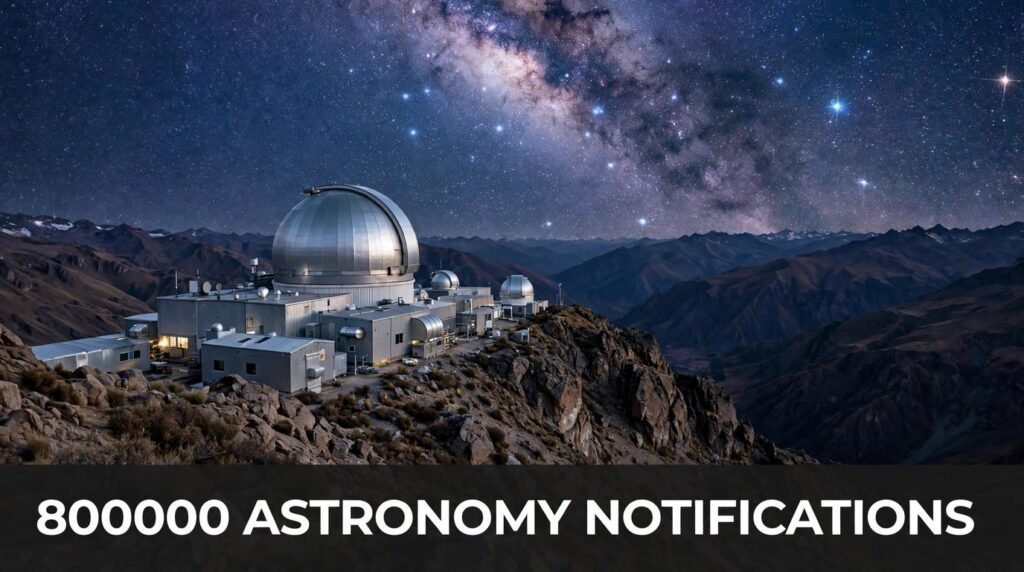
On the night of 24 February 2026, astronomers around the world woke up to something no telescope had ever done before: around 800,000 notifications, each one announcing that something in the night sky had changed. A star had exploded. An asteroid had moved. A distant black hole had flared. Every single alert came from one mountaintop in Chile, where the Vera C. Rubin Observatory had just switched on the most ambitious sky-watching machine ever built — and 800,000 was only its first night.
What Are the 800000 Astronomy Notifications?
The 800000 astronomy notifications are the alerts produced by the Rubin Observatory’s Alert Production Pipeline on its first public night of operation. Rubin is not a normal telescope that points at one target at a time. Its Simonyi Survey Telescope scans huge swathes of the southern sky again and again, photographing a new patch of sky roughly every 40 seconds with the largest digital camera ever built for astronomy — a 3,200-megapixel giant mounted behind an 8.4-metre mirror.
Software then compares every new image against a template built from earlier images of the same patch of sky. Anything that has changed — a new point of light, a star that brightened or faded, an object that moved — generates an alert, and that alert is pushed out to the world within about a minute or two of the shutter closing. Multiply that process by a whole night of observing and you get the headline number: roughly 800,000 notifications in a single night, covering supernovae, variable stars, flaring supermassive black holes, and asteroids sweeping through our own solar system.
For researchers and skywatchers alike, the 800000 astronomy notifications mark a turning point in how the night sky is studied. Instead of waiting weeks for news of a distant explosion, the 800000 astronomy notifications put fresh discoveries in front of telescopes within minutes, so follow-up observations can begin while events are still young. And because the 800000 astronomy notifications are public, anyone with a broker account can watch the same stream the professionals use, filtering it down to the supernovae, asteroids and variable stars they care about most.
The Night the Flood Began
Rubin Observatory, perched on Cerro Pachón in the Chilean Andes and jointly funded by the US National Science Foundation and the Department of Energy, released its first public images in June 2025 to global attention. But astronomers were waiting for a second milestone that mattered even more to them: the alert stream. A beautiful picture of a galaxy is science at rest; an alert is science in motion, a chance to point other telescopes at an event while it is still happening.
That stream went live on 24 February 2026. The system, developed by a team of about two dozen researchers at the University of Washington’s DiRAC Institute, processed the night’s images and distributed some 800,000 alerts about moving asteroids, exploding stars, and other celestial changes. Eric Bellm, the UW astronomer who leads the Alert Production Pipeline group, described the goal plainly: the system was designed to let anyone identify interesting events with enough notice to obtain time-critical follow-up observations. On night one, it delivered — 800,000 times over.
How the Alert System Works
The machinery behind the notifications is a race against the sky. Rubin generates up to 20 terabytes of data every night, far more than any human team could inspect. So the pipeline is fully automated. Each incoming image is aligned with the observatory’s reference template of that region. The template is subtracted, and what remains — the difference image — should be almost empty. Whatever survives the subtraction is, by definition, something that changed.
Each surviving change is measured, packaged with a small cutout image and basic data about the object, and classified as far as the software can manage on its own: this one is moving like an asteroid, that one brightened like a supernova, that one sits exactly on a known galaxy. Then, within roughly 60 seconds to two minutes of the original exposure, the alert leaves the mountain. The entire chain — photons hitting the camera to a notification on an astronomer’s screen on another continent — takes about as long as brewing a cup of tea.
What Triggers an Alert?
Not all 800,000 notifications are equal, and that is precisely what makes them valuable. The biggest category by scientific drama is supernovae: stars ending their lives in explosions so bright they can outshine their home galaxies. Catching a supernova within hours of the blast, which Rubin’s alerts now make routine, lets astronomers watch the explosion unfold from the very beginning instead of arriving days late.
Then there are the movers. Asteroids reveal themselves by shifting position between images, and Rubin’s nightly harvest includes vast numbers of them — most harmless main-belt rocks, but the same net catches near-Earth objects whose orbits need tracking for planetary defence, and occasionally something stranger: an interstellar visitor passing through our solar system, the kind of object humanity has only ever spotted three times. Add variable stars pulsing and eclipsing, and active galactic nuclei flickering as black holes feed, and a single night’s notifications become a census of everything in the universe that refuses to sit still.
Brokers: Making Sense of 800,000 Alerts a Night
Here is the obvious problem: no astronomer can read 800,000 notifications before breakfast. So the alerts do not go directly to scientists. They flow first to a layer of software platforms called brokers — systems with names like ANTARES, ALeRCE, AMPEL, Fink, Lasair, and Pitt-Google — which ingest the entire stream and filter it.
Brokers use machine-learning algorithms to sort, classify, and cross-reference every one of the 800000 astronomy notifications against catalogues of known objects across many wavelengths. A supernova team can subscribe only to likely supernovae in nearby galaxies; an asteroid group can take only the fast movers; a student can follow just the brightest events visible from their hemisphere. Crucially, the alerts are public. Anyone — professional researchers, students, and citizen scientists alike — can access the stream through the brokers and set up their own filters. The 800,000 notifications belong to everyone.
Why the 800000 Astronomy Notifications Change Astronomy
Astronomy has always been a science of patience, but its most exciting events are impatient ones. A supernova’s first hours reveal how the star died. A newly discovered asteroid’s first nights of data decide whether its orbit is a curiosity or a concern. A tidal disruption event — a star being torn apart by a black hole — fades on a schedule no one controls. Before automated alerts, most such events were found late, by luck, or not at all.
Rubin’s stream industrialises discovery. Instead of a handful of noticed changes per night across the whole planet’s telescopes, the field now receives a comprehensive, machine-readable account of everything that changed in the southern sky, delivered in minutes. As one of the broker developers put it, going from the old way to 800,000 alerts per night is a sea change. Follow-up telescopes — including amateur ones — can be pointed at fresh events the same night, and the archive of alerts becomes a searchable record of the sky’s behaviour that researchers will mine for decades.
From 800,000 to 7 Million Notifications a Night
Perhaps the most startling part of the story is that 800,000 is the small number. The first-night figure came from a system still warming up. Once the observatory’s ten-year Legacy Survey of Space and Time (LSST) is running at full capacity, the Alert Production Pipeline is expected to produce up to 7 million alerts per night — nearly ten times the debut flood, sustained for a decade.
That scale is why the broker layer matters so much, and why machine learning sits at the heart of modern astronomy whether astronomers planned it that way or not. The discoveries of the LSST era will not be made by someone looking through an eyepiece. They will be made by well-tuned filters catching the one notification in seven million that turns out to be something entirely new — a type of explosion never catalogued, an object behaving in a way no theory predicted.
The Telescopes That Answer the 800000 Astronomy Notifications
An alert on its own discovers nothing new — it is an invitation. The science happens when other telescopes accept the invitation within hours, while the event is still young. That is why observatories around the world have built rapid-response programmes specifically designed to drink from alert streams like Rubin’s. Large telescopes in Hawaii, the Canary Islands, Australia, and South Africa can interrupt their scheduled programmes, swing to the coordinates in a promising notification, and take spectra that reveal what the new object actually is: its composition, its distance, whether that brightening point of light is a nearby flare star or the death of a massive star billions of light-years away.
Smaller telescopes matter too. A one-metre telescope cannot compete with Rubin’s camera for discovery, but it can monitor a brightening supernova night after night, building the light curve that tells physicists how the explosion evolved. University observatories and even well-equipped amateur astronomers feed follow-up measurements into the same public databases the brokers draw from.
The result is a genuine division of labour across the whole planet: one giant eye in Chile notices everything that changes, and thousands of smaller eyes — professional and amateur alike — examine the most interesting changes in detail. The 800,000 notifications are the connective tissue of that global system, and every follow-up observation they trigger makes the next night’s alerts smarter, because the brokers learn which kinds of changes turned out to be real discoveries and which were noise.
Can You Receive Astronomy Notifications Yourself?
Yes, at two levels. For the Rubin stream specifically, the public route to the 800000 astronomy notifications is through the official brokers: you create an account with a broker such as Lasair or Fink, define filters for the kinds of events you care about, and receive your own personal slice of the nightly flood. It is aimed at researchers, but nothing stops an enthusiastic amateur from exploring it.
For everyday skywatching, the same alert philosophy powers the apps on your phone. Services and apps notify users about International Space Station passes, bright satellite trains, meteor shower peaks, aurora forecasts, eclipses, and planetary conjunctions. The principle is identical to Rubin’s, just scaled down: software watches the sky so you do not have to, and pings you when something worth seeing is about to happen. Between the professional stream and the phone apps, the night sky has effectively learned to send notifications — and after Rubin’s first night, it sends them 800,000 at a time.
Frequently Asked Questions
What does “800000 astronomy notifications” mean?
It refers to the roughly 800,000 alerts the Vera C. Rubin Observatory’s automated system sent out on its first public night, 24 February 2026. Each notification flags something that changed in the sky — an exploding star, a moving asteroid, a flaring black hole, or a variable star.
Who sends the 800,000 notifications?
The alerts are produced by the Rubin Observatory’s Alert Production Pipeline in Chile and distributed worldwide through software platforms called brokers, such as ANTARES, ALeRCE, Fink, and Lasair, which filter the stream for different research teams and the public.
How fast do the alerts arrive after something happens?
Very fast. Rubin’s software compares each new image to a reference template and issues an alert within about 60 seconds to two minutes of the image being taken, fast enough for other telescopes to observe the event the same night.
Are the Rubin Observatory alerts free to access?
Yes. The alert stream is public. Anyone can explore it through the official broker systems, from professional astronomers hunting supernovae to students and citizen scientists following the brightest events.
Will there really be 7 million notifications a night?
That is the expected figure once the ten-year Legacy Survey of Space and Time reaches full operations — up from the 800,000 alerts of the first night. Brokers and machine-learning filters exist precisely to make that volume usable.
Final Thoughts
A generation ago, discovering that a star had exploded was the work of weeks. On one February night in 2026, a telescope in Chile announced 800,000 changes in the sky before sunrise, and it was only getting started. The 800000 astronomy notifications are more than a big number: they are the moment astronomy became a real-time science, with the whole changing universe delivered as it happens — to anyone who cares to listen.
Read Also: What Is the Biggest Star in the Universe?
1 Comment