
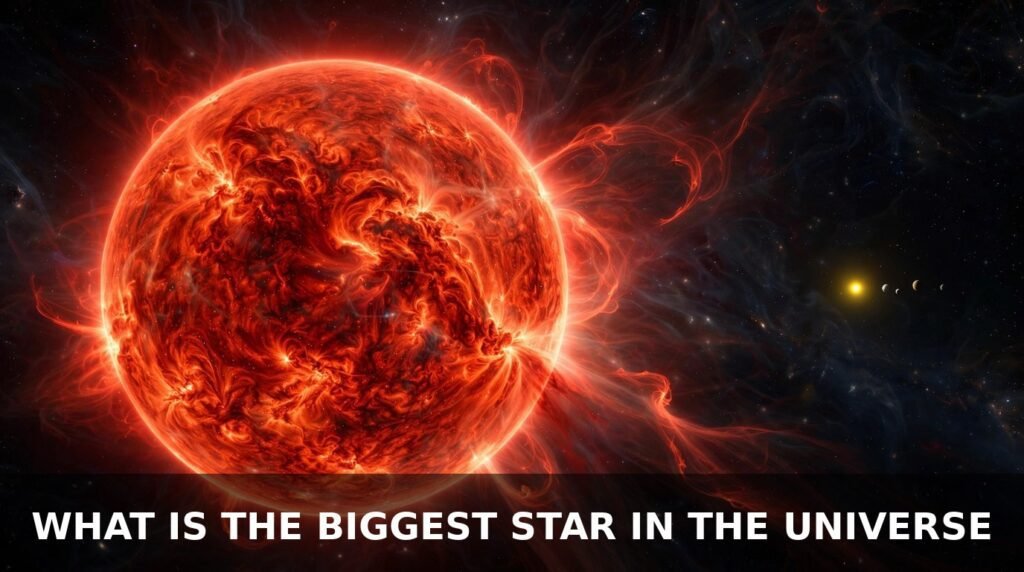
Every star you have ever seen is a spark compared with this one. So what is the biggest star in the universe? Based on the best current measurements, the title belongs to Stephenson 2-18, a red supergiant so enormous that if it replaced the Sun, its surface would stretch out past the orbit of Saturn. Its radius is estimated at about 2,150 times the Sun’s, wide enough to fit roughly ten billion Suns inside it.
That answer comes with a warning label, though. The crown for biggest star has changed hands several times in the last decade, and it will probably change again. Measuring these bloated giants is genuinely difficult, and yesterday’s record holder, UY Scuti, shrank dramatically when astronomers measured its distance more carefully. Here is what we know about the current champion, the rivals behind it, and why the title is so hard to hold.
The Short Answer: Stephenson 2-18
Stephenson 2-18, also catalogued as St2-18, is a red supergiant in the constellation Scutum, lying roughly 19,000 light-years from Earth in the direction of a dense star cluster called Stephenson 2. Astronomers who studied it using its estimated distance and brightness calculated a radius of around 2,150 solar radii, which would make it the largest star yet measured, ahead of every other known candidate.
It is not just wide. Stephenson 2-18 is thought to shine with the light of several hundred thousand Suns, despite having a surface temperature of only around 3,200 degrees Celsius, far cooler than the Sun’s 5,500 degrees. That combination, immense size, huge luminosity and a cool red surface, is the signature of a star in the final, swollen stage of a short and violent life.
One honest caveat: even its distance is debated. If Stephenson 2-18 turns out not to belong to the cluster whose distance was used in the calculation, its true size would change too. Astronomers are upfront about this. It is the biggest star we know of, with an asterisk.
How Big Is Stephenson 2-18, Really?
Knowing what is the biggest star in the universe is one thing; picturing it is another. Numbers like 2,150 solar radii are hard to feel, so try some comparisons.
- Against the solar system: the Sun’s radius is about 696,000 kilometres. Multiply that by 2,150 and Stephenson 2-18 spans roughly 3 billion kilometres from side to side. Placed at the centre of our solar system, it would swallow Mercury, Venus, Earth, Mars and Jupiter whole, and its surface would reach beyond Saturn.
- Against the Sun’s volume: volume grows with the cube of the radius, so a star 2,150 times wider holds about ten billion times the Sun’s volume. You could pour roughly ten billion Suns into it.
- Against light itself: light crosses the Sun in under five seconds. It would need nearly three hours to travel from one side of Stephenson 2-18 to the other.
- Against Earth: our entire planet, placed on this star’s surface, would be smaller relative to it than a marble is to a stadium. There is no familiar object that makes the scale feel real, which is precisely why astronomers reach for the solar system instead.
And yet, for all that bulk, Stephenson 2-18 is not especially heavy. Red supergiants are astonishingly thin and diffuse, more like a glowing red fog held together by gravity than a solid ball of fire. Much of the star’s outer volume is gas thinner than the air in a vacuum chamber on Earth.
What Is the Biggest Star in the Universe Compared With the Other Giants?
Ask what is the biggest star in the universe and Stephenson 2-18 is only the first name on the list. It leads a field of monsters. Here are the main contenders, with the radius estimates astronomers currently work with. Treat every figure as approximate, because each one depends on a measured distance that carries real uncertainty.
| Star | Estimated radius (Sun = 1) | Notes |
|---|---|---|
| Stephenson 2-18 | ~2,150 | Current record holder; distance debated |
| WOH G64 | ~1,540–1,730 | In the Large Magellanic Cloud; wrapped in dust |
| VY Canis Majoris | ~1,420 | Famous red hypergiant, shedding huge clouds of gas |
| UY Scuti | ~755 (revised) | Former champion at 1,708 before Gaia data |
| Betelgeuse | ~700–1,000 | The red shoulder of Orion; size varies as it pulsates |
| Antares | ~680 | The red heart of Scorpius |
| The Sun | 1 | Our star, for scale |
Two things stand out from that table. First, every serious contender is a red supergiant or hypergiant, a massive star in its death throes. Second, the error bars are enormous by the standards of most astronomy. A star listed at 1,700 solar radii today can be remeasured at 1,500 tomorrow, not because the star changed, but because our ruler did.
Rankings like this are also why the answer to what is the biggest star in the universe keeps changing. A single improved distance measurement can promote or demote a candidate overnight, and new surveys keep turning up fresh contenders in dusty corners of the galaxy that older telescopes could not see into. Stephenson 2-18 itself only took the crown in recent years. So if you ask again in a decade what is the biggest star in the universe, do not be surprised if a different name comes back. The giants are not changing. Our view of them is, measurement by measurement, year by year.
Whatever Happened to UY Scuti?
For most of the 2010s, if you asked what is the biggest star in the universe, the standard answer was UY Scuti, another red supergiant in Scutum. A widely reported 2013 estimate gave it a radius of about 1,708 times the Sun’s, enough to reach past Jupiter if it sat in the Sun’s place. Headlines crowned it the largest star ever found, and the claim spread everywhere.
Then the European Space Agency’s Gaia spacecraft measured the star’s parallax, the tiny wobble that reveals distance, and suggested UY Scuti is considerably closer to us than previously assumed. A closer star shining with the same apparent brightness must be smaller and less luminous than believed. Recalculated, UY Scuti’s radius came down to roughly 755 solar radii, less than half the old figure. It is still a monster, several times wider than Earth’s orbit, but it lost the crown without changing at all. Only our measurement did.
The UY Scuti story is the perfect illustration of why astronomers answer the biggest-star question so cautiously. These stars are rare, distant, dimmed by dust and measured at the edge of what our instruments can do. Every record on the list, including Stephenson 2-18, carries the same invisible footnote.
Why “Biggest” Is Such a Slippery Title
Part of the problem is that a star is not a billiard ball. The Sun has no solid surface, and a red supergiant barely has a surface at all. Its outer layers shade gradually from thin gas into space, so where you declare the star to “end” depends on the definition you use, usually the photosphere, the layer where the gas becomes opaque. Different instruments effectively see different layers, and give different answers.
These giants also pulsate. Betelgeuse, the most famous red supergiant in our sky, swells and shrinks noticeably over a cycle of a few hundred days, and in late 2019 it faded dramatically in what astronomers called the Great Dimming, probably caused by a cloud of its own dust. A star that changes size while you measure it is never going to give you one clean number.
Add in the dust these stars manufacture and eject, which dims and reddens their light, plus distances measured in thousands of light-years with percentage errors that translate into hundreds of solar radii, and you see the difficulty. So when astronomers answer the question of what is the biggest star in the universe, they are really saying “the biggest star our current measurements support.”
Biggest Is Not the Same as Most Massive
It surprises many people that the widest stars are not the heaviest. Ask what is the biggest star in the universe and you get a red supergiant; ask for the most massive star and you get something else entirely. Stephenson 2-18 probably contains only a few dozen times the Sun’s mass spread across its absurd volume. The heavyweight title belongs to a very different kind of star: R136a1, a blue giant in the Tarantula Nebula in the Large Magellanic Cloud, around 160,000 light-years away.
R136a1 is estimated at roughly 200 times the mass of the Sun, give or take a few dozen solar masses depending on the model, and it shines millions of times more brightly. Yet it is only a few dozen times wider than the Sun. Where red supergiants are bloated and cool, stars like R136a1 are compact, ferociously hot and burn through their fuel at a furious rate. Size in astronomy can mean width, mass or brightness, and a different star wins each contest.
How Does a Star Get This Big?
No star is born the size of Stephenson 2-18. These giants start life as massive stars, perhaps 15 to 25 times the Sun’s mass, burning hydrogen at a tremendous rate on the main sequence. Because they burn so hot, their lives are short: millions of years rather than the Sun’s ten billion.
When the hydrogen in the core runs out, the star’s structure fails and rebuilds itself. The core contracts and heats up, fusing heavier and heavier elements, while the outer layers expand and cool, ballooning outward by hundreds of times. The star becomes a red supergiant: a dense, furiously burning core wrapped in an immense, thin, cool envelope. It is less a single object than a bonfire inside a fog bank the size of a solar system.
This phase cannot last. Within a few hundred thousand years, a blink in cosmic terms, the core will collapse and the star will tear itself apart as a supernova, briefly outshining its entire galaxy and leaving behind a neutron star or a black hole. Stephenson 2-18, UY Scuti and Betelgeuse are all living on borrowed time. One of them could, in principle, have already exploded, with the light still travelling towards us.
Frequently Asked Questions
What is the biggest star in the universe?
The biggest star currently known is Stephenson 2-18, a red supergiant with an estimated radius of about 2,150 times the Sun’s. Placed in the Sun’s position, its surface would extend past the orbit of Saturn. The estimate depends on its distance, which is still debated, so the title could change with better measurements.
Is UY Scuti still the biggest star?
No. UY Scuti held the title for years with an estimated radius of about 1,708 solar radii, but data from the Gaia spacecraft suggested it is closer to Earth than previously thought. Recalculated at the shorter distance, its radius is roughly 755 solar radii, which dropped it down the rankings.
How many Suns would fit inside Stephenson 2-18?
By volume, roughly ten billion. Because volume grows with the cube of the radius, a star about 2,150 times wider than the Sun has around ten billion times its volume, even though its actual mass is only a few dozen Suns, spread extremely thin.
What is the most massive star known?
R136a1, in the Tarantula Nebula in the Large Magellanic Cloud. It is estimated at around 200 times the Sun’s mass and shines millions of times more brightly, yet it is far smaller in width than the red supergiants. Biggest by mass and biggest by size are different titles.
Is Betelgeuse the biggest star?
No, but it is the most famous giant. Betelgeuse, the red star in Orion’s shoulder, measures somewhere around 700 to 1,000 solar radii depending on the method used, and it changes size as it pulsates. Immense, but well short of Stephenson 2-18.
Could an even bigger star exist that we have not found?
Almost certainly, in the sense that our catalogue is incomplete. There may be larger red supergiants hidden behind dust in our own galaxy or in galaxies too far away to measure. There also seems to be a physical limit to how large a star can grow, so any undiscovered champion is unlikely to dwarf Stephenson 2-18 by much.
The Bottom Line
What is the biggest star in the universe? As far as current measurements can tell, Stephenson 2-18: a cool red supergiant some 2,150 times wider than the Sun, big enough to swallow the solar system out to Saturn, yet so diffuse that its substance is closer to a vacuum than to air. Hold the answer lightly, though. UY Scuti’s fall from the top shows how quickly the record can change when a better measurement arrives, and somewhere in the dust of our own galaxy, an even bigger star may already be shining, waiting for us to measure it properly.
Read Also: How Many Stars Are in the Milky Way? The Surprising Answer
1 Comment