
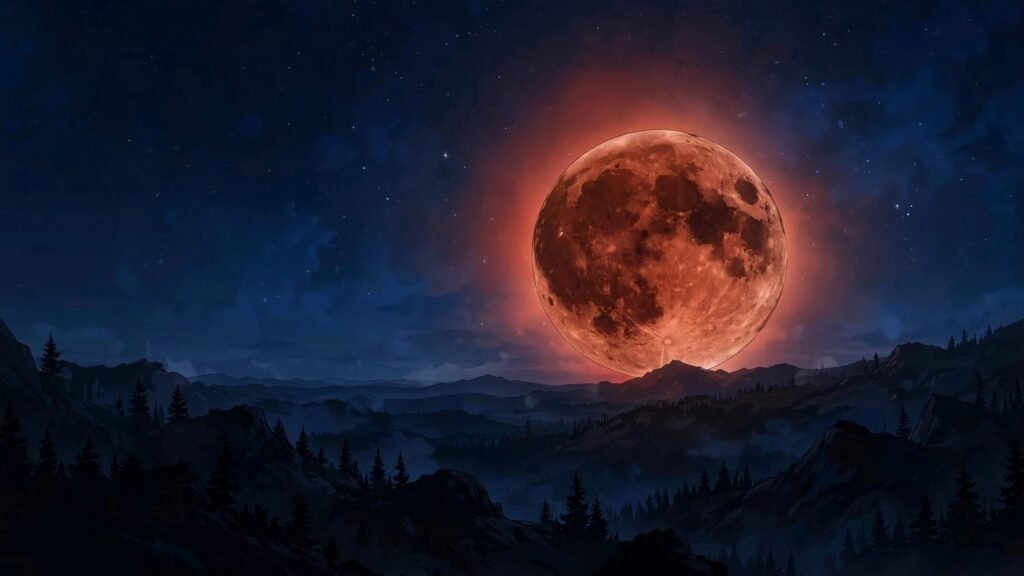
There is a particular kind of evening that catches people off guard. You walk outside, glance up, and the Moon — which you have seen a thousand times — looks wrong. It is coppery, or rusty red, or half-swallowed by a creeping dark curve that was not there an hour ago. Somebody nearby is taking photos with their phone. Somebody else is asking, out loud, what on Earth is happening up there. What they are really asking is what causes a lunar eclipse — and the answer is simpler, and stranger, than most people expect.
What is happening is simple enough to explain and remarkable enough to be worth explaining well. A lunar eclipse is not the Moon doing anything unusual. It is Earth, doing something it does all the time: casting a shadow. The Moon just happens to wander into it.
This guide walks through the whole mechanism — the alignment, the two-part shadow, the 5-degree tilt that keeps eclipses rare, the three types, and the reason the Moon glows red instead of vanishing. By the end, you will be able to look up at the next one and know exactly what you are watching.
The short answer: What causes a lunar eclipse is a simple lineup: the Sun, Earth, and Moon arrange themselves with Earth in the middle, so Earth’s shadow falls on the Moon. It can only happen during a full moon, and only when that full moon lands near one of the points where the Moon’s tilted orbit crosses Earth’s orbital plane. Total eclipses turn the Moon red because Earth’s atmosphere bends and reddens sunlight into the shadow, the same scattering that makes sunsets red.
What causes a lunar eclipse, exactly?
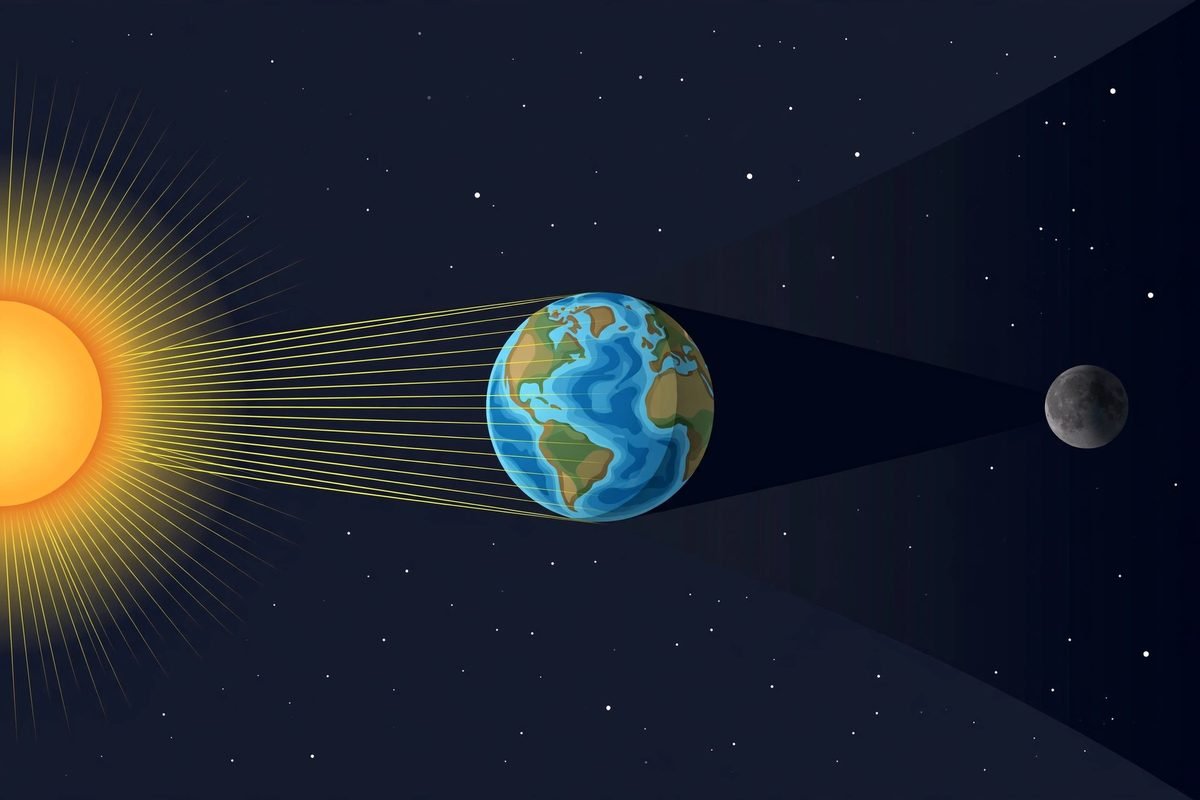
A lunar eclipse occurs when Earth passes directly between the Sun and the Moon. The Sun shines on Earth, Earth blocks that light, and the resulting shadow — enormous, invisible in empty space — falls across the Moon’s face. From our vantage point, we watch Earth’s shadow take a bite out of the Moon, slide across it, and then retreat.
Notice the direction of the action here, because it is easy to mix up with a solar eclipse. In a lunar eclipse, the shadow is Earth’s and the object being darkened is the Moon. In a solar eclipse, the shadow is the Moon’s and the object being darkened is us. Two different events, same three characters, and the order of the lineup is everything.
The alignment astronomers describe has a name — syzygy — which is one of those words that sounds complicated and means something plain: three celestial bodies arranged in a roughly straight line. Every lunar eclipse is a syzygy with Earth in the middle seat.
Why can a lunar eclipse only happen during a full moon?
Think about what has to be true for Earth’s shadow to land on the Moon. The Moon has to be on the opposite side of Earth from the Sun — because Earth’s shadow, like any shadow, stretches away from the light source. The Moon is opposite the Sun from our point of view exactly once per lunar cycle: at full moon.
This is a necessary condition, not a sufficient one. Every lunar eclipse happens at full moon, but as we will see in a moment, most full moons sail past without any eclipse at all. The full moon is the invitation; the actual event needs one more ingredient.
What are the umbra and penumbra — and why does Earth’s shadow have two parts?
Here is where most diagrams get interesting. Earth’s shadow is not one uniform cone of darkness. It has two regions, and the difference between them decides what kind of eclipse you get.
- The umbra is the deep, central core of the shadow. Inside the umbra, Earth blocks the Sun’s direct light completely. If you stood on the Moon inside Earth’s umbra, you would watch the Sun disappear entirely behind the dark disk of Earth — a total solar eclipse, from the lunar point of view.
- The penumbra is the outer, lighter fringe of the shadow. Inside the penumbra, Earth blocks only part of the Sun. Light is dimmed, not cut off. It is the same soft, fuzzy edge you see in a shadow cast by a desk lamp — sharp darkness in the middle, a gradual fade at the rim.
How big is Earth’s shadow, really?
Big enough to swallow the Moon several times over, but not infinitely big. At the Moon’s distance — roughly 384,400 kilometres — Earth’s umbra is still about 1.4 times as wide as the Moon itself. That is why a total lunar eclipse is possible at all: the Moon can fit entirely inside the dark core, with room to spare.
The umbra also tapers. Like the shadow of your hand under a lamp, it narrows with distance and eventually ends. Earth’s umbra fades out roughly 1.4 million kilometres from Earth — comfortably beyond the Moon’s orbit, which is why the Moon passes through it instead of slipping past the end.
If there is a full moon every month, why isn’t there a lunar eclipse every month?
This is the question that unlocks the whole subject, and the answer is a matter of five degrees.
The Moon does not orbit Earth in the same flat plane that Earth orbits the Sun. Its path is tilted by about 5 degrees relative to the ecliptic — the plane of Earth’s orbit around the Sun. Five degrees sounds trivial. In space, it is the difference between a bullseye and a clean miss.
Because of that tilt, the Moon’s orbit crosses the ecliptic at only two points, called nodes. Picture two dinner plates, one held almost flat and the other tilted slightly: they intersect along a single line, at two opposite spots. The Moon only meets the ecliptic at those two spots.
Most full moons simply miss the shadow
For most of the year, when the Moon is full, it is either above or below the ecliptic plane — gliding serenely past Earth’s shadow lane, too high or too low to touch it. No alignment, no eclipse, just an ordinary bright full moon. Earth’s shadow is wide, but at the Moon’s distance it is a limited target, and a 5-degree tilt is plenty to aim over or under it.
An eclipse can only happen when a full moon arrives while the Moon is at or very near one of the nodes — when the tilted orbit and the ecliptic cross at the same moment the lineup is right. That is a far stricter condition than “full moon,” which is why eclipses arrive in clusters and then disappear for months.
What is an eclipse season, and why do eclipses come in pairs?
There are two windows each year, lasting about 34 to 37 days, when the Sun sits close enough to one of the Moon’s nodes for eclipses to be possible. Astronomers call these eclipse seasons, and they repeat roughly every six months as the geometry drifts through the calendar.
A season is long enough to contain one new moon and one full moon, which is why eclipse seasons so often deliver both a solar eclipse and a lunar eclipse within weeks of each other — one at the new moon, one at the full moon. The August 2026 season did exactly this: a total solar eclipse on August 12 followed by a partial lunar eclipse on August 28.
What makes the calendar shift around is that the Moon’s orbital plane is not fixed. The nodes slowly drift around Earth — a process called nodal precession — so eclipse seasons arrive a little earlier each year and never quite settle on the same dates. That slow migration, layered on top of the monthly cycle of phases, is what makes eclipses predictable centuries in advance yet never quite on a monthly schedule.
What are the three types of lunar eclipse?
Not every lunar eclipse looks the same. The type depends entirely on how deeply the Moon passes through Earth’s shadow — a near miss through the penumbra, a glancing blow on the umbra, or a full plunge into the dark core.
| Type | What happens | What you see | How dramatic |
|---|---|---|---|
| Total lunar eclipse | The entire Moon passes through Earth’s umbra | The Moon turns deep red or coppery for up to about an hour and three-quarters | ★★★★★ |
| Partial lunar eclipse | Only part of the Moon enters the umbra; the rest stays in the penumbra | A dark “bite” appears to grow and shrink on the Moon’s face | ★★★★ |
| Penumbral lunar eclipse | The Moon passes only through the faint outer penumbra | A subtle dimming, sometimes barely noticeable to the naked eye | ★★ |
Total lunar eclipses
The full event. Roughly a third of all lunar eclipses are total, and they are the ones that make headlines — because the Moon does not go black. Instead, it glows a deep, unsettling red. More on why in a moment.
Partial lunar eclipses
Partial eclipses happen when the alignment is slightly off-centre and only a slice of the Moon crosses into the umbra. You watch a curved dark shadow — which is literally the edge of Earth’s shadow — creep across the lunar disk and then withdraw. It looks dramatic in photographs, like someone taking a bite out of the Moon.
Penumbral lunar eclipses
The shyest of the three. The Moon only dips into the penumbra, so it dims by a few percent without any sharp edge or colour change. Many people would not notice one unless they were told it was happening — which is why penumbral eclipses rarely make the news, even though they are the most common type.
Why does the Moon turn red during a total lunar eclipse?
This is the part that surprises almost everyone. If Earth blocks the Sun’s direct light, why doesn’t the Moon go completely dark?
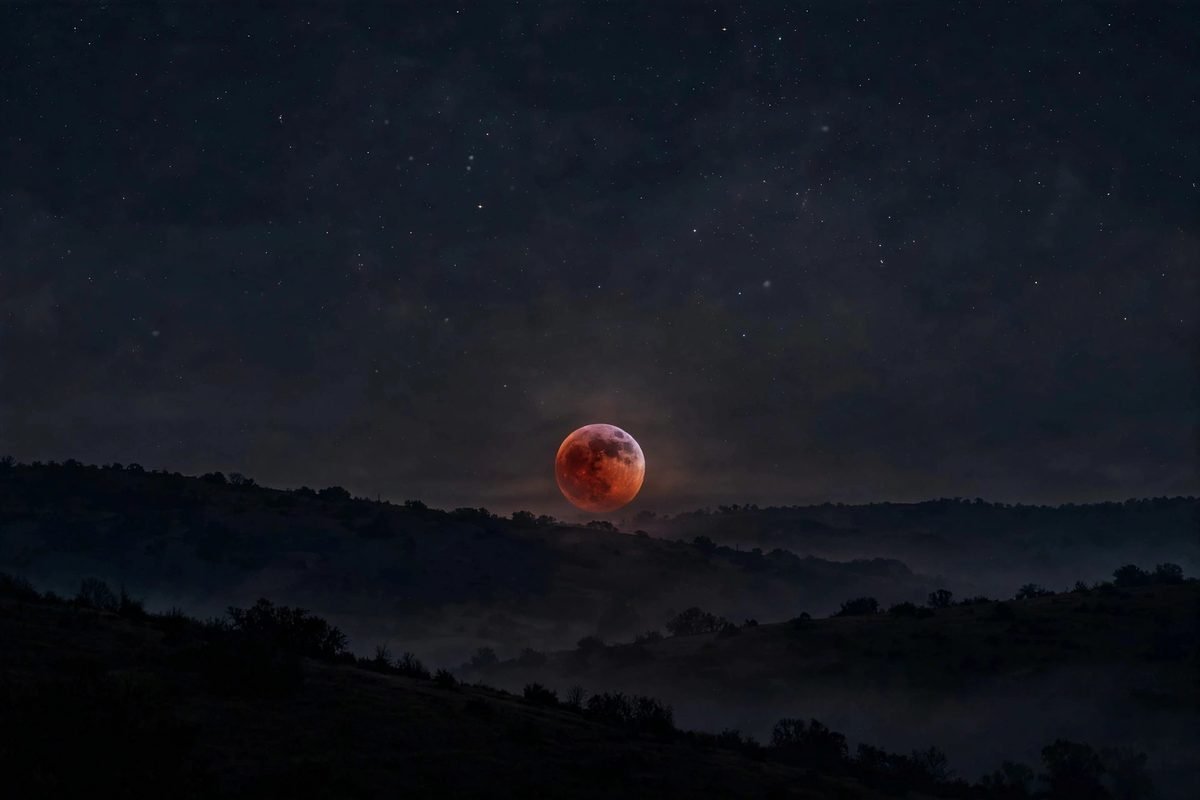
The answer is Earth’s atmosphere. Sunlight skimming past Earth is bent — refracted — as it passes through the air, and a portion of it is funnelled into the umbra. But the atmosphere also acts as a filter. It scatters short-wavelength blue light out of the beam, the same process called Rayleigh scattering that paints sunrises and sunsets orange and red. What survives the trip through the atmosphere is mostly long-wavelength red and orange light, which spills onto the eclipsed Moon.
Why the colour varies from eclipse to eclipse
No two total lunar eclipses look quite the same, because the filter — Earth’s atmosphere — changes. After a major volcanic eruption, dust and ash in the upper atmosphere can scatter and absorb so much light that the eclipsed Moon turns a deep, dark maroon or even nearly black. After the eruption of Krakatoa, the 1884 total eclipse produced a Moon so dark that observers struggled to find it at all.
On a typical clear night, expect a coppery orange-red. The colour can also vary across the Moon’s face during a single eclipse, darker near the centre of the umbra and brighter toward its edges, where more refracted light leaks through.
What if Earth had no atmosphere?
Here is a thought experiment that makes the physics click: without an atmosphere, a total lunar eclipse would plunge the Moon into true darkness. No scattering, no bent red light, nothing. The “blood moon” exists because of the thin shell of air we live in — which is a poetic way of saying that what you are really seeing, during totality, is every sunrise and sunset on Earth at once, projected onto the Moon.
How long does a lunar eclipse last?
This is another difference that surprises people who are used to solar eclipses, where totality is measured in minutes. Lunar eclipses are leisurely events.
- Total lunar eclipses: the entire event — from the first brush of the penumbra to the last — can last up to 6 hours, with totality alone lasting as long as about 1 hour and 47 minutes (the theoretical maximum). Totality of over an hour is common.
- Partial lunar eclipses: typically last 2 to 3 hours from start to finish, with the partial phases (the umbra’s bite) covering most of that time.
- Penumbral lunar eclipses: similar total durations, but nothing visibly dramatic — just a slow dimming and recovery.
Why so long? Because Earth’s shadow is enormous and the Moon moves slowly through it. Totality’s maximum length depends on the Moon’s distance — a Moon near apogee (its farthest point) moves more slowly across the sky, stretching out the crossing — and on how centrally the Moon passes through the umbra.
Can everyone on Earth see the same lunar eclipse?
Anyone on the night side of Earth during the event can see it — no special location, no narrow path of totality, no travel required. That is one of the great democratic joys of lunar eclipses: unlike solar eclipses, which are visible only along a thin ribbon of the planet, a lunar eclipse is visible to roughly half the world at once. If the Moon is above your horizon while the eclipse happens, you are in the audience.
How is a lunar eclipse different from a solar eclipse?
The two get confused constantly — understandably, since they share the cast of characters and even the eclipse-season calendar. Here is the clean distinction:
| Lunar eclipse | Solar eclipse | |
|---|---|---|
| Lineup order | Sun → Earth → Moon | Sun → Moon → Earth |
| Whose shadow | Earth’s shadow falls on the Moon | The Moon’s shadow falls on Earth |
| Moon phase | Full moon only | New moon only |
| Visibility | Entire night side of Earth | Narrow path on Earth’s surface |
| Totality duration | Up to ~1 hour 47 minutes | Up to ~7 minutes 30 seconds |
| Safety | Completely safe to watch with the naked eye | Dangerous to view without certified eye protection |
| The “red” factor | The Moon turns red | The Sun’s corona blazes white |
Note the safety line, because it matters: a lunar eclipse is perfectly safe to watch with your naked eyes, through binoculars, or through a telescope. The Moon is dimmer than usual, not brighter. A solar eclipse is the opposite — staring at the Sun’s disk without protection can cause permanent eye damage in seconds. One of these events invites you to look up; the other requires you to look away.
When is the next lunar eclipse?
The lunar eclipse calendar for the next few years is a good one. After the partial lunar eclipse of August 28, 2026, skywatchers get a run of total eclipses — including a notable total lunar eclipse on February 20, 2027, visible across much of the Americas and beyond, and another on July 18, 2028.
Eclipse dates are worth checking against a dedicated calendar before planning anything (predictions are typically accurate to the minute, but visibility depends on your location). The important thing to remember is the pattern: they arrive in eclipse seasons, roughly six months apart, and total lunar eclipses recur roughly every year or two somewhere on Earth. You will not wait a decade.
How do I watch and photograph a lunar eclipse?
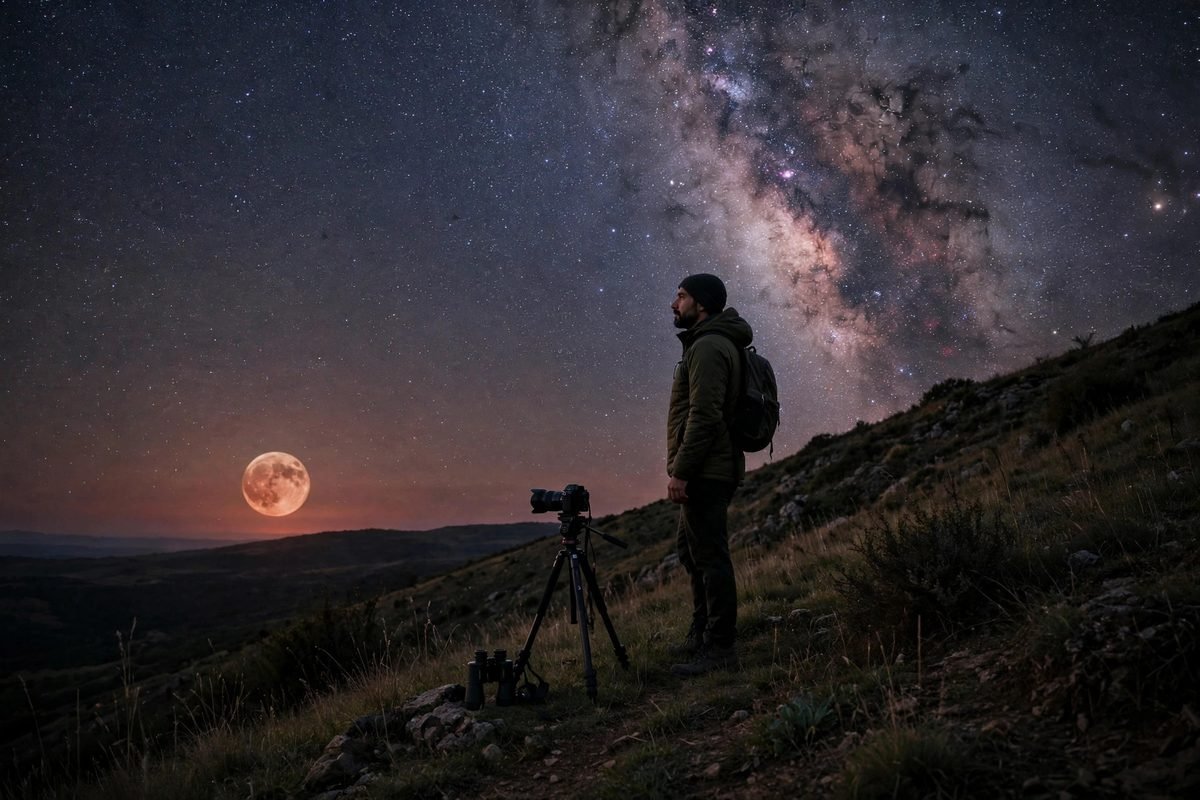
The barrier to entry is delightfully low. You need clear skies, the Moon above your horizon, and your eyes. No filters, no glasses, no equipment. But if you want to make an evening of it:
- Find a dark spot with a clear view of the Moon — even a backyard works, away from streetlights.
- Check the timing for your timezone: note when the partial phases begin, when totality starts and ends.
- Bring binoculars if you have them — they reveal the curved edge of Earth’s shadow and the texture of the darkened Moon beautifully.
- For photos, a camera on a tripod with a zoom lens works best. Use manual settings, a remote shutter or timer to avoid shake, and take a series of shots through the phases to build a composite later.
- Dress warmly — totality can last over an hour, and standing still in the dark gets cold fast.
Myths and misconceptions about lunar eclipses
A phenomenon this visible has collected a thick layer of folklore. Let me clear away the most persistent myths.
- “A lunar eclipse means something bad is happening to the Moon.” Nothing is happening to the Moon at all — it is simply passing through a shadow. The Moon itself is unchanged.
- “The Moon is in danger / damaged by Earth’s shadow.” A shadow cannot damage anything. The Moon endures eclipses exactly as it endures ordinary nights.
- “You need protective glasses, like for a solar eclipse.” No. A lunar eclipse is the Moon getting darker, and watching it is as safe as watching any moonrise.
- “Eclipses are rare everywhere.” Total lunar eclipses are visible from somewhere on Earth roughly every year or two — far more accessible than total solar eclipses.
- “A blood moon is a sign or omen.” It is a sign that the lineup of Sun, Earth, and Moon happened to pass through Earth’s atmosphere-filtered sunlight. Cultures have layered meanings onto eclipses for millennia, but the physics is neutral.
Frequently asked questions
What causes a lunar eclipse?
A lunar eclipse is caused by Earth passing directly between the Sun and the Moon, so that Earth’s shadow falls on the Moon’s surface. It can only happen during a full moon, when the Moon is near one of the two points where its tilted orbit crosses Earth’s orbital plane.
Why does the Moon turn red during a lunar eclipse?
The Moon turns red because Earth’s atmosphere bends sunlight into the shadow and scatters away the blue wavelengths, leaving mostly red and orange light to reach the Moon — the same Rayleigh scattering that makes sunsets red.
How often do lunar eclipses happen?
Lunar eclipses occur only during eclipse seasons, roughly two windows of about five weeks each year. Total lunar eclipses are visible from somewhere on Earth roughly every year or two; partial and penumbral eclipses are more frequent.
Is it safe to look at a lunar eclipse?
Yes — completely. Unlike a solar eclipse, a lunar eclipse is the Moon getting darker, and watching it with the naked eye, binoculars, or a telescope is perfectly safe.
What is the difference between a lunar and solar eclipse?
In a lunar eclipse, Earth’s shadow falls on the Moon (Sun → Earth → Moon) during a full moon. In a solar eclipse, the Moon’s shadow falls on Earth (Sun → Moon → Earth) during a new moon.
Final thoughts: the next time the Moon turns red
The next time you hear that a lunar eclipse is coming, you will know what causes a lunar eclipse: Earth, standing between the Sun and the Moon, draping its shadow across the lunar surface — and Earth’s own atmosphere, doing the unexpected kindness of lighting the Moon red instead of letting it vanish. It is one of the few astronomical events that asks nothing of you: no telescope, no travel, no protective gear. Just step outside, look up, and watch a shadow the size of a planet do its slow work.
Read Also: Astronomy for Beginners: Your First Year Under the Stars

1 Comment