
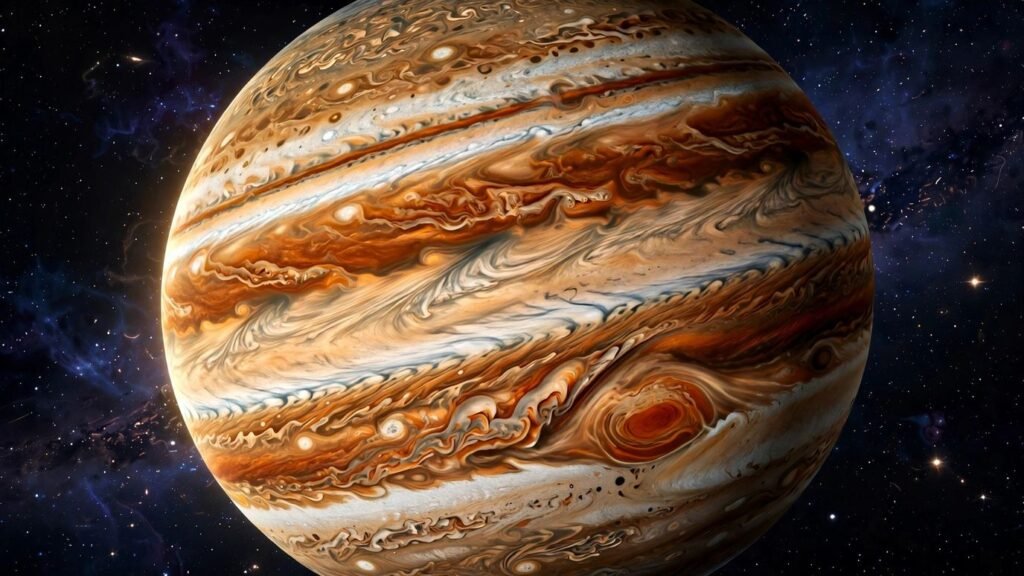
What Is the Biggest Planet in the Solar System? (2026 Guide)
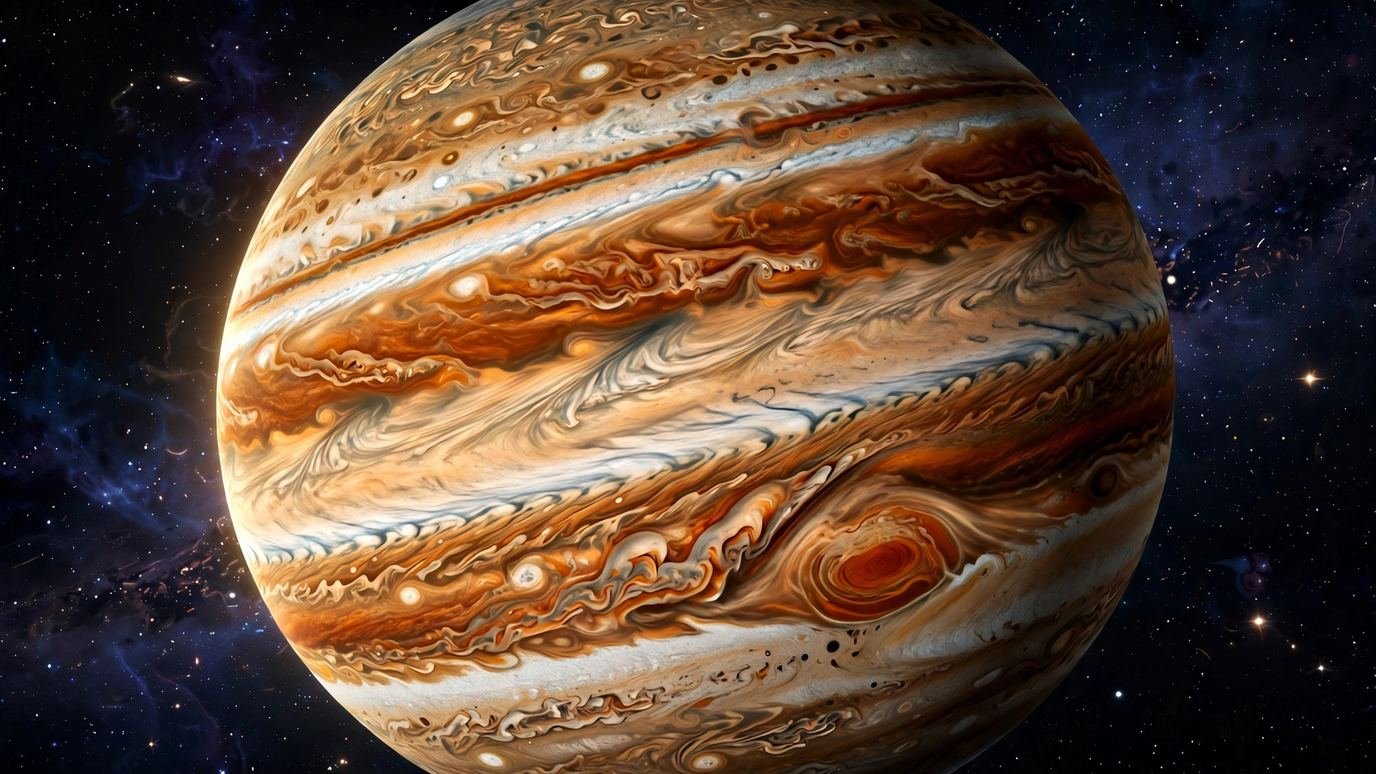
Look up on a clear night and you might catch it without even trying: a bright, steady point of light that refuses to twinkle the way stars do. That calm, brilliant wanderer is very often Jupiter, and it has been catching human attention for thousands of years. Long before telescopes existed, skywatchers noticed that a handful of bright objects moved against the background of stars, night after night, month after month. Jupiter was one of the brightest of them, and it has held its place in our imagination ever since.
So which planet actually takes the crown for size? It is a question that sounds simple, and in one sense it is. But the more you look into it, the more remarkable the answer becomes. Jupiter is not just slightly bigger than the runner-up. It dwarfs everything else in the solar system to a degree that is genuinely hard to picture, and the story of why it grew so large, and what it is like up close, is one of the best stories in astronomy.
The short answer: Jupiter is the biggest planet in the solar system. It measures about 139,820 kilometres across, roughly 11 times the diameter of Earth. More than 1,300 Earths could fit inside it by volume, and its mass is about 318 times that of Earth — around 2.5 times the combined mass of all the other planets put together.
What Is the Biggest Planet in the Solar System?
If size is measured by diameter, the answer is Jupiter, and it is not close. Jupiter is the fifth planet from the Sun, sitting just beyond the asteroid belt, and it belongs to a family of worlds called the gas giants. Unlike Earth, Mars, Mercury, and Venus, which are built mostly from rock and metal, Jupiter is made almost entirely of gas. That difference matters enormously, because it is the reason Jupiter could grow to such an enormous size in the first place.
Why diameter is the fairest way to judge
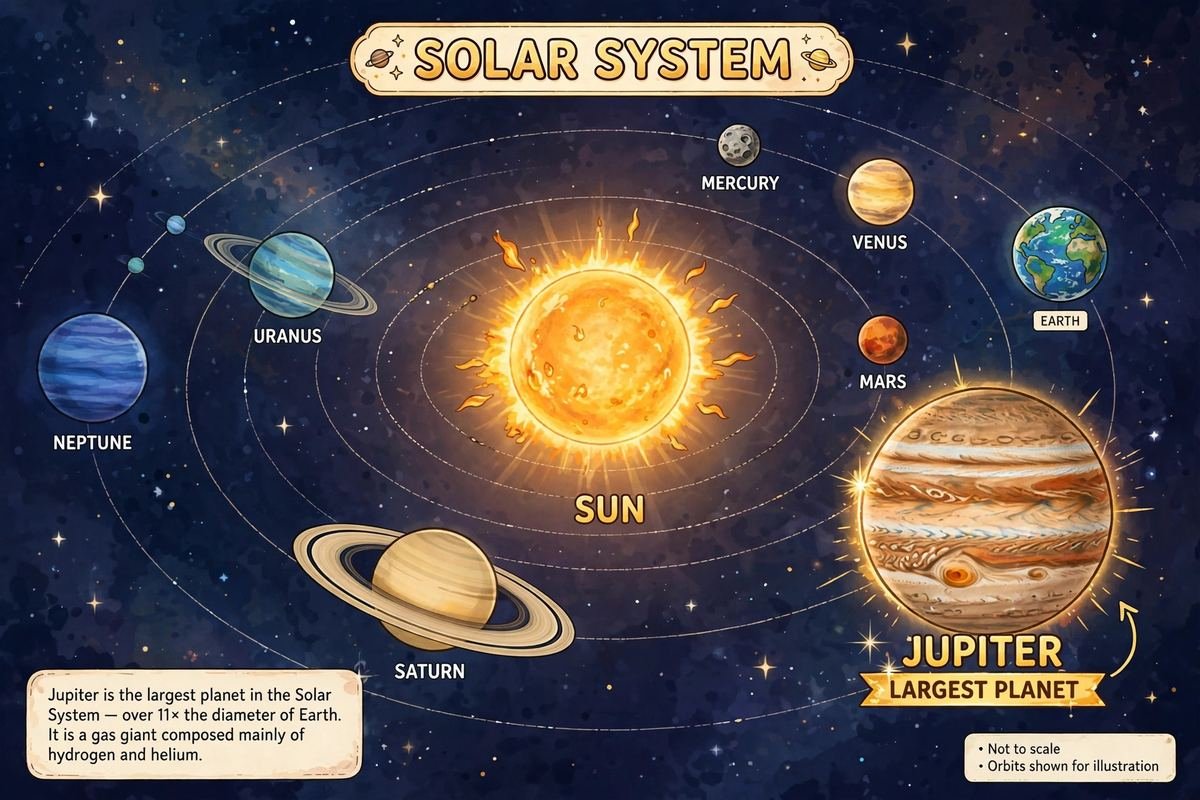
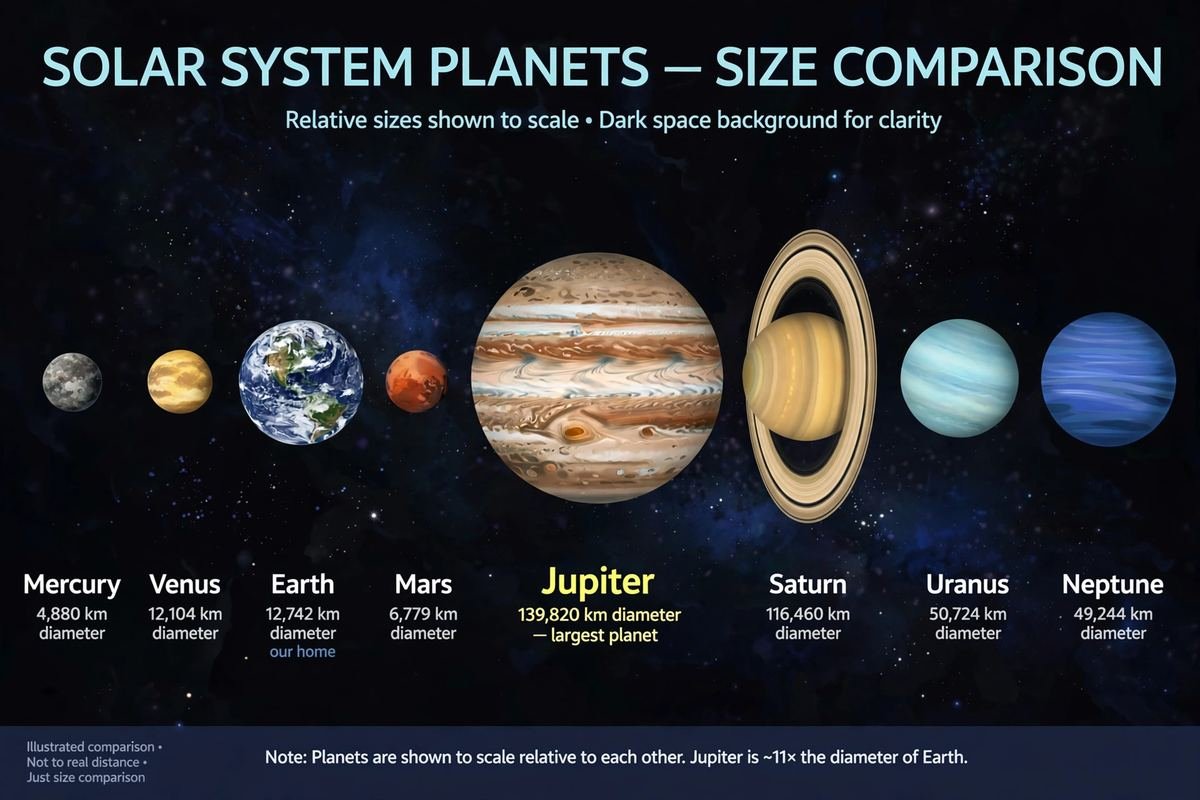
Astronomers usually compare planets by their diameter, the distance straight through the middle, because it gives a clean, like-for-like measurement. By that yardstick, Jupiter wins easily. Saturn comes second, but it is still noticeably smaller. The ice giants, Uranus and Neptune, are far behind both, and the rocky planets look tiny by comparison. If you lined up all eight planets side by side, Jupiter would dominate the row in a way that would make the rest look like marbles next to a beach ball.
What about mass?
Jupiter wins on mass too, which is reassuring, because sometimes a dense little world can outweigh a puffy big one. Not here. Jupiter’s mass is about 318 times that of Earth, and it outweighs all the other seven planets combined by a factor of roughly 2.5. In other words, if you put every other planet on one side of a cosmic set of scales and Jupiter on the other, Jupiter would still win. That is a useful fact to keep in mind, because it explains a lot about Jupiter’s influence on the rest of the solar system, from the way it tugs on asteroids to the way it shepherds comets.
How Big Is Jupiter, Really?
Numbers like 139,820 kilometres are so large that they slide straight past most of us. It helps to break them down into comparisons you can actually feel. Jupiter’s diameter is about 11 times the diameter of Earth. Imagine eleven Earths lined up in a row, edge to edge, and you would have roughly the width of a single Jupiter.
Volume tells an even more dramatic story. Because volume grows much faster than diameter, Jupiter could swallow more than 1,300 Earths inside it. Picture a vast hollow sphere the size of Jupiter and try to fill it with Earth-sized balls. You would need over thirteen hundred of them, and you would still have gaps left over. That is the scale we are talking about, and it is worth pausing on, because our brains are not really built to picture something that big.
A sense of scale in everyday terms
Another way to think about it is travel time. A passenger jet flying around Earth’s equator would take roughly two days of non-stop flying. The same jet circling Jupiter’s equator would need the better part of three weeks. And if you could drive a car around Jupiter at motorway speed without ever stopping for fuel, food, or sleep, the trip would take years. These are silly thought experiments, of course, but they do something that raw numbers cannot: they turn an abstract figure into a journey, and journeys are something we understand.
How Does Jupiter Compare to Earth?
The Earth-Jupiter comparison is the one most people reach for first, and it is full of surprises. Beyond sheer size, the two worlds could hardly be more different, and those differences explain why Jupiter looks and behaves the way it does.
| Feature | Earth | Jupiter |
|---|---|---|
| Diameter | About 12,742 km | About 139,820 km |
| Type | Rocky planet | Gas giant |
| Day length | 24 hours | About 9 hours 56 minutes |
| Year length | 365.25 days | About 11.86 Earth years |
| Known moons | 1 | 95 officially recognised |
| Main ingredients | Rock, metal, water, air | Mostly hydrogen and helium |
The most startling row in that table is probably the day length. Despite being enormously larger than Earth, Jupiter spins much faster. A full Jovian day lasts just under ten hours. That furious spin has real consequences: it squashes Jupiter slightly at the poles and bulges it at the equator, and it helps drive the wild weather in its atmosphere.
Size is not the same as solidity
One common misunderstanding is worth clearing up early. When we say Jupiter is the biggest planet, we mean it is the widest and the most massive, not that it has the biggest solid surface to stand on. Jupiter has no solid ground in the way Earth does. Dive into its atmosphere and you would pass through thicker and thicker gas until the pressure and heat made further travel impossible. There is no beach, no mountain range, no place to plant a flag. That does not make it any less of a planet, but it does mean that “biggest” here describes a giant ball of gas, not a giant ball of rock.
Why Is Jupiter So Much Bigger Than the Other Planets?
The short version is that Jupiter got first pick of the ingredients. When the solar system was forming, about 4.6 billion years ago, the young Sun was surrounded by a disc of gas and dust. Close to the Sun, it was too hot for light gases like hydrogen and helium to stick around, so the inner planets formed from heavier, scarcer materials like rock and metal. Farther out, beyond what astronomers call the frost line, it was cold enough for those light gases to be captured and held.
Jupiter formed just beyond that line, in a region rich in hydrogen and helium, the two most abundant elements in the universe. Its growing core acted like a gravitational vacuum cleaner, pulling in gas from the surrounding disc until it had gathered far more material than any other planet. By the time the Sun’s early winds cleared away the leftover gas, Jupiter had already taken the lion’s share.
Could Jupiter have become a star?
This is a question that comes up a lot, and the answer is no, not even close. Stars shine because nuclear fusion burns in their cores, and that requires a huge amount of mass and pressure. Jupiter would need to be roughly eighty times more massive than it is today before fusion could begin. It is a giant among planets, but it is still a lightweight compared to even the smallest stars. Think of it as the heavyweight champion of planets, not a failed star.
What Is Jupiter Made Of?
Jupiter is mostly hydrogen and helium, the same two gases that make up the Sun. That is one reason astronomers sometimes describe it as a miniature version of a star’s ingredients, without the star’s fire. Beneath its visible cloud tops, hydrogen is squeezed by immense pressure into stranger and stranger forms, eventually behaving like a liquid metal that conducts electricity and helps generate Jupiter’s powerful magnetic field.
What we actually see when we look at Jupiter, whether through a telescope or in a spacecraft photograph, is its cloud layer. Those clouds are arranged in bands of white, cream, orange, and brown that wrap around the planet like stripes. The colours come from different chemicals in the atmosphere, stirred by powerful winds that blow in opposite directions in neighbouring bands. It is this banded appearance that makes Jupiter so instantly recognisable, even in a small backyard telescope.
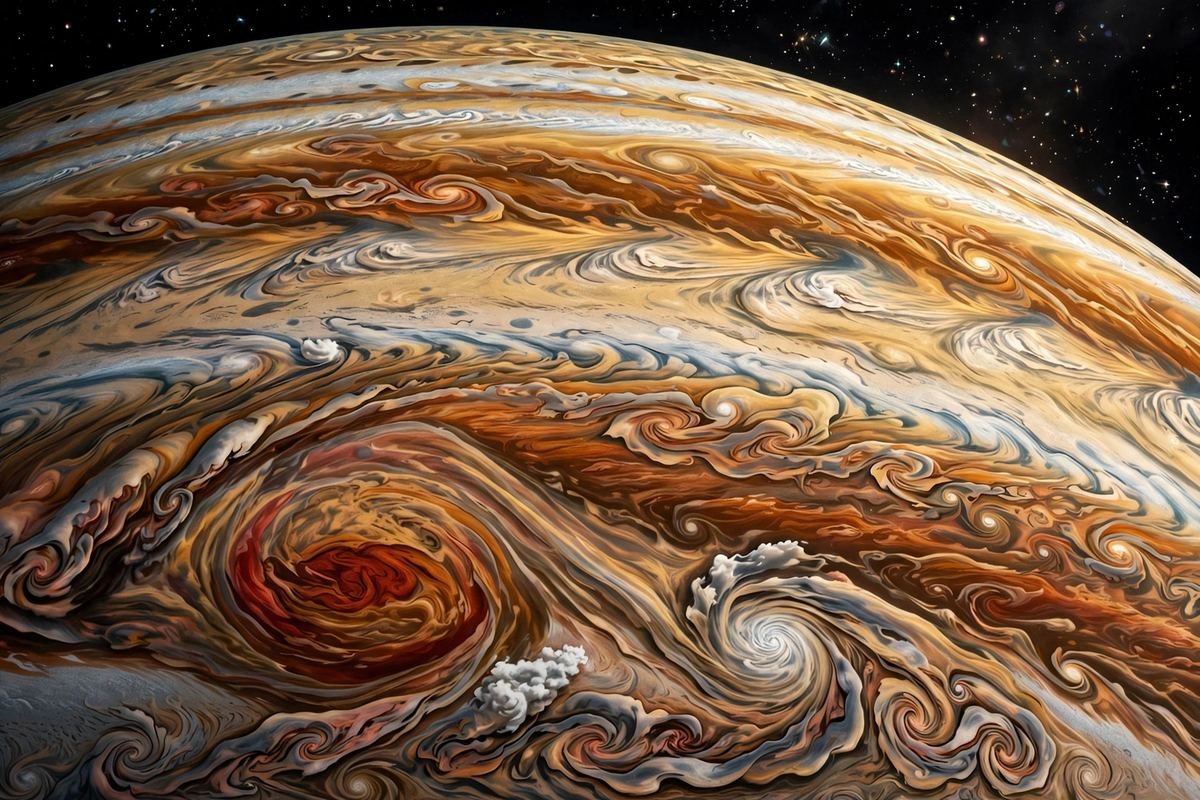
Why does Jupiter have stripes?
The stripes are essentially weather systems stretched around the whole planet. Because Jupiter spins so quickly, its atmosphere is pulled into long east-west bands, each moving at a different speed. Where two bands meet, the difference in speed creates turbulence, eddies, and storms. Some of those storms are small and short-lived. One of them is anything but.
What Is the Great Red Spot?
The Great Red Spot is Jupiter’s most famous feature, and it deserves its reputation. It is a gigantic storm, wider than the entire Earth, that has been raging for centuries. Astronomers have observed it continuously since at least the 1800s, and there are hints that it may have been spotted even earlier, in the 1600s. Most storms on Earth last days or weeks. This one has lasted longer than any human lifetime, and it shows no sign of stopping.
The storm spins like a hurricane, but on a scale that makes earthly hurricanes look like dust devils. Its winds race around its edge at tremendous speeds, and its reddish colour probably comes from chemicals in the atmosphere being lifted up from below and changed by sunlight, though the exact recipe is still debated. Interestingly, the spot has been shrinking over the decades. It is still larger than Earth, but it is not as enormous as it was a century ago, and astronomers are watching closely to see whether it keeps shrinking, stabilises, or surprises everyone.
A storm bigger than a planet
It is worth saying this plainly, because it is easy to read past it: a single storm on Jupiter is bigger than our entire planet. If you dropped Earth into the Great Red Spot, it would fit inside with room to spare. That one fact captures the difference between Earth weather and Jupiter weather better than any table of wind speeds ever could.
How Long Is a Day and a Year on Jupiter?
Jupiter’s day is about 9 hours and 56 minutes long. That means that if you could somehow hover above its clouds, you would see the Sun rise and set more than twice during a single Earth day. The speed of that spin is part of what shapes Jupiter’s weather, and it also means the planet bulges noticeably at its equator.
A year on Jupiter, meaning one full trip around the Sun, takes about 11.86 Earth years. So a person born on Jupiter, if such a thing were possible, would not celebrate their first birthday until they were nearly twelve in Earth years. Jupiter sits much farther from the Sun than Earth does, about five times farther away, so its orbit is far longer, and it moves more slowly along that path. The combination of a huge orbit and a leisurely pace adds up to a very long year indeed.
How Many Moons Does Jupiter Have?
Jupiter has 95 officially recognised moons, as of recent counts, and that number keeps creeping upward as telescopes and surveys spot ever smaller, more distant companions. Most of these moons are tiny, irregular chunks of rock and ice, some only a kilometre or two across, probably captured asteroids that wandered too close and never escaped Jupiter’s gravity.
The real stars of the show are the four large moons discovered by Galileo Galilei in 1610: Io, Europa, Ganymede, and Callisto. They are known as the Galilean moons, and each one is a world in its own right.
- Io is the most volcanically active body in the solar system, covered in erupting volcanoes that constantly resurface it.
- Europa hides a salty ocean beneath its icy shell, making it one of the most exciting places in the search for life beyond Earth.
- Ganymede is the largest moon in the solar system, bigger than the planet Mercury.
- Callisto is ancient, heavily cratered, and one of the most battered surfaces anywhere in the solar system.
Ganymede: a moon bigger than a planet
Ganymede deserves a special mention. It is the largest moon in the solar system, and it is actually larger than Mercury, the smallest planet. If Ganymede orbited the Sun on its own instead of orbiting Jupiter, it would count as a planet in its own right by size alone. It is also the only moon known to generate its own magnetic field, which is a remarkable claim for a body that is technically just a satellite.
Why Isn’t Saturn the Biggest Planet?
Saturn is the planet most people guess first, and it is an understandable guess. Saturn is enormous, it is spectacular, and its rings make it the most photographed planet in the solar system. But when you measure it, Saturn comes second. Its diameter is about 116,460 kilometres, which is roughly 23,000 kilometres less than Jupiter’s. That gap is nearly twice the diameter of Earth, so it is not a photo finish.
Saturn is also much less dense than Jupiter. In fact, Saturn is the least dense planet in the solar system, so light that it would float in a large enough bath of water. Jupiter, by contrast, packs far more mass into its frame. So whether you judge by width or by weight, Jupiter stays ahead.
Do Saturn’s rings make it bigger?
This is a fair question, because Saturn’s rings are spectacularly wide. Measured from tip to tip, the ring system stretches far beyond the planet itself. But rings are not part of the planet’s body. They are made of countless chunks of ice and rock orbiting around Saturn, and they are incredibly thin, only tens of metres thick in places. When astronomers rank planets by size, they measure the planet itself, not the halo of material around it. On that fair basis, Saturn is second, and Jupiter is first.
Why Don’t Uranus and Neptune Come Close?
Uranus and Neptune are often grouped with Jupiter and Saturn as the outer planets, but they belong to a different class. They are ice giants, not gas giants, and they are much smaller. Uranus measures about 50,724 kilometres across, and Neptune about 49,244 kilometres. Both are roughly four times the diameter of Earth, which sounds impressive until you compare it with Jupiter’s eleven.
The difference comes down to composition and formation. Uranus and Neptune formed even farther from the Sun, where there was less material available, and they are made mostly of water, ammonia, and methane ices, with only a modest envelope of hydrogen and helium. They never had the chance to gather gas on Jupiter’s scale. They are fascinating worlds in their own right, Neptune has the fastest winds in the solar system, and Uranus rolls around the Sun tilted on its side, but neither one threatens Jupiter’s title.
Why Doesn’t Pluto Count?
Pluto is the answer many people of a certain age grew up with, or at least the answer they remember from school posters that no longer hang on classroom walls. Pluto was considered the ninth planet from its discovery in 1930 until 2006, when the International Astronomical Union reclassified it as a dwarf planet. That decision was controversial at the time, and it still stirs feelings today, but it was made for a clear reason.
To count as a planet under the current definition, a body must orbit the Sun, be round under its own gravity, and have cleared its neighbourhood of other objects. Pluto fails the third test. It shares its region of space, the Kuiper Belt, with many other icy bodies, and it has not gravitationally dominated its orbit the way the eight planets have.
Pluto is smaller than you think
Even before the reclassification, Pluto was never a contender for biggest planet. It is smaller than Mercury, the smallest of the eight planets, and it is even smaller than several moons, including Earth’s own Moon and Jupiter’s Ganymede. So Pluto’s story is not one of a giant being demoted. It is a small, distant, icy world that turned out to belong to a different category than the one it was first placed in, and learning that has taught us a great deal about the outer solar system.
How Was Jupiter Discovered and Observed?
Jupiter was never really discovered in the way a new island might be discovered, because it has been visible to the naked eye since humans first looked up. Ancient Babylonian, Greek, Chinese, and Roman skywatchers all tracked it, gave it names, and worked out that it moved in a regular cycle. The Romans named it after Jupiter, king of their gods, which tells you something about how bright and commanding it appeared to them.
The real revolution came in 1610, when Galileo pointed a telescope at Jupiter and found four points of light moving around it. Those were the Galilean moons, and their discovery changed astronomy forever. Until then, many people believed everything in the heavens orbited Earth. Here was clear proof that other bodies could orbit something else, and that observation helped tip the balance towards the Sun-centred view of the solar system.
From early telescopes to modern spacecraft
Since Galileo’s time, every improvement in telescopes has brought Jupiter into sharper focus. Astronomers mapped its bands, tracked the Great Red Spot, and measured its size with increasing precision. Then, in the space age, spacecraft began visiting in person. Pioneer and Voyager flew past in the 1970s, Galileo orbited Jupiter in the 1990s and dropped a probe into its atmosphere, and the Juno mission arrived in 2016 to study the planet in unprecedented detail.
How Can You Spot Jupiter in the Night Sky?
One of the best things about Jupiter is that you do not need fancy equipment to find it. On many nights of the year, it is the brightest object in the sky after the Moon and Venus, and it shines with a steady, creamy-white light. Unlike stars, which twinkle because their light is bent by Earth’s atmosphere, planets appear as tiny discs, so their light twinkles far less. If you see a bright light that holds steady while the stars around it shimmer, there is a good chance you are looking at a planet, and very often that planet is Jupiter.
A pair of binoculars is enough to take the experience to another level. Hold them steady, aim at Jupiter, and you should be able to pick out up to four tiny points of light lined up near it. Those are the Galilean moons, the same ones Galileo saw, and there is something quietly thrilling about seeing them with your own eyes four centuries later. A small telescope will go further still, revealing Jupiter’s banded clouds and, on a good night, the Great Red Spot itself.
Tips for your first look
- Check a stargazing app or astronomy calendar for the nights when Jupiter is well placed in your area.
- Get away from bright streetlights if you can, and give your eyes twenty minutes to adjust to the dark.
- Rest binoculars on a fence or tripod to keep the view steady.
- Look on successive nights and watch how Jupiter moves relative to the stars, and how its moons shift position.
What Has the Juno Mission Taught Us?
NASA’s Juno spacecraft has been orbiting Jupiter since 2016, swooping close over its poles on each orbit, and it has changed our picture of the planet in important ways. Before Juno, Jupiter was often imagined as a fairly tidy world, with neat bands and a deep interior that behaved in predictable ways. Juno showed something messier and more interesting.
Its measurements revealed that Jupiter’s atmosphere is more turbulent and more deeply mixed than expected, with storms and weather systems reaching far deeper below the cloud tops than many models predicted. It found that the planet’s magnetic field is stronger and more irregular than anticipated, with surprising features that do not match a simple bar-magnet picture. And it gave us the closest, most detailed images of Jupiter’s poles ever captured, revealing swirling clusters of cyclones arranged in patterns nobody had predicted.
Why Juno matters for the rest of astronomy
Juno’s findings matter beyond Jupiter itself, because Jupiter is the best example we have of how giant planets form and behave. Many of the planets discovered around other stars are gas giants, and understanding Jupiter helps astronomers understand those distant worlds too. In that sense, studying the biggest planet in our solar system is also a way of studying planets everywhere, and Juno is still adding to that picture with every orbit.
How Do the Planets Compare by Size?
It is one thing to say Jupiter is the biggest, and another to see the whole ranking laid out. The table below lists all eight planets by diameter, from largest to smallest, so you can see exactly where each world stands.
| Rank | Planet | Diameter (approx.) |
|---|---|---|
| 1 | Jupiter | 139,820 km |
| 2 | Saturn | 116,460 km |
| 3 | Uranus | 50,724 km |
| 4 | Neptune | 49,244 km |
| 5 | Earth | 12,742 km |
| 6 | Venus | 12,104 km |
| 7 | Mars | 6,779 km |
| 8 | Mercury | 4,879 km |
The gap between second and third place is the most striking thing in that table. Saturn is more than twice the diameter of Uranus, and Jupiter is nearly three times wider than Uranus. The solar system, in size terms, is really a story of two giants, two medium-sized ice worlds, and four small rocky ones.
Frequently Asked Questions
Is Jupiter really the biggest planet in the solar system?
Yes. Jupiter is the biggest planet by both diameter, at about 139,820 kilometres, and by mass, at about 318 times the mass of Earth. No other planet comes close on either measure, and Saturn, the runner-up, is smaller in both respects.
How many Earths could fit inside Jupiter?
More than 1,300 Earths could fit inside Jupiter by volume. That figure always surprises people, because eleven Earths across does not sound like thirteen hundred Earths inside, but volume grows much faster than width, and Jupiter’s volume is truly enormous.
What is the biggest planet in the universe?
That is a different question, and a harder one to answer with certainty. Astronomers have found exoplanets, planets around other stars, that are larger than Jupiter, but measuring their exact sizes is difficult, and new discoveries keep changing the picture. Within our own solar system, though, the answer is settled: it is Jupiter.
Is Jupiter bigger than some stars?
No. Even the smallest stars are far more massive than Jupiter, and Jupiter would need roughly eighty times its current mass before nuclear fusion could ignite in its core. Jupiter is a giant planet, but it is nowhere near star-sized, and calling it a failed star is misleading.
Can you see Jupiter without a telescope?
Yes, easily. Jupiter is often one of the brightest objects in the night sky, shining with a steady light that does not twinkle the way stars do. With binoculars you can also see its four largest moons, and with a small telescope you can make out its cloud bands.
Why is Jupiter called a gas giant?
Jupiter is called a gas giant because it is made mostly of hydrogen and helium, rather than rock and metal. It has no solid surface to stand on. Beneath its clouds, gases are compressed by enormous pressure into liquid-like states, which is very different from the solid ground of a rocky planet like Earth.
Does Jupiter protect Earth from asteroids and comets?
Jupiter’s gravity does influence the paths of asteroids and comets, sometimes pulling them in and sometimes flinging them away, and it has famously captured or deflected objects that might otherwise have travelled inward. The popular idea that Jupiter acts as a simple shield for Earth is overstated, though, because its gravity can also send objects towards the inner solar system. The truth is more complicated, and more interesting, than the shield story suggests.
Conclusion
So, what is the biggest planet in the solar system? The answer is Jupiter, and it wins by a margin that is hard to overstate. At about 139,820 kilometres across, with a mass roughly 318 times that of Earth and more than 1,300 Earths able to fit inside it, Jupiter is not just the largest planet we have. It is a world on a completely different scale from the rest, a gas giant with a storm larger than Earth, a day shorter than ten hours, a year lasting nearly twelve Earth years, and a family of 95 known moons led by Ganymede, the largest moon in the solar system.
The next time you are outside on a clear night and you notice a bright, steady light that refuses to twinkle, take a second look. There is a good chance you are staring at the biggest planet in our solar system, a world that has fascinated skywatchers for thousands of years and still has surprises left for the spacecraft studying it today. That is a pretty good reason to look up.
Read Also: How to Remove Chocolate Stains Quickly and Easily

1 Comment