
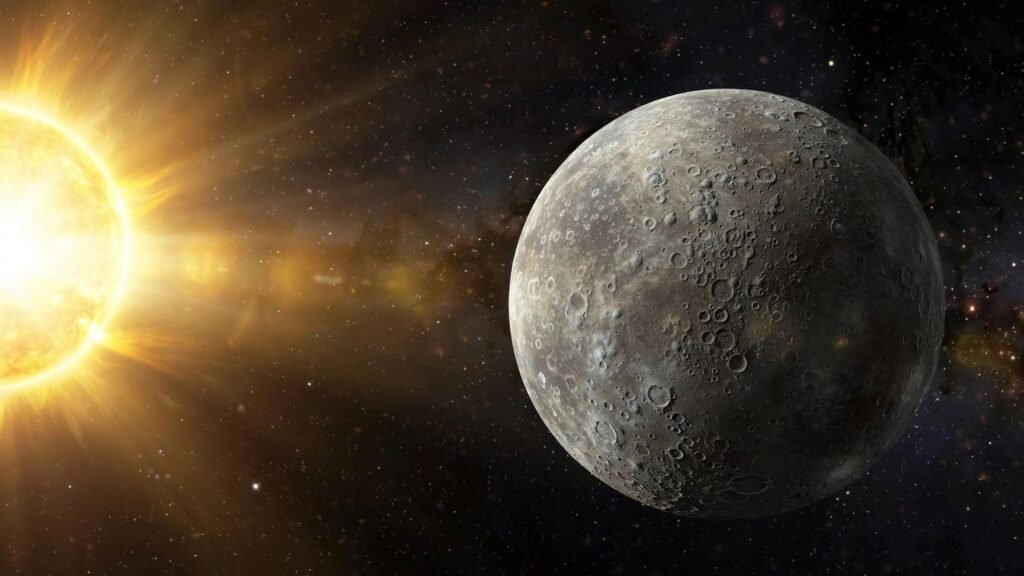
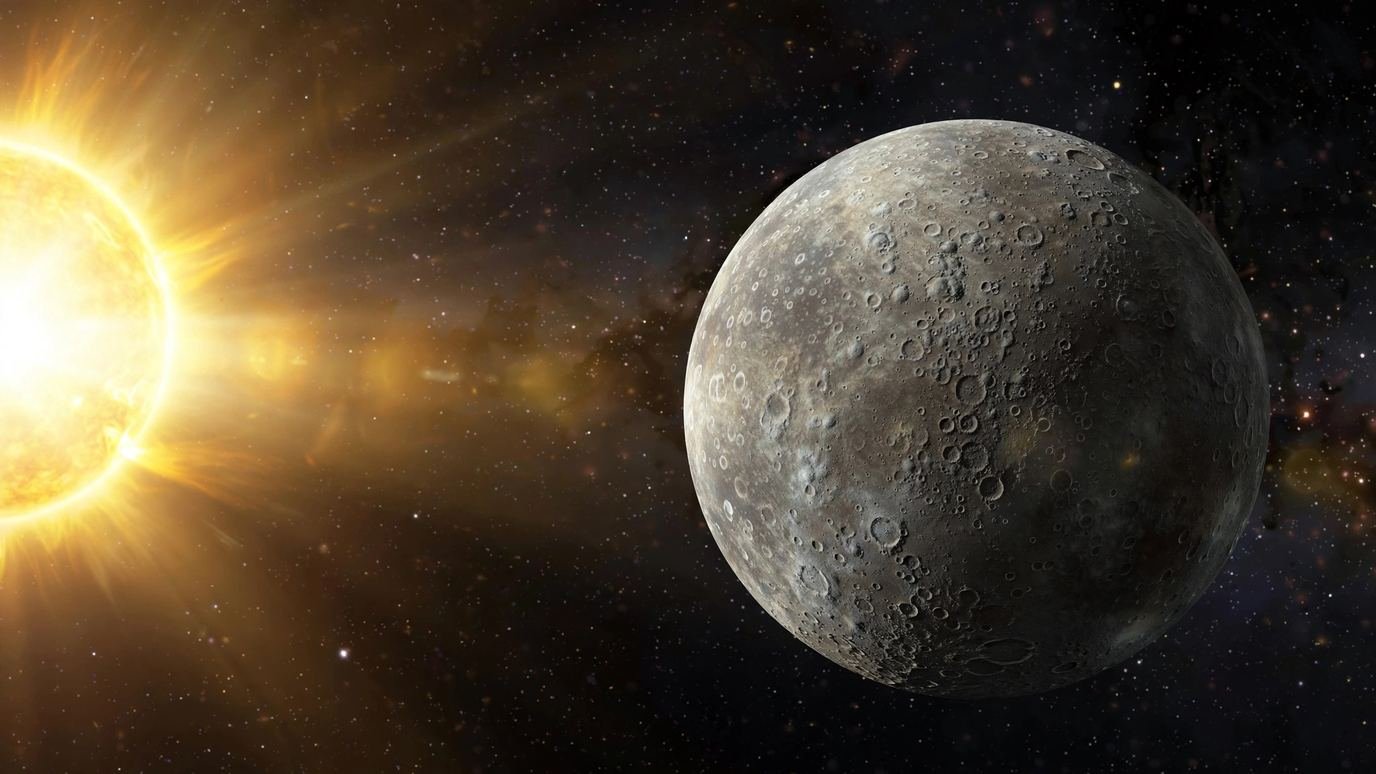
If you lined up all eight planets in our solar system from biggest to smallest, the one at the very end of the line would probably surprise you. It is not a distant, icy world at the edge of the Sun’s family. It is the planet closest to the Sun itself, a rocky little world that races around its star faster than any other planet, and yet is easy to miss entirely if you do not know where — and when — to look.
Most of us grew up picturing planets as fairly grand things. Jupiter is enormous, Saturn has its rings, Earth feels comfortably middle-sized. Mercury breaks that picture. It is small enough that you could, in a very rough sense, compare it to a Moon that somehow earned planet status. And that comparison is not just a handy image. As we will see, Mercury really is only slightly larger than Earth’s Moon.
So what is the smallest planet in the solar system, and why does it hold that title? The answer is simple on the surface, but the story behind it — how Mercury ended up so small, why it is so dense, why its days and years feel so strange, and why Pluto is no longer in the running — is far more interesting than a one-line fact.
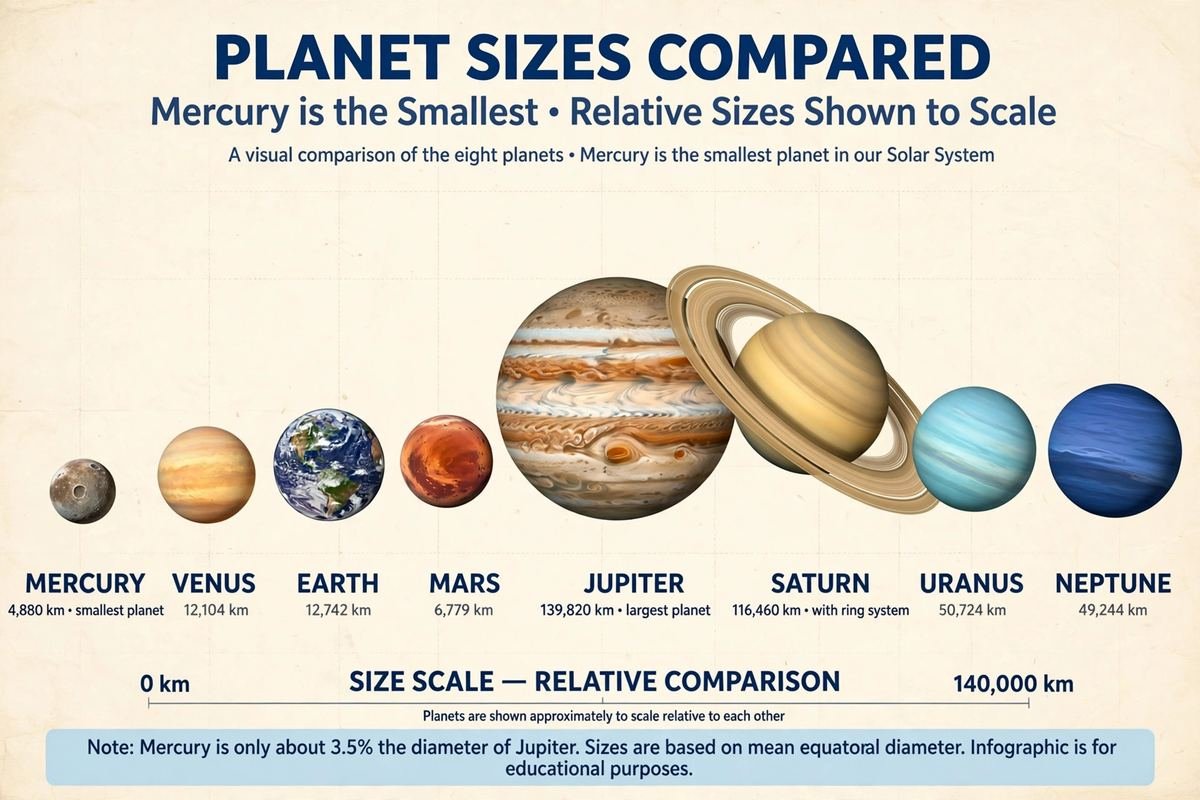
The short answer: Mercury is the smallest planet in the solar system. It has a diameter of about 4,879 km, a mass of about 0.055 times Earth’s, and it completes an orbit around the Sun in just 88 Earth days. Pluto is smaller, at about 2,377 km across, but it was reclassified as a dwarf planet in 2006, so it no longer counts as a planet.
What Is the Smallest Planet in the Solar System?
Mercury is the smallest planet in the solar system, and it has held that title since Pluto was moved into the dwarf planet category in 2006. Before that change, school textbooks often listed Pluto as the smallest planet, which is why many adults still remember it that way. If you learned the planets in the 1990s or earlier, you are not misremembering — the list itself changed.
Mercury is a terrestrial planet, which means it is made mostly of rock and metal, like Earth, Venus, and Mars. It is not a gas giant like Jupiter or Saturn, and it is not an ice giant like Uranus or Neptune. Among those four rocky planets, Mercury is by far the smallest, and it is also the closest to the Sun.
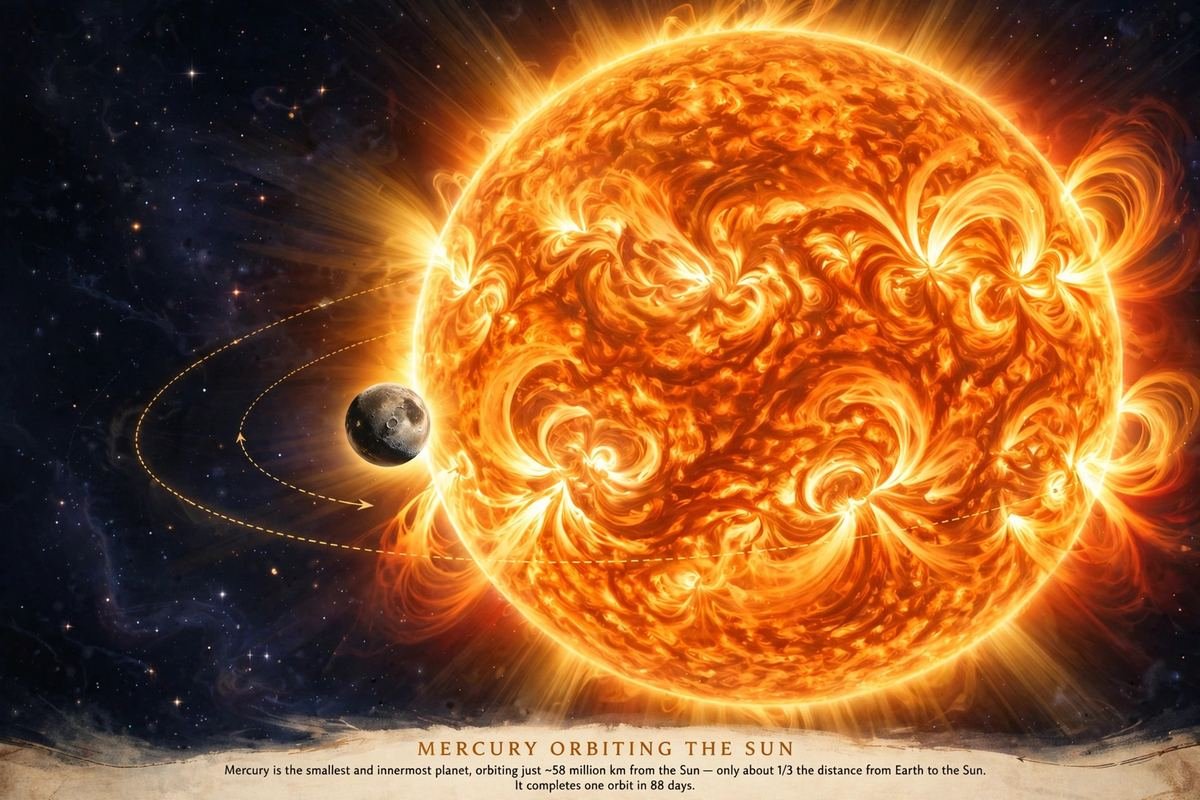
That closeness matters. Mercury orbits at an average distance of only about 58 million kilometres from the Sun. Earth, by comparison, sits about 150 million kilometres away. Being that close means Mercury is baked by intense sunlight, whipped around the Sun at high speed, and very hard to observe from Earth because it never strays far from the Sun in our sky. For centuries, astronomers knew it was there, but they knew surprisingly little about what it actually looked like up close.
How Small Is Mercury, Really?
Numbers help here, because “small” on a planetary scale can still sound huge in everyday terms. Mercury’s diameter is about 4,879 km. If you could drive around its equator, the trip would be roughly 15,300 km — long by human standards, but tiny for a planet.
To put that in perspective, Earth’s diameter is about 12,742 km. That means you could fit roughly two and a half Mercurys side by side across Earth. Mercury’s mass tells a similar story. At about 0.055 times Earth’s mass, Mercury weighs only about five and a half percent as much as our planet. If you stood on Mercury, gravity would feel much weaker than on Earth — only about 38 percent as strong — so you would feel light on your feet, even though you would not want to spend long outside in that temperature and near-vacuum.
Here is another comparison that tends to stick in people’s minds:
- Mercury’s diameter: about 4,879 km
- Earth’s Moon’s diameter: about 3,474 km
- Earth’s diameter: about 12,742 km
- Mars’s diameter: about 6,779 km
Mercury is bigger than the Moon, but not by a huge margin. It is about 40 percent wider than the Moon. Put another way, if the Moon were a planet in its own right, it would be in the same size conversation as Mercury — which is part of why Mercury feels so surprisingly modest when you first learn its size.
Why Is Mercury So Small?
This is one of those questions where scientists have good ideas, but not a single settled answer. Mercury probably started out larger, or at least with a different mix of materials, and then lost a lot of its outer rocky layer early in the solar system’s history.
One leading idea is that a giant impact — or several — stripped away much of Mercury’s original outer shell, leaving behind a planet that is mostly core. That would explain one of Mercury’s strangest features: its enormous iron core. For a planet this small, Mercury is remarkably dense. Its large iron core makes up a large share of its interior, far more, proportionally, than Earth’s core does. In effect, Mercury is a bit like a planet that kept its heavy centre and lost much of its lighter wrapping.
Another possibility is that Mercury formed close to the Sun, where temperatures were so high that lighter rocky material was harder to gather and hold on to. In the early solar system, the region near the Sun was a harsh neighbourhood for building a planet. Heavy metals could condense and stick together, but lighter materials were more likely to be blown outward or vaporised. Mercury may simply never have had the chance to grow as large as Venus, Earth, or Mars, which formed farther out where conditions were kinder.
It is also worth remembering that small does not mean simple. Mercury’s small size is part of what makes it scientifically valuable. Because it is small, it cooled faster than Earth. Because it is close to the Sun, it experiences extremes no other planet does. And because it kept such a large iron core, it offers clues about how planets form and how they can be reshaped by violent early collisions. Astronomers study Mercury not in spite of its size, but partly because of it.
How Does Mercury Compare to the Other Small Planets?
When people ask about the smallest planet, they usually want to know how it stacks up against the next-smallest contenders. The honest answer is that there is a clear gap. Mars is the next smallest planet after Mercury, and it is noticeably larger.
Mercury vs Mars, Venus, and Earth
Mars, often thought of as a small planet itself, has a diameter of about 6,779 km — roughly 39 percent wider than Mercury. Venus and Earth are in a different league again, both over 12,000 km across. So Mercury is not just slightly smaller than the runner-up. It is in a size class of its own at the bottom of the list.
| Planet | Type | Diameter (approx.) | Mass compared to Earth |
|---|---|---|---|
| Mercury | Terrestrial | 4,879 km | 0.055 |
| Mars | Terrestrial | 6,779 km | 0.107 |
| Venus | Terrestrial | 12,104 km | 0.815 |
| Earth | Terrestrial | 12,742 km | 1.0 |
That table makes the point visually. Mercury is less than half Earth’s width and only a little more than half Mars’s mass. If you were ranking planets by size, Mercury would not be a close call. It wins — or loses, depending on how you look at it — by a comfortable margin.
Why size is not the whole story
It is tempting to equate small with unimportant, but in planetary science that would be a mistake. Mercury’s small size is part of what makes it scientifically valuable. Because it is small, it cooled faster than Earth. Because it is close to the Sun, it experiences extremes no other planet does. And because it kept such a large iron core, it offers clues about how planets form and how they can be reshaped by violent early collisions. Astronomers study Mercury not in spite of its size, but partly because of it.
Is Mercury Smaller Than Earth’s Moon?
This is a common follow-up question, and it deserves a clear answer: no, Mercury is not smaller than the Moon. It is larger, but only just.
Mercury’s diameter of about 4,879 km compares with the Moon’s diameter of about 3,474 km. Mercury is therefore about 1,405 km wider than the Moon. In terms of volume, Mercury is considerably bigger, because volume grows quickly with diameter. But if you saw the two side by side in a photograph with no scale, you might struggle to tell which was which at first glance, especially since both have grey, cratered surfaces.
| Feature | Mercury | Earth’s Moon |
|---|---|---|
| Diameter | About 4,879 km | About 3,474 km |
| Type | Planet | Natural satellite |
| Surface | Heavily cratered, rocky | Heavily cratered, rocky |
| Atmosphere | Thin exosphere | Extremely thin exosphere |
| Orbits | The Sun, in 88 Earth days | Earth, in about 27 days |
The Moon comparison is useful because most people have a mental image of the Moon’s size. When you realise Mercury is only a bit bigger than that familiar object in our night sky, its smallness suddenly feels real. It also raises an interesting point: the Moon is not a planet, even though it is similar in size to Mercury, because it orbits Earth rather than orbiting the Sun directly. Size alone does not make a planet. Orbit and other criteria matter too — which brings us neatly to Pluto.
Why Doesn’t Pluto Count as the Smallest Planet?
If you have ever felt a bit sad about Pluto’s demotion, you are not alone. For 76 years, from its discovery in 1930 until 2006, Pluto was listed as the ninth planet, and the smallest. Many people still think of it that way, and textbooks took years to catch up.
Pluto’s diameter is about 2,377 km, which is indeed smaller than Mercury’s 4,879 km. So why isn’t Pluto the answer to our question? Because in 2006, the International Astronomical Union adopted a formal definition of what counts as a planet, and Pluto did not meet all three parts of it.
Under that definition, a planet must:
- Orbit the Sun directly
- Be massive enough for its own gravity to pull it into a nearly round shape
- Have cleared its neighbourhood of other objects of similar size
Pluto meets the first two, but not the third. It shares its region of space, the Kuiper Belt, with many other icy bodies of comparable size. It has not gravitationally cleared its orbit the way the eight planets have. As a result, Pluto was reclassified as a dwarf planet, a category it now shares with Ceres, Haumea, Makemake, and Eris.
That reclassification is why the question “what is the smallest planet?” has a different answer today than it did in, say, 1995. If you count dwarf planets, Pluto is smaller than Mercury. But if you are asking about planets in the strict, current sense — and most people are — the answer is Mercury, without question.
It is worth noting that this is not a judgement on Pluto’s interest or beauty. Dwarf planets can be fascinating worlds, and Pluto, with its heart-shaped glacier and thin atmosphere, is a perfect example. It is simply in a different category now.
What Is Mercury’s Surface Like?
If you could stand on Mercury — with a lot of protective equipment — the landscape would feel oddly familiar and deeply alien at the same time. Familiar, because it is covered in craters, much like the Moon. Alien, because of the scale of some of those features and the extreme light and shadow.
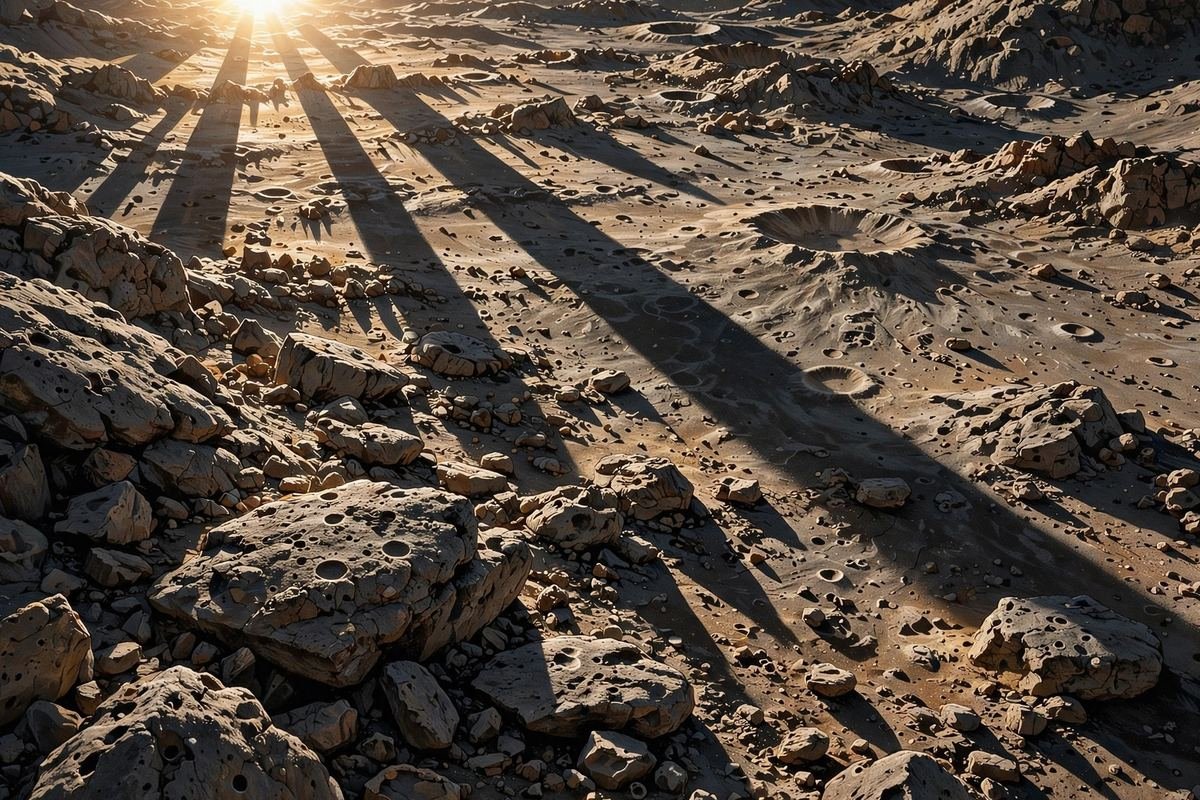
Mercury’s surface is heavily cratered, a record of billions of years of impacts from asteroids and comets. Unlike Earth, Mercury has no weather, no flowing water, and almost no atmosphere to erode those craters away, so they stay visible for an extremely long time. Some are small pits. Others are vast basins hundreds of kilometres wide.
One of the most famous is the Caloris Basin, one of the largest impact basins in the solar system. It was formed by an enormous impact early in Mercury’s history, and it is so large that it reshaped a huge portion of the planet’s surface. The impact was violent enough to create strange, jumbled terrain on the opposite side of the planet as well, where seismic waves from the collision are thought to have disrupted the ground.
Mercury also has long, winding cliffs called lobate scarps, which formed as the planet cooled and shrank slightly over time, wrinkling its surface like the skin of a drying apple. There are smooth plains, too, thought to be ancient volcanic lava flows, and mysterious bright spots and dark patches that scientists are still working to explain. It is a quiet world now, geologically speaking, but its surface reads like a history book.
How Hot and Cold Does Mercury Get?
Mercury has the most extreme temperature swings of any planet in the solar system, and the reason is closely tied to its thin exosphere and its slow rotation.
During the day, when a given spot on Mercury faces the Sun, temperatures can climb to about 430°C. That is hot enough to melt lead and tin. At night, when that same spot turns away from the Sun, temperatures can plunge to roughly -180°C. That is a swing of more than 600 degrees between day and night on the same patch of ground.
Why so extreme? On Earth, our thick atmosphere acts like a blanket, spreading heat around and softening the difference between day and night. Mercury does not have that blanket. Instead of a thick atmosphere, it has a thin exosphere — a very tenuous layer of atoms knocked off its surface by sunlight and tiny impacts, rather than a true, dense atmosphere. With almost nothing to hold heat in or move it around, daytime heat builds up fiercely and nighttime cold bites just as fiercely.
There is a twist, though. Despite those scorching daytime temperatures, Mercury may harbour water ice in permanently shadowed craters near its poles. Because Mercury’s axis is barely tilted, the floors of some deep polar craters never see sunlight at all. In those cold traps, ice delivered by comets could survive for billions of years, even on the planet closest to the Sun. It is one of the loveliest paradoxes in the solar system: ice on the hottest planet’s coldest corners.
How Long Is a Year — and a Day — on Mercury?
Mercury’s calendar is gloriously confusing, and it is one of the best ways to impress people at a dinner party with planet facts.
A year on Mercury — one full orbit around the Sun — lasts only 88 Earth days. That makes Mercury the fastest planet in the solar system, zipping around the Sun at an average speed of about 47 kilometres per second. If you lived on Mercury, you would have a birthday roughly every three Earth months.
A day is a different story. Mercury rotates on its axis once every about 59 Earth days. That is already slow, but the solar day — the time from one sunrise to the next at a given spot — is far longer, about 176 Earth days. That happens because Mercury’s rotation and its fast orbit combine in a strange 3:2 resonance: it rotates three times for every two orbits around the Sun. The result is that a single Mercurian solar day lasts about two Mercurian years.
Imagine that: you watch the Sun rise, you live through a scorching day, a freezing night, and then another day, and by the time the Sun rises again, two whole years have passed on the calendar. It is a reminder that “day” and “year” are not universal constants. They depend entirely on where you are standing.
What Have Spacecraft Taught Us About Mercury?
For a long time, Mercury was the least-explored terrestrial planet, largely because getting there is hard. A spacecraft heading toward the Sun has to shed a lot of speed, fight intense heat, and deal with the Sun’s gravity pulling it in. It is, counterintuitively, in some ways harder to reach Mercury than to reach the outer planets.
That changed with Mariner 10, which flew past Mercury three times in the 1970s and sent back the first close-up images of its cratered surface. Before Mariner 10, astronomers had only fuzzy telescopic views. Suddenly, Mercury had a face — grey, battered, and Moon-like, but with its own distinct features.
Decades later, NASA’s MESSENGER spacecraft did far more. It orbited Mercury from 2011 to 2015, mapping the entire surface in detail, measuring its composition, studying its magnetic field, and confirming the presence of water ice in those shadowed polar craters. MESSENGER showed that Mercury is not just a dead rock. It has a complex geological history, evidence of past volcanic activity, and a surprisingly dynamic exosphere.
Now, BepiColombo, a joint mission, is en route to Mercury. In general terms, it is expected to build on MESSENGER’s work with more detailed studies of Mercury’s surface, interior, and magnetic environment when it arrives and begins its orbital science phase. For anyone curious about the smallest planet, the next few years should bring a fresh wave of discoveries, and possibly some revisions to what we think we know.
Could There Be a Planet Smaller Than Mercury We Haven’t Found?
It is a fair question, especially given how often astronomy surprises us. Could there be a ninth planet, smaller than Mercury, hiding somewhere in the outer solar system?
Within the eight known planets, Mercury is definitively the smallest. No other confirmed planet is smaller. Beyond Neptune, there are dwarf planets and many smaller Kuiper Belt objects, but none of them currently meets the definition of a planet, for the same cleared-neighbourhood reason that applies to Pluto.
The much-discussed hypothetical “Planet Nine,” if it exists at all, is thought to be much larger than Earth, not smaller than Mercury, so it would not change this answer. And any undiscovered planet in the inner solar system would be very hard to hide, because it would be relatively close and bright. Astronomers are confident about the inner solar system inventory in a way they are not about the far outer reaches.
So, for the foreseeable future, Mercury’s title is safe. It is the smallest planet we know, and the smallest planet in the solar system as currently defined.
Frequently Asked Questions
What is the smallest planet in the solar system?
Mercury is the smallest planet in the solar system. It has a diameter of about 4,879 km and a mass of about 0.055 times Earth’s, making it smaller than Mars, Venus, Earth, and all the giant planets.
Is Pluto smaller than Mercury?
Yes, Pluto is smaller, with a diameter of about 2,377 km. However, Pluto is classified as a dwarf planet, not a planet, since its reclassification in 2006. That is why Mercury, not Pluto, is the correct answer when someone asks for the smallest planet.
How big is Mercury compared to Earth?
Mercury’s diameter is about 4,879 km, compared with Earth’s diameter of about 12,742 km. Mercury is less than half as wide as Earth and has only about 5.5 percent of Earth’s mass. Its surface gravity is about 38 percent of Earth’s.
Is Mercury smaller than the Moon?
No, Mercury is slightly larger than Earth’s Moon. Mercury is about 4,879 km across, while the Moon is about 3,474 km across. The two look similar because both have heavily cratered, grey surfaces, but Mercury is the larger body.
Why is Mercury so hot in the day and so cold at night?
Mercury has only a thin exosphere instead of a thick atmosphere, so there is almost nothing to trap or spread heat. Daytime temperatures can reach about 430°C, while nighttime temperatures can fall to roughly -180°C. The same spot can swing by more than 600 degrees between day and night.
How long is a year on Mercury?
A year on Mercury lasts just 88 Earth days, the shortest year of any planet. Mercury also rotates slowly, once every about 59 Earth days, which leads to a solar day — sunrise to sunrise — of about 176 Earth days.
Which spacecraft have visited Mercury?
Mariner 10 flew past Mercury in the 1970s and returned the first close-up images. NASA’s MESSENGER orbited Mercury from 2011 to 2015 and mapped the whole planet in detail. BepiColombo is now en route to Mercury to continue that exploration with new observations.
Conclusion
Mercury is easy to overlook. It is small, it hides near the Sun’s glare, and it does not have rings, bright colours, or a famous set of moons to draw the eye. But once you look closely, it turns out to be one of the most distinctive worlds in the solar system.
It is the smallest planet, only slightly larger than Earth’s Moon, yet it packs a huge iron core, the wildest temperature swings of any planet, the shortest year, and one of the strangest days you will find anywhere. Its cratered surface, including the vast Caloris Basin, preserves a record of the solar system’s violent early days. And its story — from a planet stripped down by ancient impacts, to a world once mistaken for a twin of the Moon, to a target for some of the most challenging spacecraft missions ever flown — is a reminder that size is a poor measure of interest.
So the next time someone asks what the smallest planet is, you will have more than a name to give them. You will have Mercury: tiny, fast, scorched, frozen, cratered, and far more fascinating than its size suggests.
Read Also: What Is the Biggest Planet in the Solar System? (2026 Guide)

1 Comment