
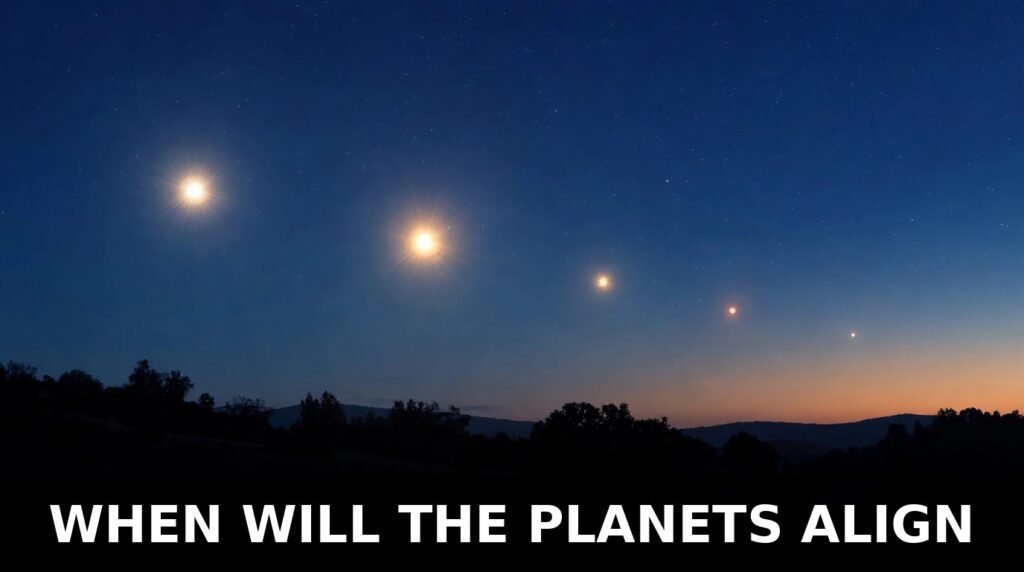
When Will the Planets Align? The Next Dates
When will the planets align next? The most recent alignment peaked on November 14, 2026, when Mercury, Venus, Mars and Jupiter gathered in the pre-dawn sky — and if you missed the peak night, the same four planets stay visible together until about November 28. The next alignment after that comes on April 18, 2027, when Mercury, Venus, Saturn and Neptune share the morning sky. If you are wondering when will the planets align next after November, the short answer is April 18, 2027.
Here are the confirmed dates for the rest of 2026 and 2027, so you can plan ahead instead of hearing about it the morning after:
| Date | Planets | Size | Best time |
|---|---|---|---|
| November 14, 2026 | Mercury, Venus, Mars, Jupiter | Small (4 planets) | Before sunrise |
| April 18, 2027 | Mercury, Venus, Saturn, Neptune | Small (4 planets) | Before sunrise |
| July 2, 2027 | Mercury, Venus, Saturn, Uranus, Neptune | Large (5 planets) | Before sunrise |
| September 18, 2027 | Mercury, Venus, Mars | Mini (3 planets) | After sunset |
| December 25, 2027 | Mercury, Venus, Mars, Saturn, Uranus, Neptune | Large (6 planets) | After sunset |
There is also a friendly evening lineup in late February to mid-March 2027, when Mars, Jupiter and Saturn all sit in the evening sky at once — the first evening parade in a while that does not need an alarm clock. The new Moon falls on March 8, 2027, so the first week of March is both dark and well placed for it.
One honest warning before you mark the calendar: these are reference dates. The best viewing night for your town can shift by a few days either way, and which planets you can actually see depends on your latitude, your horizon and the weather. Treat the dates as the centre of a window a week or two wide, not as a single night that either works or fails.
What Is a Planetary Alignment, Really?: When Will the Planets Align Next?
Most people picture the planets lining up like beads on a string, all in a perfect straight row. That picture is wrong, and it causes most of the disappointment around these events. What astronomers call an alignment — and what everyone else calls a planet parade — is much simpler and much easier to see.
All eight planets orbit the Sun in roughly the same flat plane. Seen from Earth, that plane appears as a line across the sky called the ecliptic, the same path the Sun and Moon follow. Because the planets all travel close to that line, they are always somewhere near it. An alignment happens when several of them happen to sit on the same side of the Sun from our point of view, so you can catch three, four or more of them in one sweep of the sky instead of hunting for one here and one there.
They are not physically lined up in space. They are hundreds of millions of kilometres apart, at very different distances from the Sun, and each orbit is tilted a little differently from the rest. They only look lined up because we are viewing them along the ecliptic, strung out in a gentle arc from one horizon toward the other. A literal alignment, with the planets physically strung in a straight line out in space, essentially never happens — and when it is described that way in a viral post, it is usually a misunderstanding or an exaggeration.
The phrase “planet parade” is not an official astronomical term at all. It is a popular nickname for the same thing, and it has stuck because it describes the experience well: a row of bright worlds marching across the sky together. For practical purposes, “planetary alignment” and “planet parade” mean the same event.
Small, Large and Mini: What the Sizes Mean
Guides usually sort alignments by how many planets take part. A mini alignment has three planets. A small alignment has four. A large alignment has five or six. The count matters because the more planets involved, the rarer the event and the wider the stretch of sky you need to take in. A three-planet evening in September is a pleasant sight; a six-planet evening on Christmas Day 2027 is the kind of thing people remember for years.
The count also decides how much help you need. In a four-planet morning alignment, every planet is usually bright enough to see with the naked eye. Once Uranus or Neptune joins the parade, you need binoculars or a small telescope, because those two are never naked-eye objects. That does not make the event worse — it makes it a better reason to own binoculars.
November 14, 2026: The Alignment That Just Happened: When Will the Planets Align Next?
The November 2026 alignment is the one most readers will have just missed or just caught. Around November 14, Mercury, Venus, Mars and Jupiter gathered in the morning sky, visible together for roughly two weeks, from November 12 to about November 28. All four are bright enough for naked-eye viewing, although Mercury is the tricky one: it stays low and close to the Sun’s glare, so it is easy to lose in the horizon haze, especially from southern locations.
The best mornings were around November 16 to 22. Mars and Jupiter sat only about a degree apart around November 16, which is close enough that both fit in the same binocular view — a striking sight, two bright worlds side by side with Venus blazing nearby. The rule for this one was simple: look east, 60 to 30 minutes before your local sunrise, and give your eyes a few minutes to adjust.
If you missed it, do not feel too bad. This was a small alignment, and it was the final planetary alignment of 2026. Bigger ones are coming in 2027, including a six-planet evening show on Christmas Day. The November event is still worth remembering, though, because it shows the pattern: these parades are windows, not instants, and a cloudy peak night rarely ruins the whole event.
April 18, 2027: The Next Small Alignment: When Will the Planets Align Next?
The next planetary alignment after November 2026 takes place on April 18, 2027, when Mercury, Venus, Saturn and Neptune appear together in the morning sky. Like the November event it is a small, four-planet alignment, and like that one it is best seen before sunrise.
There is one important difference: Neptune. Neptune is far too faint to see with the naked eye, so while the date counts four planets, most viewers will see three bright ones — Mercury, Venus and Saturn — and will need a telescope to pick out Neptune in the same stretch of sky. Saturn will be the steady, pale-gold anchor of the group, and Venus will be the unmistakable bright one.
Mercury, as always, is the challenge. It never strays far from the Sun, so it hugs the horizon and appears only briefly in the twilight. A clear, flat eastern horizon matters more for Mercury than for any other planet. If your view east is blocked by hills or buildings, you may see Venus and Saturn and never know Mercury was there.
July 2, 2027: A Large Five-Planet Morning Alignment: When Will the Planets Align Next?
July 2, 2027 brings the first large alignment of the year: Mercury, Venus, Saturn, Uranus and Neptune together in the morning sky. Five planets in one sweep is a genuinely uncommon sight, and this one rewards anyone who owns binoculars.
Venus and Saturn will be the easy ones. Mercury will be low and brief, as usual. Uranus and Neptune will need optical help — Uranus is just about reachable in good binoculars from a dark site, Neptune needs a telescope. The spread of the five will be wide, so you will need a good stretch of open eastern sky and a bit of patience, turning slowly from one bright point to the next along the ecliptic.
Summer mornings are a mixed blessing for this event. In the northern hemisphere the nights are short, so the pre-dawn window is tight and the sky brightens fast. Set the alarm early, scout your viewing spot the day before, and check the forecast — a clear horizon matters far more than a dark sky for a morning alignment.
December 25, 2027: The Big Six-Planet Evening Alignment: When Will the Planets Align Next?
The headline event of 2027 falls on Christmas Day. On December 25, 2027, six planets — Mercury, Venus, Mars, Saturn, Uranus and Neptune — gather in the evening sky after sunset. It is a large alignment, the biggest of the year, and the evening timing makes it the most accessible one on this list: no alarm clock, no pre-dawn cold, just step outside after dark and look west.
Four of the six will be naked-eye objects: Mercury, Venus, Mars and Saturn. Uranus and Neptune will need binoculars or a telescope. The planets will be spread along the ecliptic from the western horizon upward, so find a spot with a clear view to the west and southwest, and start looking as soon as the sky is dark enough for Venus to appear — that bright “evening star” is your signpost for the rest.
There is also a smaller evening event worth noting earlier in the year. On September 18, 2027, Mercury, Venus and Mars form a mini evening alignment after sunset. Three planets is modest, but the evening timing and the short wait after dark make it an easy win, especially for families and first-time skywatchers.
How to Watch a Planetary Alignment: When Will the Planets Align Next?
Seeing a planet parade is easy. Seeing it well takes a little preparation. These are the things that actually make a difference, learned the hard way by people who have stood in cold fields at 5 a.m. for nothing.
Know When to Look
Morning alignments mean looking east, 30 to 60 minutes before your local sunrise. Evening alignments mean looking west, shortly after sunset. The exact time shifts with your location and the season, so check a planetarium app for your town rather than trusting a generic time from the internet. The planets are only visible while the sky is dark enough but the planets are still above the horizon — a window that can be as short as half an hour for Mercury.
Pick Your Spot the Day Before
Scout in daylight. You need a clear horizon in the right direction — east for morning events, west for evening ones. Hills, tall buildings and trees are the usual reason people “miss” an alignment that was plainly there. A hilltop, a beach, an open field or a high rooftop works. A street with lamps and rooftops does not, especially for Mercury, which sits low.
Dark Skies Help, but the Horizon Matters More
You do not need a remote dark-sky site to enjoy a planet parade. The planets are bright — Venus, Jupiter, Mars and Saturn punch through city light without trouble. What you need is a dark, unobstructed horizon and a few minutes for your eyes to adjust. Turn off your phone screen or switch it to red mode, and avoid white flashlights. Binoculars help enormously, not just for Uranus and Neptune but for splitting close pairs like Mars and Jupiter.
Use an App to Find Each Planet
A free planetarium app on your phone will label every bright point in the sky in real time. Point it at the horizon and it will show you exactly where each planet is, which is far more reliable than guessing from a star chart. Just remember to hold the phone away from your eyes between checks, or the screen will ruin your night vision.
Photographing the Parade
A phone on a tripod can capture a four- or five-planet alignment if you use night mode and a short delay timer so the camera does not shake. Include a tree line or a rooftop in the frame — it gives the picture scale and proves you were really there. Do not expect the faint planets to show up on a phone; Uranus and Neptune need a camera on a tripod with a long exposure, or a telescope.
How Often Do the Planets Align?: When Will the Planets Align Next?
Small alignments of three or four planets happen fairly often — roughly once or twice a year. Large alignments of five or six planets are rarer, coming around every few years. The exact rhythm is uneven because each planet moves at its own speed: Mercury laps the Sun in 88 days, Neptune takes 165 years, and the rest fall in between. They drift in and out of the same stretch of sky on their own schedules, and the interesting nights are the ones when several schedules happen to overlap.
The next truly grand gathering is still some way off. On February 3, 2034, all seven planets visible from Earth — Mercury, Venus, Mars, Jupiter, Saturn, Uranus and Neptune — will share the evening sky at once. That is the next seven-planet parade, and it is worth putting on a long-term list. There was also a six-planet evening parade in February 2026, and another six-planet morning gathering on August 12, 2026, so the current run of good years is not a one-off.
A date that sometimes appears in viral posts deserves a correction. Some lists claim the next major alignment will not happen until 2040. That refers to a much stricter definition — a very tight grouping of the planets, or a specific close configuration — and it does not mean there is nothing to see until then. By the normal, practical definition used by astronomers and skywatchers, there are five named alignments in 2026 and 2027 alone. Do not wait until 2040. Go out on April 18, 2027.
Do Planetary Alignments Affect Earth?: When Will the Planets Align Next?
Every time a planet parade is announced, the same claims come back: earthquakes, strange weather, bad luck, a shift in the tides, a change in your mood. None of them holds up, and the reason is simple arithmetic.
Gravity weakens very fast with distance. The Moon raises our tides because it is close — about 384,000 kilometres away. Jupiter is the most massive planet, but at its closest it is still more than 600 million kilometres from Earth, and its gravitational pull on you is weaker than the pull of a car parked across the street. The combined pull of all the planets lined up is still far smaller than the Moon’s pull on its own, and it does not add up to anything measurable in earthquakes, weather or human behaviour.
Astrologers sometimes give alignments spiritual meaning, and that is a matter of belief, not measurement. Scientifically, an alignment is a beautiful viewing opportunity and nothing more. It does not change the tides, it does not trigger earthquakes, and it does not make your horoscope more accurate. The honest wonder of the event is that you can stand in your garden and see five worlds at once with your own eyes — that is remarkable enough without adding powers to it.
Planetary Alignment vs Conjunction vs Planet Parade
The three phrases get mixed up constantly, so here is the quick version:
| Term | What it means |
|---|---|
| Planetary alignment | Several planets appear gathered along the same stretch of sky, usually three or more, visible in one sweep. |
| Planet parade | The popular nickname for a planetary alignment. Same event, friendlier name. |
| Conjunction | Two planets (or a planet and the Moon) appear very close together in the sky, often within a degree or two. Alignments are often made of several conjunctions at once. |
So when Mars and Jupiter sit a degree apart on November 16, 2026, that is a conjunction. When Mercury, Venus, Mars and Jupiter are all up together that same week, that is an alignment — a parade of four, with a conjunction inside it.
Frequently Asked Questions: When Will the Planets Align Next?
When will the planets align next?
The most recent alignment peaked on November 14, 2026, with Mercury, Venus, Mars and Jupiter in the morning sky, visible until about November 28. The next alignment after that is April 18, 2027, when Mercury, Venus, Saturn and Neptune gather before sunrise. The biggest one of 2027 is December 25, when six planets appear in the evening sky.
Can you see a planetary alignment with the naked eye?
Yes — mostly. Mercury, Venus, Mars, Jupiter and Saturn are all bright enough to see without any equipment. Uranus and Neptune are the exceptions: they always need binoculars or a telescope. In the April 18, 2027 alignment, for example, three of the four planets are naked-eye objects and only Neptune needs optical help.
What time should I look for the planets to align?
For a morning alignment, look east 30 to 60 minutes before your local sunrise. For an evening alignment, look west shortly after sunset. The window is often short, especially for Mercury, which sits low and disappears into the twilight quickly — so check a planetarium app for the exact time at your location.
How long does a planetary alignment last?
Days to weeks, not minutes. The November 2026 alignment was visible from about November 12 to November 28, with November 14 as the peak. The listed date for any alignment is the reference or peak date; the planets are usually visible together for a week or two around it, which is good news if the peak night is cloudy.
Will the planets align in a perfect straight line?
No. A perfect straight line of planets in space essentially never happens, because each orbit is tilted slightly differently and every planet moves at its own speed. What you see is an apparent lineup: the planets strung along the ecliptic arc in the sky, which looks like a line from Earth but is not one in space.
Do planetary alignments cause earthquakes or affect Earth?
No. The combined gravitational pull of the aligned planets is far weaker than the Moon’s pull, and there is no measurable link between alignments and earthquakes, weather or tides. An alignment is a viewing event, not a geophysical one.
Final Thoughts: When Will the Planets Align Next?
When will the planets align? The honest answer is that they are aligning right now — the November 2026 parade runs until about November 28 — and the next chances are April 18, July 2, September 18 and December 25, 2027. The December date is the one to circle in red: six planets, after sunset, on Christmas Day.
Do not overthink it. Check the date, check the weather, find a clear horizon in the right direction, and step outside at the right time. Bring binoculars if you have them and a planetarium app on your phone. The planets will do the rest, the same way they have for every skywatcher who ever looked up and noticed that several bright “stars” had quietly arranged themselves in a row.
So when will the planets align next in a way that is easy for a beginner to enjoy? The honest answer is that you do not need to wait for a rare, perfect night. When will the planets align next after the November parade is a question with a friendly answer: April 18, 2027 is close, bright and early, and the Christmas Day parade later in the year is even easier because it happens after sunset.
Pick one date, check the weather that afternoon, and give yourself a clear horizon. If clouds spoil the peak night, try again the next clear night, because the planets move slowly and the parade lasts for days. That simple plan is how most people finally see one.
Read Also: Population Density Map: 5 Essential Steps to Read It Right