
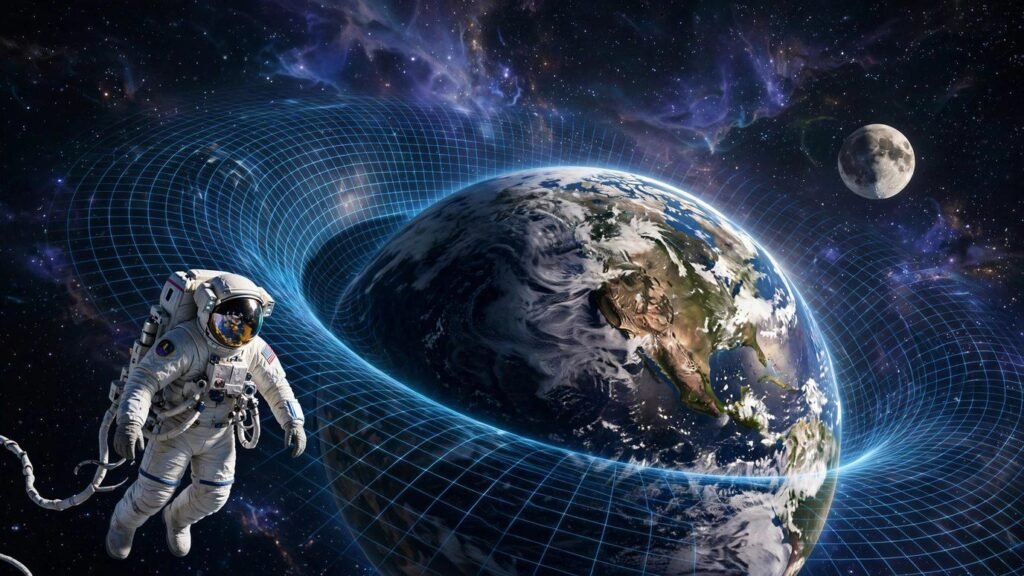
How does gravity work in space? Here is the simple answer.
If you have ever watched an astronaut drift through the International Space Station, hair floating, coffee blobs hovering in midair, it is natural to wonder whether gravity just stops working up there. It does not. In fact, gravity at the height of the space station is still about 90 percent as strong as it is on the ground. The astronauts feel weightless for a completely different reason, and that reason is one of the most satisfying ideas in all of science.
This guide walks through it step by step. We will start with Newton’s simple rule, then see why Einstein had to rewrite it, then use both ideas to explain orbits, the Moon, tides, and black holes. No math degree required. By the end, you will be able to explain to someone else why things float in space — and why that explanation is both weirder and simpler than most people expect.
The short answer: Gravity in space works the same way it works on Earth — mass bends the shape of space itself, and other objects follow that shape. Astronauts are not floating because gravity is gone. They are falling, continuously, around Earth. The Moon does not fly away because Earth’s gravity keeps bending its path into a circle. And far from any planet, gravity gets weaker, but it never truly drops to zero.
What Does Gravity Actually Do in Space?
On Earth, gravity feels like a downward pull. Drop a phone and it falls. Jump and you come back down. That everyday experience makes gravity seem like a force that yanks things toward the ground. In space, the same effect looks different because there is no ground to land on and no air to slow things down. A spacecraft, a moon, or a planet keeps moving unless something changes its motion. Gravity is the thing that changes it, bending its path over and over again.
- Gravity pulls every mass toward every other mass.
- The bigger the mass, the stronger the pull.
- The farther apart two objects are, the weaker the pull becomes.
- Nothing in the universe is completely free of gravity, because gravity reaches across enormous distances.
That last point matters. Space is not a place where gravity ends. It is a place where gravity is the main architect. It holds planets in orbit around stars, stars in orbit around the centers of galaxies, and galaxies in loose groups that drift together through the cosmos. Without gravity, the universe would be a scattering of lonely particles flying in straight lines forever.
Newton’s Simple Rule: Mass Attracts Mass
In the 1600s, Isaac Newton gave the first rule that actually worked for both an apple falling from a tree and the Moon circling Earth. His insight was radical at the time: the same gravity that pulls objects down on Earth also reaches all the way to the Moon. Newton’s law of universal gravitation says, in plain language, that:
- Every object with mass attracts every other object with mass.
- The attraction grows stronger when the masses get bigger.
- The attraction gets weaker, quickly, as the distance between them grows. Double the distance and the force drops to one-quarter of what it was.
That rule is still good enough to aim spacecraft at distant planets. Engineers at NASA still use Newton’s math for most mission planning because it is simpler and, for most everyday speeds and gravity strengths, it is extremely accurate.
Newton also gave us the idea that an orbit is just a fall that keeps missing. Imagine throwing a ball horizontally. It arcs down and hits the ground. Throw it harder and it lands farther away. Now imagine throwing it so fast, from high enough up, that as it falls toward Earth, Earth’s surface curves away beneath it at exactly the same rate. The ball never lands. It just keeps falling around the planet. That is an orbit.
This is why the Moon does not crash into Earth and does not fly off into deep space. It is moving sideways fast enough that its constant fall toward Earth bends into a closed loop. The same is true for satellites, the space station, and Earth itself as it travels around the Sun.
Why Newton’s Rule Was Not the Whole Story
Newton’s law tells you how strong gravity is, but it does not really explain what gravity is. It treats gravity as an invisible force acting instantly across distance, like a rope nobody can see. Newton himself was uneasy about that. How could the Sun pull on Earth across 93 million miles of empty space, with nothing in between? For more than 200 years, nobody had a better answer. Then Albert Einstein came along and changed the picture entirely.
Einstein’s Big Rewrite: Gravity Is the Shape of Spacetime
Einstein’s theory of general relativity, published in 1915, says gravity is not really a pulling force at all. Instead, mass and energy bend the fabric of spacetime — the combined four-dimensional stage on which space and time play out — and objects simply follow the straightest possible paths through that curved stage. The classic analogy helps, even if it is imperfect. Picture a stretched rubber sheet. Put a heavy bowling ball in the middle and the sheet dips down around it. Now roll a marble across the sheet. It will curve toward the bowling ball, not because the ball is magnetically pulling it, but because the sheet itself is curved. In Einstein’s picture, planets are marbles, stars are bowling balls, and spacetime is the sheet.
- Time itself is affected. Clocks run slightly slower where gravity is stronger. This is not science fiction; GPS satellites have to correct for it, or their position readings would drift by miles within a day.
- Light bends too. Starlight passing near the Sun follows the curve of spacetime, so its path bends slightly. Astronomers have measured this during solar eclipses, and it was one of the first confirmations of Einstein’s theory.
- There is no instant action at a distance. Changes in gravity ripple outward as gravitational waves, traveling at the speed of light, rather than appearing everywhere at once.
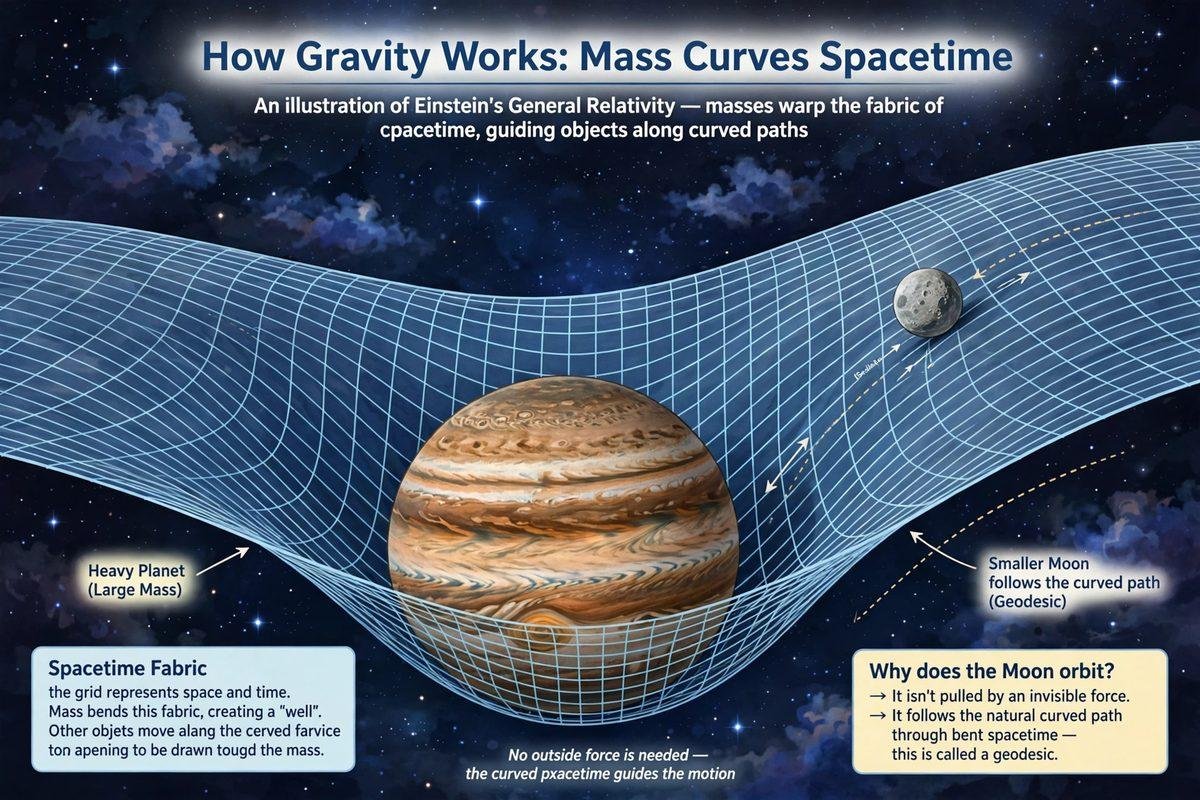
Newton vs. Einstein at a Glance
| Question | Newton’s Answer | Einstein’s Answer |
|---|---|---|
| What is gravity? | An invisible force between masses | The curvature of spacetime caused by mass and energy. |
| Why do orbits curve? | A sideways-moving object is pulled toward the larger mass | An object follows the straightest path through curved spacetime. |
| Does gravity affect time? | No, time ticks the same everywhere | Yes, stronger gravity slows time slightly. |
| When is it most useful? | Everyday speeds, most spacecraft navigation | Very strong gravity, very precise measurements, black holes. |
Neither man was simply wrong. Newton gave a superb approximation that works beautifully in most situations. Einstein gave the deeper explanation that holds up even where Newton’s rule starts to fail, such as near extremely massive objects or when extreme precision is needed.
Why Astronauts Float: The Secret Is Freefall, Not Zero Gravity
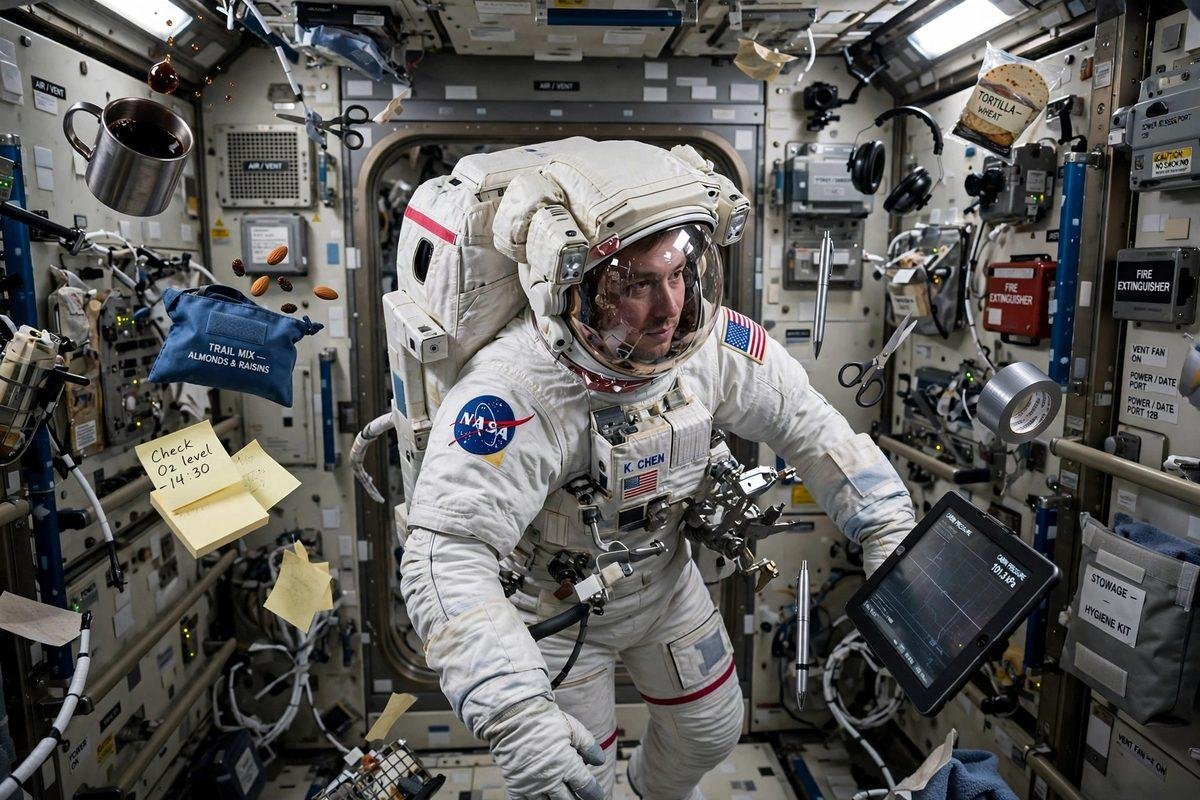
Here is the fact that surprises almost everyone: the International Space Station orbits only about 400 kilometers above Earth, and gravity there is still roughly 90 percent as strong as on the surface. If you put a scale up there and stood on it while the station was somehow held still, you would weigh almost the same as you do at home. So why do astronauts float? Because the station is not held still. It is falling — all the time — around Earth, at about 28,000 kilometers per hour. Everything inside it, astronauts included, is falling at exactly the same rate. When you and everything around you are falling together, there is nothing to push against, and you feel weightless. It is the same feeling you get for a split second at the top of a roller coaster drop or in a falling elevator, except in orbit the fall never ends. The station keeps missing Earth because it is moving sideways so fast, so the weightlessness goes on for months instead of seconds. Scientists prefer the term microgravity to zero gravity, and for good reason:
- True zero gravity does not exist anywhere we can reach. Even in the emptiest stretches between galaxies, the faint gravity of distant masses is still present.
- Microgravity means very small net gravity effects, not none at all. Tiny vibrations, air currents, and the station’s own motion create small forces, but they are minuscule compared to what we feel on Earth.
- Your body notices the difference. Without gravity loading bones and muscles every day, astronauts lose bone density and muscle mass, which is why they exercise for about two hours a day in orbit.
So the next time you see an astronaut floating serenely through a hatch, remember: they are not beyond gravity’s reach. They are riding it, in the longest fall humans have ever managed.
If Gravity Is Everywhere, Why Doesn’t Everything Crash Together?
If every mass pulls on every other mass, a fair question is why the universe has not collapsed into one giant clump. The answer is motion. Almost everything in space is moving sideways relative to something else, and that sideways motion turns a head-on collision into an orbit. Earth moves around the Sun. The Sun moves around the center of the Milky Way. The Moon moves around Earth. Each of these motions balances the inward pull of gravity with just enough sideways speed to keep missing. There are exceptions, and they are dramatic:
- When an object does not have enough sideways speed, it falls inward. This is how stars form from collapsing clouds of gas.
- When two objects spiral too close together, they can merge, sometimes releasing gravitational waves that ripple across the universe.
- When a massive star runs out of fuel, gravity wins completely, and the core collapses — which brings us, later, to black holes.
But in general, the universe is a balancing act. Gravity pulls inward. Motion carries things sideways. Orbits are what happen when those two tendencies settle into a stable dance.
How Strong Is Gravity on the Moon, Mars, and the Space Station?
Gravity is not one fixed number. It depends on the mass of the world you are standing on and how far you are from its center. That is why the same person would weigh very different amounts on different worlds, even though their mass — the amount of stuff they are made of — never changes.
| Location | Gravity Compared to Earth | What It Feels Like |
|---|---|---|
| Earth (surface) | 100% | Normal weight, familiar walking and jumping. |
| Moon (surface) | About 1/6, or roughly 17% | Long, floating leaps; Apollo astronauts bounced rather than walked. |
| Mars (surface) | About 38% | Noticeably lighter, but still a definite sense of down. |
| International Space Station (orbit) | About 90% pull, but effectively weightless | Freefall; floating because station and crew fall together. |
| Deep space, far from stars | Extremely weak, but never zero | Almost no pull in any one direction. |
A couple of details here are worth noting. First, the Moon’s gravity is weaker mainly because the Moon is much less massive than Earth, even though it is smaller. Second, Mars has about 38 percent of Earth’s surface gravity despite being a fairly substantial planet, because its mass is only about one-tenth of Earth’s. Size alone does not decide gravity; mass does. This is also why future Mars explorers will face a different challenge from Moon walkers. On the Moon, the main problem is how little gravity there is. On Mars, there is enough gravity to feel like a real direction, but little enough that long-term effects on the human body are still an open question. For a lighter look at how space stories and exploration ideas capture the public imagination, readers often browse Daily Orvix alongside their astronomy reading.
Tides: The Moon Pulling Earth’s Oceans Sideways
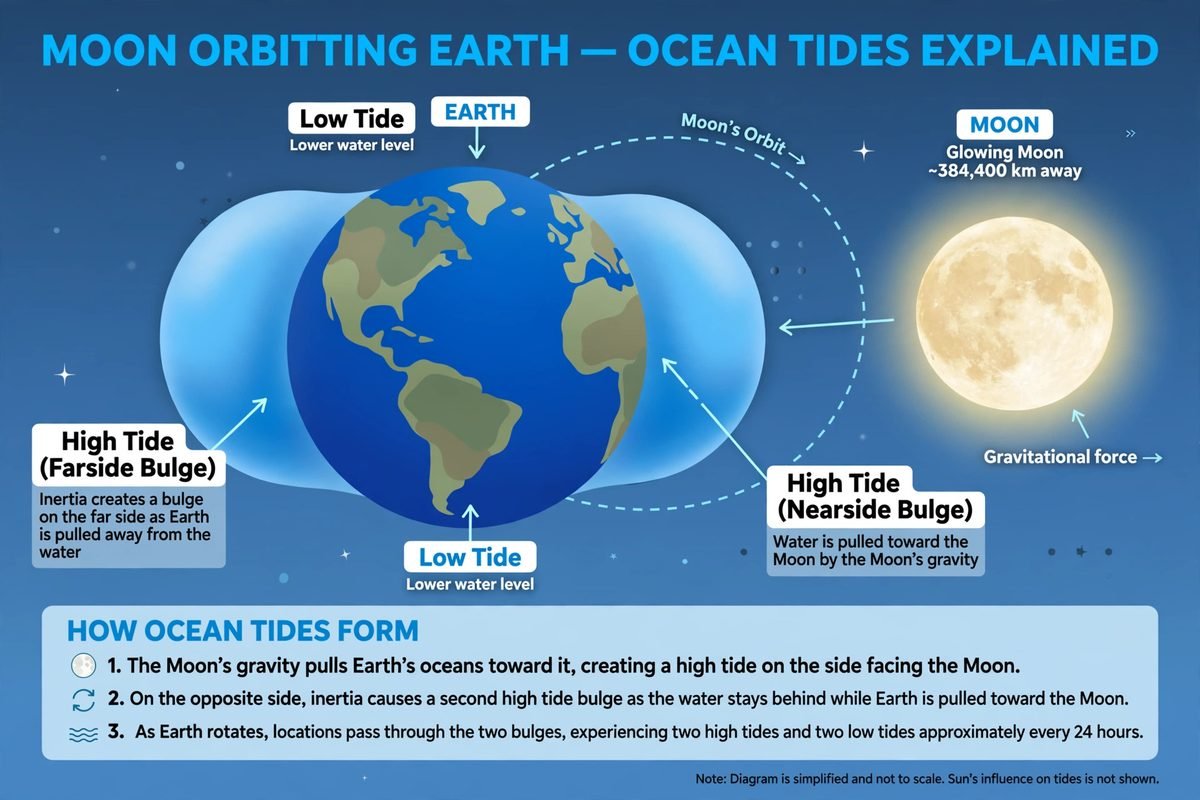
Tides are one of the most visible effects of gravity in space, and they happen right here on Earth. Twice a day, in most coastal places, the sea rises and falls, and the Moon is largely responsible. Here is the simplified version of how it works:
- The Moon’s gravity pulls on Earth, but it pulls harder on the side of Earth facing the Moon than on the far side, because that side is closer.
- Ocean water on the near side bulges toward the Moon, creating a high tide.
- On the far side, the water is left slightly behind as Earth itself is pulled toward the Moon, creating a second bulge — and a second high tide.
- As Earth rotates beneath these two bulges, a given coastline passes through a high tide, then a low tide, then the other high tide, roughly every day.
The Sun also raises tides, but because it is much farther away, its tidal effect is smaller than the Moon’s, even though the Sun’s overall gravitational pull on Earth is far stronger. Tides depend not just on how strong gravity is, but on how much it differs from one side of a body to the other. Distance makes that difference shrink fast. Tides do more than move water. Over billions of years, Earth’s tides have gradually slowed the Moon’s rotation until the Moon now always shows the same face to us. That is why we never see the far side of the Moon from Earth — it is not dark, it is just turned away. The same tidal braking is slowly lengthening Earth’s day, by a tiny amount each century.
Lagrange Points: Parking Spots Written by Gravity
If gravity were only about falling toward the nearest big object, parking a telescope in deep space would be tricky. It would drift away or fall back. But when two large bodies, like Earth and the Sun, both pull on a small object, there are five special spots where their pulls and the object’s motion balance out. These are called Lagrange points, named after mathematician Joseph-Louis Lagrange. The most famous one right now is the Sun-Earth L2 point, about 1.5 million kilometers from Earth in the direction away from the Sun. The James Webb Space Telescope sits there. From L2, the Sun, Earth, and Moon are all roughly in the same direction behind the telescope, which makes it easier to shield its instruments from their heat and light while it stares into the deep universe. Lagrange points are not magic anti-gravity zones. They are balance points, and most of them need small course corrections to stay useful. But they show how subtle gravity can be. It is not just a downward yank. In the right geometry, it creates stable pockets where spacecraft can hover, more or less, for years.
Black Holes: Where Gravity Goes to Extremes
So far, gravity has been a gentle sculptor: bending orbits, raising tides, holding galaxies together. Around a black hole, it becomes something else entirely. A black hole forms when a very massive star collapses and its mass is packed into an extremely small region. Spacetime curves so steeply around it that, past a boundary called the event horizon, every path leads inward. Nothing, not even light, can escape once it crosses that boundary — not because it is being sucked by a cosmic vacuum cleaner, but because spacetime itself is curved so severely that outward is no longer a direction that leads out.
- They do not suck everything in from across the galaxy. Far away from a black hole, its gravity behaves like that of any other object of the same mass. You could, in principle, orbit a black hole safely, just as Earth orbits the Sun, as long as you stay well outside the event horizon.
- They are not holes in the everyday sense. They are regions of extreme spacetime curvature, not tunnels you could climb through.
- They still follow the same rules. The same gravity that holds the Moon in orbit also governs a black hole. It is simply operating at an intensity we never encounter in daily life.
Black holes are also where Newton’s picture breaks down completely and Einstein’s becomes essential. Near an event horizon, time dilation becomes extreme, light bends into loops, and predictions from Newton’s law give the wrong answers. Studying black holes is therefore one of the best ways scientists test whether our understanding of gravity is complete — and so far, Einstein’s theory keeps passing.
What Gravity Cannot Yet Explain
For all its successes, our picture of gravity is incomplete, and scientists are refreshingly honest about that. Here are the open edges:
- Gravity and quantum mechanics do not fit together yet. The other fundamental forces have quantum descriptions. Gravity does not, at least not one that has been confirmed. Finding a theory of quantum gravity is one of the biggest unsolved problems in physics.
- Dark matter and dark energy are placeholders. Galaxies rotate and the universe expands in ways that do not match what visible matter alone would produce. Something else is going on, and gravity is at the center of the mystery.
- We have never directly felt the inside of a black hole. Our equations suggest a singularity, a point of infinite density, but most physicists suspect that is a sign the equations break down rather than a literal description of reality.
None of this means gravity is a guess. The parts we understand — orbits, tides, time dilation, gravitational waves — have been tested again and again. It means the story is unfinished, which is exactly what makes it worth following. New telescopes and detectors are probing gravity’s extremes right now, and the next surprise could come from any of them. Broader science coverage and everyday explainers on related topics can be found through Adailyinsight360, which many general readers check between deeper astronomy reads.
Frequently Asked Questions
Does gravity exist in outer space?
Yes. Gravity exists everywhere in space, though it gets weaker with distance from massive objects. There is no place we can reach where gravity is truly zero. Astronauts feel weightless because they are in freefall, not because gravity has disappeared.
Why do astronauts float if gravity is still strong on the space station?
Because the station and everyone inside it are falling around Earth together at the same rate. With nothing pushing back against them, astronauts experience weightlessness, even though Earth’s gravity at that altitude is still about 90 percent as strong as on the ground.
How does gravity work on the Moon?
The Moon’s surface gravity is about one-sixth of Earth’s, because the Moon is much less massive than Earth. An astronaut who weighs 180 pounds on Earth would weigh about 30 pounds on the Moon, but their mass would be exactly the same. That is why Apollo astronauts could leap long distances with relatively little effort.
Why doesn’t the Moon fall to Earth?
It is falling toward Earth constantly. It just also moves sideways fast enough that its fall curves into an orbit instead of ending in a collision. An orbit is a continuous fall that keeps missing the body it is falling toward.
Is gravity a force or a curvature of spacetime?
Both descriptions are used, for different purposes. Newton’s picture treats gravity as a force between masses, and it works well for most practical calculations. Einstein’s picture treats it as the curvature of spacetime, and it is the more accurate description, especially in strong gravity or when extreme precision matters.
How do tides work?
Tides are caused mainly by the difference in the Moon’s gravitational pull across Earth. Water bulges toward the Moon on the near side and is left behind in a second bulge on the far side. As Earth rotates under these bulges, coastlines experience alternating high and low tides.
Can gravity affect time?
Yes. According to general relativity, clocks run slightly slower in stronger gravity. The effect is tiny in everyday life, but it is real and measurable, and GPS satellites must correct for it to give accurate positions.
Final Thoughts
Gravity in space is not a switch that turns off when you leave the atmosphere. It is the same phenomenon you feel every time you drop something, playing out on a grander stage, with no floor to catch the fall. Newton showed us that one rule governs apples and moons alike. Einstein showed us that the rule is really about the shape of spacetime itself. Once you see an orbit as a fall that keeps missing, a lot of space suddenly clicks into place. Astronauts float because they are falling together with their spacecraft. The Moon stays up because it is falling sideways. Tides rise because the Moon’s pull is uneven across Earth. And black holes mark the place where that same, familiar effect becomes so extreme that even light cannot climb out. The next time you look up at the Moon on a clear night, it is worth remembering that you are watching gravity at work — not as an abstract force in a textbook, but as the quiet, constant sculptor of everything above us.
Read Also: What Is a Quad Equalizer? 4-Band Audio EQ Explained Simply (2026 Guide)

1 Comment